Weighted tarps use ballast in perimeter hems or pockets to help keep a cover edge down. For industrial storage, equipment and field-cover projects, the right specification balances coverage, edge contact and the weight your crew can handle.
Build your project around DERFLEX PVC coated polyester fabric, custom dimensions and reinforced fabrication. Submit the proposed ballast layout for technical review before sampling and bulk supply.
Custom project enquiries for importers, distributors, cover fabricators and OEM brands. Weighted-edge construction, ballast supply and final performance require project confirmation.
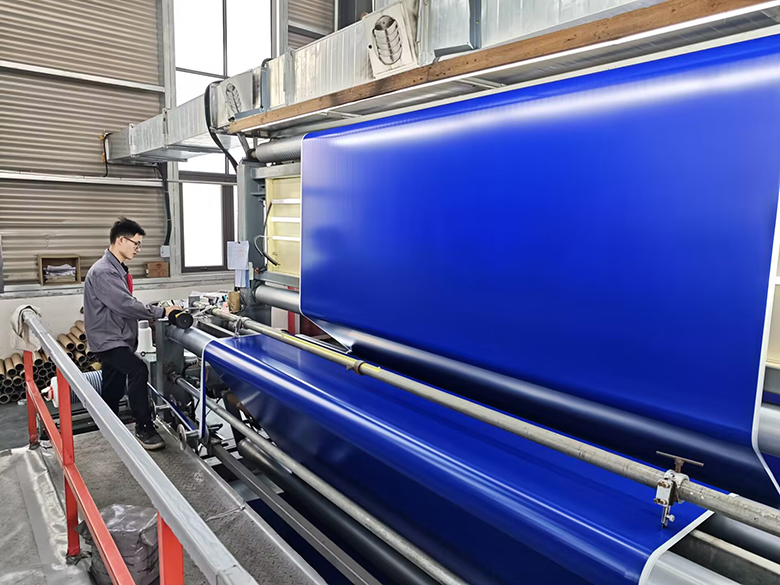
The material behind the coverDERFLEX coated-fabric production reference. Weighted-edge details are developed separately to the approved project drawing.
Edge layoutContinuous hems or separate ballast pockets
Handling massSpecify fabric and ballast weight separately
Supply formatMaterial, panels or finished-cover review
The quick answer
What is a weighted tarp?
A weighted tarp is a protective sheet with added mass held in its edge, hem or attached pockets. The ballast helps maintain perimeter contact and reduce edge movement. Common approaches include enclosed chain, removable inserts and fillable ballast pockets.
Heavy fabric alone does not create a weighted-edge system. Ballast also does not establish a wind rating: performance depends on the cover geometry, surface contact, exposure and complete restraint arrangement.
01 / Start with the perimeter
Three ways to configure the weight.
Select the edge concept before finalizing the fabric. These are engineering options for discussion; availability and construction are confirmed after DERFLEX reviews the intended use.
01 — CONTINUOUS HEM
Enclosed weighted hem
A retained chain or flexible insert distributes ballast along the edge. It can suit repeated placement on reasonably flat surfaces, provided the hem can follow the ground.
Review
Mass per metre, corner turns, enclosure, corrosion protection and replaceability.
Trade-off
Weight remains with the cover during handling and shipping.
02 — REMOVABLE INSERTS
Removable ballast sleeves
Accessible sleeves allow suitable inserts to be removed for transport or replacement. Segmenting long edges may make assembly and storage more manageable.
Review
Insert dimensions, access opening, closure, retention and abrasion at the ends.
Trade-off
Assembly takes longer, and inserts need separate storage.
03 — SEGMENTED POCKETS
Fillable ballast pockets
Separate pockets hold approved fill or contained ballast units. Shipping them empty can reduce transport mass, while local filling adds an on-site preparation step.
Review
Pocket spacing, fill containment, closures, emptying and the gaps between pockets.
Trade-off
Uneven filling can leave parts of the edge less controlled.
Drawing note: diagrams show concepts, not approved DERFLEX product specifications. Keep ballast enclosed, prevent insert escape and review ground contact rather than judging a design by total kilograms alone.
Weighted tarp or sandbags?
A weighted edge keeps the ballast associated with the cover. Separate sandbags are easier to reposition but add individual placement and retrieval tasks. The better arrangement depends on the site, contact surface and operating routine.
02 / Match the use to the design
Where will the edge actually rest?
A flat ground cover and a cover draped over machinery create different edge conditions. Use the contact geometry to guide the ballast plan.
Application-to-specification guide — project review is required for each installation.
Application
Design direction
Buyer should confirm
Stationary equipment & pallet storage
Close-fitting cover with controlled side drop; removable ballast or pockets may be considered.
Does the weighted edge reach a stable surface? Check rubbing points and ventilation needs beneath the cover.
Baseball mound & home plate covers
Shape-matched cover with a perimeter that follows the field surface.
Segmented ballast arrangement with a reinforced edge and a planned water runoff path.
Ground roughness, sharp contact points, local exposure and whether supplementary restraints are needed.
OEM & distributor programs
Standardized cover drawings, repeatable pocket positions and an agreed ballast supply format.
Empty or filled delivery, packed mass, labels, retail instructions and prototype approval.
Elevated covers or exposed sites
Review a complete anchored or restrained system before specifying ballast.
A hanging hem or exposed edge may have poor contact. Added weight alone does not resolve the installation.
On smaller screens, swipe the table horizontally.
DERFLEX field-cover application reference; this image does not show a weighted-edge construction.
Field covers need a ground-contact plan.
Specify the exact area being protected instead of selecting by a generic field name. A mound cover, home plate cover and large infield sheet differ substantially in area, perimeter, storage volume and placement effort.
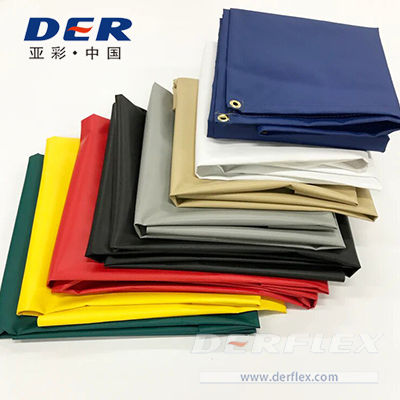
Real DERFLEX finished-tarp reference: color and reinforced fabrication. Ballast pockets and weighted hems are not shown.
03 / Material + edge + handling
Specify the cover as a complete system.
PVC coated polyester combines a woven reinforcement with a protective vinyl coating. The fabric, seams and edge assembly must be considered together. Review DERFLEX PVC tarpaulin material options against the actual exposure and fabrication method.
Fabric mass is one input.
GSM describes mass per unit area. It does not independently establish tear resistance, finished-cover waterproofing or the ballast required at the edge.
The edge carries repeated loads.
Pocket ends, insert ends and corners create local wear points. Reinforcement and closures need to match how the cover is placed, moved and stored.
Finished size must be explicit.
Distinguish coverage area, side drop and finished outer dimensions. Agree whether pocket depth sits inside or outside the stated cover size.
Weighted tarp specification checklist
Material construction
PVC coated polyester direction; confirm fabric GSM, thickness, base cloth and required finish.
Cover geometry
Finished length, width or diameter; side drop; shape; dimensional tolerances and seam layout.
Weighted perimeter
Which edges carry ballast; active weighted length; continuous or segmented layout.
Ballast arrangement
Mass per metre or per pocket; insert type; access and retention; supplied filled or empty.
Fabrication & tests
Weld or seam details; corner reinforcement; closure design; agreed leakage and handling checks.
Operating & supply details
Ground surface, exposure, temperature needs, crew handling, quantity, packaging and destination.
No default ballast value: final GSM, hem dimensions, pocket spacing, ballast mass and performance limits must be confirmed for the approved construction. No universal wind-speed rating is stated for these project concepts.
04 / Manufacturing notes that matter
The small details decide how the cover behaves.
Discuss these points with the fabricator before making the first sample. A made-to-measure tarp drawing should describe the edge assembly as clearly as the main sheet.
Retain the ballast at every opening.
Specify how inserts stop at corners and how access closures stay closed during repeated folding. The end of a rigid insert needs a protected contact zone so it cannot push directly into the main sheet.
Separate water protection from pocket access.
Plan openings and stitch lines outside the critical covered area where practical. A waterproof PVC sheet does not prove that a sewn pocket, closure or finished seam is watertight.
Build wear allowance into the edge.
Ballast concentrates contact at the perimeter. Examine pocket bottoms and corner turns after trial placement on the actual surface. Protective layers may be needed at abrasive contact points.
Keep lifting loads out of unapproved hems.
A weighted hem or eyelet is not automatically a lifting point. Plan the handling method, crew size, storage support and any dedicated reinforced handles around the approved finished mass.
Estimate the weight before the order.
For a rectangular sheet with all four edges weighted:
Fabric kg = L × W × GSM ÷ 1,000
Ballast kg = 2 × (L + W) × kg/m
Worked example: a 4 × 6 m sheet at 650 gsm has 15.6 kg of base-sheet mass. A 20 m perimeter at an illustrative 0.5 kg/m adds 10 kg, giving a 25.6 kg subtotal.
Illustration only. The ballast input is not a recommendation or wind-resistance calculation. Add the actual mass of hems, seams, pockets, fittings, handles and other components.
05 / Develop, sample, verify
A clearer route to a production quote.
DERFLEX's custom tarp manufacturing options include project-based dimensions, materials, reinforcement and finishing. For weighted tarps, confirm the proposed edge system and ballast supply scope before treating a quotation as final.
Send the use case.Share a dimensioned sketch, photos of the contact surface, exposure, quantity, destination and handling routine.
Agree the drawing.Identify coverage dimensions, weighted edges, pockets, closures, reinforced points and empty or filled delivery.
Evaluate a prototype.Check fit, finished mass, edge contact, ballast retention, seam details and repeated deployment on the intended surface.
Freeze the specification.Approve materials, tolerances, labels, packed mass and inspection criteria before the bulk order.
What drives weighted tarp price?
Cover area, fabric construction, total weighted length, pocket count, corner complexity, removable access, reinforcement, printing and packaging all affect cost. Compare quotations on the same ballast supply basis: an empty-pocket cover and a filled cover have different freight and assembly requirements.
What should the sample prove?
Record actual dimensions and mass. Inspect insert retention and pocket wear after repeated placement. Review waterproofing at the relevant seams and confirm that packed covers can be moved and stored as planned. Define any project-specific performance tests before placing the order.
For wholesale and OEM sourcing: request a project quotation for MOQ, sampling cost, production timing and packaging. These depend on the approved construction and order quantity. Explore the DERFLEX tarpaulin manufacturing and supply framework when planning repeat orders.
06 / Questions before purchase
Weighted tarp buyer questions.
Practical answers on ballast, weather protection, handling and custom supply.
What is the difference between a weighted tarp and a heavy-duty tarp?
A weighted tarp has added ballast in hems or pockets. A heavy-duty tarp describes a material or construction intended for demanding use, without a universal industry weight threshold. A heavier sheet can still have an unweighted edge; specify fabric GSM and ballast mass separately.
Do weighted tarps need tie-downs?
They may. Ballast can help maintain edge contact, but the need for supplementary restraints depends on exposure, cover area, geometry and the consequences of movement. Do not assume that an added weight or a weighted hem makes a cover suitable for every wind condition.
How much weight should be added to a tarp?
There is no single correct ballast mass per metre for every tarp. Specify the installation, contact surface, dimensions and exposure first. The mass estimator on this page helps estimate handling weight only; it does not calculate wind uplift or select a safe ballast value.
Are weighted PVC tarps waterproof?
The PVC coated sheet can provide a waterproof barrier, but the finished cover also depends on seams, closures, holes and the installation. Confirm the intended water exposure, seam construction and any leakage acceptance criteria. Weighted edges do not create a watertight ground seal.
Can ballast be removed for shipping or storage?
A removable-insert or empty-pocket construction can be considered during design review. Specify access, closure, insert retention and who provides the ballast. A permanently enclosed weighted hem is normally moved with its ballast in place.
Can weighted tarps be used on trucks or trailers?
A general-purpose weighted cover should not be assumed suitable for road transport. Vehicle airflow, vibration and cargo-restraint requirements create different demands. Use a transport-specific cover and fastening specification approved for the application; loose ballast must not be able to escape.
How should a weighted tarp be cleaned and stored?
Remove surface dirt using a compatible mild cleaning method and let the cover dry before storage. Inspect pockets, hems, closures and ballast containment. Follow the approved folding or rolling method, and use storage supports and handling equipment appropriate to the actual finished mass.
Can DERFLEX quote custom weighted tarps for bulk or OEM orders?
Send the application, finished dimensions, fabric requirements, proposed ballast layout, quantity and destination to DERFLEX for technical review. Confirm edge-system feasibility, ballast inclusion, prototype requirements, MOQ and production timing in the project quotation before ordering.
Your next cover starts with a clear brief
Put your weighted-edge project on the drawing.
Share the coverage area, ground conditions and handling plan. DERFLEX can review the fabric and fabrication direction, then clarify the sampling and quotation scope.
Include these details
Application · Finished size · Fabric requirements · Weighted edges · Ballast type or proposal · Empty or filled supply · Quantity · Destination · Drawing or photo