01 / FEEDING
Does it track smoothly?
Check slipping, surface drag and coating marking with actual machine feet and feed mechanisms, especially in multi-layer hems.




PVC coated polyester rolls selected for clean cutting, controlled needle penetration, durable folded edges and repeatable cover production.
Whether you manufacture machinery covers, outdoor equipment enclosures or made-to-measure industrial protection, start with the fabric–thread–seam combination rather than choosing by GSM alone. DERFLEX supports OEM roll-material sourcing and practical grade selection for converters.
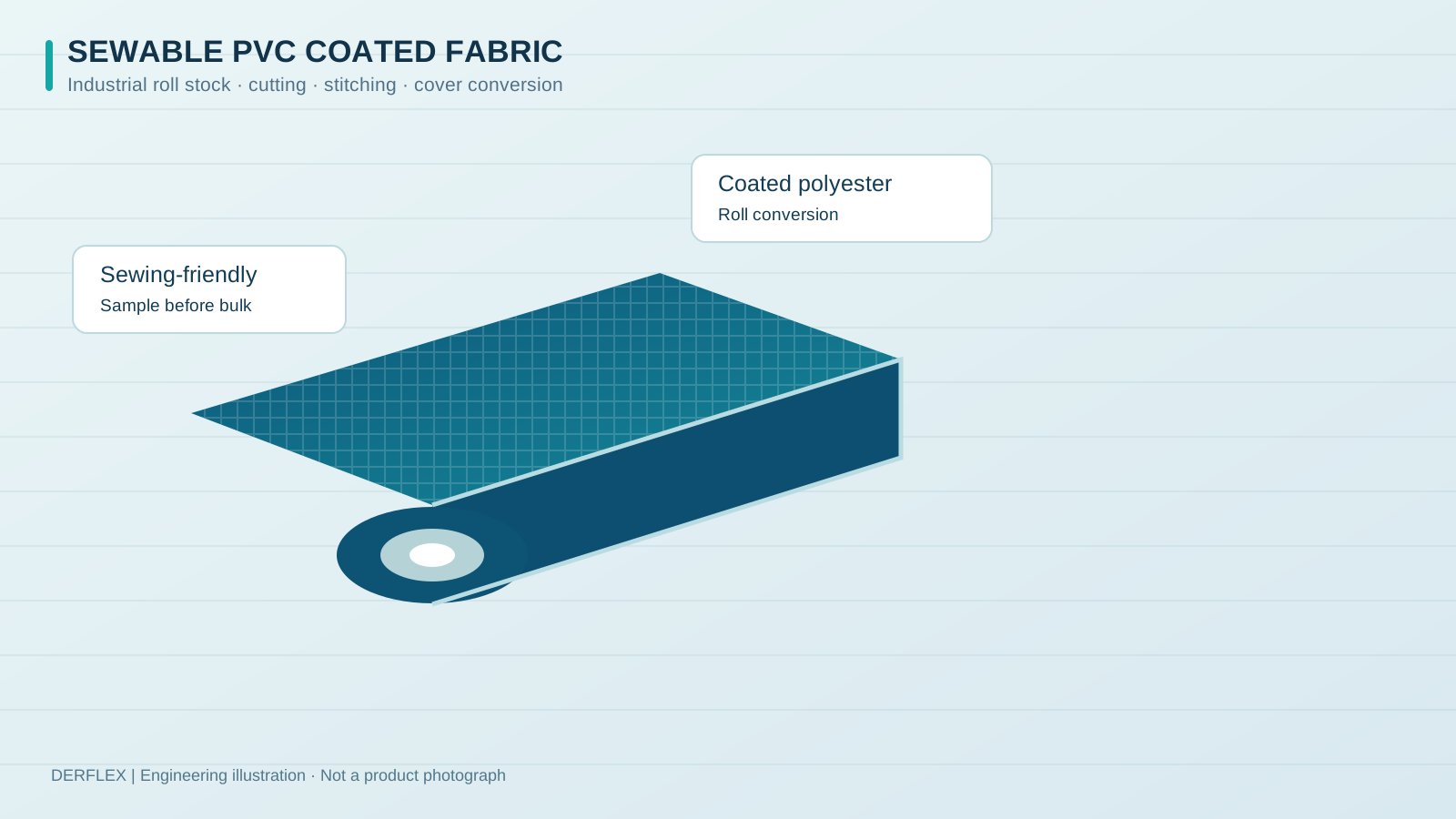 Technical illustration — replace with verified DERFLEX roll-stock photograph before publication.
Sewable PVC coated fabric is a coated textile whose base weave, coating flexibility and thickness allow it to be pierced, fed and stitched into a dependable seam for a specified use.
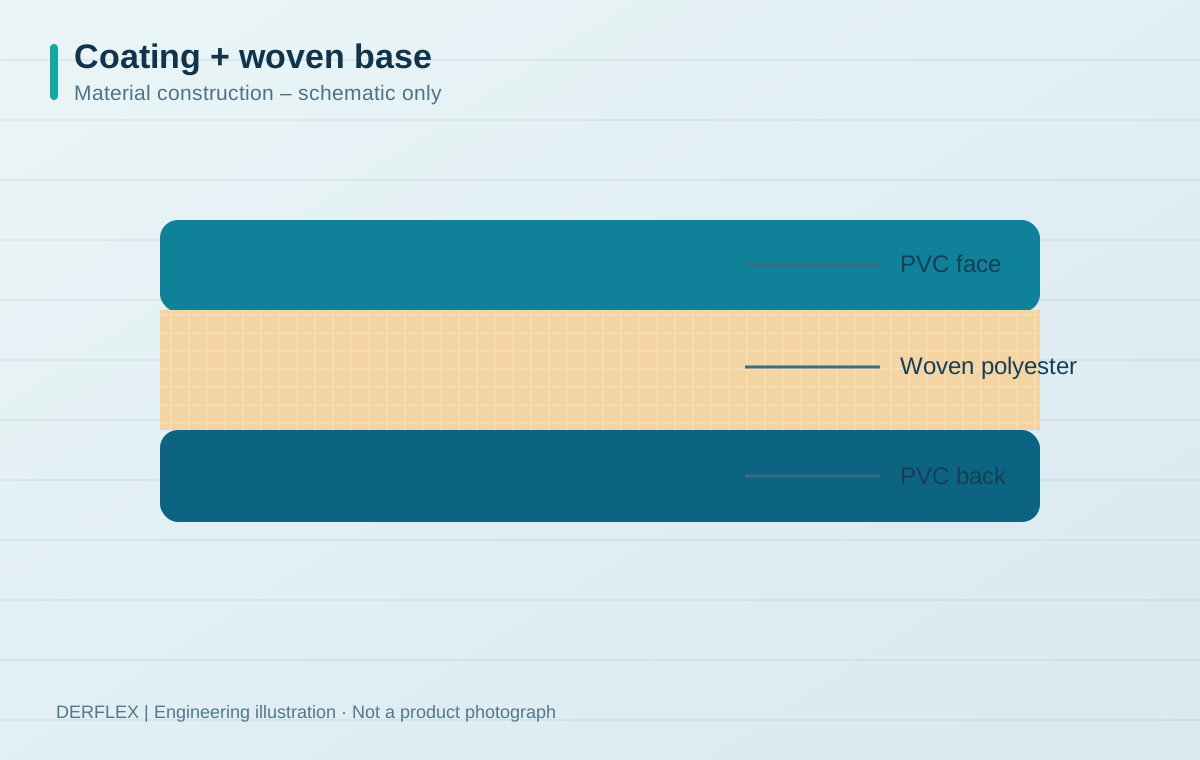
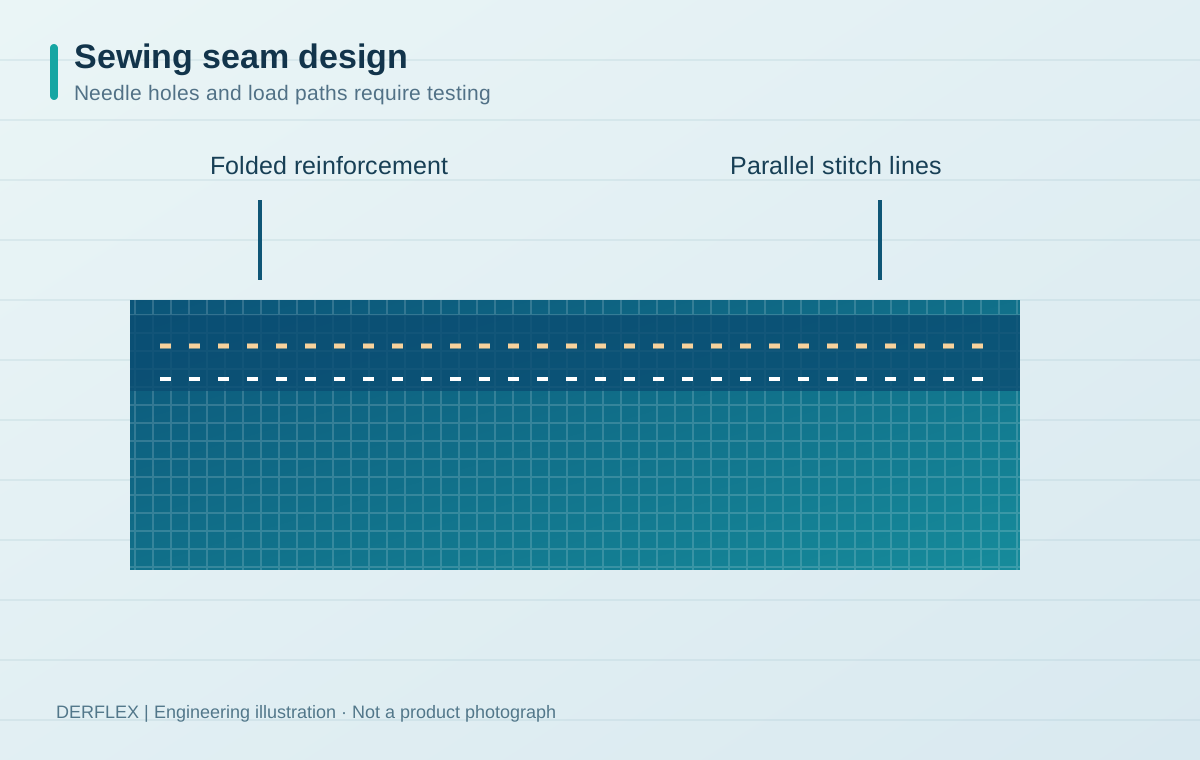
The polyester scrim carries most of the structural load, while the PVC layer helps provide weather resistance and a wipe-clean surface. But the material alone does not establish seam durability: the fabric near each needle hole, stitch tension, edge reinforcement and loading direction determine how the finished joint behaves. An unsuitable needle or excessively dense stitching may weaken otherwise strong fabric.
This page is dedicated to sewable coated roll goods rather than generic PVC fabric specifications. Confirm whether the cover will be stitched only, sewn and seam-sealed, or stitched at attachment zones with other joints welded.
Two rolls with similar nominal weight can behave differently during feeding, folding and stitch formation. For repeat production, request material samples from the intended specification and run the same seam that will be used in bulk manufacturing.
For a wider overview of coating grades, see DERFLEX PVC coated fabric manufacturing.
Check slipping, surface drag and coating marking with actual machine feet and feed mechanisms, especially in multi-layer hems.
Evaluate needle size, point style, heat build-up and local coating damage. Closer stitching is not always a stronger seam.
Compare stitch orientation, seam allowance and reinforcement fabric where tensile loads or repeated opening occur.
Test repeated bending and deployment after sewing, including any cold-weather operating conditions relevant to the product.
Coated fabric can resist water while a stitched seam leaks. Assess overlap, seam tape, sealant or welding where required.
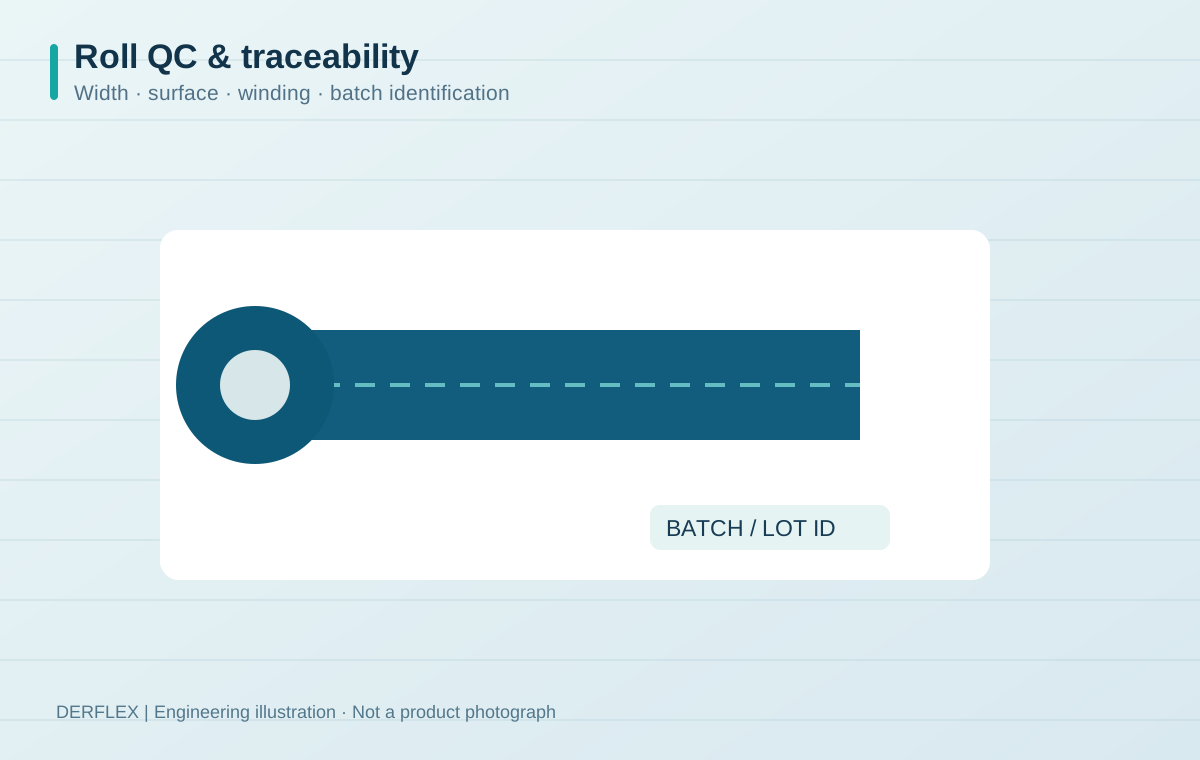
Fix the approved material grade, color, usable width, roll identification and seam benchmark before the repeat order.
The table below is a purchasing checklist, not an unverified technical data sheet. DERFLEX publishes a broad range of coated fabric grades; the final numeric values, allowable tolerances and available options must be stated in a grade-specific quotation and sample approval.
| Specification | What to define in your RFQ | Why sewing teams care |
|---|---|---|
| Base construction | Polyester yarn denier, weave density and required mechanical performance | Influences tear propagation and behavior around stitches |
| Coating method / side | PVC coated or laminated structure; finish on each face | Affects feeding, fold memory and repeated handling |
| Weight & thickness | Target g/m² and mm; tolerance on approved grade | Changes fold bulk and needle penetration requirements |
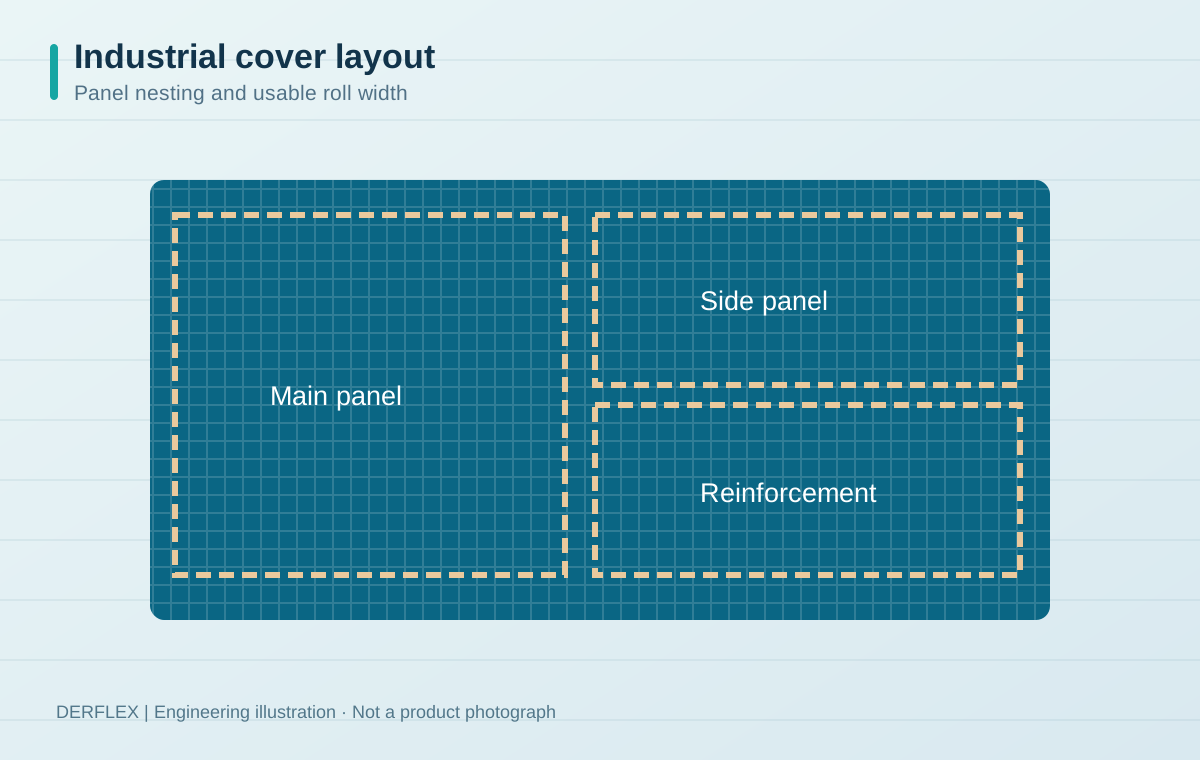
| Usable width | Cuttable width excluding defective edges; tolerance | Controls nesting efficiency and seam count |
| Roll length & joints | Length, winding direction, core, permitted joins and labeling | Prevents unplanned cutting stops and hidden yield loss |
| Color & finish | Color reference, gloss/matte, surface texture, matching tolerance | Supports production matching and repeat orders |
| Service requirements | UV, cold-flex, abrasion, cleaning and optional fire performance | Sets the correct environment for seam qualification |
| QC evidence | Batch ID, grade TDS, relevant test methods and acceptance criteria | Links production defects to a traceable specification |
For comparison only, DERFLEX's broader PVC coated fabric listings describe hundreds of g/m² and multiple widths; no one range is asserted here as the guaranteed sewable grade. Request actual tested samples and written limits.
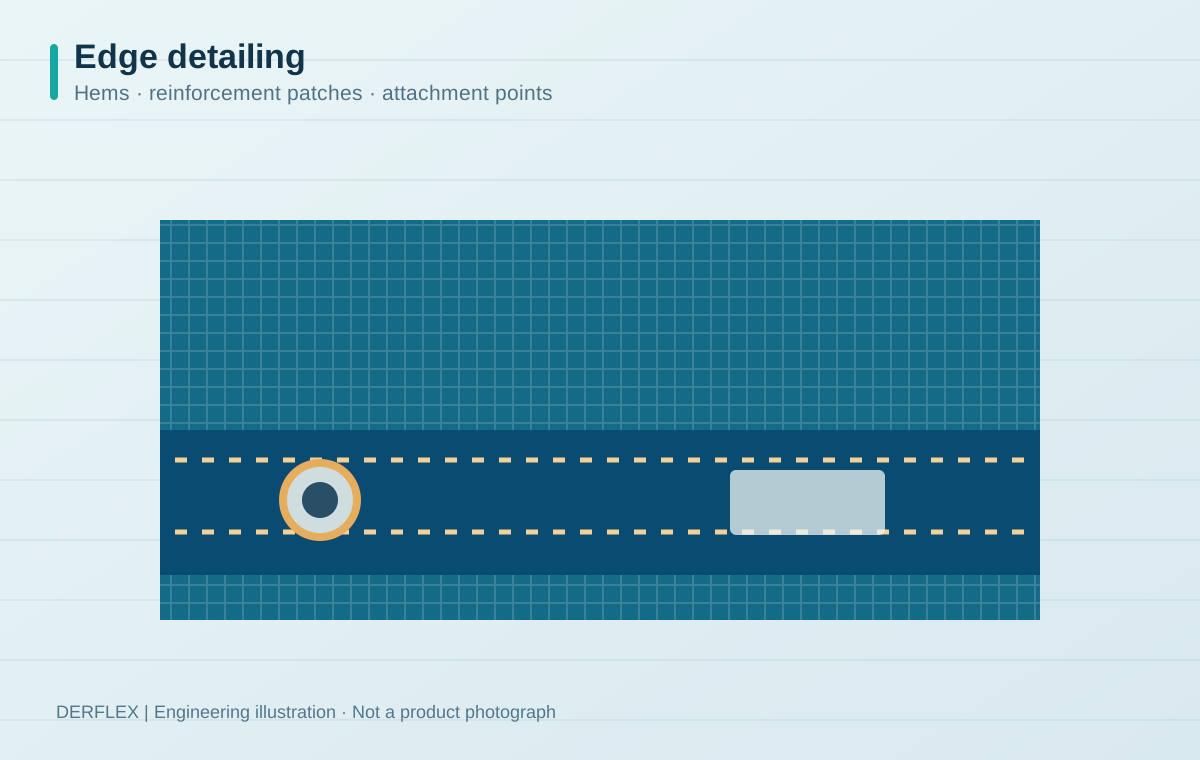
Most industrial covers do not fail in the middle of an undamaged panel. The demanding locations are frequently hems, fastener points, corners, lifting tabs and places where fabric rubs against equipment. These details should drive material choice.
See also industrial curtain materials and truck tarp manufacturing applications for adjacent converter needs.
Removable protective enclosures benefit from flexible panels, access openings, abrasion-aware corners and manageable folding behavior.
Fabricators need consistent roll width, predictable cutting yield, strap reinforcement and seam construction suited to intended tension.
Hanging covers and movable work-zone curtains require attention to weight, repeated flexing, attachment zones and cleaning procedures.
Jobsite covers should account for rough edges, temporary tie-down loads, drainage and differing exposure cycles.
Side covers and detachable panels need seams qualified for handling, abrasion and repeated opening; load retention must be assessed separately.
Repeat designs need consistent color lots, cutting layouts, approved sample seams and a defined roll-labeling system.
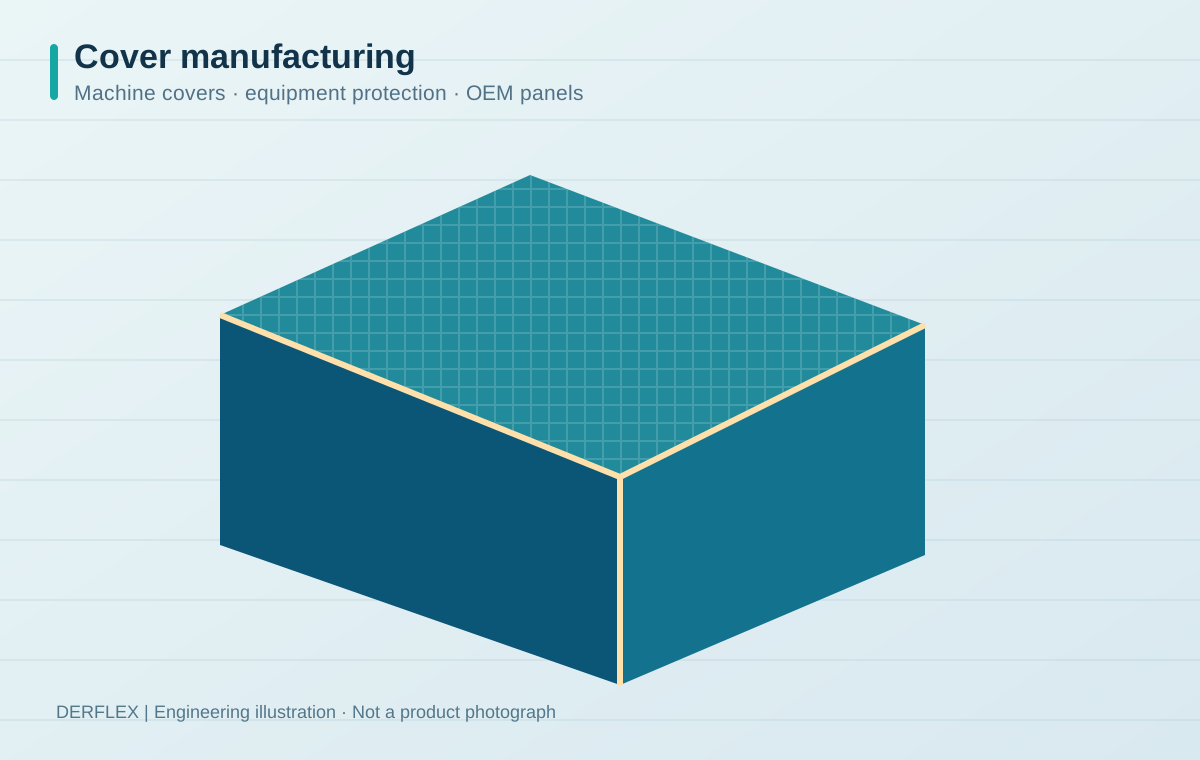
The following original diagrams are provided offline in the package. Before publishing as a verified product photography gallery, replace them with real DERFLEX roll-edge, stitching trial, coated-weave close-up and packing images.
| Joint method | Strongest reason to consider | Important limitation |
|---|---|---|
| Sewn seam | Compatible with irregular shapes, zipper attachments, webbing and repairable components | Needle perforations, local tear and water ingress must be assessed |
| Hot-air / hot-wedge welded seam | Potentially continuous sealed joining with compatible thermoplastic coatings | Requires correct coating, temperature, pressure, speed and operator control |
| High-frequency welded seam | Repeatable shaped joining on suitable PVC systems | Tooling, seam geometry, material formulation and equipment compatibility matter |
| Hybrid seam | Stitched accessories combined with sealed panel joints | Interfaces, transition zones and assembly-level testing remain essential |
A waterproof PVC surface does not make a needle-pierced seam waterproof. A heat-sealable PVC grade does not guarantee that every welded joint meets a given strength or ingress target.
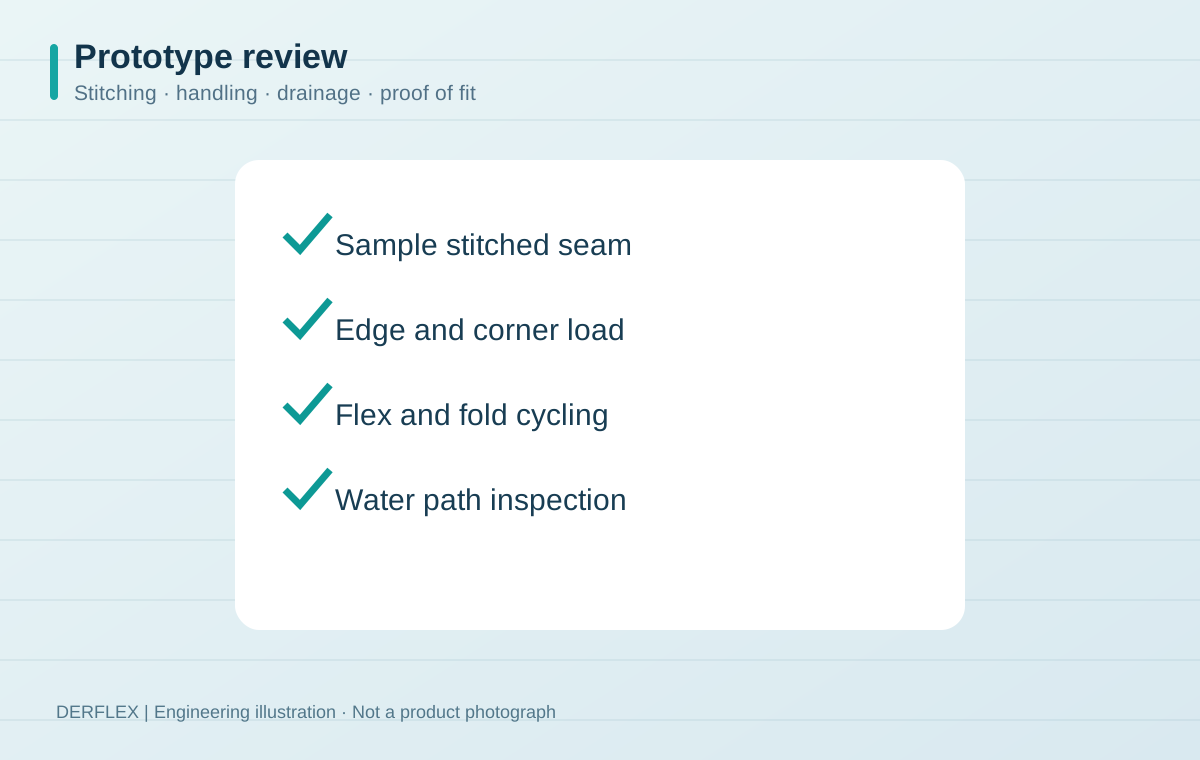
A representative sample helps control rework cost, but it does not replace project-specific safety testing or whole-system assessment.
DERFLEX supplies PVC coated and laminated textile grades for industrial conversion and OEM sourcing. For this application, the purchasing benefit is a coordinated discussion of coating structure, processing method and roll logistics, with the exact performance confirmed on the proposed grade.
Discuss stitchability alongside UV exposure, tear behavior, bending and the expected cover lifecycle.
Request feasible colors, usable widths, surface finishes, roll packing and OEM labeling instead of accepting a generic roll listing.
Agree on inspection points and batch records appropriate to your order; request relevant grade-specific evidence before approval.
For adjacent material options, review PVC coated fabric manufacturing, heavy-duty industrial coated fabric, PVC tarpaulin material and tarpaulin solutions.
No. Sewing suitability depends on coating flexibility, woven substrate, thickness, needle penetration, seam strength and the intended service conditions. Test the actual grade with your production needle, thread, seam pattern and edge construction.
Not automatically. Needle holes create potential water paths even when the PVC coated fabric itself is waterproof. Where watertightness matters, assess seam sealing, overlap design or welding and test the completed joint.
There is no single correct GSM. Lightweight covers prioritize folding and handling, while covers with frequent abrasion or high tension may need heavier reinforcement. Share use conditions, dimensions and sewing machine capability to select trial grades.
DERFLEX offers custom roll programs subject to production feasibility and minimum order requirements. Confirm usable width, roll tolerance, splice policy, color reference, winding direction and batch labeling before placing a production order.
Some PVC coated grades support both fabrication methods, but process compatibility is grade- and equipment-dependent. Trial sewing and welding separately, especially where the same panel combines stitched attachments and sealed joints.
Request grade-specific technical data, test methods and dated results relevant to tensile strength, tear strength, coating adhesion, flex behavior and any specified fire or environmental requirement. Do not assume a certificate for one grade applies to another.
Send your drawing, expected use, target width, roll quantity and stitching process. Request fabric swatches and a grade-specific quotation from DERFLEX.
Include: usable width, weight or thickness target, color, quantity, finished cover application, service conditions and seam method.