



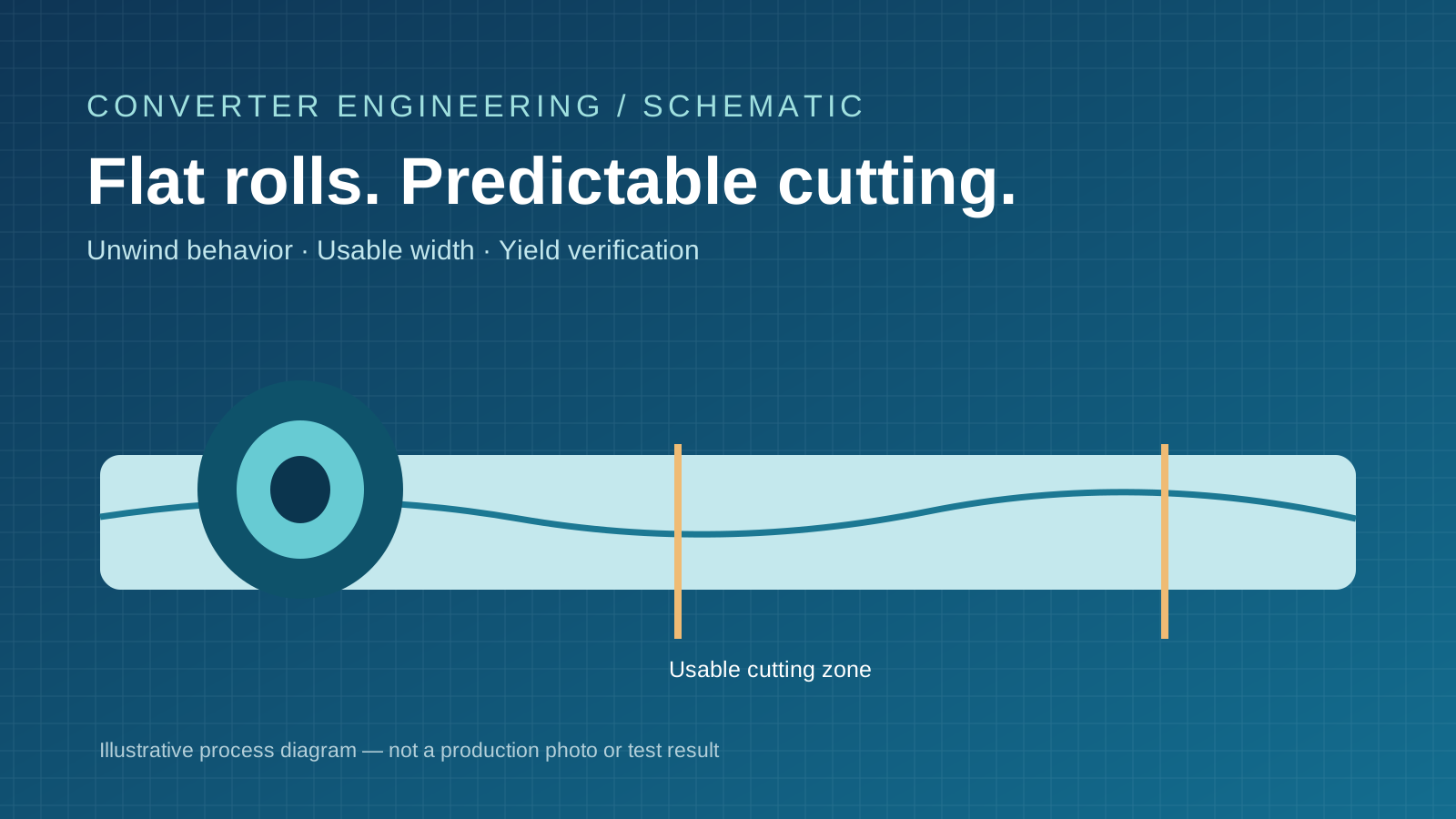
Roll curl and flatness: a cutting problem, not just a cosmetic one
PVC fabric roll flatness is the ability of a conditioned, unwound coated textile web to lie sufficiently even for the intended feeding, registration and cutting process. A roll can look smooth on its core yet develop edge lift, transverse waves or curl when it is laid on a table.
Find the source before compensating in software
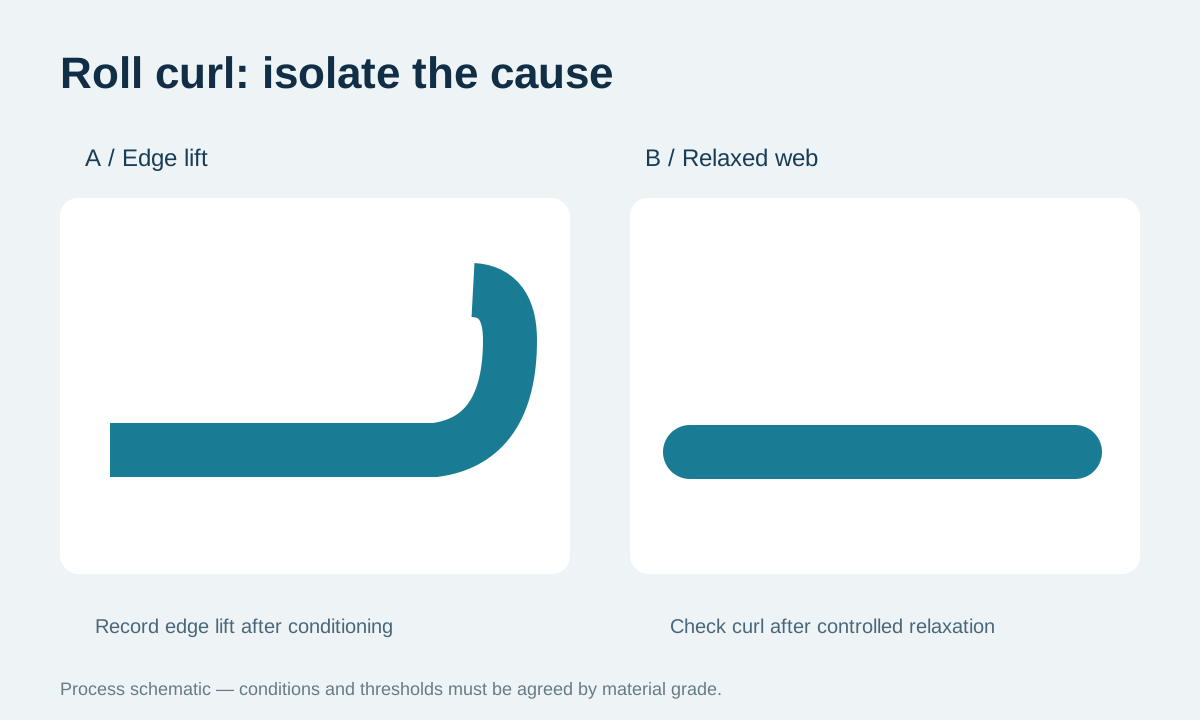
Start by recording the unwind direction, winding side, storage conditions, time since unpacking and the moment at which deformation appears. Compare leading-edge curl with center-web buckling. Note whether curl relaxes over time or increases with feed speed. These observations help distinguish roll-set behavior from inadequate tension control, skewed handling and local coating effects.
Potential causes include winding stress, core geometry, uneven temperature or moisture history, material construction and line tension. They are hypotheses to test—not a claim that every coated roll has the same root cause.
Tension and unwinding setup for automated cutting
A stable cut starts before the knife touches the fabric. Feed tension, core alignment, roll inertia and surface friction influence how consistently the web reaches the cutting table.
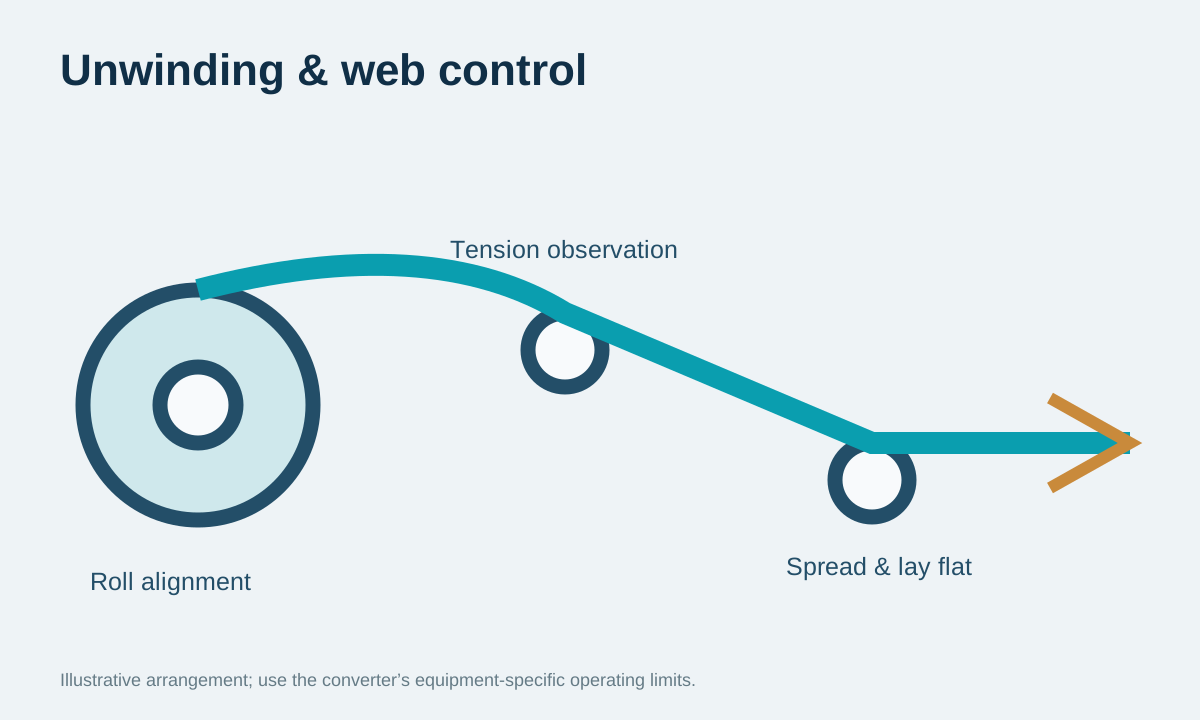
A controlled first-article setup
- Secure and identify. Confirm roll ID, orientation, core fit and free rotation before threading.
- Align the web. Check lateral tracking and measure skew after several feed cycles.
- Record tension conditions. Use equipment-appropriate settings; do not force flatness by stretching.
- Allow repeatable relaxation. Hold a test length for an agreed time before checking flatness.
- Validate at operating speed. Run a small nested pattern and inspect dimensional repeatability.
Too little control may produce wrinkles and tracking variation; excessive tension may temporarily hide curl or alter cut dimensions. Use the material grade's agreed process window rather than an arbitrary universal number.
Usable width versus nominal coated fabric width
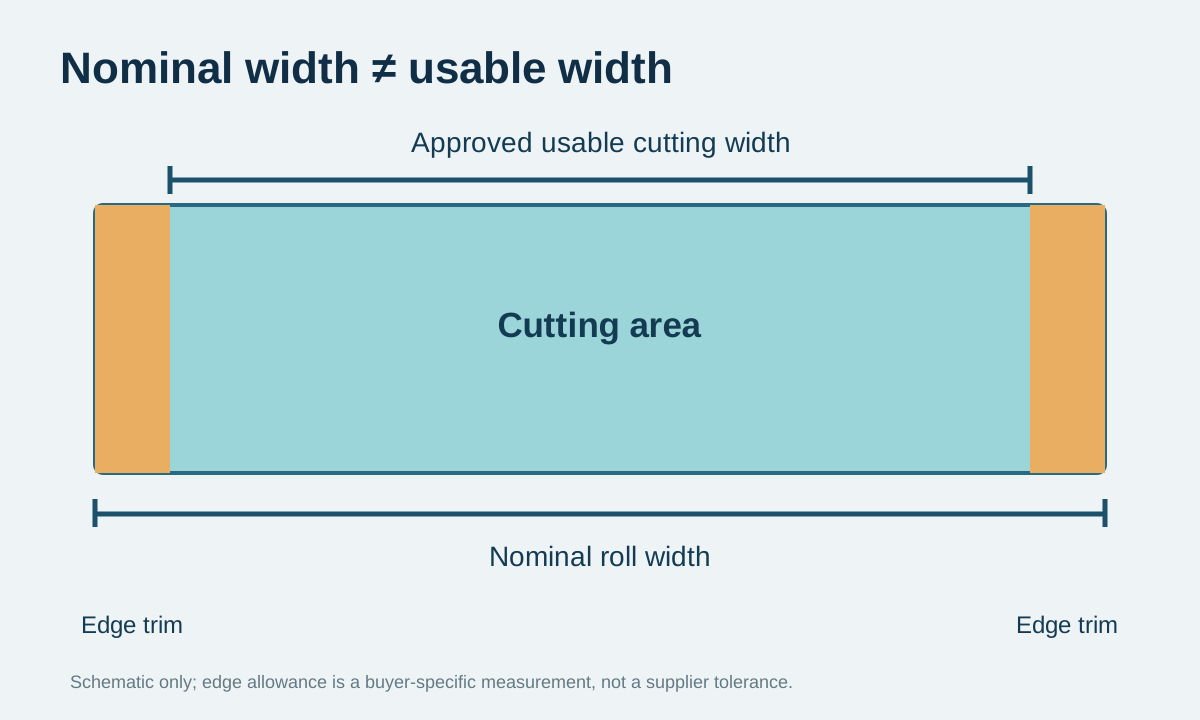
The nominal roll width is not automatically the cutting width. For a CNC converter, the commercially relevant measurement is the uninterrupted width that meets agreed visual, edge and dimensional acceptance requirements.
Specify both dimensions on the purchase order
Nominal roll width is the advertised full web measurement. Approved usable width is the continuous area after excluded edges and nonconforming sections are removed. Record minimum usable width rather than depending only on the nominal value.
For example, a theoretical roll 3.20 m wide with 0.06 m trimmed from each edge has a usable width of 3.08 m. This is an illustrative calculation only, not a DERFLEX product specification or manufacturing tolerance.
Measure at multiple points along the roll, on a defined flat surface, with stated conditioning and tension. Identify whether the roll has selvedges, coated edges, curl zones, splice regions or marks that must be excluded for your particular nest.
| Specification item | Why cutters need it | How to agree acceptance |
|---|---|---|
| Nominal width | Roll handling and initial layout planning | Define measuring condition and width unit |
| Minimum usable width | Panel fit and nesting feasibility | Measure the continuous approved cutting zone |
| Width variation along roll | Repeatability on long nested runs | Specify sample positions and minimum result |
| Edge condition | Automatic registration and edge trim | Define excluded selvedge/curl zone |
| Splice and defect policy | Interrupted nests and rejected panels | Agree markings, reporting and allowable occurrences |
Cutting-yield examples for PVC tarpaulin converters
Cutting yield is the accepted net panel area divided by material area issued to the cutting process, using a consistent measurement boundary. This allows converters to separate material losses from nesting and downstream quality rejects.
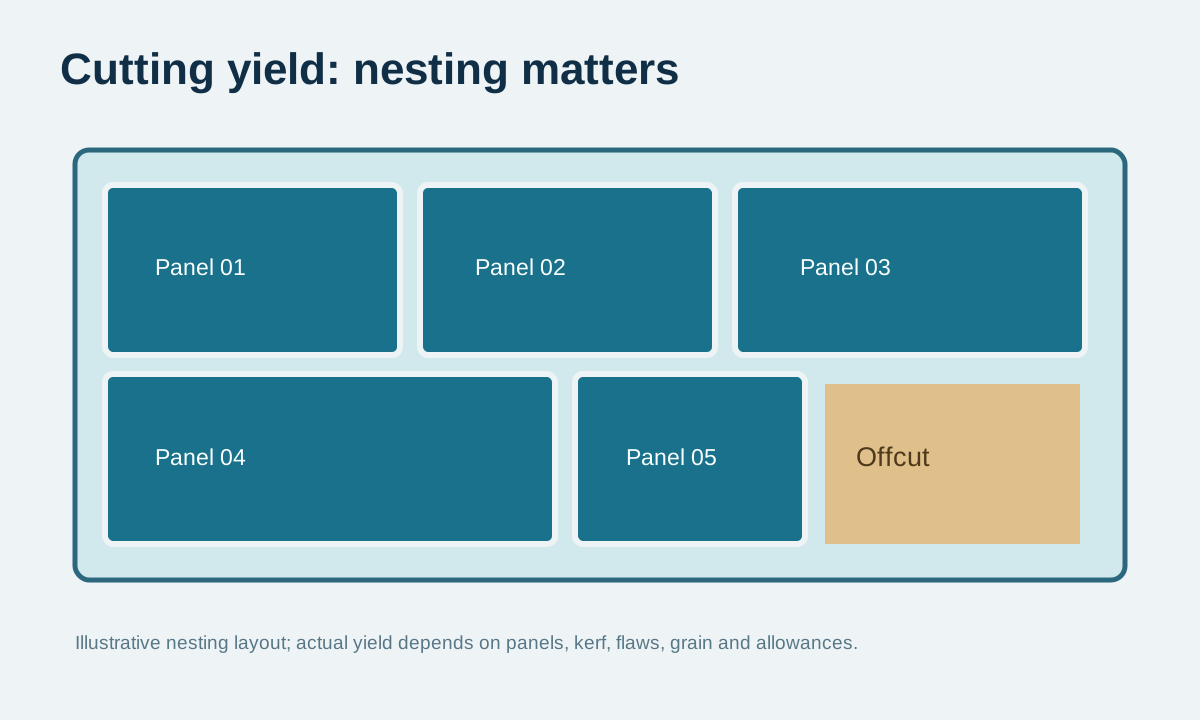
Worked example — not actual production results
Suppose 100 linear metres of fabric are issued from a nominal 3.20 m roll. The purchased area is 320 m². If accepted cutting width is 3.08 m, the available strip contains 308 m² before nesting waste and defects. If approved panels total 260 m², accepted yield is 81.25% of purchased area. Relative to the 308 m² usable strip, nesting-and-rejection yield is approximately 84.4%.
These denominators answer different questions. Record both to avoid attributing trimming losses to poor nesting, or attributing setup rejects to the coating supplier without evidence.
Example assumes continuous full-width material, 100 m issued, 0.06 m trim per edge and 260 m² accepted panel output. It excludes splices outside the measured issue length, downstream welding losses and rework. Actual values must be measured.
Make yield reports actionable
Separate edge trim, nesting offcut, defect cut-out, setup material and rejected panels. When each category is recorded by roll ID and machine program, purchasing and production teams can compare alternate widths or material constructions without confusing causes.
Inspection checklist and agreed tolerances
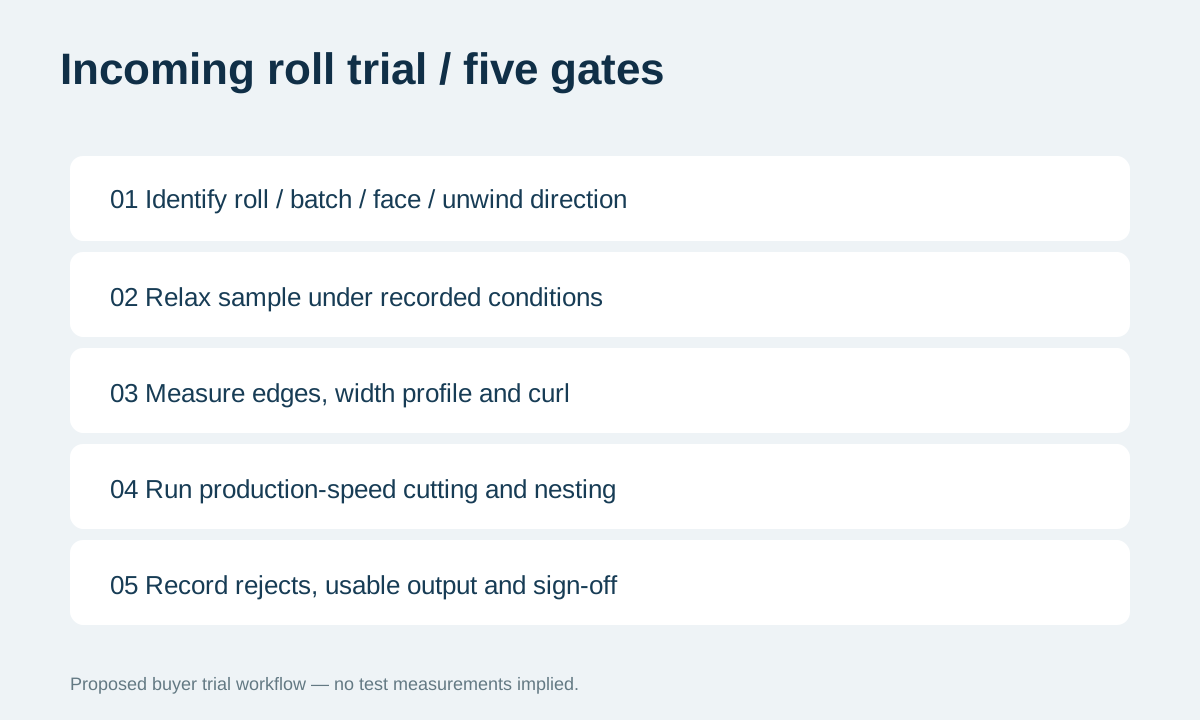
A roll consistency trial should reproduce the buyer's actual converter workflow. Agree test conditions and acceptance criteria before sampling so visual impressions cannot replace repeatable measurements.
Five checkpoints in the incoming inspection
- Identification: material code, batch, roll number, face/back, length, core, orientation and protective wrap.
- Conditioning: unpacking interval, storage environment, test temperature and time to flatten.
- Width and geometry: nominal width, minimum usable width, edge lift, waviness and skew at defined sample positions.
- Cut trial: feed tracking, machine speed, panel dimension accuracy, vacuum hold-down and repeat cut behavior.
- Release: defect locations, splice marks, acceptable cut area, rejected part count and sign-off record.
| Trial field | Measurement record | Acceptance basis |
|---|---|---|
| Curl / flatness | Edge lift, location, time after unwind | Buyer-agreed maximum under specified conditions |
| Roll width | Full width and usable width across checkpoints | Approved drawing or purchase specification |
| Web handling | Tracking deviation and feed stability | Approved machine and feed trial |
| Cut consistency | Measured first and repeated panels | Converter's part tolerance and method |
| Defects / splices | Position map and count | Agreed sampling and rejection policy |
Define the trial that matches your cutting line
DERFLEX supplies PVC tarpaulin and coated fabric roll material for converters. This page focuses on the roll-to-cut workflow; it is not an offer for CNC cutting equipment, a factory automation system or a guaranteed output yield.
Send a converter-ready RFQ
- End application and selected coating construction or current material reference
- Nominal width, minimum usable width, roll length and core requirements
- CNC knife, laser or other cutting method and table/feed description
- Panel geometry, nesting orientation, expected cut allowances and annual demand
- Flatness concern, photos of defects and any recorded failure conditions
- Target inspection plan, sample quantity and destination
Approve the roll on your equipment.
Request sample material with roll identification, inspect under agreed conditions and document results before releasing repeat orders. Material, packing and lead-time options depend on the confirmed grade and quotation.
Request Roll Consistency & Cutting Trial Samples ↗Frequently asked questions
Why does a PVC fabric roll curl after unwinding?
Curl can reflect winding history, storage temperature, residual stresses, coating construction or asymmetric relaxation. Diagnose with controlled conditioning and compare the same batch at a consistent unwind tension before changing the cutting program.
How is usable width different from nominal roll width?
Nominal width describes the stated overall roll dimension. Usable width is the continuous area that meets the agreed cutting and quality requirements after edge trim, edge defects or other exclusions. Confirm both values in the purchase specification.
Does heavier PVC tarpaulin always cut more efficiently?
No. Weight alone does not determine flatness, feeding behavior, cut accuracy or nesting utilization. Construction, coating balance, winding, equipment settings and panel geometry all affect conversion.
What should a CNC cutting trial measure?
At minimum, measure actual usable width, edge lift, flatness after relaxation, feed tracking, repeat length, cut-part dimensions, defect frequency and accepted output area, with the test conditions recorded.
Can one roll-width tolerance suit every cutting line?
No. A practical acceptance limit depends on the cutting table, vacuum hold-down, registration method, edge trimming requirements, panel size and the approved material grade.
What should I include when requesting roll consistency samples?
Send nominal and minimum usable widths, roll length and core requirements, cutting machine type, desired panel geometry, unwind orientation, target annual volume and proposed inspection method.
More predictable cutting starts with a better roll specification.
Share your machine setup, target panel dimensions and present roll issues. Define a practical trial with DERFLEX before committing to bulk material.