


PVC-coated polyester construction and surface chemistry must be compatible with the joining process.
Technical fabrication guide / PVC coated textiles
Tarp Seam Welding Guide.
PVC tarp welding is controlled joining of compatible coated-fabric surfaces using energy, pressure and cooling. For reliable large-format tarps, the method is only the starting point: material finish, overlap geometry, machine setup, critical details and inspection decide the result.
This shop-floor guide helps tarp fabricators, truck-cover OEMs, converters and procurement teams qualify seams, diagnose weak welds and specify repeatable roll or finished-cover supply with DERFLEX.
Hot-air / hot-wedge / HF-RFProduction trialsWeld defectsBuyer QC plan
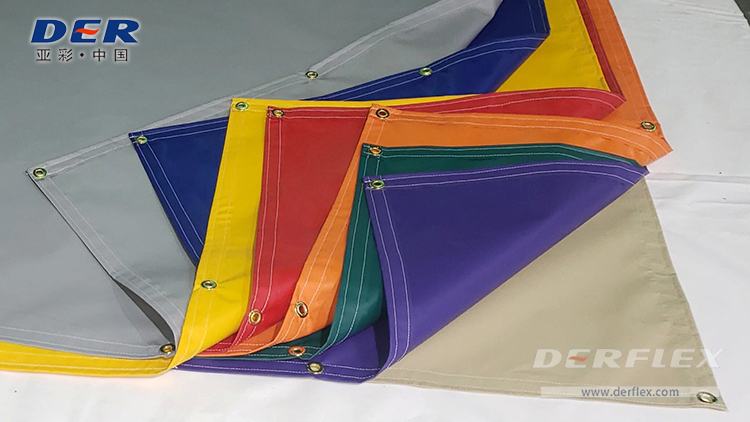
Not a fixed temperature recipe. Qualify the process on the ordered PVC coating and finish.
30-second technical answer
How do you weld a PVC tarp seam?
Align clean, compatible PVC-coated surfaces with a defined overlap. Apply controlled hot air, a heated wedge or qualified RF energy; consolidate the softened interface under pressure; allow the seam to cool without disturbance; then verify the joint with visual and project-relevant mechanical and leak checks.
Do not assume a universal heat setting or overlap. The approved combination depends on the actual coating, surface finish, number of layers, welding equipment, load direction and finished application.
Overlap, fused width, sheet orientation and corners determine the effective load path.
Heat or RF input must be balanced with dwell, travel speed, contact pressure and cooling.
Approval means identifiable samples, tests, failure observations and a controlled production record.
Material qualification
Weldability starts before the seam.
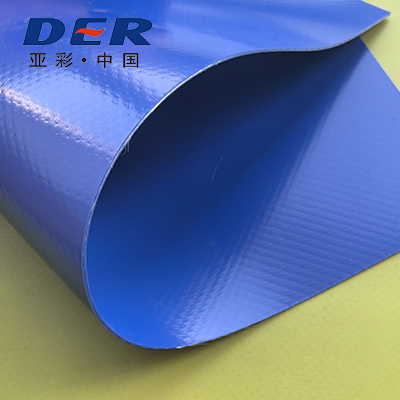
A coated textile is not a uniform sheet of plastic. Its polyester fabric, PVC formulation, coating adhesion and face finish all influence the joining response.
The grade selected for cutting and welding should be the same grade used in the approval coupon. Total weight alone does not identify the coating formulation or whether a lacquered, printed or embossed face will form an acceptable joint. Ask your converter which faces are intended to mate before fixing the panel drawing.
DERFLEX supplies PVC tarp roll materials with application-dependent construction, weight, width, color and surface options. Review available specifications in its PVC tarpaulin material range before requesting a weld trial.
Important: Typical overlapping PVC tarpaulin sheets are welded by fusing their coated surfaces; they do not ordinarily require the separate filler rod used in some rigid-plastic welding techniques.
Joining technology
Choose the process for your seam geometry.
A method name is not a performance guarantee. All three routes can be appropriate where the material and assembly have been qualified. Full details of available welded tarp constructions appear in DERFLEX's heat welded tarpaulin supply guide.
| Consideration | Hot-air welding | Hot-wedge welding | High-frequency / RF welding |
|---|---|---|---|
| How heat arrives | Hot airflow softens facing thermoplastic layers ahead of pressure rollers. | A controlled heated wedge transfers heat by contact between layers. | RF energy heats compatible polar thermoplastic material under shaped tooling. |
| Common production fit | Long or variable panel seams, large custom covers, some repair tasks. | Long, accessible seams where stable feed and wedge contact suit the assembly. | Repeated patches, shaped components, defined weld zones and tooling-led production. |
| Main process controls | Air temperature, airflow, travel speed, pressure, nozzle condition. | Wedge temperature, alignment, travel speed, pressure, contact conditions. | RF power/energy, weld and cooling time, electrode geometry, pressure. |
| Typical risk to check | Variable heating, wind or airflow effects, pressure loss at cross-seams. | Wedge alignment and contact at uneven stacks or turns. | Tooling mismatch, material-response differences, edge definition and clamp pressure. |
| Approval question | Does the longest real panel seam pass after warm-up and continuous production? | Do the thickest intersections and flat sections pass with the same qualified window? | Do the repeated parts and multilayer interfaces pass with the actual electrode? |
Selection directions, not promises of absolute strength or watertightness. The final method, parameters and testing scope must be approved on the actual construction.
Joint design / critical dimensions
Overlap is not the same as usable weld width.
An overlap only describes how far one sheet covers another. The effective fused zone may be narrower, interrupted by a channel or displaced by edge distortion.
A production drawing should identify panel direction, the two mating faces, overlap width, intended fused band, seam-start and seam-end treatment, distance from the edge, and junctions where several layers meet. For exposed covers, consider water-shedding orientation as well as load direction.
At corners, hems or reinforced inserts, the material stack becomes thicker. That can alter heat transfer and compression: an attractive straight seam sample does not automatically validate the actual intersection.
The finished sequence also matters. DERFLEX's tarpaulin manufacturing process overview shows how coating, cutting, joining and edge reinforcement fit together.
Do not copy an arbitrary 20 mm / 30 mm overlap or a single nozzle temperature from a web guide into a purchase order. Validate the joint width and machine window for the approved material and load.
Workshop sequence
The six-stage PVC tarp welding workflow.
Use this as a control sequence for making and qualifying seams, not as a substitute for equipment-specific operating instructions, operator training or a documented factory safety process.
Lock the material.
Check the approved grade, coating sides, lot, thickness/weight direction, visible finish, specimen orientation and revision. Label offcuts.
Clean, dry, support.
Remove contamination by a surface-safe method; ensure the full panel is supported without dragging. Mark overlap and high-layer zones.
Establish the window.
Trial the actual equipment and proposed seam stack. Adjust heat or energy, feed/dwell, pressure and cooling systematically.
Control the travel.
Keep alignment, speed and contact stable. Watch seam starts, stops, direction changes and material thickness transitions.
Avoid early loading.
Allow the joined PVC zone to cool under appropriate support/pressure before pulling, bending, handling or checking.
Inspect and record.
Measure fused geometry and conduct agreed strength and barrier checks. Retain representative samples and the settings record.
What should the setup sheet record?
- Welder model, nozzle or wedge details, pressure roller condition.
- Heat set point and relevant actual display readings; airflow for hot air.
- Travel speed, pressure, weld path and seam geometry.
- Ambient conditions, warm-up, start/end behavior and material lot.
- Coupon outcome and the approved allowable process variation.
What changes for RF joining?
- Machine and tooling/electrode identity, clamp alignment and stacking.
- Validated power or energy setting and weld-time controls.
- Pressure and cooling or hold time appropriate to the geometry.
- Critical cross-seam and patch-trial evidence.
- Operator safety interlocks and equipment procedures followed as specified by the OEM.
Hot PVC equipment can cause burns and fumes. Use trained operators, appropriate extraction/ventilation and the equipment manufacturer's safeguards. Avoid recommending a universal temperature or an uncontrolled solvent-cleaning procedure.
Fault isolation / manufacturing insights
Diagnose the symptom before changing settings.
A weak weld is not always an “underheated” weld. Look first at where separation occurs: PVC-to-PVC interface, PVC-to-textile coating bond, or rupture of the coated fabric next to the seam.
| Observed symptom | Likely investigation route | Corrective trial | Release evidence |
|---|---|---|---|
| Clean interface peel / weak grab | Low interface energy; excessive travel speed; pressure shortfall; wrong mating face; incompatible finish. | Check grade/face first, then vary one controlled process factor at a time on labeled coupons. | Peel/shear outcome and failure location on the approved construction. |
| Brown or glossy distorted band | Excess heat, excessive dwell, unsuitable air/wedge contact or local pressure variation. | Review actual thermal exposure and speed; compare surface appearance with a control sample. | No unacceptable scorching, loss of coating or strength reduction. |
| Wrinkles / waviness at seam | Misaligned panels, uneven support, feed tension, pressure/temperature mismatch. | Improve table support and alignment; repeat seam at production length, not a short coupon. | Flatness and dimensions remain within the agreed limits. |
| Open edge or water channel | Incomplete fused width, entrapped dirt, poor overlap path, corner transition or start/stop defect. | Inspect seam edge and cross-seam; adjust geometry or process on representative assembly. | Project-defined leak or hydrostatic evaluation if required. |
| Coating lifts from polyester | Coating adhesion or material heat tolerance may limit the seam before the PVC interface does. | Inspect the material/finish and request a coating-adhesion assessment; do not simply increase temperature. | Separate material adhesion and joint-strength results. |
| Strong flat seam, weak corner | Added layer count, pressure void, abrupt stiffness change or high local load. | Trial the real corner/patch stack and modify local geometry/reinforcement as needed. | Approved critical-detail coupon plus visual and functional inspection. |
| Variability between production lots | Different finish, formulation, coating build, operator, equipment or settings record. | Compare lot IDs and retained coupons; review controlled material/process changes. | Traceable incoming grade, shift checks and reapproval trigger. |
The table is a fault-isolation framework, not an instruction to change machine settings without a trained technical review.
Quality verification / acceptance
What does a “passed weld” actually prove?
No single visual check proves strength, waterproofness and long-term flexibility at once. Test the seam against the finished product's failure risks, using the exact agreed method, units, direction and limits.
| Check | What it reveals | Evidence to request |
|---|---|---|
| Geometry and visual continuity | Overlap, fused band, alignment, burns, channels, edge lifting. | Inspection criteria + measured seam + defect record. |
| Peel / opening behavior | Resistance to opening across the welded interface. | Named procedure, specimen geometry, direction, conditioning, result and failure mode. |
| Shear / seam strength | Capacity under an agreed tensile load path. | Coated-fabric-appropriate method, units and minimum agreed with buyer. |
| Water / leak check | Barrier continuity for the actual rain or containment exposure. | Medium, pressure/exposure, duration, test location and acceptance rule. |
| Fold / cold condition | Potential cracking or degradation after relevant handling exposure. | Defined cycle or conditioning and recheck against project acceptance. |
| Cross-seam / reinforcement | Loss of pressure or load concentration around real assembly details. | Representative multilayer coupon and recorded outcome. |
ASTM D751 includes coated-fabric test procedures relevant to seam strength; select the actual applicable procedure and edition rather than treating the standard name as an automatic pass mark. See DERFLEX's heavy-duty weld-strength acceptance guide for the distinction between test result and buyer limit.
Production traceability
A repeatable weld needs a repeatable material lot.
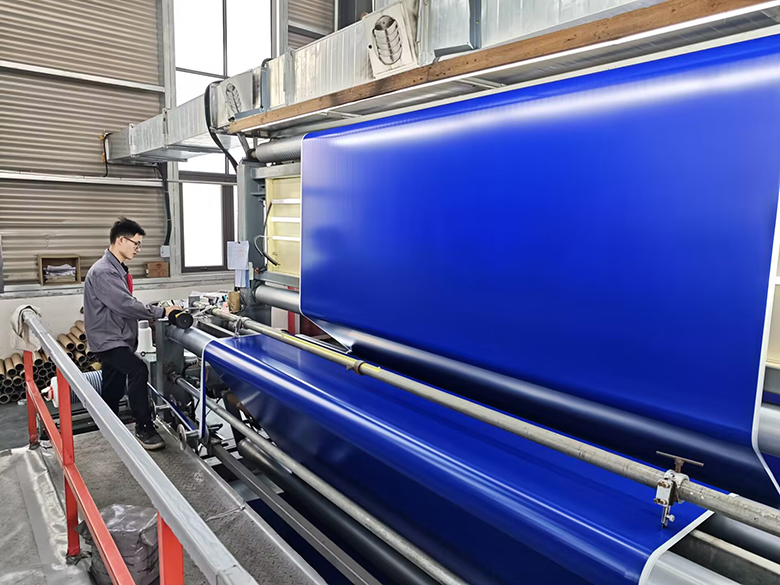
Changes to lacquer, coating formulation, pigment, fabric construction or surface treatment may require a fresh weld trial even if the roll's nominal GSM remains unchanged. Converters should maintain a control sample or approved reference against which later batches can be checked.
For a deeper inspection framework covering tensile, tear, coating adhesion and fabrication-related risks, review PVC coated fabric testing and buyer checks.
Load paths / actual use cases
Specify the seam that will see the field conditions.
Applications differ in what a “good weld” must survive. The table below helps select project verification priorities, not a universal material rating.
| Application | Exposure / failure risk | Seam-design checkpoint | Suggested evidence |
|---|---|---|---|
| Truck tarps and trailer panels | Road wind, flex cycles, abrasion, tie-down tension. | Long panel alignment, seams near fold paths, reinforced hems and hardware. | Strength, folding and stress-zone detail checks. |
| Industrial equipment covers | Irregular shapes, sharp contact, repeated handling. | Curved seams, reinforced corners and zip/access transitions. | Assembly coupon and abrasion-prone geometry review. |
| Construction and outdoor storage | Weather, uplift, corners and possible pooling. | Water-shedding lap direction, cross-seams, corner patches and anchors. | Water exposure plus anchorage/detail checks. |
| Industrial curtains / temporary shelters | Frequent movement, wide welded panels and attachment points. | Flexing and seam transitions at keder, tabs or suspension hardware. | Dimensional, flex and local-detail acceptance. |
| Liquid- or air-retention assemblies | Leakage and sustained pressure: higher barrier consequence. | Qualified joining system, full assembly and special transitions. | Defined leak/pressure protocol in addition to mechanical checks. |
Buying insight: A waterproof fabric does not guarantee a waterproof finished cover. Water paths can remain at starts/stops, intersections, hardware holes, drainage defects and separately sewn components. A direct comparison with alternative join construction is in DERFLEX's welded versus sewn seam guide.
B2B sourcing / converters / OEM procurement
Send a seam-ready request, not only a tarp size.
DERFLEX can discuss PVC-coated roll materials and custom tarp fabrication requirements. A usable RFQ includes the joining route and acceptance basis so the material sample, converter trial and quote address the same finished construction.
- Product & exposureTruck, industrial curtain, storage or shelter; climate, loading, folding and water exposure.
- Material & supply stageRoll / cut panels / welded components / finished cover; grade, GSM or sample, width, color and finish.
- Machine & jointHot-air, wedge or HF/RF; model, faces, overlap geometry, intersections and drawings.
- Acceptance criteriaPeel/shear method, units, water or pressure test, fold/aging condition and defect limits.
- Commercial deliveryEstimated quantity, sizes, order program, packing, labels, destination and documents.
A practical technical RFQ sentence
“Please propose a PVC-coated tarp construction suitable for [application] and [welding process/machine]. Review [finished dimensions/roll width], [coating/finish], [seam drawing and load path], and [test method + minimum + leak criterion]. We require [quantity], [packaging] and shipment to [destination]. Please confirm the weld trial and sample approval route.”
Replace all bracketed fields. Any performance limit must be agreed with the buyer and validated for the actual application.
What DERFLEX can review
Material → seam → finished-tarp specification
- PVC-coated polyester constructions and appropriate roll formats.
- Color, surface finish, print and application-specific requirements.
- Fabrication compatibility and approved-seam sample needs.
- Panel layout, reinforced hems, pockets, webbing, grommets and D-rings.
- Project-based documentation, packing and export coordination.
Explore the DERFLEX technical cluster
Six related resources for specification-led buyers.
Go deeper into the material, fabrication, failure modes and testing that determine finished-cover performance.
01 / PVC Tarpaulin MaterialsConstruction, weight, width and surface options; see material qualification earlier in this guide.02 / Heat Welded TarpaulinsSupply formats and the fabrication-readiness of welded covers.03 / Tarpaulin Manufacturing ProcessFrom coating and finishing through conversion and inspection.04 / Welded vs Sewn SeamsUnderstand the limits of a method-only comparison.05 / Heavy-Duty Weld StrengthHow to define a measurable acceptance criterion.06 / Coated Fabric Test MethodsMatch material checks with seam and assembly testing.
These six resources are also linked at relevant decision points within this guide. Request A Quote is a separate inquiry action.
Questions fabricators and buyers ask
PVC tarp welding FAQ.
Short direct answers to common welding, testing and production-control questions.
Can you weld PVC tarpaulin without sewing?
Yes. Many PVC-coated polyester tarpaulins can be joined using qualified hot-air or hot-wedge welding, and compatible constructions may use HF/RF welding. A continuous fused panel seam avoids a needle-hole line, but the complete tarp still needs checks at corners, patches and hardware penetrations.
What temperature should I use to weld a PVC tarp?
There is no universally correct setting. The required machine setting depends on coating chemistry, finish, fabric thickness, airflow or contact conditions, travel speed, pressure and equipment design. Use the welder manufacturer's instructions and qualify a controlled setting window on production-representative samples.
How wide should a welded tarp overlap be?
Specify the overlap and effective fused width from an approved drawing and application-specific test. No single overlap suits all tarp grades, equipment or load paths. Cross-seams, hems and corners require separate attention because changing layer counts can reduce contact uniformity.
Why does a PVC tarp weld peel apart?
Possible reasons include insufficient interface energy or contact pressure, unsuitable travel speed, contamination, wrong mating faces, incompatible lacquer or coating adhesion failure. Diagnose the actual failure location first and compare labeled trial coupons rather than making an uncontrolled temperature change.
Are hot-air welded tarp seams waterproof?
They can be highly water-resistant when properly fused and qualified, but welding alone does not prove a waterproof finished cover. A project may need a defined leak or hydrostatic check around overlap ends, intersections, folds, penetrations and repaired areas.
Which test confirms PVC tarp weld strength?
Use a coated-fabric-appropriate seam method agreed by the buyer and fabricator, specifying specimen width, load direction, conditioning, units and acceptance limit. ASTM D751 contains relevant coated-fabric seam procedures. Record whether the weld opens, the coating peels or the base fabric fails; add a separate barrier test when needed.
Can I use a filler welding rod on overlapping PVC tarp sheets?
Typically the two coated tarp faces are fused directly under heat and pressure; a separate plastic filler rod is not ordinarily part of conventional hot-air overlap seam welding. Do not copy a rigid-PVC rod-welding procedure to coated-fabric sheet joining without specific process validation.
What should I request from a PVC tarp supplier before bulk welding?
Ask for the exact material grade, composition/finish information, approved physical swatch, welding compatibility trial, agreed seam drawing, relevant mechanical and leak criteria, material and process traceability, and a documented procedure for reapproval when construction or settings change.
Technical context: Industry descriptions of heat-and-pressure joining are available in Leister's Welding of Technical Textiles guide, Miller Weldmaster's hot-wedge technology notes and Forsstrom's covers-and-tarpaulins HF technology overview. These are general process references, not DERFLEX-specific machine settings, test reports or approved material ratings. Values, suitability and standards must be confirmed for the purchased construction.
Ready to specify your seam?
Source the PVC material and seam construction as one project.
Share your welding machine, material reference, seam drawing, application, finished dimensions, quantity and testing requirements. DERFLEX can review the appropriate coated-fabric direction and quote-related next steps.
Request A Quote