News
Industry News

Tarp with Reinforced Edges | Custom Heavy Duty Tarps | DERFLEX

Update:2026/8/24 17:02:03 Views:
Industrial tarp & coated fabric manufacturing
Custom edge engineering for B2B tarp programs

Tarp with Reinforced Edges

The perimeter is where tie-down force enters a tarp. DERFLEX develops tarp with reinforced edges for buyers who need the hem, webbing, corners, grommets, D-rings and local wear zones to work as one practical fastening system—not as isolated accessories.

Configure PVC coated polyester material, finished size, edge build-up and hardware layout for transport, construction, equipment protection, agriculture, warehouse use and private-label supply. Final specifications are confirmed according to application, quantity and approved sample.

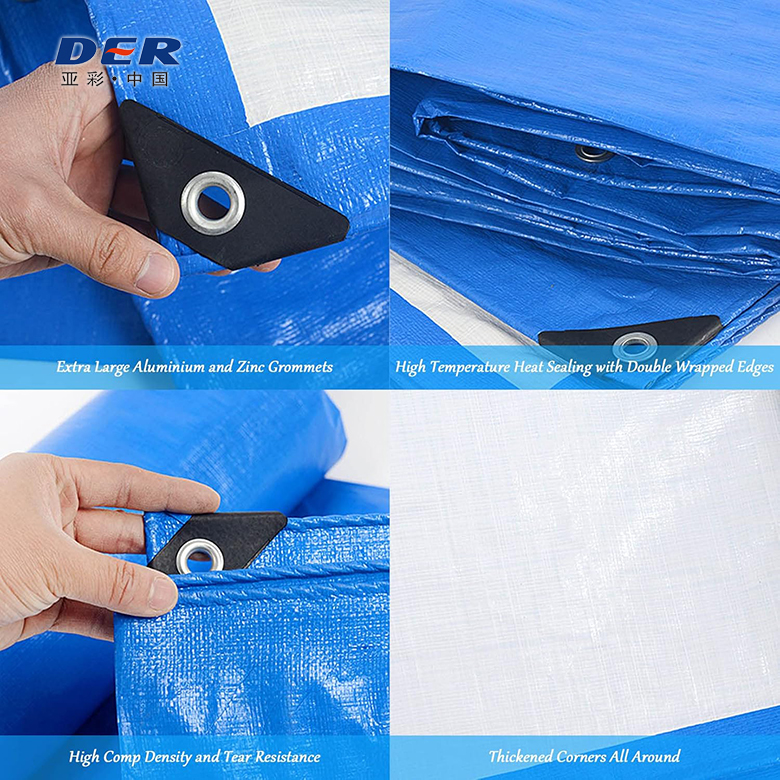
DERFLEX tarp with reinforced edges, reinforced corners and grommets
Product image: reinforced perimeter & corner details Edge build-up, corner patches and eyelet layout can be adjusted to the real anchor system and service condition.
450–1200 gsmTypical PVC tarp discussion range
Custom Edge Build-UpHem, webbing, rope, double layer, patches
Mapped HardwareGrommets, D-rings, straps, loops, pockets
OEM / Bulk ProgramsFinished tarps, panels or roll material
Product definition

What Is a Tarp with Reinforced Edges?

A tarp with reinforced edges is a protective cover whose perimeter has been strengthened beyond the basic fabric layer. Reinforcement can be created by folding and welding the hem, sewing or welding webbing into the perimeter, enclosing rope, adding compatible fabric strips, building larger corner patches, or reinforcing selected zones behind grommets and D-rings.

The purpose is not simply to make the edge thicker. The practical goal is to distribute tension, reduce stress concentration around fixing points, protect high-wear sections and provide a more controlled interface between the tarp and the frame, hooks, ropes, straps or anchors used in the field.

For industrial procurement, the phrase reinforced edge tarp should therefore be translated into a measurable drawing: finished dimensions, hem width, reinforcement material, corner geometry, hardware type, center-to-center spacing, row position and local wear protection. This makes sampling, inspection and repeat orders easier to control.

  • For importers and distributors: turn a generic tarp idea into a consistent product family with documented finishing details.
  • For fleet and logistics buyers: match reinforcement and hardware to repeated tension, folding, vibration and cargo contact.
  • For contractors and projects: coordinate edge strength with real anchor locations rather than using an arbitrary eyelet pattern.
  • For OEM brands: control color, logo, labels, packaging and edge specifications as part of one repeatable program.
Reinforcement architecture

Six Ways to Build the Edge Around the Real Failure Risk

A heavier tarp is not always the answer. The edge construction can be selected by pull direction, handling cycle, abrasion, anchor geometry and the amount of perimeter control required.

01

Folded or Welded Hem

A clean perimeter fold adds layers around the cut edge and creates a stable zone for eyelets. Suitable PVC structures can be hot-air or high-frequency welded; sewing may be used where the structure or hardware system calls for it.

02

Webbing-Reinforced Edge

Polyester or project-specified webbing can spread tie-down force along a wider section of the perimeter. It is commonly considered where the tarp is tensioned often or where D-rings, straps and grommets need a stable backing zone.

03

Rope-in-Hem

A rope enclosed in the hem adds body to the edge and can support lacing, hooks or broader perimeter tension. Rope material, diameter and closure method should be selected for the installation and exposure conditions.

04

Double-Layer Reinforcement

An extra compatible fabric strip can be applied around the full perimeter or only at selected high-load sections. The reinforcement width should extend beyond the immediate hardware washer or stitching line.

05

Corner Patches

Corners receive combined forces from two edges and are frequently over-tightened. Larger patches, crossed webbing or dedicated corner hardware can provide more useful load distribution than placing another eyelet too close to the corner.

06

Wear-Zone Protection

Local reinforcement can be added where the tarp rubs against cargo, a trailer rail, frame, machine edge, roller or ground. This targets the actual abrasion point without unnecessarily increasing the weight of the whole cover.

Product image & edge anatomy

Reinforcement Should Follow the Pull, Not Just the Perimeter

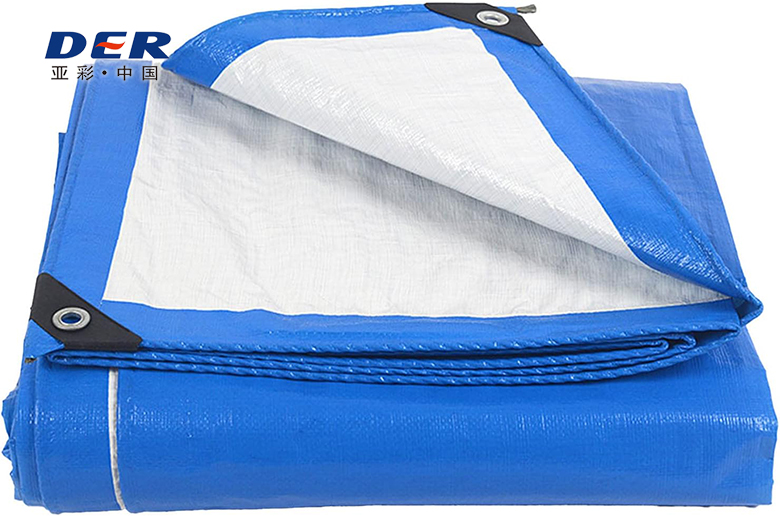
The drawing below should be thought of as a specification map: where does the force enter, how frequently is the cover handled, and which areas see abrasion or diagonal pull?

Blue DERFLEX reinforced tarp with strengthened edge and corner grommets
Specify the load path

Five Details to Confirm Before Production

1. Anchor geometry: identify rails, hooks, frame points, ground anchors or machine connection locations. Hardware should align with usable anchors rather than forcing diagonal ropes across the hem.

2. Pull direction: indicate whether force acts outward, downward, lengthwise or diagonally. Webbing tabs and D-rings should be oriented accordingly.

3. Handling cycle: a seasonal storage cover and a tarp removed every day may use different edge construction even at the same fabric weight.

4. Abrasion map: mark contact with sharp or repetitive wear points so patches can be positioned where needed.

5. Hardware map: show grommet diameter, center-to-center spacing, D-ring rows, strap length, pocket location and any special corner detail.

Grommets / EyeletsCompact tie-down points for rope, hook or bungee.
D-RingsDefined connection points for hooks, straps and buckles.
Webbing LoopsSoft connection where metal contact is undesirable.
Pockets / SleevesContinuous edge control for poles, battens, bars or cable.
Typical specification directions

Configure Material, Reinforcement and Hardware as One System

The ranges below are procurement starting points rather than performance guarantees. Final construction depends on application, climate, duty cycle, fabrication route, quantity and approved sample.

Specification Item Typical / Custom Options What the Buyer Should Confirm
Main Material PVC coated polyester, PVC laminated structures, selected PE woven tarp or mesh depending on program Outdoor exposure, waterproof requirement, welding/sewing method, handling frequency
Weight Direction Approx. 450–1200 gsm for many PVC tarp discussions; other constructions can be reviewed Balance handling weight with tensile/tear needs, abrasion and expected reuse
Edge Construction Single/double fold, welded hem, sewn hem, rope edge, webbing, double-layer strip Hem width, reinforcement material, overlap, weld or stitch route
Corner Reinforcement Compatible tarp patch, webbing cross, molded/added corner protector, custom tab Patch dimensions, direction of diagonal pull, hardware location
Grommets / Eyelets Aluminum, brass, stainless or project-specified metal; size and washer structure by requirement Inside diameter, spacing, edge offset, corrosion environment, exact count
Grommet Spacing Drawing-based; 12–18 in, 18–24 in and wider spacing can be considered by exposure and anchor layout Do not use spacing alone as a strength indicator; confirm usable anchors and hem structure
D-Rings / Straps Single or multiple rows, webbing tabs, adjustable straps, buckle systems and custom orientations Ring size, row height, tab length, pull angle, strap adjustment range
Seams Hot-air welded, hot-wedge welded, HF welded, sewn or mixed route where appropriate Panel size, water-shedding expectation, seam position relative to high-load zones
Surface / Performance Direction UV-resistant, abrasion-resistant, cold-flex direction, anti-mildew and flame-retardant options by project Required test method or market standard should be stated before quotation
Finished Size & Shape Rectangle, square, shaped equipment cover, truck drop, flap, sleeve, cut-out or drawing-based geometry Finished size vs cut size, tolerances, datum points and installation fit
Branding & Packing Logo printing, label, carton, bale, pallet, private-label and export packing directions Artwork, label language, packing count, barcode and shipment method

Note: any test value, outdoor-life target or fire-retardant designation should be confirmed against the final material code, test report, approved sample and purchase contract.

Selection by use

Where Reinforced Edges Matter Most

The value of reinforcement depends on how the cover is installed and stressed. These examples help buyers define the first specification before sampling.

Truck & Open-Deck Cargo

Dynamic air movement, repeated folding and cargo contact can place cyclic load on lower edges, flap corners and hardware rows.

Webbing + D-rings + wear patches
Construction & Temporary Weather Covers

Large exposed edges may need closer perimeter control, lacing, rope hems or reinforced fixing points around irregular structures.

Wide hem + corners + mapped eyelets
Industrial Equipment Covers

Custom shapes, access flaps and machine contact points often make exact D-ring, strap or grommet positions more useful than uniform spacing.

Local patches + exact hardware map
Agricultural Storage & Farm Covers

Seasonal wind, large panel area and ground anchoring can shift the reinforcement focus toward corners, ridge contact and lower perimeter zones.

Rope edge + loops + ground-contact protection
Warehouse Dividers & Industrial Curtains

Top suspension lines, pull handles, side fixing points and bottom wear areas may need different reinforcement methods within the same panel.

Top load line + bottom pocket / wear strip
OEM Replacement Cover Programs

Repeat fit depends on consistent datum dimensions, hardware locations, edge build-up and packing—not only on fabric color and GSM.

Drawing control + approved sample reference
From requirement to repeat order

A More Controlled Way to Buy Reinforced-Edge Tarps

For B2B programs, a short approval route helps avoid vague terms such as “heavy duty,” “standard eyelet” or “reinforced hem” producing different results between samples and repeat orders.

STEP 01Map the InstallationProvide finished size, frame geometry, anchor points, photos and expected pull directions.
STEP 02Select the MaterialMatch fabric structure and weight to exposure, handling, abrasion and fabrication route.
STEP 03Define the EdgeConfirm hem width, webbing, rope, patches, hardware size, spacing and special wear zones.
STEP 04Approve a SampleCheck dimensions, hardware alignment, weld/sew quality, edge flatness and fit on the real anchors.
STEP 05Lock Repeat DetailsKeep the approved drawing, material code, packing and inspection points for future production runs.
Supply formats

Buy the Level of Fabrication Your Supply Chain Needs

DERFLEX can discuss the same material family at different stages of conversion, helping importers, local tarp fabricators and OEM brands choose a practical supply model.

Tarp Fabric by Roll

For converters that perform local cutting, welding, sewing and eyeleting.

  • Custom PVC coated fabric direction
  • Roll width, color and finish planning
  • Suitable for local product-line fabrication

Cut Panels / Semi-Finished

For buyers who want pre-cut or partly welded components while retaining local finishing.

  • Panel dimensions from drawing
  • Selected seams or reinforcement pre-applied
  • Lower local cutting and preparation work

Finished Custom Tarps

For distributors, fleets, contractors and brands that need a ready-to-use finished cover.

  • Reinforced edge and hardware installation
  • Custom size, logo, labels and packing
  • Repeat-order drawing and sample control
Procurement guidance

What to Send for a More Useful Reinforced Tarp Quote

A simple marked drawing usually produces a more useful quotation than a request that only says “heavy duty tarp with reinforced edges.”

8 inputs that reduce specification ambiguity

  • 01
    Application & environmentTruck, equipment, construction, farm, warehouse, outdoor storage or resale line; note wind, cold, UV and abrasion.
  • 02
    Finished dimensionsLength, width, drops, flaps, cut-outs and whether dimensions are finished size or cut size.
  • 03
    Quantity & buying formatRoll goods, panels or finished covers; sample quantity and expected repeat volume.
  • 04
    Material directionPreferred GSM, coating type, color, surface and any test requirement already specified by your market.
  • 05
    Anchor layoutMark every usable hook, rail, tie point or frame location whenever possible.
  • 06
    Edge constructionHem, webbing, rope, double layer, corner patch and wear-zone requirements.
  • 07
    Hardware mapGrommet or D-ring size, spacing, rows, strap length, loop opening and orientation.
  • 08
    Branding & packingLogo file, label information, carton/bale/pallet method and private-label requirements.

Choose the reinforcement by failure mode

The most useful question is not “How many grommets can I add?” but “Where is this tarp likely to fail first, and what structure should carry that load?”

Edge flutter / wind movementReview anchor spacing, panel size, edge stiffness and whether additional lacing, pockets or closer fixing points are justified.
Grommet pull-outIncrease backing area, improve load sharing, verify pull alignment and avoid relying on closer spacing alone.
Corner tearingUse larger reinforcement geometry that spreads diagonal load into both adjoining edges.
Repeated abrasionAdd a sacrificial or replaceable wear layer at the actual contact zone instead of simply making the whole tarp heavier.
Inconsistent replacement fitControl hardware coordinates from defined datum points and reference an approved sample or drawing revision.
FAQ

Tarp with Reinforced Edges: Buyer Questions

Answers are written as specification guidance. Final production details should always be confirmed against the actual application and approved sample.

What is the difference between a reinforced edge and a standard tarp hem?

A standard hem may simply fold the cut fabric edge. A reinforced edge can add webbing, rope, extra fabric layers, larger corner patches or dedicated backing behind hardware. The right construction depends on the force and abrasion the edge must manage.

Does a tarp with more grommets automatically resist more load?

No. Closer grommet spacing can improve perimeter control only when the hem, backing layer, anchors and tie-down method distribute force effectively. A weak hem, diagonal pull or uneven tension can still concentrate stress even with many eyelets.

What grommet spacing should I use for a reinforced-edge tarp?

There is no universal spacing. Many custom programs discuss directions such as 12–18 inches for more exposed or frequently handled edges, 18–24 inches for many general industrial uses, and wider spacing for sheltered or lower-tension conditions. Actual anchor positions and the edge construction should decide the final layout.

When should I use webbing instead of only a folded hem?

Webbing is often considered when the edge is tensioned repeatedly, when hardware rows carry cyclic pull, or when the buy, er wants a broader load-transfer zone. Truck tarps, equipment covers and some large industrial covers can benefit from webbing-based reinforcement, subject to the final design.

Can DERFLEX make the edge and hardware according to my drawing?

Yes. A drawing can specify finished dimensions, hem width, patch size, grommet center-to-center positions, D-ring row heights, strap lengths, pockets, loops and wear zones. Photos of the frame or an old cover are also useful when creating the first sample.

Can I order roll material instead of finished reinforced tarps?

Yes. DERFLEX can discuss PVC tarp fabric by roll, cut or semi-finished panels, and finished custom tarps. Roll supply is useful for converters that perform local welding, sewing, eyeleting and final fabrication.

Build the Edge Around the Real Anchor System

Send DERFLEX your application, finished dimensions, photos or drawing, quantity, preferred material, anchor positions and reinforcement details. The team can review a practical material-and-finishing direction for sampling or B2B production.

Request A Quote
Product ranges and configuration examples on this page are selection directions only. Final material data, test standards, tolerances, performance requirements and commercial terms should be confirmed in the quotation, approved sample and purchase contract.
Consulting Services
+86-021-54361792 / 54361798
Email
sales@derflex.com