

News
Industry News

What Is a Duct in Ventilation? Types, Uses & Flexible Duct Guide | DERFLEX

Update:2026/7/23 23:46:08 Views:
Ventilation Knowledge & Product Selection

What Is a Duct in Ventilation?

A ventilation duct is an enclosed passage that carries air from a fan, air handler or intake point to another location—or removes air from a work area toward an exhaust or treatment point.

This guide explains what ducts do, how a duct differs from a vent, when rigid or flexible construction is appropriate, and which project details help buyers specify an industrial flexible ventilation duct.

Direct answer

A duct transports air. A vent is the opening where air enters or leaves. Ductwork is the complete network of ducts, fittings, branches, dampers and outlets.

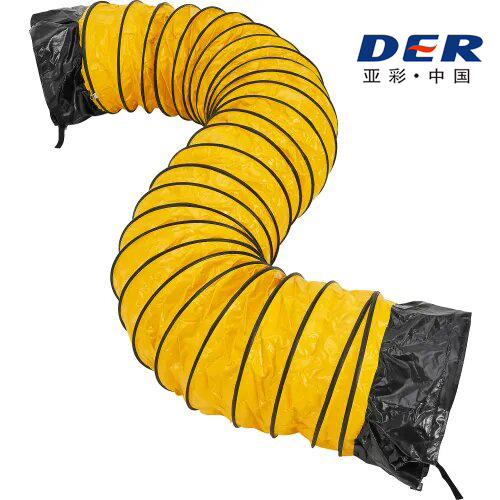
DERFLEX yellow flexible industrial ventilation duct
SupplyPositive-pressure air
ExhaustNegative-pressure air
CustomSize and connection
Basic Definition

A duct is the controlled route that air follows

Ventilation depends on moving a planned volume of air between two points. The duct creates a contained route so that a fan or air-handling device can deliver fresh air, return conditioned air, extract heat, or carry dust- and fume-laden air toward a suitable collection or discharge system.

A single straight tube is a duct. Several connected sections form ductwork. A complete ventilation route may also include bends, reducers, branches, dampers, filters, silencers, suspension hardware and terminal openings. The product must therefore be selected as part of an airflow system rather than by diameter alone.

Why the definition matters in industrial purchasing

Industrial buyers often use “air hose,” “vent tube,” “flex duct” and “ventilation duct” for related products. Those names do not automatically describe pressure direction or structure. A collapsible layflat duct may be appropriate for forced-air supply, while an extraction route normally needs reinforcement to prevent the wall from collapsing under suction.
Airflow Path

How a ventilation duct works in a complete system

The duct does not create airflow by itself. It guides the air moved by a fan or air-handling device and must be matched to the route, pressure loss and operating environment.

01

Air source or capture point

Fresh air enters through an intake, or contaminated air is captured near a process or work zone.

02

Fan or air handler

The fan creates the pressure difference needed to push or pull air through the route.

03

Duct and fittings

The duct carries air through straight sections, bends, reducers, branches and connections.

04

Outlet, return or treatment

Air reaches a work zone, returns to equipment, or moves to filtration and approved discharge.

Structure Comparison

Rigid, semi-rigid, flexible and fabric ducts solve different problems

The suitable duct type depends on whether the route is permanent or temporary, whether air is pushed or pulled, how often the line moves, and which temperature, abrasion or compliance conditions apply.

Rigid duct

Sheet-metal, aluminum, PVC or other solid ductwork is commonly used in permanent building and process systems where the route is fixed.

  • Stable cross-section and predictable routing
  • Suitable for permanent distribution networks
  • Requires more installation space and fittings

Semi-rigid duct

Semi-rigid construction offers limited bending while retaining more shape than unsupported flexible tubing.

  • Useful for shorter equipment connections
  • Balances routing flexibility and shape retention
  • Bend limitations depend on construction

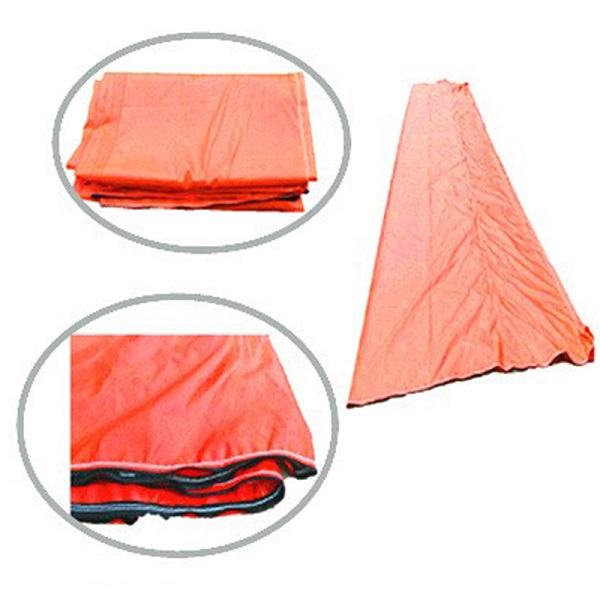
Layflat flexible duct

A coated-textile tube inflates when a forcing fan supplies positive pressure and collapses for compact storage when airflow stops.

  • Long temporary fresh-air routes
  • Compact transport and extension
  • Not normally selected for unsupported suction

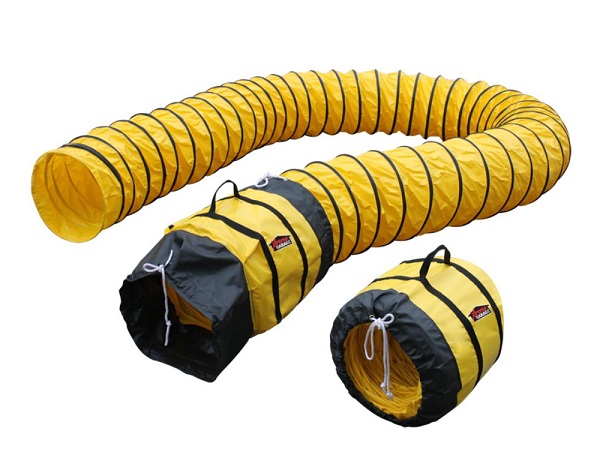
Spiral wire-reinforced duct

A spring-steel helix supports the airway so the duct can retain its bore during suction, exhaust, bending and frequent relocation.

  • Extraction and portable blower connections
  • Tighter routing and changing work zones
  • Wire pitch and body weight affect flexibility
Orange collapsible layflat ventilation duct product
Collapsible layflat duct

Commonly evaluated for positive-pressure supply where compact storage and long temporary routes are important.

Yellow spiral wire reinforced flexible ventilation duct product
Spiral wire-reinforced duct

Mechanical reinforcement helps the passage remain open for extraction, bends and mobile equipment connections.

Pressure-First Selection

Start with the airflow job, not the fabric color

Pressure direction changes the structural requirement. The table below provides a practical early-stage comparison rather than a final engineering design.

Airflow task Pressure behavior Common starting structure Important buyer data
Fresh-air delivery Positive pressure Layflat or ring-supported flexible duct Fan outlet, airflow, route length, suspension and coupling
Dust, fume or hot-air extraction Negative pressure Spiral wire-reinforced duct Static pressure, contaminant, temperature, bend radius and wear zones
Temporary heating or cooling Supply or return Temperature-matched flexible duct Equipment collar, air temperature, insulation need and occupied-zone route
Large-room air distribution Distributed airflow Suspended textile air-distribution duct Room geometry, throw pattern, airflow volume, suspension and outlet design
Project Configuration

What buyers should specify for a flexible ventilation duct

A product name alone is not enough for a reliable quotation. The duct body, reinforcement, connection, seam and documentation scope should be reviewed together.

Final values and compliance statements apply only to the confirmed construction, sample, test method and order documentation.

Product formFinished flexible ventilation duct section with selected body, seams, reinforcement, end connections, suspension details and packing.
Airflow modePositive-pressure supply, negative-pressure extraction, reversible supply/exhaust, or distributed airflow.
Body materialPVC-coated polyester technical textile is a common industrial option; construction is selected according to pressure, temperature, abrasion and chemical exposure.
DiameterCustom to blower outlet and airflow plan. Project-reference ranges can extend from compact portable sizes to large mine and tunnel ducting.
Section lengthSelected for handling, storage, coupling frequency and site access. Portable sections are often quoted in modular lengths.
ReinforcementUnsupported layflat body, spaced support rings, or continuous spring-steel helix with optional wear strip.
ConnectionsSteel rings, zipper with sealing flap, drawstring cuff, belted cuff, clamp interface, hook-and-loop overlap or custom adapter.
SuspensionEyelets, hooks, tabs, webbing loops or a continuous suspension fin at agreed spacing.
Performance optionsFlame-retardant, antistatic, abrasion-focused, low-temperature or other formulations can be reviewed against the stated test method and acceptance criteria.
IdentificationCustom color, airflow arrows, section codes, printed logo, storage bag and private-label packing can be discussed.
Quality planningDimension checks, seam inspection, connection-fit review, visual inspection, packing review and agreed sample or pressure testing.
Application Routes

Where flexible ventilation ducts are commonly used

Flexible ducting is especially useful when routes change, installation access is limited, or the duct must connect portable equipment to a temporary work zone.

01

Construction and renovation

Fresh-air delivery, drying, temporary heating or cooling, basement work and controlled airflow between interior zones.

02

Industrial maintenance

Temporary intake, process exhaust, equipment cooling and air transfer during shutdowns, cleaning or installation.

03

Mines and tunnels

Extendable ventilation routes for headings, shafts and underground work areas, with structure and options selected for the project.

04

Confined spaces

Portable supply or extraction for tanks, chambers, vessel compartments and controlled-entry maintenance locations.

05

Dust and fume control

Flexible extraction positioned closer to welding, grinding, coating, dust-generation or heat sources as part of an approved control plan.

06

Fan and equipment OEMs

Private-label duct sections matched to portable blowers, axial fans, temporary HVAC equipment and rental-fleet connections.

Quotation Checklist

Six details that make a duct inquiry easier to evaluate

Clear project data reduces connection errors, unsuitable reinforcement and unnecessary revisions during sample approval.

1. Airflow direction

State whether the fan will push air, pull air or operate reversibly. This affects whether the duct can be layflat or needs structural reinforcement.

2. Fan interface

Provide outlet diameter, flange or collar geometry, airflow, static pressure, clamp method and equipment drawings or photographs.

3. Route geometry

List total length, section length, bends, vertical drops, access openings, available clearance and suspension points.

4. Air stream and environment

Identify clean air, humidity, dust, fumes, heat, oil, chemicals, sparks, outdoor exposure and abrasion zones.

5. Connections and handling

Choose the required setup speed, leakage control, fleet compatibility, carrying method, storage format and packing.

6. Testing and marking

Name the required standard, target value, report format, labeling, traceability, inspection plan and approval-sample process.

DERFLEX Manufacturing Approach

From coated textile selection to a finished duct assembly

DERFLEX works with industrial coated fabrics and fabricated flexible duct products. A project can be reviewed as one assembly covering the duct body, welded seams, helix or ring reinforcement, connection hardware, suspension, identification and packing.

Custom development is based on buyer-supplied operating conditions. Performance values, certificates and regulatory statements are confirmed for the selected construction and agreed test route rather than treated as universal for every duct.

Send Fan & Route Details
Material reviewCoating, textile structure, flexibility, weldability and surface requirements.
Finished fabricationCutting, welding, reinforcement, cuffs, suspension and marking in one scope.
Connection matchingProject-defined rings, zippers, drawstrings, belts, clamps or adapters.
OEM supportColor, logo, section coding, storage bags and private-label packing by order.
Frequently Asked Questions

Ventilation duct questions from buyers and project teams

These answers provide selection context. Final duct sizing and system suitability should be checked against fan data, pressure losses and applicable rules.

What is a duct in ventilation?

A duct is an enclosed tube, channel or passage that carries air within a ventilation system. It can deliver fresh or conditioned air, return air to equipment, or extract heat, dust, fumes and other airborne contaminants toward treatment or discharge.

What is the difference between a duct and a vent?

The duct is the passage that transports air. The vent is the opening where air enters or leaves the system. A grille, register, diffuser or intake opening may be fitted at the vent.

What is the difference between a supply duct and an exhaust duct?

A supply duct carries air toward the work zone or occupied space, usually under positive pressure. An exhaust duct carries air away from the source, often under negative pressure. The structural support should match the pressure direction.

When should a flexible ventilation duct be used?

Flexible ducting is considered when the route must bend, move, compress for storage, pass through limited access, connect portable equipment or extend as the work zone changes. Permanent building systems may still favor rigid ductwork.

Can a layflat duct be used for suction?

An unsupported layflat duct normally depends on positive internal pressure to stay open and may collapse under suction. Negative-pressure extraction commonly requires rings, a wire helix or another supporting structure selected for the expected pressure.

Which material is used for industrial flexible ventilation ducts?

PVC-coated polyester technical textile is a common choice because it can combine flexibility, an air-barrier surface, weldability and reinforced fabric strength. The formulation and weight should be selected for temperature, abrasion, chemicals, fire testing and static-control requirements.

What information does DERFLEX need for a duct quotation?

Provide the application, airflow direction, fan model, outlet dimensions, airflow and static pressure, diameter, route length, bends, section length, connection method, suspension, temperature, exposure conditions, required testing, quantity, branding and delivery destination.

Specify the duct around the fan and airflow route

Send your blower outlet, airflow direction, static pressure, duct diameter, route sketch, connections, operating environment and required test method. DERFLEX can review a project-based flexible ventilation duct configuration and quotation scope.

Request A Quote

Technical note: This page is a general selection guide, not a substitute for ventilation engineering, hazardous-atmosphere assessment, confined-space procedures or local regulatory review.

Consulting Services
+86-021-54361792 / 54361798
Email
sales@derflex.com