Fresh-Air Supply
Move outside or conditioned air toward basements, tanks, temporary enclosures, work bays or confined access points.
Common starting point: collapsible supply duct or reinforced duct when bends and vertical drops are expected.


 Finished Flexible Ducting · Project Configuration
Portable, collapsible air duct sections for temporary fresh-air supply, exhaust, drying, cooling and jobsite airflow—configured by pressure direction rather than selected from a generic size list.
DERFLEX can coordinate the coated duct body, reinforcement, seams, cuffs, couplings, suspension and packing as one finished product for contractors, equipment brands, rental fleets and industrial buyers.
“Temporary” describes the installation period—not permission to ignore airflow direction, connection fit, bend behavior or repeated handling. DERFLEX selection principle for portable ventilation routes
Temporary ventilation ducting is a flexible conduit used to carry air between portable fans, temporary HVAC equipment and a changing work zone. Unlike fixed sheet-metal ductwork, it can be compressed, moved and re-routed as construction, maintenance or access conditions change.
A finished temporary air duct normally combines coated technical fabric with welded or sealed seams, an inlet and outlet interface, suspension details and—when suction or tight bends are involved—a continuous wire helix or supporting rings. The correct assembly depends on the operating method, not simply on the required color or nominal diameter.
Lightweight disposable tubing can be useful for short forced-air distribution where the tube may collapse after the fan stops. Reusable PVC-coated ducting is considered when crews need defined couplings, repeated deployment, abrasion protection, compact storage or supply-and-exhaust capability.
Use the work objective to define the duct route, pressure direction, connection and material package.
Move outside or conditioned air toward basements, tanks, temporary enclosures, work bays or confined access points.
Common starting point: collapsible supply duct or reinforced duct when bends and vertical drops are expected.Carry heat, smoke, dust-laden air or process fumes toward an approved discharge or filtration arrangement.
Common starting point: wire-supported duct that keeps its bore open under negative pressure.Connect temporary climate-control equipment to occupied zones, drying areas, event structures or interior workspaces.
Common starting point: temperature-specific wall construction and a secure equipment-matched collar.Direct high-volume air toward wet surfaces, machinery, cable routes or enclosed areas during maintenance and restoration.
Common starting point: portable sections with fast connections, compact storage and visible identification.Temporary ducting is easiest to manage when the structure is matched to how the fan creates pressure.
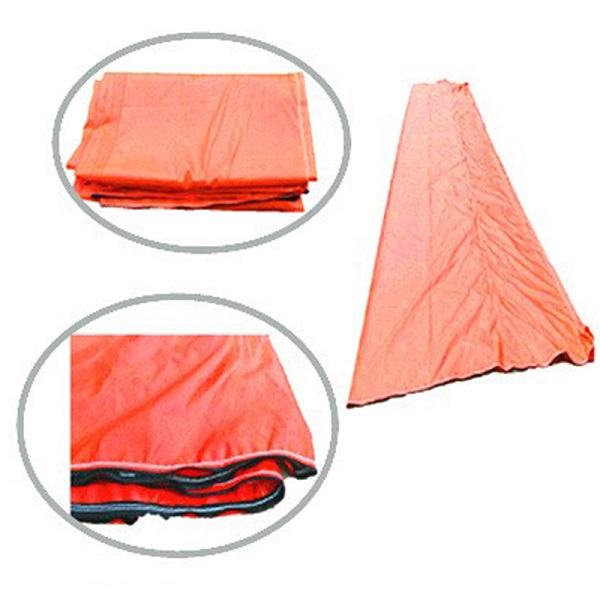
Inflates under forced air and packs nearly flat when the fan is stopped. This reduces shipment and storage volume where the duct does not need to resist suction.
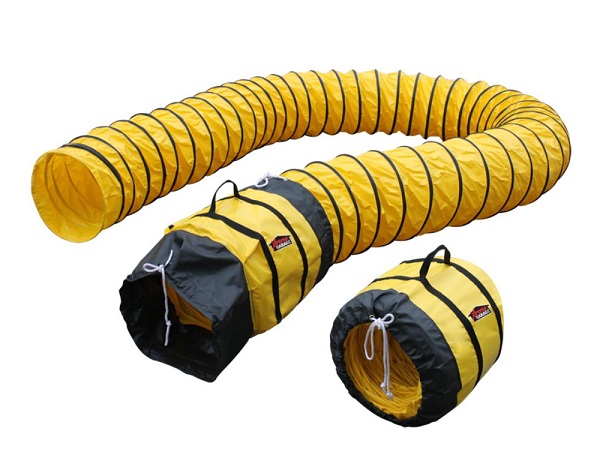
A continuous helix supports the airway during extraction, bending and frequent repositioning. External wear bands can be added where the duct contacts floors, openings or equipment.
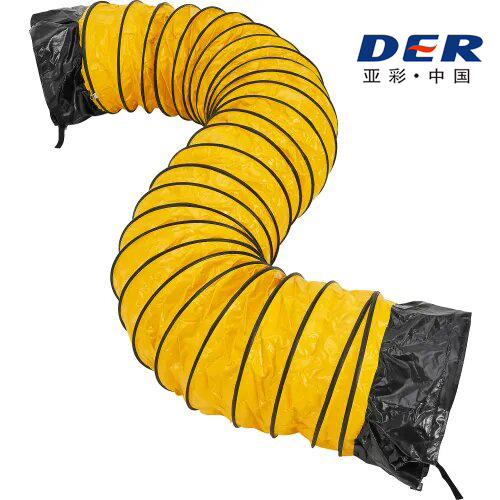 Equipment-matched cuff
Protected wire helix
Compressed storage format
Equipment-matched cuff
Protected wire helix
Compressed storage format
Leakage, handling and service life are influenced by the complete assembly. DERFLEX can review the coated textile together with the following fabrication details.
Selected for flexibility, weldability, cleanability and the required balance of tensile, tear and surface performance.
Hot-air or high-frequency welded construction can be coordinated with wear zones, wire pitch and local reinforcement.
Steel rings, belted cuffs, zippers, drawstrings, clamps or buyer-defined interfaces can be selected for setup speed and route modularity.
Tabs, eyelets, webbing loops, section numbers, airflow arrows and buyer codes can simplify field installation and fleet control.
The ranges below are project-reference values for quotation planning. Final values depend on the approved construction, dimensions, fan data, test method and order specification.
| Finished product | Fabricated temporary ventilation duct section with selected body, seams, reinforcement, connections, suspension and packing. |
|---|---|
| Airflow mode | Positive-pressure supply, negative-pressure extraction, or reversible supply/exhaust configuration. |
| Base construction | Woven or knitted polyester substrate with PVC coating; formulation and textile structure selected for the application. |
| Reference fabric weight | Common project range approximately 400–900 g/m²; lighter or heavier constructions can be reviewed. |
| Diameter | Project-reference range 300–3000 mm; blower outlet and route clearance should be checked before confirmation. |
| Section length | Typical portable sections 5–20 m; shorter or longer sections can be considered according to handling, diameter and route. |
| Reinforcement | Layflat body, spaced rings, or continuous spring-steel helix with optional external wear strip. |
| Connection options | Steel ring and rope, zipper with sealing cover, belted cuff, drawstring cuff, clamp connection, hook-and-loop overlap or custom adapter. |
| Suspension options | Eyelets, hooks, tabs, webbing loops or continuous suspension fin at agreed spacing. |
| Seam method | Hot-air or high-frequency welding; sewn and sealed construction where geometry or material selection requires it. |
| Performance options | Abrasion-focused, flame-retardant, antistatic, low-temperature or temperature-specific constructions subject to agreed test method and approved data. |
| Color and marking | Yellow, orange, blue, green, black or custom color; logo, section code, airflow arrow and private-label packing available by order. |
| Quality planning | Dimension checks, seam review, coupling fit, visual inspection, packing review and agreed sample or pressure testing. |
Specification notice: listed values are not universal guarantees. Confirm the final datasheet, sample, test standard, installation limits and complete ventilation-system suitability before procurement or site use.
m³/h before duct friction, bends, leakage, filters and pressure losses.
This simple air-change estimate is for early planning only. Confined-space, hazardous-fume, combustion-air and life-safety ventilation must be designed and verified by qualified personnel under applicable rules.The duct becomes part of a temporary airflow plan for work areas where permanent rigid pipe is impractical or the route changes frequently.
Basements, interior fit-outs, curing, drying, temporary heating or cooling, and controlled air movement between work zones.
Fresh-air routing or extraction for tanks, manholes, utility chambers, access shafts and enclosed maintenance locations.
Temporary intake, exhaust and equipment-cooling routes during installation, cleaning, repair and plant maintenance.
Positioned extraction closer to temporary welding, grinding, coating or hot-work areas as part of an approved control plan.
Portable air routes for compartments and maintenance zones where rigid ducting is difficult to handle.
OEM or private-label sections matched to portable blowers, axial fans, temporary HVAC equipment and fleet storage requirements.
A useful quotation includes enough information to match the duct to the equipment, route and documentation scope.
Provide outlet outside diameter, flange geometry, cuff area, clamp method and an equipment drawing or clear photos.
Confirm supply, exhaust or reversible use so the support structure and seams can be selected correctly.
State total length, section length, bends, vertical drops, access openings, suspension points and expected relocation frequency.
Identify temperature, abrasion, outdoor exposure, moisture, oil, chemicals, sparks, dust and electrostatic concerns.
Choose fast deployment, reduced leakage, compatibility with an existing fleet, carry bags, cartons or pallet packing.
List the required standard, report format, labeling, traceability, inspection plan and approval sample before production.
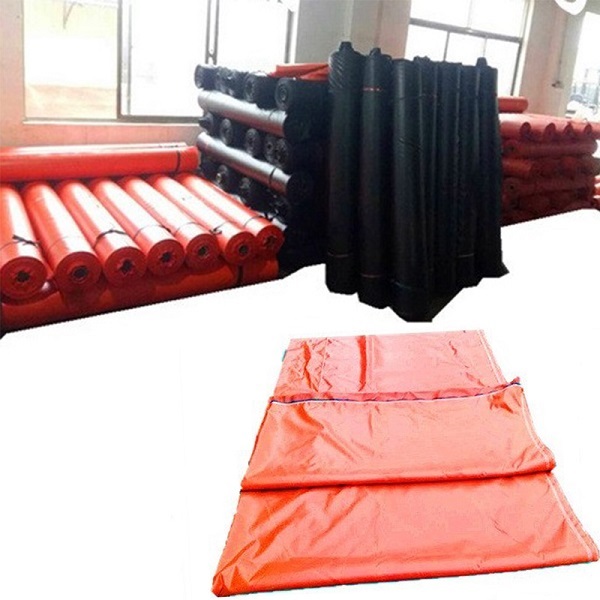
DERFLEX's coated-fabric background supports review of the duct body's flexibility, tensile, tear, adhesion, surface and weldability requirements. For a finished temporary ventilation duct, these properties must then be coordinated with seam layout, helix pitch, cuffs, suspension and packing.
Diameter, length, airflow mode, reinforcement and connections can be adjusted around the fan and work route.
Cutting, welding, ring or helix installation, end connections, suspension and marking can be supplied as one assembly.
Custom colors, printed logos, section codes, airflow arrows, storage bags and private-label packing can be discussed.
Test methods, inspection records and sample approval should be agreed before production rather than inferred from a broad category name.
These six pages cover adjacent finished-product structures, pressure modes and connection options.
Temporary ducting is designed for portable equipment and changing routes. It can be compressed, moved and reconnected, while permanent HVAC ductwork is normally fixed to the building. Temporary systems still require correct sizing, pressure review, safe discharge and suitable installation.
A wire-reinforced duct can often be configured for both directions, but the final construction, cuffs, seams and blower interface should be reviewed for reversible service. Unsupported layflat ducting is generally intended for positive-pressure supply and may collapse under suction.
Diameter depends on the blower outlet, required airflow, available static pressure, total route length, bends and acceptable air velocity. Provide the fan model or fan curve and route details rather than selecting diameter from floor area alone.
Equipment-matched cuffs, rings, zippers, belts, drawstrings, clamps and adapter sections can be discussed. Photos, outlet dimensions and a drawing of the existing connection help reduce fit errors.
Optional formulations and constructions can be developed for an agreed test method and market requirement. Compliance applies only to the tested and approved configuration, so the required standard and documentation should be identified before quotation.
Send the application, airflow direction, blower model, outlet dimensions, airflow and static pressure, diameter, route length, bends, section length, connection method, temperature, abrasion or chemical exposure, required testing, quantity and destination.
DERFLEX can review a temporary ventilation ducting configuration around your airflow mode, equipment connection, section length, handling method, operating environment and documentation scope.