
Coated textile wall
High-tenacity polyester with PVC coating provides a flexible, cleanable and weldable air barrier. Coating formulation and weight are selected by duty.



A finished, wire-reinforced duct assembly for routing exhaust air, fumes, dust and process heat around machinery, confined spaces and changing industrial layouts.
DERFLEX coordinates coated textile selection, helix reinforcement, welded duct forming, cuffs and suspension details around the actual airflow plan—not a one-size-fits-all hose description.
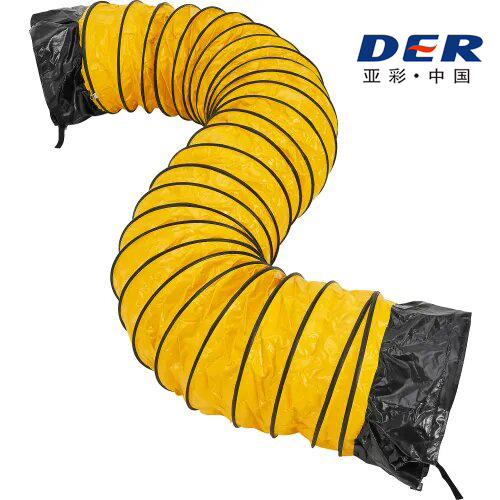
A flexible exhaust duct is a compressible air passage used on the suction or extraction side of a ventilation system. Its continuous wire helix supports the wall against collapse while the coated textile body allows the route to bend around equipment, pass through restricted access points and pack down for transport.
The product may also be described as a flexible exhaust hose, negative-pressure duct, fume extraction duct or industrial air suction duct. The important distinction is not the wording—it is whether the wall, helix pitch, wire gauge, seam, cuffs and suspension system are matched to the actual vacuum and handling conditions.
Temperature alone does not determine the right product. Air chemistry, vacuum, particles, movement, bend radius and installation method should be reviewed together.
| Exhaust duty | Suggested construction direction | Details to confirm | Common buyer |
|---|---|---|---|
| Portable fan exhaust | Flexible PVC-coated body, moderate helix pitch, quick-connect cuff or buckle. | Fan inlet diameter, suction level, section length, relocation frequency and storage space. | Rental fleets, contractors, confined-space teams |
| Welding fume extraction | Flame-retardant grade by specified test method, abrasion protection and grounded/antistatic option where required. | Spark exposure, fume temperature, distance from source, local extraction velocity and safety documentation. | Fabrication shops, integrators, ventilation contractors |
| Dust collection connection | Wear-resistant wall or external wear strip with tighter helix support for repeated handling. | Particle type, loading, abrasion points, static risk, vacuum and whether material contacts the wall. | Woodworking, grinding, cement and process plants |
| Machinery heat removal | PVC-coated textile within the confirmed service range; higher-temperature technical textile when continuous or peak temperature exceeds that range. | Continuous and peak temperature, radiant heat, airflow volume, condensate and distance from hot surface. | Machine builders, OEMs, plant engineering teams |
| Chemical or solvent vapors | Material selected only after media compatibility review; no universal chemical-resistance assumption. | Full chemical name, concentration, temperature, humidity, exposure time and required documentation. | Chemical plants, coating lines, laboratories |
| Mine, tunnel or civil works | Heavy-duty coated textile, reinforced suspension, durable cuffs and wire/wear-strip configuration for the route. | Diameter, pressure, section plan, drag contact, low-temperature duty, flame/antistatic requirements and inspection regime. | Mining contractors, tunneling projects, underground works |
Duct performance is created by the interaction of the wall, reinforcement, seam and connection—not by fabric weight alone.
High-tenacity polyester with PVC coating provides a flexible, cleanable and weldable air barrier. Coating formulation and weight are selected by duty.
Spring-steel wire supports the cross-section under suction. Gauge and pitch influence collapse resistance, flexibility, bend behavior and weight.
High-frequency welding and localized reinforcement are used to control air leakage and protect repeated load points.
Connection ends, hanging points and external wear strips are configured around installation speed, route movement and abrasion exposure.

The table is a quotation framework, not a universal rating sheet. Final construction is confirmed against project conditions.
Pressure and vacuum capability cannot be stated responsibly from diameter alone. Wire gauge, helix pitch, section length, temperature, bends and installation support all affect performance. Request a project-specific confirmation before ordering.
The product is most useful where rigid metal ducting is slow to route, difficult to move or impractical around temporary and changing work zones.
Connect portable blowers to tanks, pits, manholes, vessels and enclosed maintenance zones where the duct must pass through restricted access points.
Portable routingCarry extracted smoke away from fabrication workstations, with material and safety treatments selected around temperature and spark exposure.
Source extractionBridge machinery and collectors where vibration, maintenance access or equipment movement makes rigid transitions inconvenient.
Flexible connectionRemove warm air from production equipment, printing lines, generators and process enclosures after confirming continuous and peak temperature.
Thermal reviewRoute exhaust from service bays or test areas when gas temperature, condensate and chemical exposure have been assessed for the selected textile.
Media check requiredSupport shutdowns, maintenance, emergency airflow and construction phases with compressible sections that can be deployed and stored repeatedly.
Reusable sections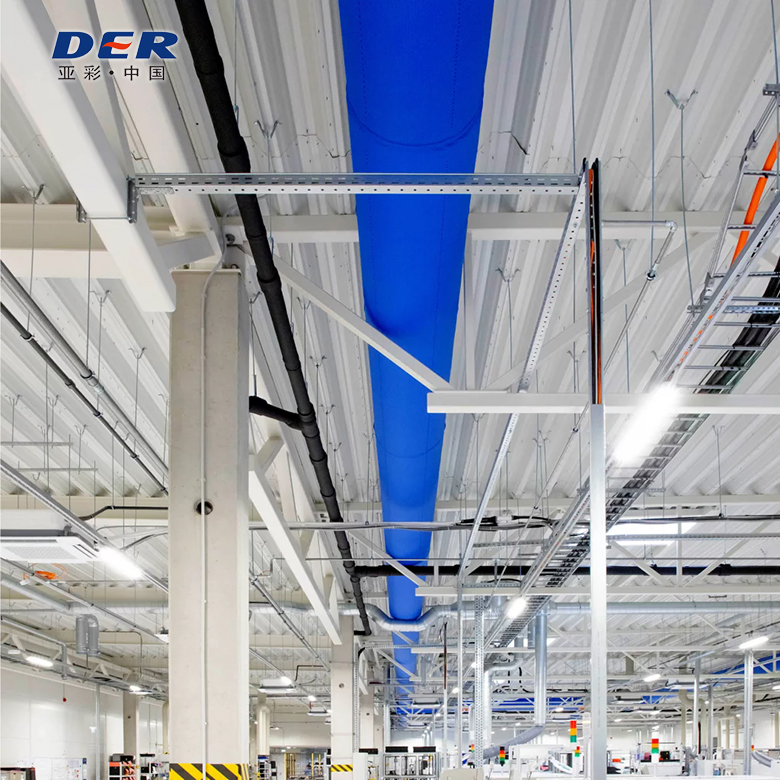
DERFLEX combines coated-fabric manufacturing with finished duct conversion so the material, reinforcement and connection details can be reviewed as one assembly.
Confirm source, fan position, duct length, bends, suspension points and how often the route will move.
State air composition, dust loading, chemical exposure, moisture, continuous temperature and peak temperature.
Select coated textile, wire gauge, pitch and wear protection according to vac, uum, diameter and bend requirements.
Define fan connection, section-to-section cuff, clamp, buckle, zipper, ring or transition fitting geometry.
Agree on dimensions, seam checks, available test documents, labeling, compressed packing and shipment format.
A fabric test alone does not confirm how a completed exhaust duct will fit, seal or handle. The finished section should be checked across the details that affect installation.
This operating model supports material selection, roll production and finished flexible duct processing within a coordinated supply discussion.
A flexible exhaust duct uses continuous helix reinforcement to hold the passage open under suction or negative pressure. A layflat duct normally depends on positive internal pressure to inflate. The two products may look similar when packed but serve different airflow conditions.
Yes. Diameter, section length, wire pitch, cuff style, suspension details, color and packing can be discussed by project. Final availability depends on the pressure, material grade, handling requirements and order conditions.
A reference PVC-coated configuration may be suitable around -20°C to +80°C, but the exact limit depends on formulation, test method, airflow, radiant heat and mechanical load. Continuous or peak temperatures above the confirmed PVC range require an alternative technical textile review.
Chemical compatibility depends on the exact substance, concentration, temperature and exposure time. Provide the media data before selection. DERFLEX does not treat “chemical resistant” as a universal claim across all acids, alkalis, oils or solvents.
Common choices include soft cuffs, belt or buckle ends, zippers, hook-and-loop cuffs, rings and clamps. The fan inlet, mating duct and installation sequence should be supplied so the connection can be matched correctly.
Optional flame-retardant and antistatic constructions can be discussed. The required standard, test method, limit value and document format should be stated in the inquiry because terminology differs between industries and countries.
Share the exhaust medium, temperature, fan data, diameter, length, route and connection drawings. DERFLEX can use that information to prepare a more relevant material and finished-duct proposal.