It is not simply a thicker standard tarp.
A normal waterproof tarp can screen rain, dust and visibility, but it is not automatically an acoustic barrier. Noise-control performance depends on the relationship between mass, absorptive layers, panel continuity, overlaps, edge sealing, mounting, distance from the source and the frequency profile of the noise. A useful acoustic curtain therefore starts with a project brief rather than a single GSM number.
Absorption and sound blocking solve different problems.
A porous or fibrous layer helps reduce reflected sound and reverberation on the source side. A dense, flexible barrier layer helps reduce transmission through the curtain. For many industrial applications, a combined barrier-and-absorber construction is more suitable than a single homogeneous sheet. The selected build should be verified against the required test method and installation layout.
Why buyers use flexible curtain systems.
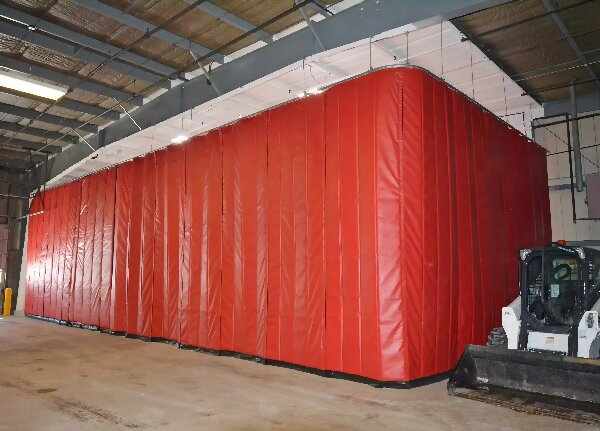
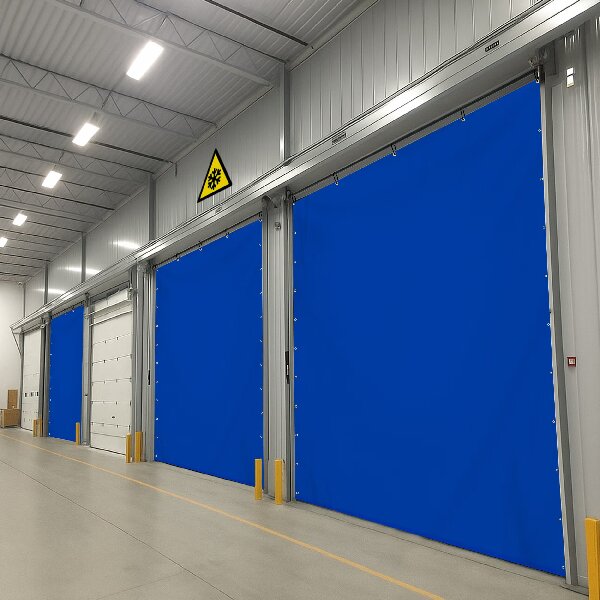
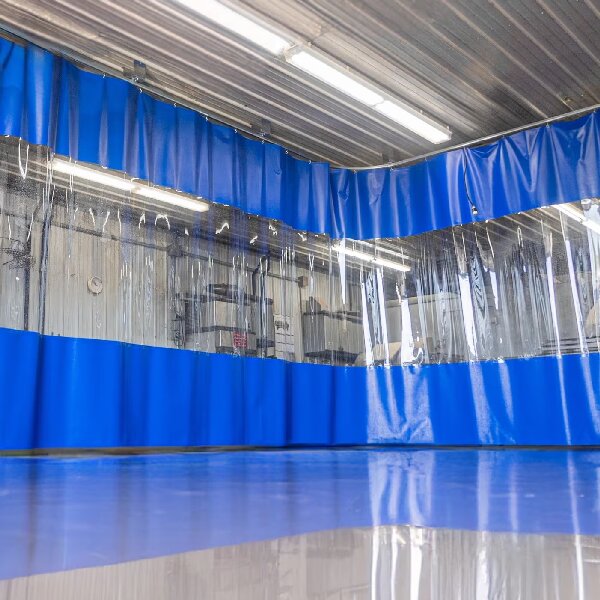
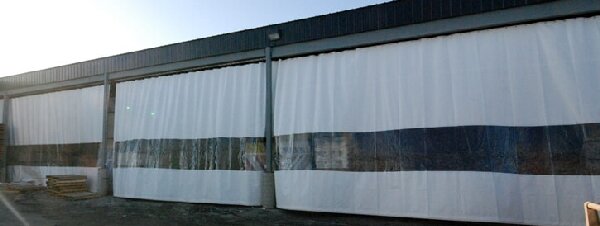
Permanent acoustic walls can be appropriate for fixed facilities, but they may limit access and require more construction work. A custom acoustic curtain tarp can be configured as a hanging screen, machinery wrap, partial enclosure, retractable divider or temporary boundary. Panels can be removed for maintenance, extended when a project grows, or replaced individually after localized damage.
Engineering note: DERFLEX does not recommend publishing a fixed dB, STC or NRC claim without a defined curtain build and test report. Real-world results vary with noise frequency, barrier height, gaps, overlaps, mounting and site geometry.