Coated Surface
A continuous PVC layer should cover the polyester base fabric without pinholes, exposed scrim or damaged coating.



 Waterproof PVC Tarp Buyer Guide
The PVC-coated fabric can form a continuous waterproof barrier. Whether the finished tarp remains watertight depends on its seams, grommets, edges, installation and condition.
This guide helps importers, distributors, tarp fabricators, truck body builders, contractors and industrial buyers specify a PVC tarp that protects against rain without relying on a material label alone.
PVC tarpaulin blocks water through its coated surface. Leaks usually begin where that surface is interrupted—at a poorly sealed joint, a sewn needle line, an unprotected fixing point, a worn fold or a puncture.
Many product descriptions stop at “PVC is waterproof.” That statement is useful but incomplete for B2B procurement. A truck cover, temporary roof, machinery cover or outdoor storage tarp is a fabricated assembly exposed to tension, wind, repeated folding, abrasion and drainage loads.
For reliable rain protection, buyers should confirm both the base material and the fabrication details. The specification should explain how panels are joined, how hardware is installed, how edges are reinforced and how water will leave the installed cover.
The weakest point controls the final result. Review all five before approving a sample or production order.
A continuous PVC layer should cover the polyester base fabric without pinholes, exposed scrim or damaged coating.
Hot-air or high-frequency welding is generally preferred when a water-tight seam is required. Sewn seams need a separate sealing plan.
Grommets, D-rings, straps, zippers and fasteners interrupt the surface and must be reinforced and positioned to reduce leakage risk.
A sagging cover can collect water. Correct slope, support and fastening reduce ponding, seam stress and deformation.
UV exposure, abrasion, chemicals, cold folding and repeated handling can eventually damage the barrier and should guide grade selection.
This table separates a material problem from a fabrication, installation or maintenance problem.
| Observed issue | Likely cause | Relative risk | What to specify or inspect |
|---|---|---|---|
| Water enters along a panel joint | Sewn seam, narrow weld, incomplete weld or contaminated welding surface | High | Confirm weld type, overlap width, process parameters and sample seam inspection. |
| Drips appear around eyelets | Unsealed holes, distorted grommets or stress tearing around the fixing point | Medium | Use reinforced patches, suitable hardware and spacing matched to wind and tie-down loads. |
| Water pools in the middle | Insufficient slope, support spacing or tension | High | Design drainage fall, support points and installation instructions before confirming dimensions. |
| Pinpoint leaks after repeated use | Abrasion, puncture, fold fatigue or contact with a sharp edge | Medium | Select suitable weight and surface protection; add wear patches where contact is unavoidable. |
| Surface looks intact but moisture is underneath | Condensation rather than rain penetration | Low | Plan ventilation or an air gap when covering moisture-sensitive goods for long periods. |
| Cracking develops in cold handling | Material not matched to low-temperature folding or impact conditions | Medium | Confirm cold-flexibility requirement and test method for the destination climate. |
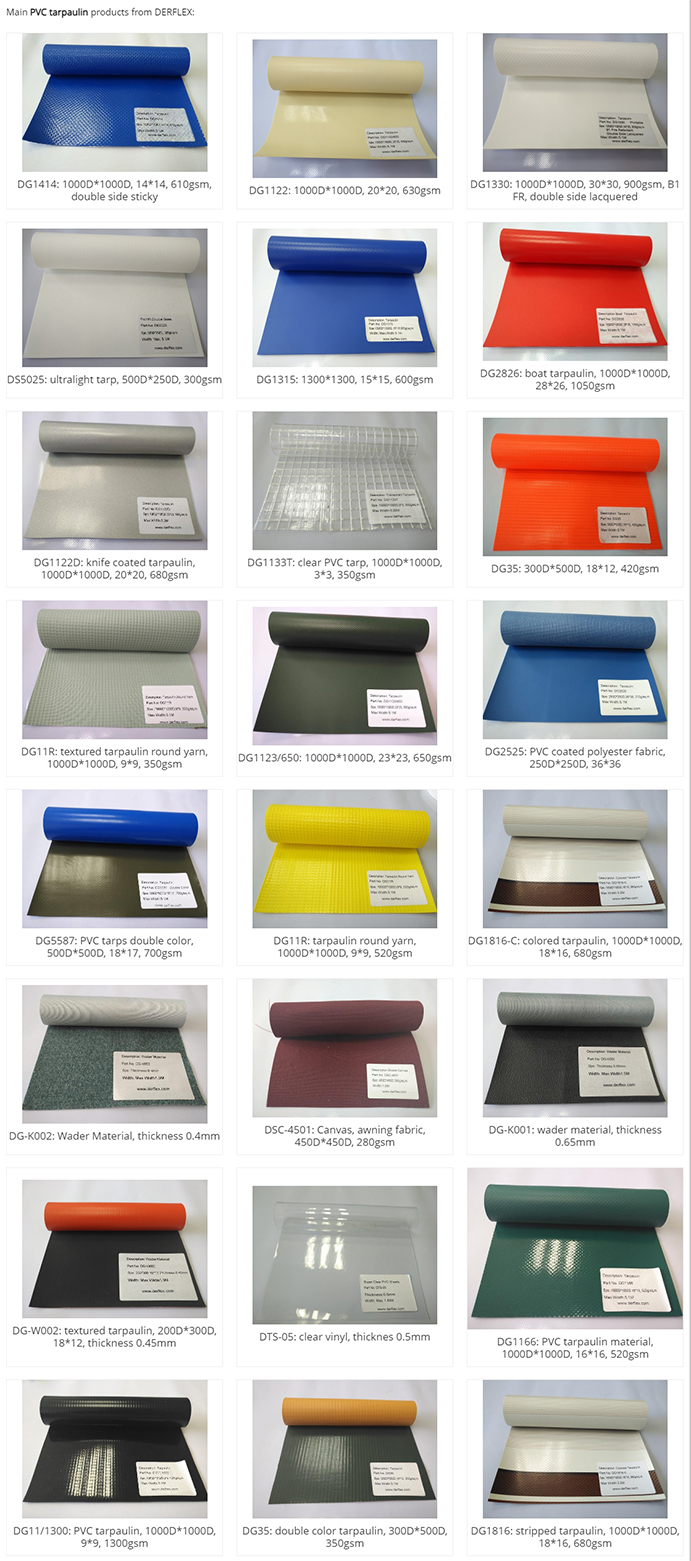
DERFLEX supplies PVC-coated polyester roll goods, cut panels and finished tarps for buyers who require waterproof protection, weldable fabrication and repeatable OEM specifications. The correct construction is selected around exposure, handling, installation and service-life expectations rather than weight alone.
A continuous PVC-coated surface combined with properly controlled welded seams is a practical starting point for truck covers, industrial covers, outdoor storage and construction protection. The seam design must still account for panel size, fabric weight, loading direction and installation stress.
When stitching is required for straps, webbing or complex geometry, the project should define whether the needle line needs sealing, an additional cover strip or a geometry that keeps the stitched zone away from standing water.
Choose by exposure, durability, breathability and fabrication needs—not by the word “tarp” alone.
Suitable for repeated outdoor use when buyers need a non-porous coated surface, weldability, abrasion resistance and custom fabrication.
Often selected for economical general coverage and easier handling. Grade, UV treatment and reinforcement vary widely across products.
Useful where airflow and condensation control matter. Treated canvas may resist rain but is not normally chosen for the same water-barrier role as intact PVC.
Designed for shade, ventilation, privacy and load containment. Open mesh construction should not be specified as a waterproof cover.
A useful RFQ describes the job, the failure risk and the required construction. “Need waterproof tarp” is rarely enough for an accurate quotation.
Each application needs a different balance of material weight, reinforcement, hardware and fabrication method.
Waterproof cargo protection with reinforced edges, suitable fastening and abrasion planning for repeated transport use.
Temporary enclosures, building material covers and weather barriers where wind load, drainage and anchoring require careful design.
Made-to-measure machinery covers with access points, reinforced contact zones and installation hardware matched to the equipment.
Rain protection for feed, grain, hay, farm equipment and outdoor storage, with attention to ventilation and condensation.
Weldable roof and sidewall materials for temporary or semi-permanent structures, subject to climate and flame-performance requirements.
Custom color, roll goods, finished sheets, private labels and export packaging for distributors, fabricators and industrial brands.
The objective is a repeatable specification that can be inspected, reproduced and supported across future orders.
Material weight, base fabric, coating route, finish and optional performance features can be discussed around the real service environment.
Seam layout, hems, webbing, grommets, D-rings, straps, printing and packaging can be developed for roll supply or finished custom covers.
Approved samples, specification records, tolerances, labels and packing details help professional buyers maintain a stable product program.
Use these six related pages to compare material, construction, duty level and customization options.
Intact PVC-coated or PVC-laminated fabric is designed to form a waterproof barrier. The complete finished tarp also needs suitable seams, protected hardware points, correct installation and an undamaged surface to remain watertight in service.
Liquid water should not pass through a sound, continuous PVC coating under its intended conditions. Leakage can occur if the coating has pinholes, cuts, abrasion damage, cracking or exposed base fabric.
A sewn seam creates needle holes and should not automatically be treated as water-tight. When waterproof seam performance is required, specify an appropriate welding or seam-sealing method and confirm it on a representative sample.
The source may be condensation, wind-driven water entering an open side, leakage around hardware, ponding stress or physical damage. Inspect the location and pattern before assuming the coated fabric itself has failed.
Rain resistance is not determined by GSM alone. Weight, base-fabric strength, coating quality, seam construction, drainage, wind load and handling frequency should be considered together. DERFLEX can discuss the grade after reviewing the application and installation.
DERFLEX supports PVC tarpaulin roll supply, cut panels and finished custom covers with selectable size, color, weight, width, finish, seam method, reinforcement, hardware, printing, labels and packaging, subject to project confirmation.
Send DERFLEX your application, dimensions, climate, fastening plan and required service conditions. The team can discuss material structure, seam design, reinforcement and supply format for your project.