
Contact-side coating
Identify which face touches the liquid. Specify that face’s compound, coating distribution and minimum thickness where applicable. A surface lacquer selected for cleanability is not automatically a solvent barrier.



For fabricators, converters & industrial OEMs
Specify the exposure. Then the fabric.
Chemical resistant PVC fabric combines polyester reinforcement with a flexible polyvinyl chloride coating selected for defined chemical contact. Consider it for industrial splash curtains, protective covers and qualified containment components—not as a universal chemical barrier.
DERFLEX supplies coated textiles with custom weight, width, color and formulation options. Share the exact liquid or mixture, concentration, temperature and contact duration to start a material review before sample approval and bulk sourcing.
Roll goods · Coating development · Application-specific sample evaluation

The direct answer
It can be resistant to selected chemicals under defined conditions. The useful question is whether a specific coated-fabric construction retains the properties your application needs after the expected exposure.
Flexible PVC fabric contains more than PVC resin: plasticizers, pigments, stabilizers, surface finishes and textile reinforcement all affect the finished material. A chart for rigid PVC pipe cannot establish the performance of a flexible coated textile, a welded seam or a fabricated liner.
For the broader material family, explore DERFLEX PVC coated fabric options. This page focuses on chemical-contact specification and acceptance of roll material.
Start with the media
Use the following questions to organize a technical review. These are procurement screening directions, not DERFLEX chemical ratings or approval for a particular liquid.
| Media group | What to identify | Material review direction | Key acceptance check |
|---|---|---|---|
| Aqueous salts & brine | Salt composition, dissolved concentration, crystallization and rinse cycle. | Evaluate a PVC formulation for the actual solution; include deposits and surface abrasion. | Coating integrity, adhesion and strength after wet/dry exposure. |
| Acids & alkaline cleaners | Exact chemical name, dilution, maximum temperature and additives. | Assess each formulation individually. pH alone cannot establish compatibility. | Swelling, cracking, mass change and retained mechanical properties. |
| Detergents & degreasers | Working blend, solvents, surfactants and repeated cleaning frequency. | Review the full cleaning product, including the strongest maintenance concentration. | Surface tack, flexibility, coating adhesion and weld behavior after cleaning. |
| Lubricants, oils & fuels | Exact grade, additives, fuel blend and maximum dwell time. | Do not transfer an oil rating to fuel service. Review specialized grades or another polymer when needed. | Absorption, softening, extraction and seam performance in the actual liquid. |
| Solvents | Solvent identity and blend; especially ketones, aromatic or chlorinated solvents. | Many such solvents are unsuitable for standard flexible PVC. Obtain chemical-specific evidence before selecting PVC. | Degradation and required permeation or barrier data; review an alternative if criteria cannot be met. |
| Oxidizers, mixed waste & unknown media | Oxidizer strength, contaminants, reaction products and changing process composition. | Require a specialist review. Unknown chemistry cannot be approved by generic material name. | A defined representative exposure program and complete fabricated-system evaluation. |
Why a “good” chart rating is only a starting point: published ratings belong to the material and conditions behind that chart. Confirm their relevance to flexible PVC, the proposed coating and the real mixture. A longer dwell time or hotter cleaning cycle can change the result.
Technical background: Buitink Technology’s PVC coated-fabric resistance guide distinguishes chemical identity, concentration and temperature. It is an external reference, not test evidence for a DERFLEX grade.
Coating + reinforcement + finish
Two PVC coated polyester fabrics with the same GSM can have different base-cloth weights and different coating distribution. Total weight does not reveal the coating thickness on the chemical-contact side.
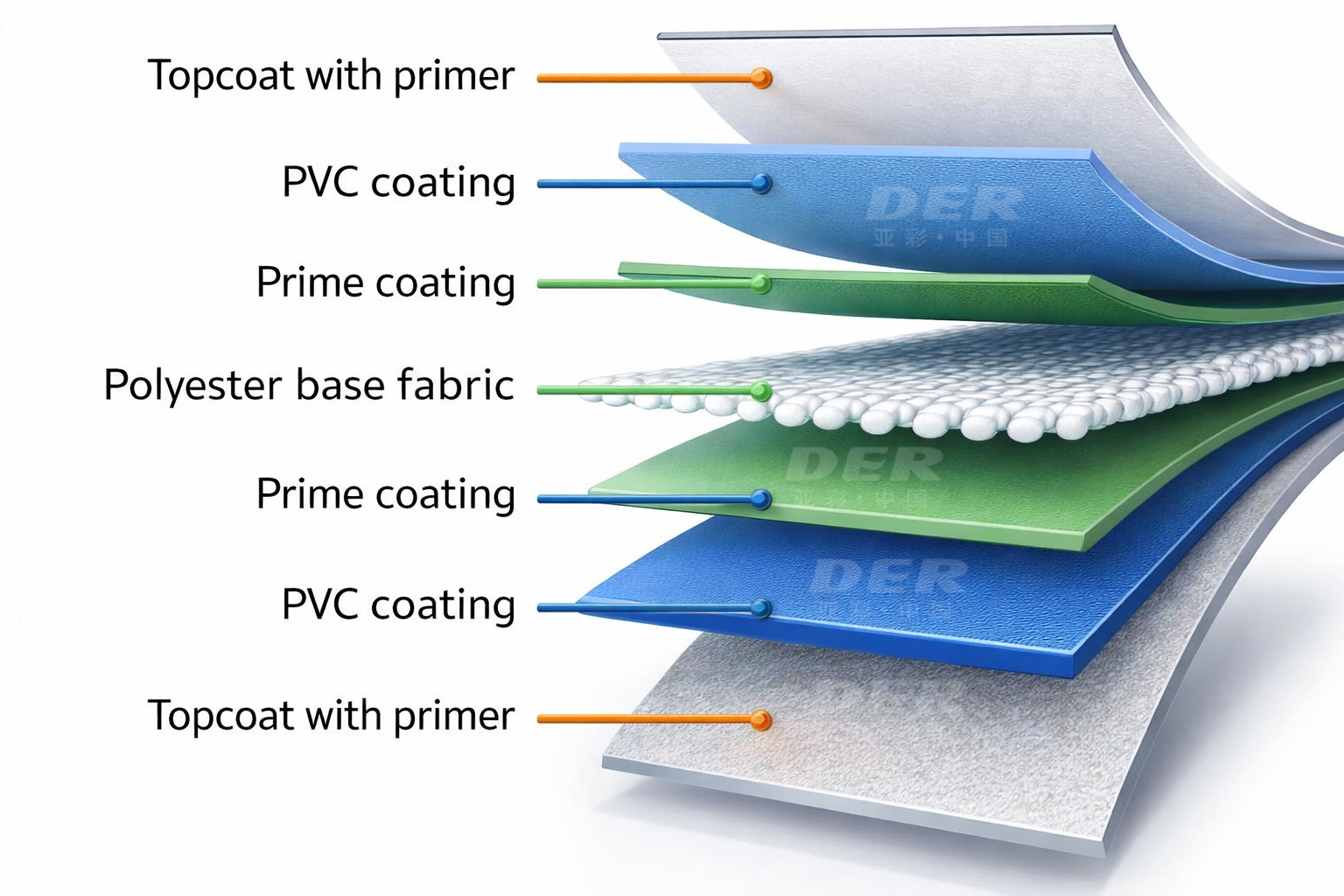
Identify which face touches the liquid. Specify that face’s compound, coating distribution and minimum thickness where applicable. A surface lacquer selected for cleanability is not automatically a solvent barrier.
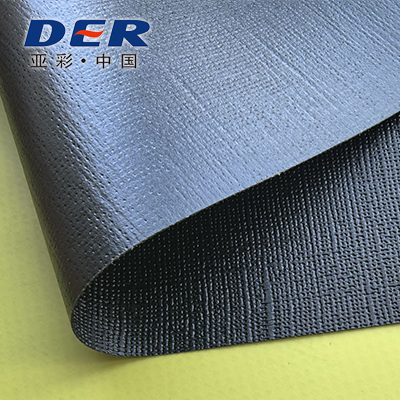
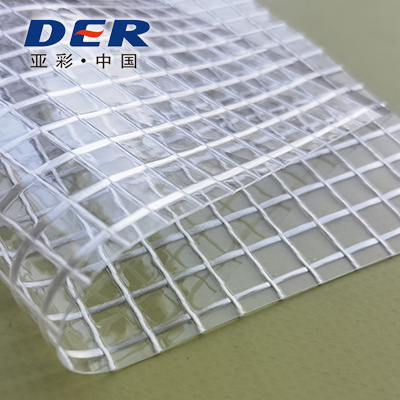
Choose yarn and weave around panel tension, tear loads and handling. Exposed cut edges need attention because liquids may reach the scrim through cuts, abrasion or fabrication details. See reinforced PVC material construction.
State whether the underside will contact wet ground, condensate, rinse water or another chemical. Front-face approval does not establish reverse-face or edge performance.
Approve the surface finish with the intended joining process. Evaluate any primer, lacquer, repair patch or seam tape as part of the final construction.
A purchase-ready specification
DERFLEX can discuss custom coating structures, fabric weight, width, color and surface options. Numeric targets below must be agreed for the selected grade; no universal chemical-resistant specification is implied.
| Property | What to agree with DERFLEX | Why the buyer needs it |
|---|---|---|
| Material identity | PVC coated polyester; agreed grade reference and approved sample. | Connects quotations, validation samples and production rolls. |
| Chemical exposure | Exact media, concentration, maximum temperature, duration and exposure mode. | Defines the limits of the material selection. |
| Weight & total thickness | Project-specific GSM and thickness with agreed tolerances and measurement method. | Balances handling, stiffness, abrasion protection and fabrication. |
| Coating on each face | Single- or double-side arrangement; contact-side thickness or coating specification where required. | Prevents total GSM from masking a thin exposed coating. |
| Base fabric | Polyester yarn, weave, warp/weft strength and tear requirements. | Matches unsupported spans, tension and installation loads. |
| Surface finish & color | Finish, face orientation, color and finish compatibility with welding and cleaning. | Keeps the approved surface consistent through conversion. |
| Usable roll width & length | Usable width, edge allowance, roll length, splices and winding direction. | Controls cutting yield, seam count and production handling. |
| Joining requirements | Proposed HF/RF, hot-air or hot-wedge process; trial seam construction and test criteria. | Confirms the fabric works with the converter’s equipment. |
| Performance after exposure | Relevant strength, adhesion, flexibility, leak or barrier limits and the agreed protocol. | Defines acceptance beyond an unchanged appearance. |
| Documentation & traceability | Grade reference, lot identification, approved data sheet and applicable project reports. | Supports receiving inspection and repeat-order control. |
For general construction and functional options, compare industrial PVC coated fabric. General product ranges do not establish this application’s chemical-contact rating.
From sample to approval
Agree a written validation plan before ordering. Match it to the real exposure and identify which properties determine whether a sample passes.
01 / Define the protocol
Record media, concentration, temperature, dwell time, one- or two-face contact and any mechanical tension. Include cleaning, drying, folding and re-exposure where these occur in service.
02 / Compare specimens
Use unexposed controls of the same construction and record specimen orientation. Assess appearance, mass or dimensional changes, flexibility and the mechanical properties selected for the job.
03 / Approve the assembly
Test representative fabricated coupons using the proposed equipment and seam details. Examine the welded joint and exposed edges after contact, then confirm the completed component’s functional performance.
Method references for an agreed laboratory plan: ASTM D543 — resistance of plastics to chemical reagents and ASTM D751 — coated-fabric test methods. Method choice, edition and suitability must be agreed with the laboratory. Listing a method here does not claim DERFLEX certification or a completed test.
Converter’s notes
Fabric compatibility is one part of a successful component. The cut pattern, joining process and contact-side details need to carry the same specification into the finished product.
Develop temperature or power, speed, pressure and overlap around the approved fabric and machine. Do not reuse a setting solely because another roll has the same GSM. Check the joint after chemical exposure, not only immediately after welding.
Identify exposed scrim, corners, stitched details and drain or connector interfaces. Sewing introduces needle holes; hems and reinforcement may require an additional sealing detail. Eyelets are attachment hardware, not a liquid-tight seal.
Keep the intended chemical-contact face consistent during nesting, joining and winding. Ask for a face-identification convention when the coating or finish differs between sides. Evaluate seams where liquid can collect or remain after drainage.
The cleaner may be more aggressive than the process liquid. Confirm cleaning chemistry and temperature, plus patch fabric and adhesive if used. Reassess the assembly when a cleaner, compound, finish or seam process changes.
Match the component to the duty
The following routes describe components to evaluate. Final suitability depends on the selected grade and the completed system.
| Application | Fabric priorities | Confirm before use |
|---|---|---|
| Wash-bay splash curtains | Cleaner compatibility, flexibility, repeated wetting and easy-clean finish. | Seam exposure, attachment loads, drainage and the maximum cleaning cycle. |
| Equipment and process-area covers | Residue exposure, abrasion, fold handling and outdoor weathering where relevant. | Whether the cover is only shielding equipment or is expected to hold liquid. For made-to-size covers, see chemical resistant tarp fabrication. |
| Secondary containment components | Actual spill liquid, dwell time, puncture exposure and coated-face consistency. | Entire floor, seams, wall transitions and fittings. A compatible roll is not approval of the containment system. |
| Process-water or tank liners | Continuous-contact qualification, support condition and retained properties. | Hydrostatic loading, welds, drains and media changes. Review industrial tank liner fabric requirements. |
| Boom shells and skirts | Exact oil contact, water exposure, UV, repeated deployment and seam durability. | Oil/fuel distinction, connectors, abrasion and folding. Compare oil spill boom material and system selection. |
Change the material route when necessary. If a PVC grade cannot meet the actual media, temperature or barrier requirements, evaluate another compound or polymer with chemical-specific evidence. More GSM or a heavier scrim cannot correct an incompatible coating.
Manufacturing & procurement
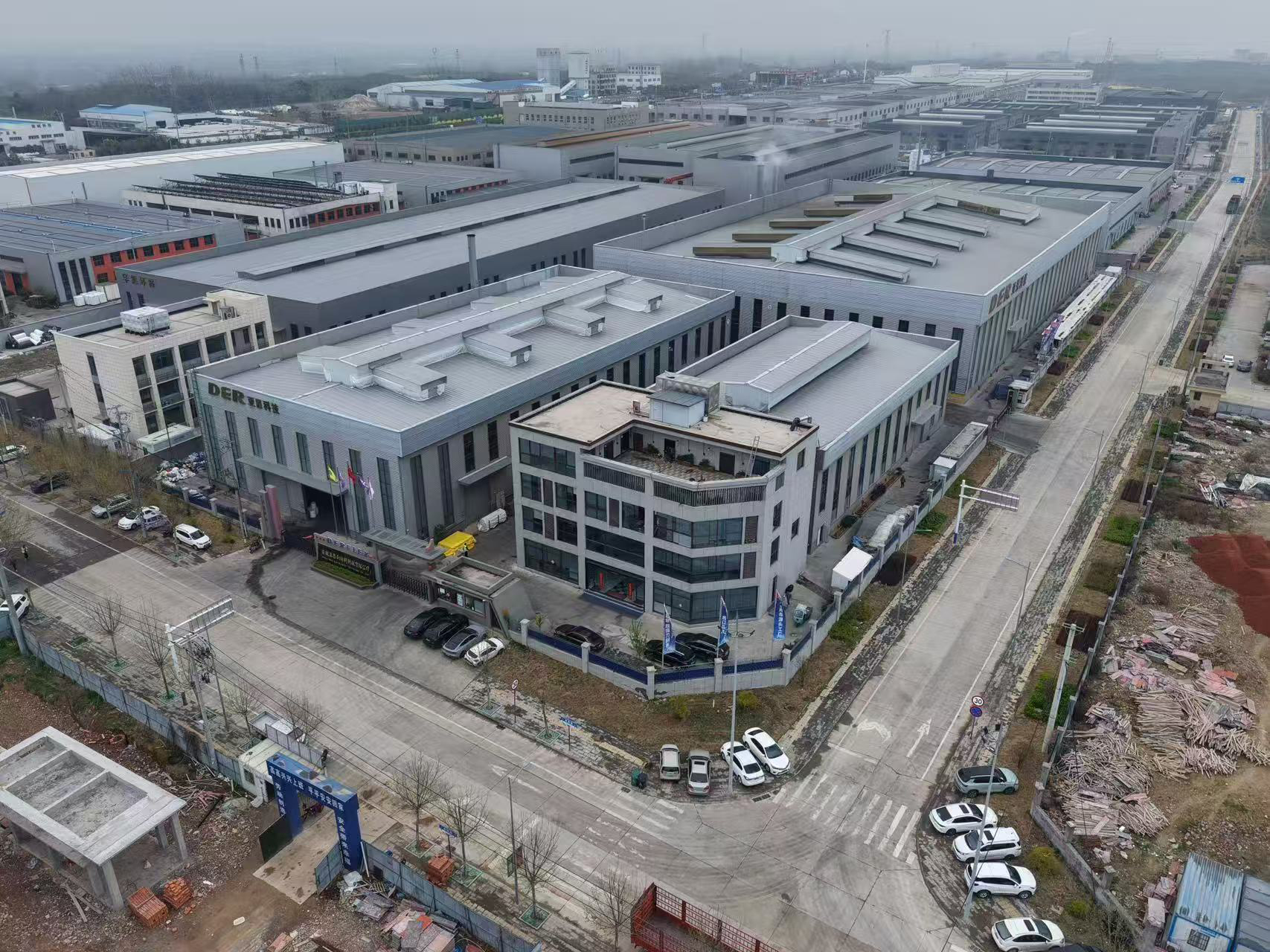
DERFLEX manufactures industrial coated textiles and offers custom constructions, colors, surface finishes and application-specific formulation options. For chemical-contact procurement, connect these choices to an approved sample and agreed acceptance criteria.
General coated-fabric process sequence. Confirm the actual route and inspection plan for the selected construction.
Make the first inquiry useful
Start with chemical and exposure details. If the required GSM or coating structure is not yet known, describe the job and include the component drawing or existing material data with your inquiry.
Coating compound, reinforcement, surface treatment, usable width, quantity, validation scope and packing can change the quotation. Compare offers against the same approved construction and acceptance criteria.
Request sample terms, minimum order quantity and production timing directly. These depend on the material and order; this page does not assign fixed values.
Prefer email? sales@derflex.com
Buyer questions
Practical answers for selecting roll material and qualifying a fabricated component.
It is a reinforced textile with a PVC coating selected to tolerate specified chemical contact. The polyester base provides structural strength, while the coating manages the contact surface. Suitability depends on the exact fabric grade, chemical, concentration, temperature, duration and required retained properties.
No. Chemical names, concentrations, temperatures and additives can change compatibility. “Acid resistant” or “alkali resistant” is not a complete specification. Submit the exact media and service conditions, and approve the proposed construction using relevant chemical-specific evidence or sample testing.
Higher GSM or thickness may help with some mechanical demands, but neither makes an incompatible compound suitable. Compare coating formulation, contact-side coating, reinforcement, surface finish and performance after exposure. Total fabric weight alone does not establish a chemical barrier rating.
Compatibility must be reviewed for the exact liquid and exposure. A result for a lubricant does not establish fuel resistance. Many ketones, aromatic solvents and chlorinated solvents are unsuitable for standard flexible PVC; a specialized grade or another polymer may be required after technical review.
No. Welding conditions, overlap, surface finish and exposed edges affect the assembly. Qualify representative seams after the agreed chemical exposure and check the strength, leak performance or barrier criteria needed for the finished component.
Provide the chemical or mixture, concentration, maximum temperature, contact mode and duration, cleaning cycle, application and joining process. Add usable roll width, quantity, destination and required test documents. Ask DERFLEX to confirm the proposed grade, sample terms, MOQ and lead time for that specification.
Turn exposure details into a fabric specification
Share your media, service cycle, component requirements and order volume. Discuss a PVC coated-fabric construction and the sample evidence needed for your project.