


What is a
stockpile cover?
A stockpile cover is a large protective tarp placed over loose bulk material to reduce direct rain exposure and shield the surface from wind and debris. A useful industrial system combines a suitable fabric with adequate coverage, sound seams, drainage and perimeter restraint. The sheet alone does not control ground water, guarantee dry storage or establish a site wind rating.
Define the duty
Start with the material
and the daily routine.
A procurement manager may be buying rain protection for a seasonal reserve. A yard operator may need to open one loading face every morning. A fabricator may need a weldable roll specification. Those requests can require different panel sizes and finishing details even when the stockpiles have the same footprint.
Tell DERFLEX which outcome matters most: limiting rain contact, reducing wind acting on surface fines, separating stored grades or making repeated covering easier. For broader sourcing, explore the DERFLEX tarp range.
Material decision
PVC, reinforced PE or mesh?
Match the actual fabric construction to the storage duty. A material name, thickness or weight on its own cannot predict the life of a finished bulk material tarp.
| Construction to compare | Useful buying direction | Trade-off to check |
|---|---|---|
| PVC coated polyester | Reusable covers requiring welded seams, durable reinforcement and localized wear protection. | Large sheets can have substantial handling mass. Compare finished weight, folding flexibility and panel size. |
| Reinforced PE / PP | Large-area or temporary programs where lower handling weight is important; assess the specific coated or laminated textile. | Verify tear performance, UV evidence, seam process and attachment details. Light weight is not a service-life specification. |
| Open mesh | Some screening duties where air movement is useful and rain exclusion is not required. | Open mesh allows water through and cannot serve as a waterproof stockpile cover. |
DERFLEX's focus on this page is custom PVC coated polyester cover supply. Other materials above are comparison options, not a claim that every grade is stocked. Review PVC tarpaulin material and coating options before fixing the roll or finished-cover specification.
Strength has a direction.
Ask for tensile and tear results in both fabric directions. A quoted GSM does not identify the yarn, weave or how the panel is oriented.
What to confirm
Base-fabric construction, finished fabric weight, measurement tolerance and directional test results.
Specify the working surface.
Coating influences weldability, cleanability, flexibility and protection of the textile. Discuss the stored material and contact conditions.
What to confirm
Coating type, adhesion evidence, weather requirement and any project-specific compatibility assessment.
The seams need their own review.
Fabric data does not describe a weld, corner or eyelet. Inspect the construction sample that represents the intended cover.
What to confirm
Seam layout, reinforcement detail, hardware coordinates and approved inspection criteria.
Storage scenarios
Different bulk materials.
Different specification priorities.
| Stockpile / operation | Cover direction to evaluate | Key approval question |
|---|---|---|
| Aggregate, sand & ore | Welded PVC panels with mapped wear strips at angular contact, ridges and drag edges. See mining and quarry stockpile guidance. | Which parts of the cover touch rough material during storage and movement? |
| Salt & fertilizer | Rain-shedding construction, a controlled lower edge and material-contact review. See salt and fertilizer storage cover selection. | What product, residue and moisture exposure will contact the fabric and hardware? |
| Coal & solid-fuel yards | Cover layout coordinated with access, monitoring and the site's stockpile procedures. Read coal pile cover considerations. | How will covering interact with required inspection and operating access? |
| Soil, road base & temporary civil works | Project-defined panels for staged opening and recovery; coordinate top cover, ground protection and runoff management. | Does the job require only surface shielding, or a separate containment or lining system? |
For fine powders, chemically active materials or food-contact storage, provide the material identity and specific handling or contact requirements. Ordinary industrial PVC should not be assumed suitable for every substance.
Quotation framework
A specification you
can compare.
Use this table to define the order. The published weight range is a quotation starting point; performance limits and finished dimensions need confirmation for the selected construction.
| Order item | DERFLEX direction | Freeze before production |
|---|---|---|
| Material | PVC coated polyester | Approved construction and sample reference |
| Fabric weight | Approximately 550–900 gsm is a published stockpile-cover direction | Exact target, tolerance, directional strength and panel mass |
| Thickness & roll width | Available according to the selected fabric | Measured thickness, usable width and joining allowance |
| Finished geometry | Custom rectangular, shaped or modular covers | Developed surface dimensions, finished-size tolerance and access details |
| Seams | Hot-air or high-frequency welding, as appropriate | Fabric compatibility, seam location, joint detail and acceptance method |
| Perimeter & wear zones | Webbing, hems, local patches and fixing interfaces | Reinforcement drawing; grommet, D-ring or pocket layout |
| Color & surface | Color and finishing options by project | Approved sample, finish and any cleaning requirement |
| Weather & temperature | UV and cold-flexibility requirements reviewed by duty | Exposure conditions, required tests and available evidence |
| Special performance | FR, anti-static or compatibility requirements subject to review | Applicable material, test method and current supporting documentation |
| Supply & packing | Rolls, cut panels, fabricated covers or marked sections | Panel IDs, fold sequence, package mass and unloading method |
Geometry & handling
Measure over the pile.
Then calculate what crews must move.
For a symmetric triangular cross-section, the surface width is longer than the ground width. Use this planning estimate to see how pile height and GSM affect the fabric area and mass of a rectangular side-and-ridge sheet.
Worked example: a 20 m ground width, 5 m height, 30 m planned sheet length and 1 m allowance at each side give about 24.36 m developed width and 730.8 m² of sheet area. At 650 gsm, fabric mass is about 475.0 kg, or 118.8 kg in each of four equal-area sections.
Assumptions: constant symmetric triangular cross-section; rectangular sheet; no separately developed sloped ends, weld overlaps, reinforcement or hardware mass. Enter the planned sheet length, not just the pile footprint length. This tool does not calculate wind, anchors or lifting capacity. Actual section layouts and joining details change the finished mass.
Panel architecture
One large sheet or a cover in sections?
Compare access and deployment before choosing the format. A modular design adds connections, but can make partial opening and replacement more practical.
| Format | When to evaluate it | Detail to resolve |
|---|---|---|
| Single fabricated sheet | A stable pile profile with infrequent opening and a defined handling method. | Total mass, folded package, deployment direction and repair access. |
| Numbered modular panels | Changing stock levels, repeated loader access or a requirement to replace individual sections. | Connection overlap, water-shedding direction, restraint at opened edges and consistent panel IDs. |
| Roll goods / cut panels | A buyer with qualified local fabrication capability. | Usable width, seam allowances, fabrication responsibility and finished-cover inspection. |
Ridge & contact
Mark sharp projections and rubbing paths. Locate seams away from concentrated contact where practical, and review local wear patches.
Water exit
Identify a continuous runoff route. Avoid unsupported depressions, and review how connecting flaps shed water after partial opening.
Perimeter restraint
Define the load path through fabric, reinforced edge, hardware and the site restraint system. Specify hardware by drawing.
Loading face
Decide which section opens, where it rests and how it is secured while open. Keep loose material out of the connection area.
There is no universal grommet spacing or ballast quantity for every stockpile. The responsible project team should define restraint for the site wind, ground conditions and changing pile geometry. Additional eyelets do not establish a tested wind rating.
Application references
Look at the cover in its working environment.
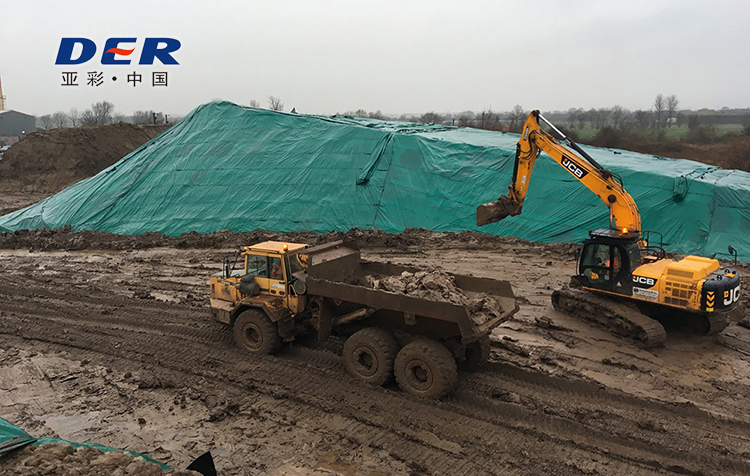
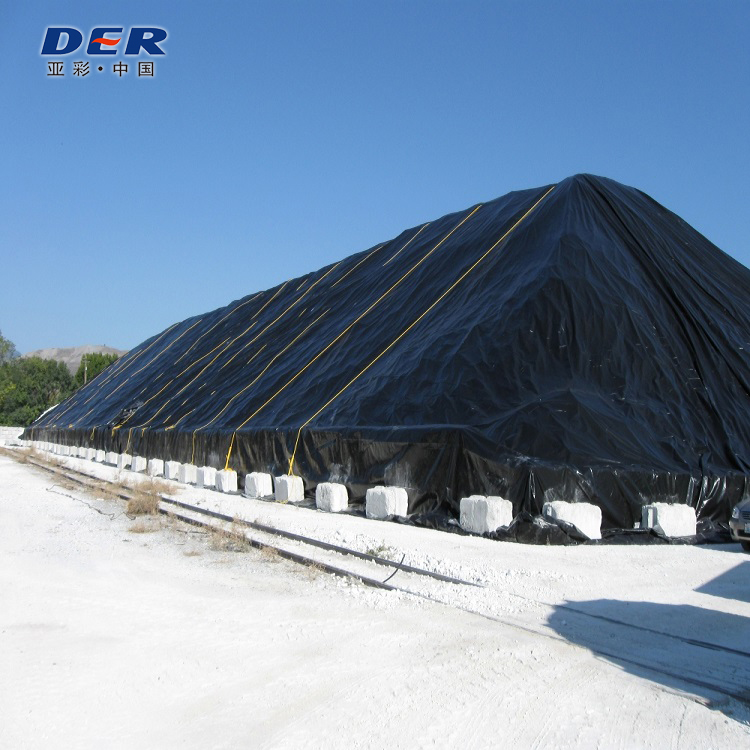
These DERFLEX stockpile photographs illustrate different pile profiles and access conditions. Use your own site images to mark the dimensions and contact zones that need review.
Working with DERFLEX
Connect the fabric order
to the finished drawing.
DERFLEX supplies coated materials and custom tarp products. This supports discussions about fabric selection, joining, edge detail and packaging within the same sourcing process.
For converters and local fabricators, the PVC coated fabrics range provides a material starting point. For finished covers, approve the fabrication detail along with the fabric sample.
- 01
Develop the brief
Confirm the material being stored, geometry, exposure and operating access. Separate fabric supply from site installation responsibilities.
- 02
Review a representative sample
Agree the material and a seam, hem or hardware sample relevant to the order. Identify any test documentation needed before approval.
- 03
Approve, identify and pack
Freeze drawing revisions, finished dimensions and panel markings. Align the folding and package plan with unloading and installation order.
Acceptance planning
Inspect the details that define the order.
Agree inspection points before bulk production. Ask what evidence will be supplied for the selected fabric and finished construction, rather than relying on a generic product description.
| Check | What the buyer should receive or agree |
|---|---|
| Material identity | Sample reference, finished fabric construction, GSM and agreed measurement tolerances. |
| Mechanical properties | Requested tensile, tear and coating-adhesion information with the test method identified; no unspecified pass/fail claim. |
| Seam construction | Joint detail, weld continuity inspection and agreed evaluation of a representative seam sample. |
| Dimensions & hardware | Finished-size checks, access openings and attachment coordinates against the approved drawing. |
| Package identity | Panel count, section labels, orientation marks and agreed package mass or handling information. |
Special performance evidence must match the material and requirement being purchased. A fabric document does not automatically certify every finished cover. Agree any third-party testing and acceptance values in the order specification.
Buying guide
Compare the complete
cover, not only its unit price.
Normalize quotations to the same finished dimensions, fabric construction, seam plan, reinforcement and hardware. Then compare packing, freight, deployment effort and the cost of replacing a damaged section.
- 01
Footprint quoted as cover size
Specify the developed surface and finished dimensions so slope coverage and edge allowances are included.
- 02
Higher GSM without a handling plan
Calculate panel mass. Evaluate smaller sections or targeted wear protection before adding weight everywhere.
- 03
A waterproof sheet treated as a dry-storage system
Review the lower edge, drainage, ground moisture and condensation separately. Identify the true route by which water reaches the material.
- 04
Unclear scope of supply
Record who supplies connection hardware, restraints, site labor and installation design; confirm these items in each quotation.
Buyer questions
Industrial stockpile cover FAQ
What is an industrial stockpile cover?
An industrial stockpile cover is a large protective tarp placed over loose bulk material in a yard, bay or bunker. It can reduce direct rain exposure and shield surface fines from wind. Coverage, drainage, seams and perimeter restraint determine how the complete system performs.
Is PVC or PE better for a bulk material tarp?
PVC coated polyester is worth evaluating for repeated deployment, welded fabrication and reinforced wear zones. Reinforced PE or PP may be suitable when lower handling weight is important. Compare the actual fabric, seams, exposure and reuse cycle; the polymer name alone does not establish service life.
How much larger than the pile should a cover be?
Measure the surface route over the pile, then add the agreed edge and connection allowances. Ground width alone is insufficient. For a symmetric triangular cross-section, the two slopes total 2 × √((width ÷ 2)² + height²). Irregular piles and sloped ends need a drawing or survey.
What GSM should I specify for a heavy duty stockpile cover?
DERFLEX publishes approximately 550–900 gsm as a stockpile-cover quotation direction. Select the exact construction using panel weight, base-fabric strength, abrasion, outdoor exposure and handling frequency. This range is not a wind rating or a guaranteed lifespan.
Will a waterproof tarp prevent condensation or ground moisture?
A waterproof cover can reduce rain entering through its surface, but moisture can still come from the ground, wet material, air leakage or condensation beneath the sheet. Review ground protection, drainage and any material-specific ventilation requirement separately.
What determines price, MOQ, samples and lead time?
Quotation depends on fabric construction, finished area, panel layout, welded seams, reinforcement, hardware, quantity, packaging and destination. Ask DERFLEX to confirm sample availability, minimum order quantity and production timing for the approved specification; these are not fixed values for every cover.
Send the pile profile.
Build a clearer cover brief.
Share the material, maximum dimensions, storage period and operating access. DERFLEX can review a fabric and fabrication direction for your bulk material tarp quotation.