


 Flexible materials
for industrial use
Controlled environments · Material selection
Cleanroom Curtain Materials for Controlled Environment Partitions
Choose flexible curtain material around the process it protects. DERFLEX supplies clear PVC film, strip rolls and reinforced industrial curtain materials for OEMs and fabricators. For cleanroom curtain projects, define particle release, static behavior, cleaning exposure and panel construction before selecting a grade. Request material against an agreed specification, then qualify the finished partition in its operating environment.
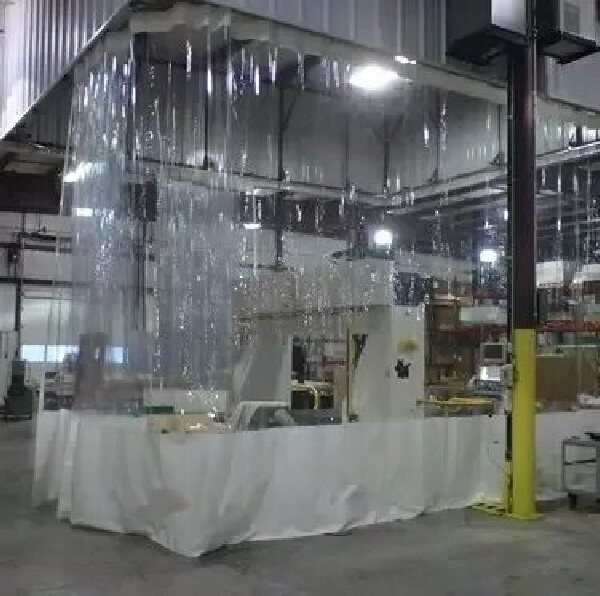
Specify the evidence
Four questions before material approval.
What is cleanroom curtain material?
Cleanroom curtain material is flexible sheet or strip stock selected for a softwall enclosure, access opening or controlled-area partition. It provides a physical boundary while allowing visibility or access. Its suitability depends on the formulation, fabrication, handling and facility protocol. A clear appearance or wipeable surface alone does not establish low particle release, static dissipation or compatibility with a classified environment.
Clear, unreinforced PVC sheet
A candidate for transparent panels and viewing sections where the process permits PVC. Compare surface finish, flexibility, thickness uniformity and the proposed joining method. Review clear PVC film roll options as a starting material family; approve the exact formulation separately for the project.
PVC strip material
A candidate for overlapping access strips and replaceable openings. Strip contact, movement, edge condition and return position all matter. Select PVC strip curtain roll stock around the opening and traffic pattern, then assess whether the opening is appropriate for the required environmental boundary.
Reinforced PVC-coated fabric may be considered for opaque or larger divider sections, but inspect exposed fabric edges, stitching, pockets and joints. Reinforcement is a structural choice; it is not evidence of cleanroom suitability. Broad industrial curtain configurations help define layout options before material qualification.
Material supply and room classification are separate. ISO 14644-1 classifies air cleanliness by airborne particle concentration. This page offers a material-selection route, not an ISO class for a roll or a guarantee of room performance.
Write a specification that can be checked
Begin with the intended boundary: a perimeter panel, personnel opening, equipment enclosure or replacement strip. Use a material code and revision on the sample approval and purchase order. Do not substitute a generic industrial PVC range for a cleanroom-specific acceptance specification.
On smaller screens, scroll the table horizontally.
| Specify | Put in the RFQ / drawing | Acceptance evidence |
|---|---|---|
| Material identity | Polymer, reinforcement if any, finish, color, formulation code and revision | Approved sample and a matching supplier specification |
| Dimensions | Nominal thickness in mm, tolerance, roll or strip width, length and measurement method | Agreed measurement locations and incoming inspection record |
| Surface & edges | Clarity needs, permitted defects, edge finish and treatment of exposed reinforcement | Visual acceptance standard and representative finished sample |
| Particle behavior | Relevant particle sizes, background control, movement / wiping challenge and pass criteria | Agreed test protocol and report for representative material or assembly |
| Electrical behavior | Property to measure, test method, acceptance range, conditioning and cleaning state | Grade-specific results; electrical continuity review where relevant |
| Cleaning exposure | Agent, dilution, contact time, temperature, wipe, rinse and repeated-cycle requirement | Compatibility trial tied to the exact formulation and procedure |
| Panel construction | Joins, overlap, mounting interface, lower edge, access openings and replacement method | Drawing approval plus inspection of the processed sample |
| Delivery control | Lot identification, cleanliness at dispatch, protective packaging and change notification | Agreed packing record and documents linked to the supplied lot |
Keep the units distinct. Thickness and areal mass are different properties. One mil equals 0.0254 mm; grams per square metre cannot be converted to thickness without adequate construction and density information.
Assess the surface after real handling
Evaluate the material in the states that matter: as received, after processing, after cleaning and after representative movement.
Particle shedding is more than a visual check
A smooth, intact face is a useful inspection feature, but a particle claim needs a defined challenge and measurement. Examine cut edges, attachment holes, seams and repeatedly flexed areas. Consider the potential for rubbing between overlapping strips or against a frame.
Agree a representative evaluation with the facility team or testing laboratory. Record the background, specimen preparation, particle-size channels, motion or wipe cycle, sampling location and result calculation. Compare material before and after the agreed cleaning exposure. A particle count without a method and blank control is difficult to interpret.
For stricter processes, include transfer from packaging and handling in the review. Film shipped as an industrial roll should not be assumed to arrive ready for direct entry into a classified area.
Anti-static is a requirement to define
Standard clear PVC is not automatically static-dissipative. An anti-static label also does not establish a permanent effect, humidity independence, a grounding path or an ESD-safe installation.
State whether the requirement concerns surface resistance, resistance to ground, charge decay or another electrical behavior. Use the appropriate test for that property. ANSI/ESD STM11.11 addresses surface resistance measurement of planar materials; it is not a room-classification test.
Ask the report to identify the material, test configuration, conditioning and relevant environmental conditions. Include measurements after the intended cleaning cycles where required. If a conductive pattern or attachment is proposed, assess the complete electrical path with the facility’s ESD specialist.
Match the report to the delivered grade. Results for a different formulation, surface treatment, thickness or processed construction need a documented applicability review. Color and a printed grid are not substitutes for measurements.
Validate the cleaning routine against the formulation
Cleaning compatibility is specific to an agent and an exposure. Submit the actual product or SDS, dilution, contact time, temperature and frequency, together with the wipe and rinse procedure. A general statement that PVC is washable does not approve alcohol, oxidizers, disinfectants or a sterilization process for every PVC formulation.
Define a repeatable coupon trial
Retain an untreated control from the same material. Expose representative coupons and a processed joint to the intended sequence, including drying and residue removal. Agree the number of cycles and acceptance limits before testing. Record both the contact conditions and the observation method.
Check more than appearance
Review haze, discoloration, swelling, tackiness, cracking, delamination, edge condition and joint damage. Check any required mechanical and electrical properties after exposure. A surface that still looks clear may no longer meet the specified static-control performance.
PVC formulation additives and residues can matter in contamination-sensitive processes. Where molecular contamination, extractables or condensable emissions are critical, define those requirements explicitly and seek relevant data. Neither a low-odor impression nor a particle test establishes low outgassing. Do not describe the material as sterile, sterilizable or suitable for aseptic processing without the corresponding evidence and facility approval.
Set a cleaning and inspection schedule in the facility procedure. Remove damaged or persistently tacky panels from service pending review; replacement decisions should reflect the required function, not a generic calendar-life promise.
Design the interfaces, not just the sheet
Specify mounting, panel joints, access strips and the lower edge together. Overlap can reduce an open line of sight through the boundary, but flexible curtains are not automatically airtight. Opening movement, pressure differences and traffic can change leakage and particle transport. Let the enclosure designer determine whether this boundary suits the process.
Edges, joints and attachments
Minimize unnecessary ledges and difficult-to-clean pockets. Where welding is proposed, verify the joint on the selected material and equipment. Do not apply a universal welding temperature. Inspect the sample for incomplete joining, distortion, residue and exposed reinforcement. Where stitching or hook-and-loop attachment is considered, review accessible cleaning and potential particle retention.
Clearance and replacement
Some softwall layouts use a designed lower air-relief opening. Do not add floor contact, seals or weights without checking the ventilation concept. Define the mounting datum, floor variation, replacement access and whether strips rub on each other or nearby equipment. Also check that personnel and carts can pass without damaging critical surfaces.
For ordinary workshop dust separation, review dust containment curtain requirements. A nuisance-dust barrier and a qualified cleanroom boundary solve different operating problems.
Review the real surface and finished details
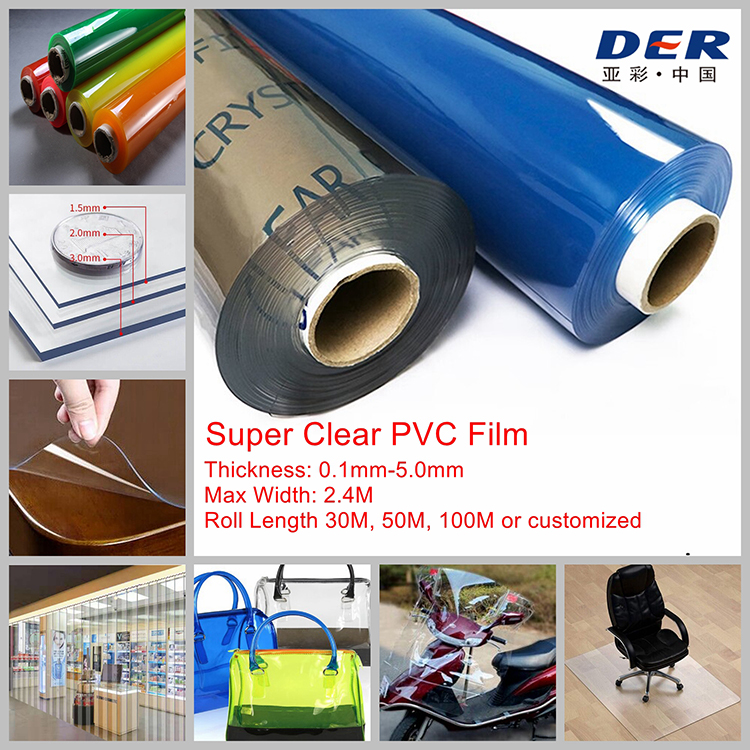
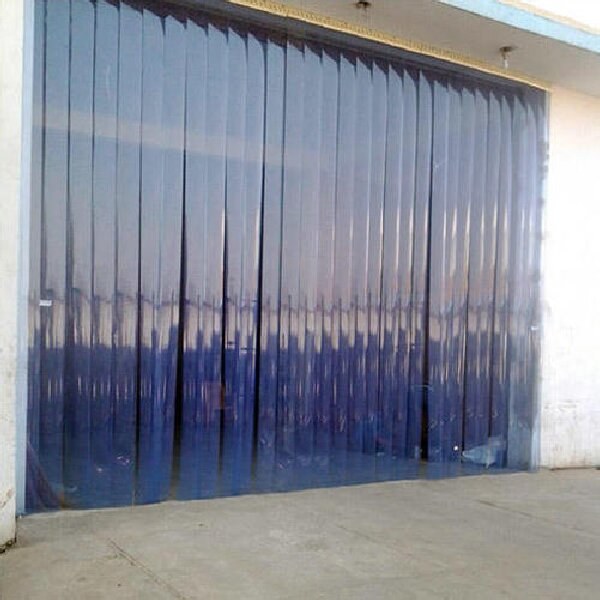
These DERFLEX website photographs show material appearance and industrial curtain arrangements. They support discussion of clarity, strip access and panel construction; they do not establish cleanroom performance, a project delivery record or test results.
Use two release decisions: material, then installation
The following is a proposed purchasing workflow. It is not a claim that a DERFLEX grade has already passed these checks. Agree the protocol with the responsible facility team before treating a sample as approved.
Describe the actual boundary
Record the area, process sensitivity, operating state, environmental conditions, traffic and cleaning procedure. Identify who approves materials and who qualifies the installed environment.
Identify one material revision
Agree formulation, dimensions, surface and sample labeling. Include a representative cut edge or joint. Request the relevant reports and state which evidence is still required.
Test the required functions
Check dimensional and visual acceptance, repeated-cleaning compatibility, electrical behavior and the agreed particle challenge. Retain the sample and conditions as the order reference.
Review performance after installation
Assess the enclosure with its airflow, access and cleaning procedures. The facility decides which room tests, monitoring and change controls apply before releasing the area for use.
Keep incoming inspection practical. Check lot identity, packing condition, thickness and width, approved visual limits, edge quality and the agreed documents. Keep retained samples where required. Reassess a formulation change or a cleaning-process change against the original acceptance basis.
Match the partition to the process
Application screening — not an approval for use. Scroll the table on smaller screens.
| Buyer / operating need | Priority in material review | Decision boundary |
|---|---|---|
| Cleanroom OEM or enclosure fabricator | Material identity, repeatable converting, joint quality and replacement details | Approve the material within the complete enclosure design and qualification plan. |
| Electronics assembly team | Electrical behavior after conditioning and cleaning, particle release and access movement | A curtain must fit the facility’s ESD control plan; “anti-static” alone is insufficient. |
| Optical or sensitive assembly process | Visibility, surface condition and process-specific particle / molecular contamination requirements | Escalate PVC restrictions or emissions limits before selecting a formulation. |
| Medical-device or life-science facility | Approved cleaning chemistry, material traceability, cleanability and change control | No inference of sterile, aseptic or regulatory suitability from an industrial material description. |
| Controlled packaging or maintenance zone | Traffic, ease of cleaning, replaceable strips and appropriate boundary construction | Define whether the area is classified or simply a cleaner industrial zone. |
Make the quotation scope explicit
DERFLEX’s published range includes flexible PVC strip materials and industrial door curtain fabric. Use these supply families to start a technical enquiry. The selected cleanroom application still needs an approved formulation and project-specific evidence.
Send a useful material brief
- Application, controlled-area requirements and any polymer restrictions.
- Drawing or opening dimensions, mounting datum, overlap, lower edge and access layout.
- Requested thickness, width, clarity, finish and dimensional tolerances.
- Cleaning agent and exposure sequence, plus required particle and electrical tests.
- Roll goods, cut strips or fabricated panels; estimated quantity and replacement demand.
- Destination, packaging requirements, required documents and project schedule.
Separate material from the system
Ask the quote to identify what is included: material, cutting, punching, joining, edge treatment, labeling and packing. Tracks, supports, grounding parts, HVAC, installation and room validation should each have an explicitly assigned supplier or responsible party.
Compare quotations on the same formulation and acceptance basis. Roll width and yield, processing, test scope, packaging, quantity and delivery terms affect cost. Request project-specific MOQ, sampling arrangements and lead time; these are not fixed by the material family.
If the complete specification is not ready, start with an application photo or sketch, opening size, cleaning procedure and estimated quantity.
From requirement to sample review
Send your partition brief to DERFLEX.
Include the intended environment, dimensions, cleaning routine and evidence requirements so the enquiry can be matched to a material and supply scope.
Cleanroom curtain material FAQ
Does a PVC curtain have an ISO cleanroom class?
An ISO air-cleanliness class describes the concentration of airborne particles in the assessed cleanroom or clean zone. A curtain material report can support selection, but it does not classify the installed room. The facility must assess the completed arrangement under its specified occupancy state and operating conditions.
Is standard clear PVC automatically anti-static?
No. Transparency, thickness and a smooth surface do not establish electrical behavior. Specify the electrical property, test method, acceptance range and conditioning. Request results for the exact formulation, including the effect of the intended cleaning cycle, before approving a static-control claim.
Which cleaning agents can be used on cleanroom curtains?
Use only the agents and procedures approved for the selected formulation and your facility. Submit the product name, concentration, contact time, temperature, wipe and rinse process, and frequency. A controlled coupon trial should check visible changes, mechanical condition, residue and any required electrical properties after repeated exposure.
Should a cleanroom curtain touch the floor?
The facility or enclosure designer should define the lower edge. Some softwall arrangements require a designed air-relief gap; other boundaries need a different closure. Floor contact can create rubbing and cleaning concerns. Do not seal a designed gap or add a weighted hem without reviewing airflow and the operating procedure.
Can DERFLEX quote rolls or replacement curtain material?
DERFLEX lists clear PVC film, PVC strip rolls and industrial curtain materials. For this application, request a quotation against an approved material specification and drawing. Identify whether you need roll goods, cut strips or fabricated panels; confirm cutting, joining, packaging, hardware and installation as separate scope items.
What should be approved before a bulk material order?
Approve the formulation and revision, dimensions and tolerances, representative sample, cleaning compatibility, required particle and static-control evidence, joining details, packaging and lot identification. Also agree change notification and incoming acceptance criteria. Material approval and installed-room qualification are separate release decisions.
DERFLEX · Material selection for OEMs, fabricators and controlled-environment project teams.