


 INDUSTRIAL COATED FABRICS
Material sourcing for OEM cover programs
Marine covers · Coastal awnings · OEM roll goods
Marine Canvas Tarps for Boat & Awning Cover Manufacturers
Choose marine canvas tarp fabric around the cover you are building: a ventilated boat cover, a removable equipment cover or a tensioned coastal awning. DERFLEX supplies PVC-coated polyester roll material for cover fabricators. Compare the construction, handling weight, seam process and exposure evidence before approving a grade. A clear specification helps you buy the right material and define what the finished cover must achieve.
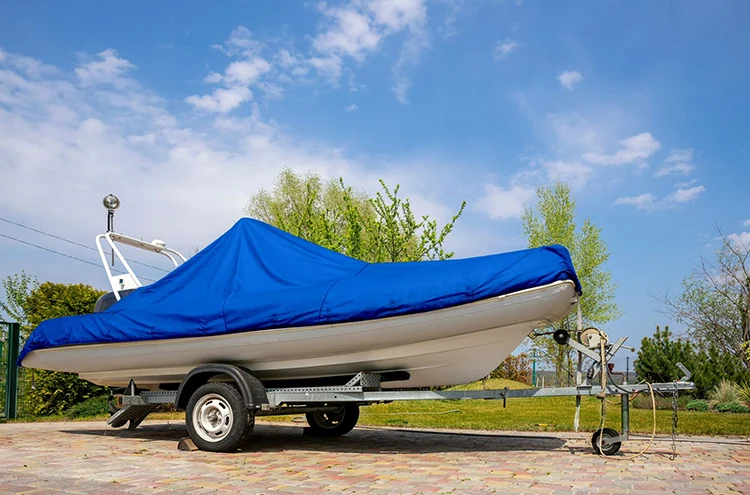
Marine canvas describes a use, not one fabric
Marine canvas tarps are protective covers made from textiles selected for a boating or coastal environment. The description can refer to solution-dyed woven canvas, coated polyester or other constructions. It does not identify a universal certification, a guaranteed lifespan or a particular waterproof rating.
For a water-barrier cover, PVC-coated polyester is a practical material family to evaluate. When airflow, textile feel or a specific colorfastness requirement drives the project, compare it with a documented woven construction. The comparison below concerns material families; it does not imply that DERFLEX supplies every alternative.
On a small screen, scroll each comparison table horizontally to view every column.
| Material family | Reason to evaluate it | What still needs approval |
|---|---|---|
| PVC-coated polyester | Continuous water-barrier surface; compatible grades can support welded panel construction. | Coating adhesion, flexibility, seam behavior and ventilation in an enclosed cover. |
| Solution-dyed woven acrylic | A textile-style route for marine tops and covers where fabric airflow is important. | Water repellency versus pressure resistance, seams, cleaning and the selected finish. |
| Other coated woven fabrics | Alternative handling or construction characteristics for a defined cover program. | Actual coating chemistry, air permeability, joining method and exposure data. |
Define the deliverable: this page focuses on material rolls. Finished covers, cut panels, frames, fasteners and installation require their own agreed scope. Marine upholstery vinyl and inflatable-hull fabric serve different jobs and should not be substituted on appearance.
Start with how the cover will live and move
A cover left over a humid cockpit faces a different problem from a canopy held under tension. State whether the fabric will be repeatedly folded, supported on bows, stretched over a frame or removed between uses. These details determine which sample checks matter.
| Application | Selection priorities | Assembly review |
|---|---|---|
| Mooring and storage covers | Water resistance, handling, coating adhesion and protection at contact points. | Ventilation, supported drainage paths, protected edges and access for inspection. |
| Removable equipment covers | Foldability, abrasion at corners and the finish against the protected surface. | Removal clearance, retaining details and clean contact patches. |
| Bimini or cockpit-top panels | Appearance, dimensional behavior and repeated movement around supports. | Frame fit, seam placement, visibility and compatibility with adjoining panels. |
| Coastal awnings | Dimensional stability, coating integrity and performance after outdoor exposure. | Frame interfaces, water shedding, edge restraint and project wind requirements. |
| Covers intended for transport | Chafe resistance and the behavior of the complete restraint system. | Separate road-use assessment; storage suitability does not establish a permissible towing speed. |
For canopy-specific frame, panel and drainage decisions, use the vinyl awning and canopy fabric guide. For an existing fitted-cover project, start with the boat cover tarp supply page.
Ask what was tested, on which component
“UV resistant,” “anti-mildew” and “saltwater resistant” are useful purchasing topics only when the supporting evidence is specific. Ask for the material reference, color, specimen construction, test method, exposure conditions and result. A report for one fabric or accessory cannot qualify the entire cover.
| Claim to evaluate | Evidence to request | Limit of that evidence |
|---|---|---|
| UV and weathering | Exposure method, lamp or light source, cycle, duration and before/after measurements for the proposed grade. | Exposure hours alone do not establish service years, fade resistance or retained strength. |
| Fungal resistance | Applicable fungal test, specimen identity, conditioning, exposure and observed growth rating. | A result for clean material does not make a dirty, damp finished cover permanently mildew-proof. |
| Water resistance | Fabric water test conditions and a separate assessment of the intended seam or finished panel. | A water-barrier face does not establish leak-free stitching, closures or complete-cover performance. |
| Coastal salt exposure | For fabric: an agreed exposure and property-retention plan. For metal hardware: component-specific corrosion evidence. | A salt spray report for metal hardware does not qualify fabric UV, fungal or waterproof performance. |
| Strength and adhesion | Test direction, specimen dimensions, units and results for reinforcement, tear behavior and coating adhesion. | New fabric strength does not establish seam strength, fastening strength or design wind capacity. |
Salt spray is not a universal marine certificate
ISO 9227:2022 addresses corrosion testing of metallic materials and their protective coatings. Its scope is relevant to specifying suitable hardware evidence. It is not a blanket qualification for a PVC-coated textile.
Separate fading from structural retention
A color result answers a different question from retained tensile or tear performance. For a repeat-order program, decide whether appearance, mechanical retention, surface cracking or more than one outcome controls acceptance.
Test-method context: ASTM G154-23 covers fluorescent UV exposure apparatus; ASTM G21-15(2021)e1 concerns fungal resistance of synthetic polymeric materials. These references explain evidence categories; they are not claims that a DERFLEX grade has passed either method. Agree material applicability with the laboratory.
Turn a sample into a repeatable material order
DERFLEX’s existing marine-cover range provides a starting point for PVC-coated polyester roll sourcing. For purchasing, replace a broad label with the agreed construction and acceptance fields below. The table is a specification checklist, not a tested-grade data sheet.
| Purchase field | What to put on the order | Why it matters |
|---|---|---|
| Material identity | Approved sample reference, base textile, coating and intended face. | Prevents a similar-looking but different construction being substituted. |
| Mass and thickness | Agreed g/m² and tolerance; thickness and method only when required. | Controls handling and consistency. Mass cannot be directly converted into thickness. |
| Usable roll width | Cuttable width, edge exclusion, roll length and permitted joins. | Controls pattern yield and the number of panel seams. |
| Color and finish | Physical color master, face orientation, surface appearance and agreed tolerance. | Supports coordinated panels and repeat orders; screen images are not color standards. |
| Functional acceptance | Applicable methods, report references, sample plan and agreed pass criteria. | Makes UV, water, fungal and mechanical requirements auditable. |
| Processing and packing | Validated seam route, winding direction, labels and batch identification. | Connects incoming rolls to approved production and inspection records. |
Estimate handling mass before choosing a heavier grade
Fabric-only mass = cut area × mass per unit area. In an illustrative calculation, 30 m² × 600 g/m² ÷ 1,000 = 18 kg, before hems, straps and other components. This is an estimating example, not a DERFLEX grade specification or load rating.
Price the usable material, not only the roll
Compare usable width, nesting waste, seam labor, reinforcement and inspection requirements alongside the quoted unit price. Ask for separate terms for samples, order quantity, packaging, destination and planned delivery; these belong to the actual quotation.
Explore boat cover fabric roll options for material-focused sourcing, or the broader PVC-coated fabrics range when comparing industrial constructions.
Waterproof fabric still needs a well-designed cover
Control seams and stress transitions
Validate a welded or sewn seam on the actual production material. A finish can affect joining, while stitching introduces needle holes. Review overlap, sealing where needed, seam position and reinforcement at snaps, eyelets and corners. Set joining conditions through trials rather than assuming that every PVC construction processes identically.
Check chafe protection at rails, windscreen edges and other contact points. Inspect how loads transfer from a fastener into the surrounding textile; adding a fitting does not establish the assembly’s capacity.
Plan drainage, ventilation and interfaces
A continuous coating can block rain while moisture still accumulates underneath. Provide an appropriate ventilation route, and support the cover so water can drain instead of collecting in pockets. The fabric selection does not replace the cover maker’s geometry or installation review.
Where a cover meets a transparent panel, check the joining process, fold behavior and cleaning compatibility of both materials. The clear PVC film category is a separate sourcing route, not proof of suitability for every marine window.
Storage is not transport approval. A material sample cannot establish towing speed, wind resistance or storm capability. Those decisions depend on the finished geometry, supports, restraints and the responsible designer’s assessment.
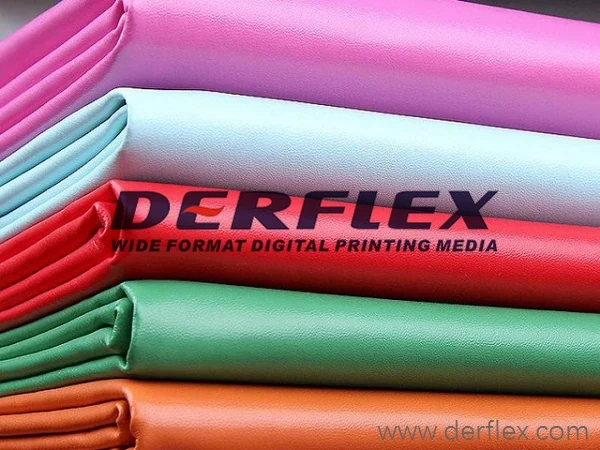
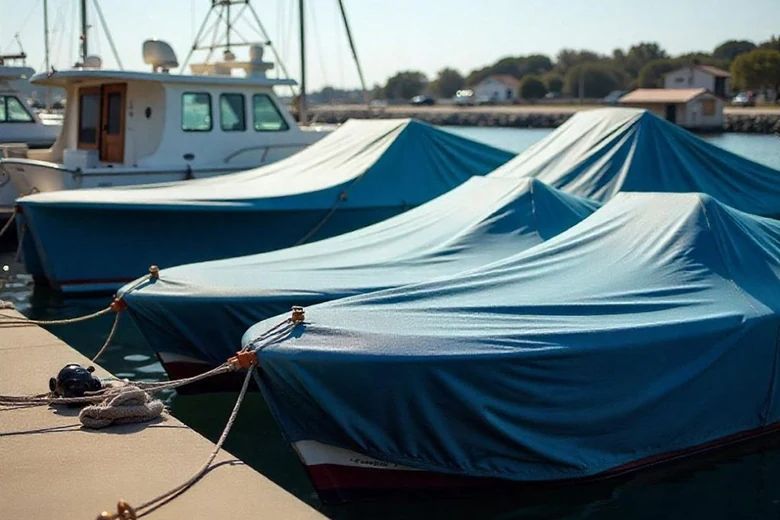
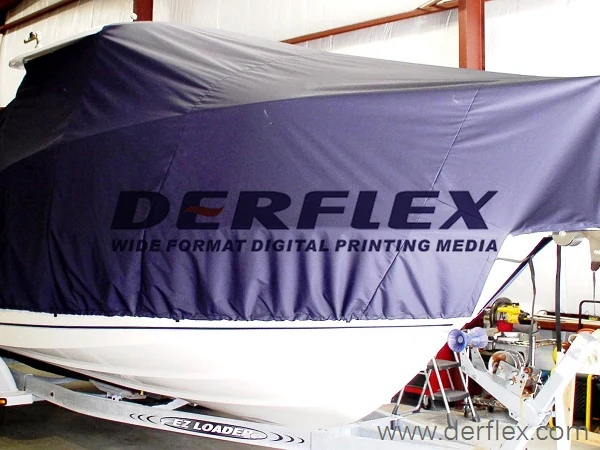
Look at the fabric and the finished interfaces
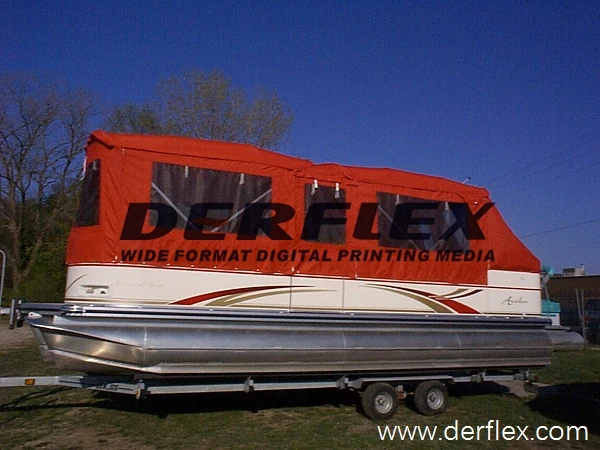
These existing DERFLEX website images illustrate material appearance and cover layouts. They are not model-specific test evidence or documented customer case studies.
Qualify one construction before scaling the order
- Write the service brief. Record location, exposure, seasonal use, cover geometry and cleaning conditions.
- Identify the material. Retain an agreed sample reference and define the properties that control acceptance.
- Make a representative trial. Include a seam, hem, fastener or contact patch that matters to your design.
- Review the evidence. Match each report to the proposed material or component and agree any additional checks.
- Freeze the order specification. Record the construction, appearance, tolerances, packaging and inspection requirements.
- Trace repeat orders. Check incoming rolls against that specification and retain batch and approval records.
Give the end user a material-specific care instruction
Remove loose dirt, rinse away salt deposits with fresh water and use a cleaning method approved for the selected construction. Test cleaners on a small area first. Do not copy a bleach or solvent instruction from another fabric family. Allow the cover to dry before packing, keep contact surfaces clean and inspect seams, fasteners and chafe zones during use.
When cracking, coating separation, persistent tackiness or damaged attachments appear, assess repair or replacement before putting the cover back into service. A surface treatment cannot be assumed to restore structural performance.
Send a brief your fabricator and purchaser can both use
You do not need a complete technical specification to begin. Send photographs or a drawing, explain the intended use and identify the requirements you already know. DERFLEX can review the roll-material requirement against its coated-fabric range; any additional fabrication must be included explicitly in the quotation scope.
Application: boat storage, mooring, equipment cover, marine top or coastal awning.
Exposure: location, sun and wetness, seasonal use, folding and cleaning.
Construction: sketch or pattern, largest panel, seam method, supports and fittings.
Material order: usable width, target mass if known, color, quantity and required documents.
Commercial brief: delivery destination, planned order date, packing and supply scope.
The checklist is an editable purchasing worksheet, not a technical data sheet, test report or certification.
Marine canvas tarp fabric FAQ
What is marine canvas tarp fabric?
Marine canvas is a trade description for fabrics used in boat covers, marine tops and related outdoor protection. It can include woven acrylic, coated polyester and other constructions. Specify the actual fiber, coating, water performance and fabrication requirements rather than treating “marine canvas” as one material or certification.
Is PVC-coated marine fabric breathable?
A continuous PVC coating acts as a water barrier and should not be assumed to pass air like an open woven fabric. An enclosed boat cover therefore needs a ventilation and drainage plan. Choose a different verified construction when air permeability through the fabric itself is essential.
Does a salt spray test prove that a tarp is marine grade?
No. ISO 9227 concerns corrosion testing of metallic materials and their protective coatings. A result for a snap or eyelet does not establish the UV durability, fungal resistance or water performance of the cover fabric. Match each report to the tested component and the performance you need.
Are marine canvas tarps mildew-proof?
No fabric should be described as permanently mildew-proof without a clearly defined basis. A fungal-resistance result applies to the tested specimen and conditions. Deposited dirt, trapped moisture, seams and backing materials still require cleaning, ventilation and complete drying before storage.
Can the same material be used for a boat cover and a coastal awning?
Possibly, after separate design reviews. A boat cover may prioritize foldability, chafe protection and vent placement; an awning may prioritize dimensional stability, frame interfaces and drainage under tension. Approve the finished assembly for each application rather than transferring approval between designs.
What should I send DERFLEX for an OEM quotation?
Send the application, exposure location, drawing or photos, approximate panel dimensions, roll requirements, color and quantity. Include the required tests, seam method, destination and planned order date. State whether you need roll goods only or want a separate review of cut panels or finished-cover fabrication.
Define the material. Validate the cover.
Build your marine cover program on an agreed specification
Send DERFLEX the application, drawing or photos, quantity and exposure requirements. Start with the correct roll-material scope, then agree the sample and evidence needed for your design.