



Open-top containers / Custom replacement covers
Shipping Container Tarp for 20 ft & 40 ft Open Tops
Order a container tarp around the equipment it must fit. DERFLEX supplies PVC coated polyester material and custom cover options for open-top shipping containers, replacement programs and outdoor storage. Start with the container model, supported roof profile and fastening layout. Then agree the finished dimensions, material, reinforcement and accessory scope before production. Send a drawing, an existing-cover reference or clear application photos to begin your enquiry.
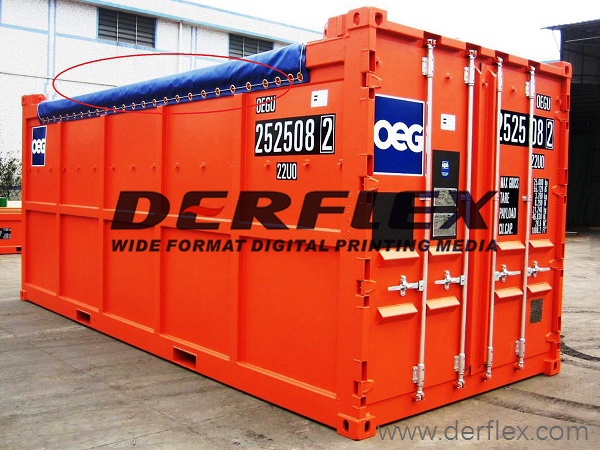
What is a shipping container tarp?
A shipping container tarp is a flexible cover fitted over an open-top container to help protect cargo from rain and debris. The finished assembly combines a coated fabric body with seams, reinforced edges and attachments that match the container. Its fit depends on the roof profile and fastening line as well as the opening.
Use this page for an exterior tarp or replacement cover. A shelter spanning between containers, an internal liner and a rigid replacement roof are separate products with different requirements.
| Buyer requirement | Cover direction | First detail to resolve |
|---|---|---|
| Open-top transport | Fitted replacement tarp matched to the equipment | Container model, bows, perimeter attachments and carrier requirements |
| Stationary outdoor storage | Weather cover with an agreed support and fastening arrangement | Runoff, inspection access and prolonged exposure |
| Cargo projecting above the rim | Custom profile assessed around the actual load | Raised geometry, protected contact points and operator acceptance |
| Fabrication in your own workshop | Material roll enquiry rather than a finished-cover order | Roll format, welding trials and your fabrication responsibility |
Comparing cover materials for several applications? Start with the tarpaulin material and application guide. A container, roof bows, lifting equipment, installation service and cables are outside the cover quotation unless specifically included.
20 ft and 40 ft are container references, not tarp cutting sizes
A roof-opening dimension is not the same as the finished cover dimension. The tarp must follow the supported profile and reach its attachment line, with the agreed drops, end details and installation allowance.
Measure the installed route
Record the actual container model and equipment identifier. Photograph the top rim, corners, door end and all fastening points. Note bow positions, the highest supported point and any cargo projection before defining the cover profile.
State whether a dimension is taken on a flat finished cover or over the installed profile. A tape stretched across an opening does not describe the extra fabric needed over a raised support.
Map attachments from one datum
Label front, rear, left and right. Measure attachment centres from a common reference rather than recording only repeated spacing. Include corner offsets, end clearances, eyelet opening dimensions and the intended cable route.
Check an old tarp against the equipment before copying it. Local stretch, repairs or a previous poor fit can otherwise become errors in every replacement.
A useful drawing separates five items: finished dimensions and tolerance; bow/profile geometry; end and corner details; attachment coordinates; and the drawing revision. Ask the container owner or operator to resolve equipment-specific requirements.
Carrier reference: Hapag-Lloyd notes that container specifications vary by manufacturer. Its published opening dimensions are equipment examples, not tarp ordering sizes.
Compare the construction behind the GSM number
DERFLEX's published container-cover range includes 650 gsm and 900 gsm material references and 1000D × 1000D polyester options. Treat these as starting points for a grade enquiry. The approved order specification should identify the actual construction, nominal mass, tolerances and any required test evidence.
| Decision | 650 gsm reference | 900 gsm reference |
|---|---|---|
| Nominal fabric mass | 0.65 kg per square metre | 0.90 kg per square metre |
| Handling implication | Lower nominal fabric mass for the same area | More nominal fabric mass to lift, fold and store |
| Strength comparison | Request comparable tensile, tear and coating-adhesion data for the proposed grades; weight alone does not establish strength. | |
| Finished-cover decision | Review seams, reinforcement, attachments, abrasion zones and exposure together. Neither weight is a wind rating or service-life promise. | |
Illustrative handling calculation: a 35 m² fabric body at 650 gsm contains about 22.75 kg of fabric; at 900 gsm it contains about 31.50 kg. The difference is 8.75 kg before hems, overlaps, patches or hardware. This is arithmetic for an assumed area, not a cover size, measured product weight or handling recommendation.
Specify cold folding conditions, sunlight exposure, cleaning practice and abrasion where they affect selection. Any flame-retardant or other special performance requirement needs evidence for the selected grade and test conditions. Review the PVC tarpaulin material range for the broader coated-fabric supply direction.
Specify seams, corners and fastening points together
Panel and seam layout
Show joints on the cover drawing. Consider where the sheet touches bows and where it folds during removal. Agree the welding method and inspection approach for the chosen material rather than specifying a universal welding temperature.
Perimeter and corner reinforcement
Define hem construction and the position of webbing or patches. An extra layer at the wrong location may add bulk without protecting the area that rubs against the container. Mark actual contact zones on photographs.
Eyelets and attachment compatibility
Record opening size, orientation, distance from the edge and centre positions. Check clearance over the receiving hardware. A generic eyelet-spacing statement cannot establish compatibility with an existing container.
Cables, straps and supplied accessories
List each included component and who supplies it. Where a TIR-style route is required, confirm the cable ends, routing and sealing arrangement with the operator. A compatible layout alone does not establish customs approval.
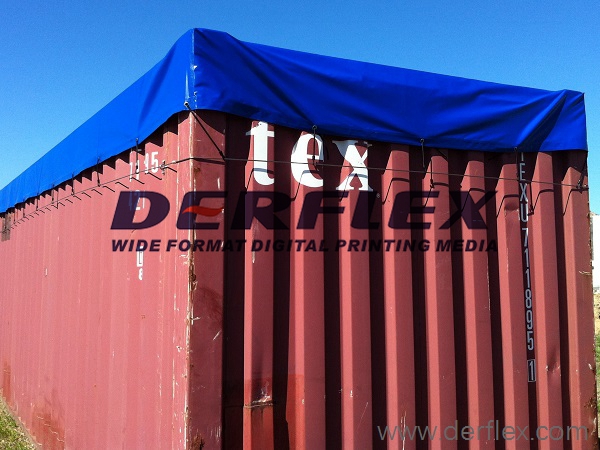
Check the profile and side drop
DERFLEX website application image. Confirm your own corner and attachment details rather than copying the pictured arrangement.
Approve the actual material sample
DERFLEX website material image. Surface appearance does not identify a GSM, coating recipe or certified performance.If the job concerns a road-vehicle body or trailer, compare the truck tarpaulin cover requirements instead. Different equipment can require different attachment and operating details.
Resolve drainage, rubbing and access on the actual equipment
Weather protection needs a supported profile
A waterproof fabric cannot compensate for an unsupported depression that collects water or an exposed gap at an end. Review runoff and cover tension with the operator. Keep roof bows and supporting equipment within their approved use; the tarp has no assumed snow-load capacity.
Rain protection also differs from moisture control inside the container. Cargo moisture, ventilation and changing temperatures can still cause condensation beneath an exterior cover.
Plan removal, inspection and storage
Identify sharp edges and high-rub contact points before installation. Protect them using an agreed arrangement, and inspect the cover after handling or abnormal weather. Do not use the tarp as a lifting sling, a work platform or cargo restraint.
Clean using a method compatible with the selected coating, allow the cover to dry and store it away from damaging contact. Get repair guidance for the actual material and reassess damaged attachment zones before reuse.
For broader finished-cover and fabrication enquiries, see the DERFLEX industrial tarp supply overview. The suitability of a complete transport or storage arrangement remains specific to the equipment and operation.
Turn the first cover into a controlled replacement specification
For depot stock or a multi-container fleet, group equipment by compatible pattern before ordering. Trial the first cover on a representative unit and retain a signed drawing revision. A shared nominal container length is not enough to make replacement covers interchangeable.
| Check | What to record | Approval evidence |
|---|---|---|
| Dimensions and orientation | Finished measuring condition, agreed tolerances and front/rear identification | Measurements against the controlled drawing |
| Installed fit | Corner clearance, end overlap, bow contact and access | Photos on the identified trial container |
| Attachment alignment | Eyelet centres, hardware clearance and cable or strap route | Fit check without improvised holes or forced alignment |
| Fabrication and rain protection | Material identity, seam condition and an agreed leakage-check method | Inspection record with conditions and acceptance criteria |
| Repeat-order identity | Pattern code, revision, material reference, color and packing labels | Approved sample reference and order specification |
Where laboratory results are required, request the report, sample identity, method and conditions for the proposed material or assembly. A fabric report does not automatically validate the welded cover. The tarp supplier audit checklist helps structure evidence requests for a repeat supply program.
Send the drawing, the quantity and the operating job
Your enquiry checklist
- Container model, photos and transport or storage use
- Finished dimensions or a drawing, with orientation
- Roof profile, corners and attachment-point map
- Quantity per pattern and replacement frequency
- Material preference, color and printing requirements
- Accessory scope, destination and required date
Use the tarpaulin specification and RFQ guide to organize the details. If you do not have a technical drawing, send a labelled sketch and photos first.
What changes the price?
Compare the same finished size and construction. Fabric grade, panel yield, seam length, reinforcement, hardware, printing, quantity, packing and delivery terms can all change the quotation.
Ask for material, fabrication and accessory scope to be clear, with freight and commercial terms identified. MOQ, sample arrangements, production timing and warranty should come from the actual quotation.
For repeat supply: agree how drawing changes are approved and how different patterns are labelled. This helps the receiving team allocate each cover to the correct equipment.
Shipping container tarp FAQ
Will a 20 ft or 40 ft container tarp fit every container of that size?
No. The container designation does not define the finished cover pattern. Roof bows, attachment positions, corner details and end geometry can differ. Match the drawing to the actual container model and approve the first cover on a representative unit.
Is 900 gsm always better than 650 gsm for a shipping container cover?
No. A heavier fabric increases handling mass and does not by itself establish better seam strength, eyelet retention or weather performance. Compare the complete grade, reinforcement and construction against the service conditions, then confirm the approved specification.
Can an old tarp be used as the replacement template?
Yes, as a reference. Identify the front and rear, record its condition and compare it with the container. Stretch, shrinkage, repairs and worn attachment holes can distort the pattern. Resolve discrepancies before copying the cover into a production drawing.
Does a TIR cable layout mean the cover is customs approved?
No. A compatible eyelet and cable layout is a construction detail. Any customs-sealing or carrier acceptance requirement must be checked against the actual container, cover assembly and required documentation. Cable inclusion must also be stated separately in the quotation.
Will an exterior tarp stop condensation inside a container?
An exterior cover addresses rain exposure at the top. It does not control all moisture already inside the container or cargo. Ventilation, cargo moisture, temperature changes and any internal protection must be assessed separately for the shipment.
What should I send for a custom container tarp quotation?
Send the container model or photos, finished dimensions or a drawing, attachment-point layout, quantity, destination and operating conditions. Add an old-cover reference, material preference, color, printing, required documents and target delivery date when available. A sketch is enough to start the discussion.
Start with your container
Specify a cover your team can reorder with confidence.
Send DERFLEX the equipment reference, drawing or photos, quantity and destination. Discuss the material, fabrication and first-cover approval requirements together.