Fan matching
Outlet size, airflow, static pressure and pressure direction help determine whether the body can be collapsible, requires continuous helix support, or needs a short reinforced transition at the machine.



 Custom industrial airflow assemblies
Large-bore flexible duct assemblies configured for high-volume air supply, extraction, temporary HVAC, mining, tunneling, industrial shutdowns and blower OEM programs.
DERFLEX can review non-standard diameter, section length, coated-textile construction, reinforcement, cuffs, zippers, rings, fan transitions, suspension and project identification as one finished ducting specification. Final performance depends on the approved construction, airflow direction, pressure, environment and test requirements.
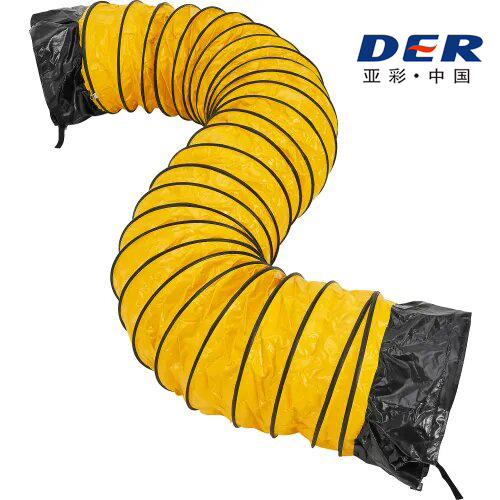
As diameter grows, the duct wall carries more area, the joint circumference increases, the fan connection becomes less forgiving, and every bend or handling point affects the installed system. A useful custom large diameter ducting specification therefore starts with the equipment and site—not with a catalog diameter alone.
Outlet size, airflow, static pressure and pressure direction help determine whether the body can be collapsible, requires continuous helix support, or needs a short reinforced transition at the machine.
A non-standard fan outlet, limited headroom, tight bend or offset connection may call for a reducer, enlarger, tapered transition, elbow, branch or custom cuff rather than a straight tube.
Oversized duct sections should be planned around installation labor, relocation frequency, suspension points, storage space, packed dimensions and the method used to replace damaged sections.
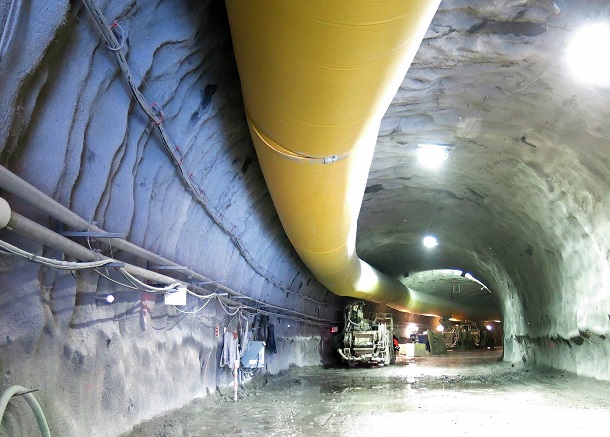
“Custom large diameter ducting” usually means more than changing the bore. The finished product may need to mate with an axial fan, temporary air handler, mine ventilation line, dehumidifier, portable heater, extraction unit or an existing duct network. DERFLEX can review the body and interface together so the quotation reflects how the product will actually be used.
For replacement projects, a dimensioned drawing is ideal. When one is not available, clear photographs with reference measurements can help identify cuff geometry, clamp zones, zipper position, suspension spacing and the transition required at the equipment.
Large-diameter airflow products can share the same nominal size while behaving very differently in service. The first selection is structural: does the duct rely on internal pressure to stay open, or must it retain its shape mechanically?
A coated-textile tube that inflates under forced air and packs flat when the fan stops. It can be practical for long temporary supply lines where low packed volume is important.
A flexible wall supported by continuous wire helix so the bore remains open under suction, at bends and near equipment connections.
Reducers, enlargers, elbows, offset pieces, Y-branches and equipment adapters can connect large duct sections where the machine outlet or site route is not a simple straight cylinder.
Connection choice affects installation speed, leakage control, replacement and compatibility with the fan or adjoining duct. Final construction should be confirmed against actual dimensions and pressure conditions.
| Connection option | Typical use | What to define in the inquiry | Procurement note |
|---|---|---|---|
| Soft cuff / belted cuff | Portable fans, heaters, chillers and temporary ventilation equipment | Equipment OD, cuff overlap, belt width and fastening method | Useful when the duct must be installed and removed repeatedly. |
| Zipper connection | Modular long-run duct lines and underground ventilation sections | Zipper type, sealing flap, orientation and section identification | Allows repeatable section-to-section connection when matched as one system. |
| Steel ring end | Large project duct sections, suspended lines and custom mechanical joining | Ring diameter, rod section, overlap and joining hardware | Ring design should be reviewed with duct size and joint loading. |
| Hook-and-loop sleeve | Fast temporary connections and equipment sleeves | Overlap length, closure width and sealing expectation | Convenient where frequent access is required. |
| Clamp interface | Fan spigots, rigid pipe interfaces and short transition pieces | ID/OD, clamp zone, reinforcement and surface geometry | Actual interface dimensions are more useful than nominal fan size alone. |
| Reducer / custom adapter | Different fan and line diameters, offset connections or equipment replacement | Both end dimensions, transition length, centerline offset and pressure direction | A drawing is recommended for non-concentric or multi-axis transitions. |
The table below is an RFQ planning reference rather than a universal guaranteed datasheet. Final size, material, pressure capability, temperature range and functional treatments are confirmed against the approved order specification and applicable test method.
| Product form | Finished custom large diameter ducting assembly for air supply, extraction or equipment connection. |
|---|---|
| Body material | PVC-coated high-tenacity polyester technical textile; fabric weight and formulation selected by duty. |
| Diameter | Common large-project discussions can include 600, 750, 900, 1000, 1200 and 1500 mm. Larger project sizes may be reviewed in suitable constructions after pressure, handling and logistics checks. |
| Imperial reference | 30 in, 36 in, 42 in and 48 in are common inquiry sizes; non-standard imperial dimensions can also be discussed. |
| Section length | 5 m, 10 m or custom. Very large diameters may use shorter sections to simplify lifting, bends, packing and replacement. |
| Structural options | Layflat positive-pressure body, continuous spiral wire reinforcement, ring reinforcement and localized support. |
| Connections | Soft cuff, drawstring, belt end, zipper, steel ring, hook-and-loop, clamp interface, reducer, enlarger or custom adapter. |
| Suspension / handling | Eyelets, webbing loops, continuous hanging fin, reinforced patches, lifting aids or buyer-defined arrangement. |
| Functional options | Flame-retardant, antistatic, abrasion-focused, moisture-resistant or cold-weather variants when a target and test route are specified. |
| Color / identification | Yellow, orange, black and project colors subject to material availability; OEM logo, section numbers and packing marks can be discussed. |
| Supply scope | Straight sections, bends, reducers, branches, fan transitions, spare cuffs, repair material and storage solutions as agreed. |
A repeat-order program is easier to control when the duct is identified by an approved drawing or specification rather than only by “diameter × length.”
Fresh-air supply, local extraction, exhaust, reversible service or a custom equipment interface.
Outlet dimensions, airflow, static pressure, operating mode and available installation clearance.
Diameter, length, bends, transitions, reinforcement, hanging system and connection details.
Coating, fabric weight, flame/static route, temperature exposure, abrasion and chemical environment.
Drawing revision, section ID, logo, packing, inspection points and replacement-part reference.
The same diameter can require different wall, reinforcement and connection details depending on the air stream, pressure direction, installation route and how often the duct is moved.
Long supply or extraction routes where diameter, suspension, section connection and safety documentation must be reviewed together.
Large heaters, chillers and air-handling units for construction, events, shutdowns and temporary climate control.
Temporary fresh-air routing, hot-air removal and local extraction during maintenance or plant modification.
Portable ventilation and extraction for tanks, hulls, confined zones and changing access routes.
High-volume conditioned-air delivery for coating, curing, water-damage recovery and large enclosed work zones.
Wire-supported ducting can be reviewed where the bore must remain open during negative-pressure extraction.
Temporary or semi-permanent airflow lines where rigid duct erection would be slow or difficult to relocate.
Private-label duct assemblies matched to equipment outlets, color systems, labeling and repeat-order packaging.
For oversized flexible ducting, the wall material and the fabricated assembly should be considered together. DERFLEX can review PVC-coated technical textile, welded seams, reinforcement, cuffs, suspension and packing within one project specification.
This approach is particularly useful for contractors, equipment brands, distributors and replacement programs that need a repeatable construction rather than an improvised one-off hose.
Metric and imperial diameters, project section lengths and non-standard fan interfaces can be reviewed from drawings or measured data.
Layflat and reinforced structures are treated as different engineering choices rather than one universal duct.
Reducers, bends, branches, adapters, cuffs, suspension components and repair items can be quoted with the main duct line.
Approved dimensions, connection details, color, identification and packing can support later replenishment and replacement orders.
A concise technical RFQ usually produces a more relevant proposal than a long inquiry that omits fan pressure, connection geometry or the intended airflow direction.
Use these related resources to compare general flexible air ducting, pressure-specific structures, industrial exhaust and confined-space applications.
There is no universal diameter threshold. In industrial projects, “large diameter” normally describes ducting that is large enough for fan matching, reinforcement, handling, section weight and connection geometry to require project review. “Custom” can refer to the bore, length, body construction, reinforcement, cuff, zipper, ring, reducer, color, suspension or OEM identification.
These are common large-diameter inquiry sizes and can be reviewed together with metric or non-standard dimensions. Feasibility and final construction depend on pressure direction, reinforcement, section length, fan interface, route geometry and packing requirements.
Yes, when the structure is designed to resist collapse under negative pressure. A spiral wire-reinforced or otherwise supported construction is normally evaluated for extraction. A plain layflat duct that depends on positive pressure to stay open should not be assumed suitable for suction.
Provide the fan outlet ID/OD, flange or spigot geometry, available clamp zone, required duct ID, pressure direction and any offset between the equipment centerline and the duct route. A dimensioned drawing is preferred for reducers, enlargers or non-concentric transitions.
Such options can be discussed when the inquiry states the relevant test method, target value and market requirement. The result applies to the confirmed material and finished construction; it should not be assumed from a generic product name.
Longer sections reduce joint count, while shorter sections can be easier to lift, route, store and replace. The practical choice depends on diameter, reinforcement weight, available crew, bends, suspension, leakage strategy and transport or storage space.
Send your fan outlet, airflow direction, pressure, required diameter, line length, bends, connection style, environment and quantity. DERFLEX can review a suitable custom large diameter ducting construction and quotation scope.