


 Project-configured industrial airflow products
Large Diameter Flexible Ducting
Flexible air duct assemblies for high-volume supply, extraction, temporary HVAC and large blower connections—configured around the fan, pressure direction, diameter, route and handling plan rather than treated as a generic hose.
Common imperial requirements such as 30, 36, 42 and 48 inch can be reviewed, while project-specific metric diameters can extend much larger in suitable constructions. Final dimensions, pressure capability and functional treatments are confirmed against the approved specification.
What is large diameter flexible ducting?
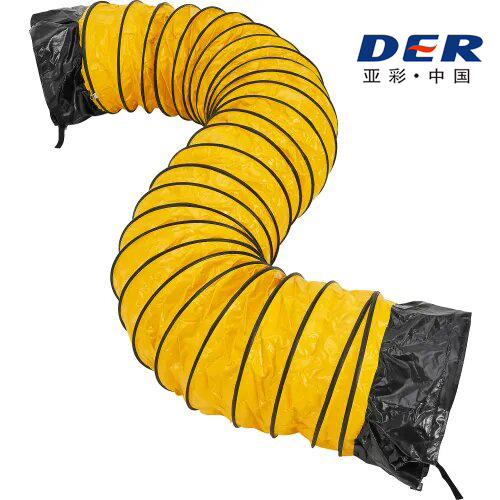
There is no single universal diameter at which flexible ducting becomes “large.” In industrial procurement, the term is commonly used when a hose is substantially larger than portable ventilation duct and begins to require project-specific review for fan matching, reinforcement, handling and connections. On this page, DERFLEX focuses on larger flexible air ducts used for moving substantial volumes of air through temporary or semi-permanent industrial systems.
Why buyers choose a flexible duct instead of rigid metal
Large rigid ductwork can be suitable for permanent installations, but it is difficult to relocate and requires more space during delivery and site assembly. A coated-textile flexible duct can be compressed, routed around temporary obstacles and connected directly to mobile ventilation equipment. This is particularly useful when the fan or work zone moves during a project.
The important distinction is that “flexible” does not mean one construction fits every pressure mode. Positive-pressure air supply can use a collapsible body that inflates during operation, while suction and extraction normally require spiral wire, rings or another structure that helps maintain the open cross-section.
Who typically specifies it?
- Industrial ventilation contractors and temporary HVAC providers
- Axial fan, blower, heater, chiller and dehumidification equipment suppliers
- Factories planning shutdown ventilation, fume extraction or process-air routing
- Construction, underground, shipyard, warehouse and maintenance project teams
- Distributors and OEM brands requiring private-label flexible duct assemblies
Start with the airflow problem, then build the duct around it
A large-diameter flexible air duct should be selected from operating data, not from diameter alone. These six questions define most of the finished construction.
Airflow direction
Fresh-air supply, return air, local extraction, process exhaust or reversible duty each place different demands on duct stability.
Fan data
Outlet diameter, airflow, static pressure and fan curve help prevent a duct from being selected independently of the equipment that drives it.
Route geometry
Total run, number of bends, bend radius, elevation changes and available clearance influence pressure loss and reinforcement.
Handling frequency
Repeated dragging, relocation and outdoor deployment may justify wear strips, reinforced cuffs, shorter sections or different packing.
Air-stream conditions
Temperature, moisture, dust, fumes and chemical exposure should be disclosed before the body material and coating are approved.
Connection strategy
Belts, soft cuffs, zippers, steel rings, clamps, reducers or fan adapters should be defined with actual interface measurements.
Large bore sizing: useful airflow starts with cross-sectional area
Increasing diameter increases the flow area quickly. That is useful for moving more air at moderate velocity, but the final duct still has to be matched with the available fan pressure, friction, bends, leakage and operating noise requirements.
A practical sizing relationship
| Nominal ID | Approx. area | Illustrative airflow at 10 m/s | Procurement note |
|---|---|---|---|
| 600 mm / 24 in | 0.283 m2 | ≈10,180 m3/h | Large portable blowers, equipment discharge and temporary ventilation. |
| 900 mm / 35 in | 0.636 m2 | ≈22,900 m3/h | High-volume jobsite supply or extraction where handling remains manageable. |
| 1200 mm / 47 in | 1.131 m2 | ≈40,700 m3/h | Large fan connections, industrial ventilation and long temporary routes. |
| 1500 mm / 59 in | 1.767 m2 | ≈63,600 m3/h | Project-sized ducts where suspension, joint loads and packing need added review. |
| 2000 mm / 79 in | 3.142 m2 | ≈113,100 m3/h | Large installations requiring coordinated fan, structure and site-handling planning. |
| 3000 mm / 118 in | 7.069 m2 | ≈254,500 m3/h | Special project reference only; feasibility depends on pressure, construction and logistics. |
Layflat or spiral reinforced? Large diameter makes this decision critical
Two ducts with the same diameter can behave very differently because one depends on internal pressure for shape while the other has mechanical reinforcement.
Large Layflat Air-Supply Duct
A collapsible coated-textile tube for forcing fresh or conditioned air from a fan to a work zone. It becomes round under positive pressure and packs flat when the fan stops.
- Useful for long supply routes where transport volume matters
- Can reduce reinforcement weight compared with a full helical-wire hose
- Suitable for suspended runs and project extension by sections
- Not automatically suitable for suction because the wall may collapse inward
Spiral Wire-Reinforced Large Duct
A shape-retaining flexible ventilation hose built around a continuous helix. The support structure helps the duct remain open during suction, fan connection and tighter routing.
- Evaluated for negative-pressure extraction and exhaust
- Works well at equipment interfaces and routes with bends
- Wire pitch and gauge can be adjusted around diameter and pressure
- External wear protection can be added for repeated ground contact
Custom large diameter flexible ducting for project and OEM supply
The values below form an RFQ framework. Final limits are confirmed after fan data, pressure mode, route and material requirements are reviewed.
Five details that matter more as the duct gets larger
Large diameter increases the consequence of weak joints, poor reinforcement spacing and inconvenient section handling. DERFLEX coordinates these details as a finished duct assembly.
Body selection
Coated textile is selected for tensile support, flexibility, weldability, moisture exposure and intended air stream.
Seam design
Welding and seam layout are reviewed with diameter, pressure and section length because circumferential loads increase with size.
Reinforcement
Wire gauge, helix pitch, rings or local support are selected around suction resistance, bend behavior and packed weight.
Interfaces
Fan cuffs, zippers, clamp zones and reducers are matched to actual dimensions to reduce improvised jobsite changes.
Handling plan
Section length, straps, lifting points, packing diameter and pallet plan are considered before shipment of oversized ducts.
Where large diameter flexible air duct is commonly useful
High-volume airflow is needed in many environments beyond a standard building HVAC system. The correct duct structure depends on how the system is installed and moved.
Temporary HVAC
Large heater, chiller and air-handling connections for construction, events, shutdowns and emergency climate control.
Industrial Ventilation
Fresh-air supply, hot-air removal and temporary process ventilation in factories and maintenance areas.
Exhaust & Fume Routing
Shape-retaining duct can be reviewed for extracting welding fumes, humid air and other disclosed industrial exhaust streams.
Drying & Dehumidification
Move conditioned air across large enclosed work areas during coating, curing, flood recovery or construction drying.
Warehouse Air Movement
Temporary or project-specific air supply across large indoor volumes where rigid duct installation is impractical.
Mining & Tunneling
Large airflow routes for underground work where diameter, pressure, suspension and safety documentation require joint review.
Shipyard & Confined Work
Portable ventilation and extraction during tank, vessel, hull or maintenance access work.
Fan & Equipment OEM
Private-label duct assemblies matched to axial blowers, packaged ventilation units and rental equipment fleets.
What to send for a useful large diameter flexible ducting quote
A short RFQ with the right technical information usually produces a more accurate proposal than a long description that omits fan and connection data.
Recommended RFQ checklist
Need a 30–48 inch duct—or something much larger?
Send a fan outlet drawing or clear dimensions together with airflow direction and pressure. DERFLEX can review whether a layflat, spiral wire-reinforced or custom transition construction is more appropriate for the job.
For very large sizes, section length and packing are evaluated with the duct geometry so the finished product remains practical to ship, lift and replace.
Request Large Duct PricingFrom coated textile to the installed duct interface
DERFLEX's ducting work combines coated-fabric knowledge with finished-product fabrication. For large diameters, that allows the body material, welded seams, reinforcement, connection hardware, suspension and packing to be considered together.
Material + fabrication coordination
Body textile and finished duct processing can be matched around weldability, flexibility, tensile demand and project handling.
Large-size project review
Project-specific ventilation sections can be evaluated beyond common 30–48 inch market sizes, subject to pressure and construction feasibility.
Complete interface package
Straight ducts, reducers, bends, branches, cuffs and fan adapters can be discussed as one coordinated airflow package.
OEM and distributor programs
Color, labels, section numbering, buyer marks and packaging can be integrated into repeat-order specifications.
Requirement-based testing
Flame-retardant and antistatic options are tied to the selected construction and named test method instead of broad unsupported claims.
Quotation built from operating data
Fan pressure, route, bends and coupling details are reviewed before the duct is treated as a simple diameter-and-length commodity.
Continue the specification with the right DERFLEX ducting resource
These pages help buyers compare general industrial ducting, pressure-specific structures, portable blower connections and custom fittings.
Large diameter flexible ducting purchasing questions
What diameter is considered large diameter flexible ducting?
There is no single industry-wide threshold. The phrase usually describes a duct that is large relative to common portable hose and therefore needs project review for airflow, pressure, reinforcement, handling and connection geometry. DERFLEX commonly treats requirements around 600 mm and above as large-project discussions, while smaller sizes can also be supplied depending on the application.
Can DERFLEX make 30, 36, 42 and 48 inch flexible duct?
These imperial diameters can be reviewed and converted into the production drawing. DERFLEX also discusses non-standard metric and imperial sizes. In suitable constructions, project-specific large ventilation sections may extend to approximately 3000 mm, with final feasibility depending on pressure, reinforcement, seam layout, section length and shipping method.
Can a large diameter flexible duct be used for suction?
Yes, but not every construction is suitable. A positive-pressure layflat duct may collapse under suction. Negative-pressure extraction normally requires a wire-, ring- or otherwise reinforced structure sized around the fan pressure, duct diameter and bend radius.
How should section length be chosen for very large ducts?
Longer sections reduce the number of joints but increase handling weight and the size of each packed coil. Shorter sections can simplify lifting, routing through bends, replacement and site storage. The practical choice balances leakage control, labor, transport and the available installation space.
Can large diameter ducting include flame-retardant or antistatic properties?
Optional constructions can be evaluated when the required standard, classification, target value and test method are provided. The claim should apply to the confirmed finished construction and its supporting documents, not to a broad product family without test context.
What affects the price of custom large diameter flexible ducting?
Diameter, section length, body material, fabric weight, reinforcement wire, helix pitch, end connections, suspension details, functional treatments, quantity, packaging and destination all influence quotation. Providing fan and connection data helps reduce unnecessary over-specification.
Can DERFLEX supply reducers, bends and fan adapters with the duct?
Project-specific reducers, elbows, Y-pieces, branches, fan transitions, special cuffs, suspension details and repair accessories can be reviewed from a drawing or measured interface. Ordering the duct and transitions as one package can simplify field compatibility.
Specify the duct around your fan—not around a catalog diameter.
Send airflow direction, fan pressure, outlet size, required diameter, route length, bends, temperature, connection style and quantity. DERFLEX will review the construction and prepare a project-based quotation for large diameter flexible ducting.