


 Industrial coated fabrics
Drop-Arm Tarp System for Roll-Off Trucks
A drop-arm tarp system uses an arm arrangement that can lower or stow out of the way at a specified stage of a roll-off truck's tarping cycle. Its value is mechanical clearance around detachable containers, not a different fabric chemistry. For fleets, equipment distributors and tarp-system OEMs, the critical cover questions are where the arms travel, how the tarp attaches to the roller or pull bar, and whether the selected mesh or solid PVC will deploy without binding. DERFLEX supports the coated fabric and custom replacement-tarp side of this application, with drawings and samples used to confirm compatibility.
For roll-off fleets, waste-equipment builders, cover-system distributors and replacement-tarp purchasers.
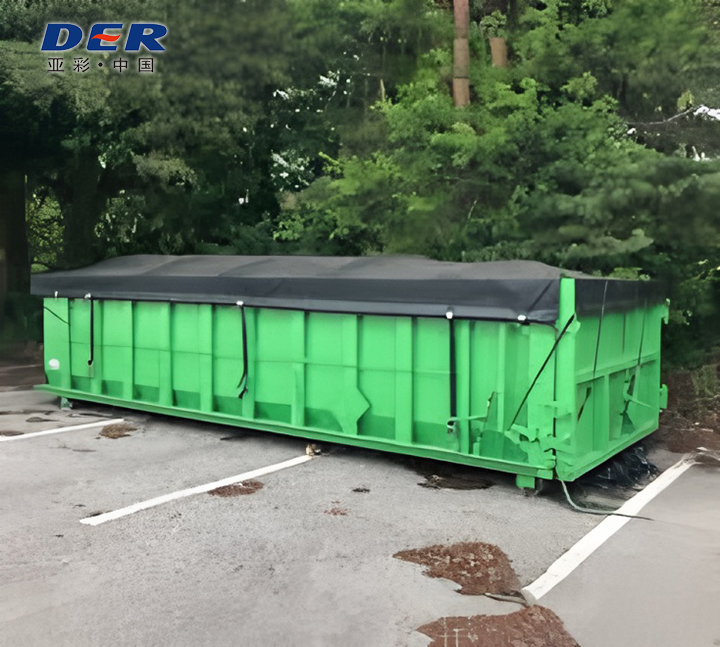
What Is a Drop-Arms System?
A drop-arm or drop-arms system is an arm-based roll-off tarping arrangement with a lowering or out-of-the-way arm position. The equipment maker determines how the arms lower, where they pivot, and whether springs, an electric roller or hydraulic components move the assembly. The term should not be treated as a standardized model specification across manufacturers.
On a typical truck-mounted roll-off tarper, a roller holds the tarp near the front of the hauling area and a pair of arms helps carry the free or leading edge over an open-top detachable container. Depending on the design, a lowered arm position can reduce exposure to container interference when a box is loaded or removed. A manufacturer of roll-off equipment describes this clearance advantage in its drop-arm design, but that statement applies to its own configuration rather than every system on the market.
For a broader overview of powered arm, gantry and armless layouts, compare DERFLEX's automatic roll-off truck tarp systems guide. This page focuses instead on drop-arm travel clearance and the compatible fabric cover.
What dropping arms may help with
Improved clearance around misaligned or differently positioned containers, easier access during selected loading phases, and potentially less exposure of arms to container interference—subject to the actual OEM geometry.
What the drop feature does not prove
It does not, by itself, establish compatibility with every roll-off box, eliminate collisions, meet transport-load regulations or validate a tarp's strength. System fit and safe operating procedures remain model-specific.
Drop Arms vs. Conventional Flip Arms vs. Armless Systems
These terms describe mechanical functions rather than DERFLEX-branded machine models. A given supplier may combine adjustable gantries, pivot arms, drop features, power rollers or different stow positions in one assembly. Compare the real operating envelope—not simply the product label.
| System concept | Operating distinction | Buyer focus | Tarp implication |
|---|---|---|---|
| Drop-arm arrangement | Arms have a specified lowered or away-from-box position | Truck and box clearance; arm stow path; loading sequence | Check cover path, pockets and snag zones through the full cycle |
| Conventional flip / swing arms | Pivot arms move the tarp across the load; rest geometry varies | Spring, pivot, arm clearance and roller positioning | Match attachment interface, span and winding behavior |
| Adjustable gantry with arms | Roller height or arm geometry adjusts across container range | Lowest/highest boxes and maximum load profile | Account for changing working distance and edge drop |
| Armless / guided system | Carriage or guide path replaces typical flip arms | Guide rails, interference and hardware design | Confirm leading edge and sliding-contact abrasion |
DERFLEX's broader truck tarp systems page connects the cover selection with the wider family of manual, electric and automatic arrangements. For the fabricated-cover business, see roll-off truck tarp materials and replacements.
Choose the Tarp Material for the Load and Arm Movement
A tarp must contain the intended cargo while winding and traveling safely through the mechanism. Drop-arm systems do not create a universal fabric specification. Total cover mass, flexibility, roll diameter, pocket build and abrasion points all matter.
PVC-Coated Mesh
Useful for many dry, bulky loads such as branches, garden waste and some recyclable materials where airflow and manageable cover mass matter. Mesh openness must still be appropriate for the actual loose material. Rain and fines can pass through.
Explore DERFLEX coated truck mesh tarpaulins for material construction and fabrication options.
Solid PVC-Coated Polyester
A practical direction when a non-porous sheet surface is required for wet or rain-sensitive cargo. Confirm installed seam and overlap design, winding torque, weight and stiffness. A waterproof-coated sheet alone does not make an entire truck cover watertight.
| Cargo / route | Material direction | Key check before approval |
|---|---|---|
| Green waste and dry bulky recyclables | Coated mesh | Opening size, debris retention, sag, flapping and contact with the arm path |
| Light packaging or mixed recyclables | Mesh or project-specific cover | Airflow versus fine-particle escape; leading edge and rear overlap |
| Rain-sensitive materials | Solid PVC-coated fabric | Sheet surface, seams, drainage, side gaps and equipment pull load |
| Sharp demolition or mixed scrap | Case-by-case reinforced construction | Remove exposed sharp projections; map puncture and abrasion exposure |
| High-cycle fleet replacement | System-approved cover construction | Roller pocket fatigue, repetitive bending, finished mass and retraction |
Do not select fabric by GSM alone. A heavy center panel may overload the roller or create tight folding. Local reinforcement at the pull edge or roller pocket can be more relevant than overall thickness. For closely related replacement sizing, see mesh dump truck replacement tarps.
Replacement Tarp Specification for Drop-Arm Systems
One truck may carry containers with different rail heights, wall shapes and lengths. A nominal 20-, 30- or 40-cubic-yard container label is not a finished tarp dimension. To manufacture a replacement, record the cover itself and its working position on the actual equipment.
| Specification field | What to submit | Why it matters |
|---|---|---|
| System identification | Make, model, truck/hoist type; arm deployed and lowered photos | Distinguishes a drop-arm path from general swing-arm applications |
| Working geometry | Actual finished width and deployed length; side drop and front/rear overlap | Controls coverage without excess folds or underreach |
| Roller interface | Spline, roller tube, sleeve or pocket shape and dimensions | Determines attachment and even winding |
| Leading edge | Pull-bar diameter, pocket, bar attachment and corner treatment | Transfers tension without concentrated tearing |
| Wear map | Locations touching arms, rails, box corners and exposed cargo | Places reinforcement only where contact occurs |
| Material requirement | Mesh versus solid PVC; cargo, climate and deployment frequency | Balances containment, permeability, flexibility and mass |
| Production controls | Approved sample / drawing revision, quantity, size series, label and packing | Supports accurate dealer and fleet reorders |
Six-step approval workflow
The broader roll-off container tarp guide covers container-mounted systems and fitted-cover measurement. For waste-stream selection, review waste truck tarp applications.
Why a Drop-Arm Cover Can Bind, Tear or Wear Early
Arm / rail contact
A lowered arm can change the contact zone during loading and tarping. Photograph any rubbing points and confirm the whole arm envelope with the OEM.
Roller pocket fatigue
Repeated bending and pull tension may fatigue a narrow pocket seam. Pocket depth, backing and geometry must suit the specific tube or spline.
Uneven retraction
Off-center tracking, bulky seams or excess material stiffness can create bunching. Check material mass and the actual roller mechanism rather than assuming more weight is better.
Snagging and sharp cargo
Peaked loads, metal offcuts or protruding debris can cut the tarp. Fix the loading profile and clearance first; patches are not a substitute for safe containment.
Edge flutter
Insufficient overlap, loose attachments or an unsuitable mesh opening can allow flutter and debris loss. Final containment must be checked on the working vehicle.
False waterproof assumption
Mesh passes water. Solid PVC sheet material can resist rain, but open gaps at the front, rear or sides can defeat whole-cover weather protection.
Application notes: Operators should follow the tarp-system manufacturer's instructions. Keep personnel clear of moving arms, suspended loads, pinch points and containers during operation. This page does not specify a machine installation procedure, substitute for structural design or certify regulatory load securement.
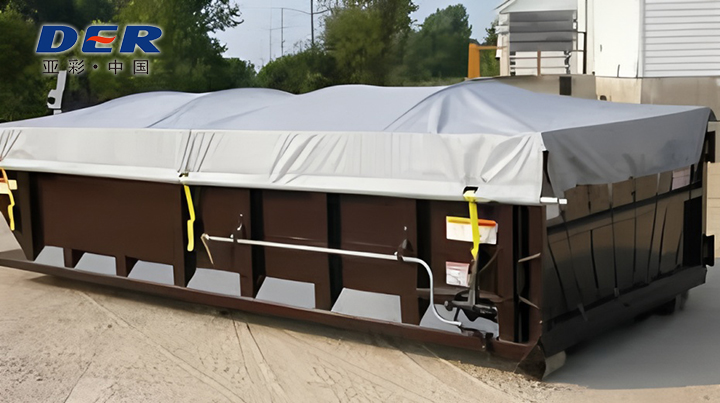
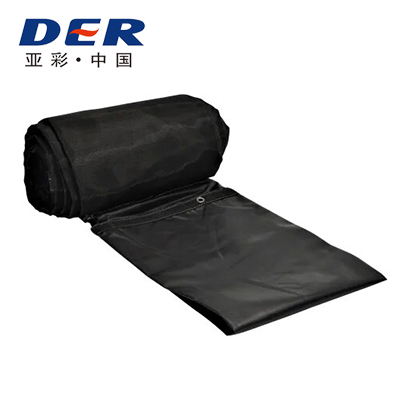
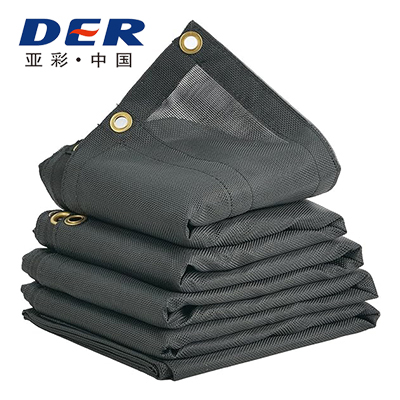
Real Roll-Off Cover and Mesh Material Images
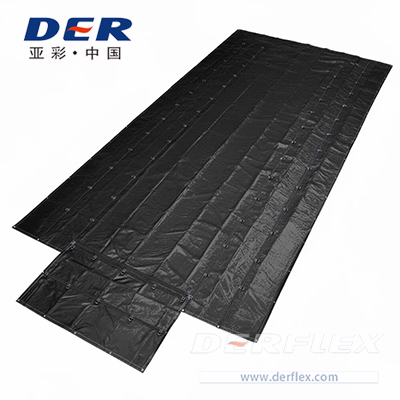
These existing DERFLEX up/pro/ images illustrate replacement covers, fitted container covers and coated mesh. They do not show or establish a specific drop-arm mechanism, electric drive or completed truck installation.
What DERFLEX Can Supply — and What Requires the Equipment OEM
DERFLEX tarp-side scope
- PVC-coated mesh or solid PVC-coated polyester rolls for fabricators
- Cut or converted panels for agreed applications
- Custom replacement tarps with documented pockets, hems, wear strips and attachment layouts
- OEM / distributor size ranges, labels and private-label packing subject to quotation
- Material and finishing sample review against a confirmed drawing
Confirm separately with the equipment OEM
- Drop arms, pivot links, springs and gantry assemblies
- Motor, electrical, remote-control and hydraulic components
- Chassis mounting, clearances and structural ratings
- On-vehicle installation, controls, guarding and safe operating procedures
- Vehicle-specific approvals and load-securement obligations
Send DERFLEX your truck type, the actual tarp, mechanism photos, material preference, known wear issues, target quantity and delivery destination. Material and fabrication pricing depends on the selected coated-fabric construction, finished area, pocket and seam work, reinforcement, labeling, packaging and order structure. No unverified equipment price or standard lead time is assumed here.
Explore the DERFLEX Truck-Tarp Topic Cluster
Drop-Arm Tarp System FAQ
What is a drop-arm tarp system on a roll-off truck?
A drop-arm tarp system is a roll-off tarping arrangement in which the arm assembly can move into a lower, out-of-the-way position in the relevant part of its operating cycle. The exact drop movement, lifting geometry and controls are specific to the equipment maker.
Is a drop-arm system the same as a flip-arm tarp system?
Not necessarily. Both can use arms to move a retractable tarp, but “drop-arm” emphasizes an arm-clearance or stowage feature. A conventional flip-arm setup does not necessarily have the same lowered resting position. Compare drawings and operating envelopes for the actual model.
Does DERFLEX sell the complete drop-arm mechanism?
This page covers DERFLEX coated-fabric materials and custom replacement tarps. Steel or aluminum arms, hydraulic cylinders, motors, controls and truck installation are not included unless a project quotation explicitly confirms them.
What material is best for a drop-arm truck tarp?
Choose coated mesh when airflow and lower cover weight are important and the load can be contained with the chosen mesh openness. Choose solid PVC-coated polyester when closed-surface weather shielding matters. Confirm roller capacity, movement clearance, load profile and finishing with the system provider.
How do I measure a replacement tarp for drop arms?
Record the existing finished width and deployed length, roller or spline interface, front and rear attachment, flap depth, pull bar and pocket geometry. Photograph the arms stowed, raised and deploying, including all rubbing and snag zones. Container cubic-yard capacity alone is not a tarp size.
Can I install a heavier tarp to make the system more durable?
Not without checking the system limits. Extra fabric weight, stiffness or reinforcement may change roller torque, folding and tracking. Often a local wear strip, revised pocket or corrected clearance is more effective than increasing the whole sheet weight.
Are drop-arm mesh tarps waterproof?
No. Open mesh lets air and water pass. Solid PVC-coated fabric can resist water through the sheet surface, but installed rain protection also depends on seams, edge overlap, open gaps and attachment details.
Need a Replacement Tarp That Works With Your Drop-Arm Layout?
Share the existing tarp or approved drawing, close-up pictures of both end interfaces, arm movement clearance, material preference, load type and annual volume. DERFLEX can review an appropriate coated-fabric and finished-cover scope for your fleet, dealer or OEM program.