Rapid Deployment
Cover sections, fold direction, center marks and identification should help crews orient a large tarp quickly when weather changes during harvest.



DERFLEX harvest grain covers are large-format protective tarps for grain that must move quickly from field to temporary storage during harvest peaks. They can be specified for outdoor piles, low-wall bunkers, commercial overflow yards and reusable on-farm storage programs.
Instead of treating the cover as a generic sheet, buyers can define pile geometry, storage duration, rainfall and wind exposure, cover weight, welded panel layout, perimeter reinforcement, tie-down details and deployment packaging as one finished program.
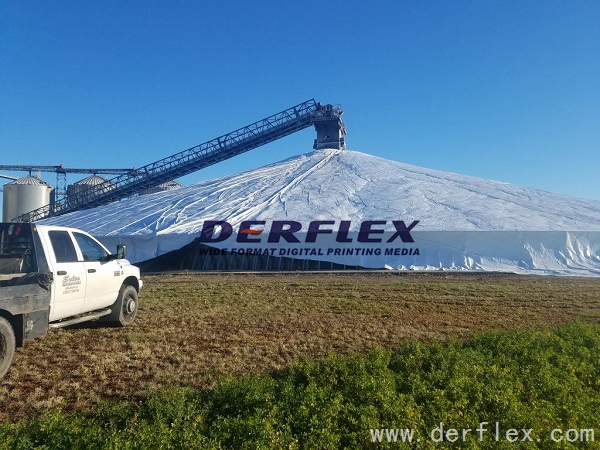
A harvest grain cover is a weather-resistant tarp or fabricated cover used to protect grain during temporary or seasonal storage after harvest. It is commonly used over corn, wheat, soybean, barley and other bulk grain stored in outdoor piles or bunkers when permanent silo capacity is unavailable or when receiving volumes exceed normal storage space.
Harvest overflow has a different operating rhythm from ordinary outdoor covering. The useful specification begins with how quickly the site fills, how the cover will be deployed, how often it will be opened or reused, and where water and wind loads will go after installation.
Cover sections, fold direction, center marks and identification should help crews orient a large tarp quickly when weather changes during harvest.
Pile profile and tarp tension should create a continuous runoff path so rainfall does not collect in low spots or transfer water toward the grain perimeter.
Large solid covers need distributed edge restraint. Reinforced hems, webbing, straps, D-rings or project-defined tie points should correspond to real site anchors.
Reusable harvest covers should account for dragging, folding, abrasion, seam intersections, corner stress and storage between seasons—not just initial waterproofing.
GSM or mil thickness is only one input. A more reliable purchase decision combines storage duration, cover handling, pile geometry, exposure, fixation method and the expected reuse cycle.
| Harvest storage scenario | Main risks | Cover direction | Fabrication focus | Buyer should confirm |
|---|---|---|---|---|
| Emergency harvest overflow | Unexpected rain, limited setup time, handling pressure | Waterproof reinforced cover selected for the intended season | Fast unfolding, clear orientation, secure perimeter | Finished size, anchor layout, crew deployment method |
| Temporary on-farm grain pile | Rain, wind uplift, UV exposure, ground moisture | Reinforced cover with project-defined durability level | Runoff slope, edge reach, wear zones, tie-down points | Storage duration, pile surface path, drainage and aeration |
| Low-wall grain bunker | Large span, seam stress, wall contact, repeated tension | PVC-coated or other reinforced cover direction according to project requirements | Welded panel map, reinforced edges, protected contact points | Wall height, top profile, side drop, edge fixing system |
| Reusable seasonal cover program | Repeated folding, abrasion, repairs, batch identification | More robust reusable coated-fabric direction | Repairability, stenciling, packaging and seasonal storage | Reuse target, handling frequency, packing format, labeling |
| Commercial harvest receival yard | Multiple piles, fast changeover, cover identification | Repeatable custom finished sizes | Panel numbering, center marks, standard tie-down pattern | Number of piles, repeat dimensions, storage flow, destination |
These material references are already published by DERFLEX for grain pile cover applications. They are practical starting points for RFQ discussion; final selection still needs confirmation against climate, storage duration, handling frequency, finished size and reinforcement layout.
| DERFLEX reference | Base fabric | Construction | Published weight | Harvest-cover direction |
|---|---|---|---|---|
| DG23 | 200D × 300D | 18 × 12 | 340 gsm / 10 oz | Lighter verified grain-cover reference; confirm exposure, duration and handling requirements. |
| DG55 | 500D × 500D | 9 × 9 | 440 gsm / 13 oz | Mid-duty verified reference for projects needing more body and repeated handling. |
| DG35 | 300D × 500D | 18 × 12 | 440 gsm / 13 oz | Alternative 440 gsm structure; final choice should follow tear, flexibility and fabrication needs. |
| DG11 | 1000D × 1000D | 9 × 9 | 610 gsm / 18 oz | Heavy-duty direction for reusable covers and larger fabricated panels. |
| DG1122 | 1000D × 1000D | 20 × 20 | 610 gsm / 18 oz | Denser heavy-duty reference where robust woven support is preferred. |
| String-reinforced option | Project-defined | Reinforced cover construction | 6 / 8 / 10 mil listed | Confirm current composition, UV direction, finished size and intended service environment before order. |
Other dimensions, weights, colors, reinforcements and finished-cover details can be discussed according to project requirements. Parameters not shown here should be confirmed with DERFLEX rather than assumed.
Large harvest covers are most vulnerable at interfaces: seams, edges, anchors, low spots, wall contacts and handling points. Designing these before production can prevent problems that a heavier sheet alone cannot solve.
Measure the actual surface path over the pile, side drop, wall height and anchor reach. Ground footprint alone can understate the finished cover size.
Panel layout should support water shedding, fabrication width and expected tension. For compatible PVC constructions, welded seams can create continuous waterproof joints.
Reinforcement should spread pull into a wider area around hems, corners and tie points rather than placing the entire load on isolated eyelets.
A smooth slope and prepared site help prevent water pockets. The cover should move rain away from the grain and away from low perimeter areas.
For large covers, fold direction, roll format, center marks and section identification can materially affect how quickly a crew can position the tarp.
Aeration ducts, sampling access, chutes, vents and any fumigation-related components should be defined before fabrication so the cover is not improvised in the field.
This harvest-focused workflow separates the page from a general grain-tarp listing. It helps farm managers, grain handlers and procurement teams turn a tarp purchase into an executable seasonal storage plan.
Record pile or bunker dimensions, drainage direction, perimeter access, anchor positions and any rough contact areas.
State grain type, expected storage duration, aeration or monitoring approach, climate and reuse expectations.
Confirm finished size, panel seams, edge reinforcement, tie points, markings, folds or roll direction and packaging.
Install with even tension, protect high-wear contact points and keep the perimeter controlled to reduce wind entry.
Check water runoff, edge movement, damage, cover tension and the stored-grain management system during the season.
The difference is not a marketing label. It is the level of control over geometry, fabrication, reinforcement, deployment and repeat supply.
Real DERFLEX website assets are used below to show large-format cover scale, perimeter restraint and coated tarp construction. Images are displayed without aggressive cropping so buyers can see the complete application.
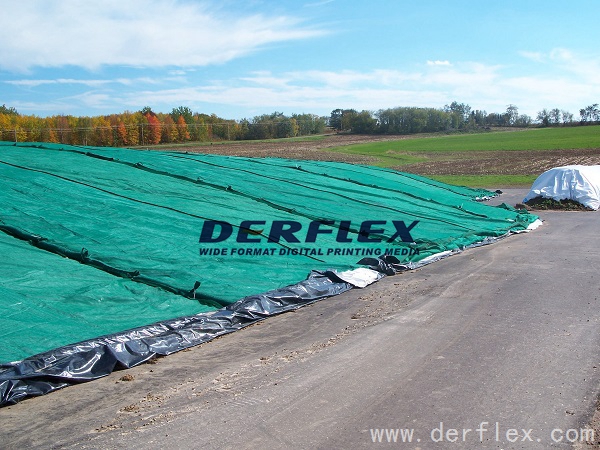
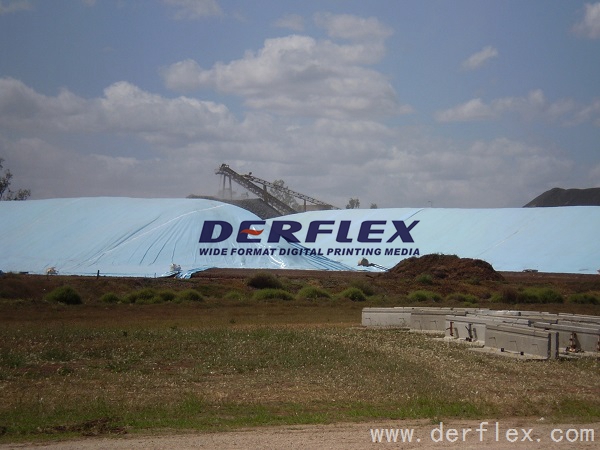
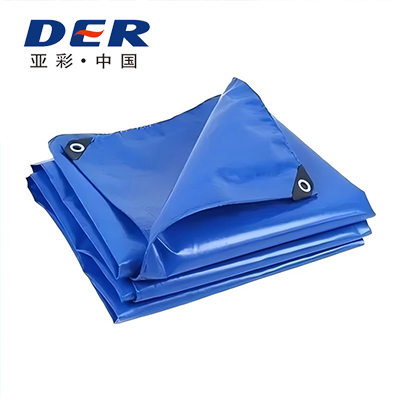
These are specification and installation problems that can undermine a large cover even when the base material itself is waterproof.
The cover follows the pile surface and needs side reach for anchoring. A plan-view length × width is rarely enough for a large irregular pile.
Excess loose fabric or a poor pile profile can create low spots. Water pockets add static load and can pull on seams and tie points.
Large covers need distributed load paths. A few heavily loaded corners can concentrate stress and allow wind under the perimeter.
A cover can be correct on paper and still be difficult to install. Folding, rolling, center marks and section IDs should match the field crew's method.
Gravel, concrete edges, bunker walls and hardware can damage coated fabric. Use handling controls and local reinforcement where contact is unavoidable.
External weather protection does not replace grain-condition control, drainage, aeration, monitoring or professional fumigation design where applicable.
A complete RFQ allows material and fabrication decisions to be reviewed together, reducing the risk of wrong sizing or missing hardware details.
For distributors, grain-storage suppliers, farm groups and commercial projects, DERFLEX can discuss the coated-fabric direction and the finished cover details together instead of separating the material from the fabrication plan.
These verified DERFLEX pages support adjacent purchasing decisions while keeping this page focused on harvest-season storage and overflow planning.
Send the grain type, pile or bunker drawing, finished dimensions, storage duration, climate, material direction, edge / tie-down layout, aeration interfaces, quantity and destination. DERFLEX can review a practical material and fabrication direction for sampling or B2B production.
Direct answers to common questions from farms, grain handlers, distributors and storage-system buyers.
The best tarp depends on storage duration, pile size, climate, wind exposure, handling frequency and whether the cover will be reused. For demanding reusable programs, PVC-coated polyester is a practical direction because it can combine waterproof coating, strong woven support, welded fabrication and reinforced edge details. Temporary storage may use lighter reinforced constructions when the exposure and storage plan allow it.
The cover material can be specified as waterproof, but the finished storage system also depends on seam quality, water shedding, perimeter control, drainage and installation. A waterproof sheet with poor seam or site design can still allow water problems around the stored grain.
Measure the actual path over the pile rather than only the ground footprint. Include the crown or peak, slopes, side drops, bunker-wall height and the extra reach needed to connect to the restraint system. For irregular or very large piles, provide a dimensioned top and side drawing.
Use distributed perimeter restraint, suitable anchors, controlled tension and a fit that limits wind from getting underneath. Reinforced hems, webbing, straps, D-rings or project-defined tie points can spread load more effectively than relying on a few isolated eyelets.
Yes, but the cover restraint, air inlets, ducts, suction and condensation-control strategy need to be coordinated with the storage system. Required airflow paths should not be blocked simply to make the cover look tighter.
DERFLEX can discuss custom finished sizes, coated-fabric direction, welded panel construction, reinforced hems, tie-down details, identification printing and B2B packaging. Send the pile or bunker dimensions, storage plan, exposure, quantity and destination for specification review.