


How to Secure a Tarp in High Winds
Keep the tarp low, remove loose fabric, spread pull across reinforced attachment points, match the tie-down to the anchor, and stop wind from getting underneath the cover. The installation matters as much as the tarp material.
Secure the tarp before the weather arrives. Start with sound, reinforced corners; tension opposite corners in diagonal pairs; then add evenly distributed tie-downs along every exposed edge. Use stable anchors, protect sharp contact points, add controlled elasticity where appropriate, and create enough slope to prevent water pooling. Do not rely on only four corners or on one over-tightened grommet.
What Is the Best Way to Keep a Tarp from Blowing Away?
The best high-wind setup controls lift, flapping and concentrated pull. Keep the cover close to the object or frame, secure the windward edge first, distribute tension through reinforced grommets, D-rings, webbing or purpose-designed clips, and use enough anchors that no single point carries most of the load.
A tarp that is heavy but loose can still fail. A properly fitted tarp with reinforced edges, stable anchors and even tension usually performs better than an oversized tarp tied only at the corners.
How to Secure a Tarp in High Winds in 9 Steps
This sequence reduces the two failure patterns that show up repeatedly in exposed tarp installations: wind getting under a loose edge and too much force being concentrated at one fixing point.
Inspect the tarp, edge and anchors first
Do not tension through torn fabric, elongated eyelets, cracked straps, loose hooks or unstable anchor points. Repair or replace damaged components before the next wind event.
Reduce the wind-catching profile
Fit the tarp close to the covered object or support structure. Where orientation is flexible, avoid presenting a broad loose face to the prevailing wind and do not leave an open windward edge that can scoop air.
Pad sharp and abrasive contact points
Protect corners, rails, pipe ends, sheet metal and rough surfaces with compatible padding or wear protection. High wind turns small rubbing points into repeated abrasion cycles.
Set the corners in diagonal pairs
Attach opposite corners first and bring the cover into position without over-tightening one side. Balanced corner tension makes it easier to remove wrinkles without pulling a single corner beyond the strength of its reinforcement.
Add intermediate tie-downs along exposed edges
Do not rely on four corners for a large tarp. Use the planned reinforced fixing points along the perimeter so edge flutter is controlled and the wind load is shared across more of the cover.
Match the connector to the attachment point
Use rope or elastic ties through suitable grommets; hooks, straps or buckles through reinforced D-rings or webbing assemblies; and purpose-designed tarp clips only on sound material. Avoid applying heavy ratchet force to unsupported eyelets.
Add secondary restraint where consequences are high
For equipment, storage piles or other suitable installations, a secondary perimeter line, cross-lashing, additional strap path or weighted lower edge can reduce movement if one primary connection loosens. The secondary system still needs safe, stable anchors.
Create drainage and eliminate deep pockets
Wind and rain often arrive together. Give the tarp a continuous slope or supported shape so water cannot collect in a sagging bay and add extra load to grommets, seams and anchors.
Do a pre-storm walk-around
Check the windward edge, corners, tie-down wear, anchor movement, slack, pooling and sharp-contact zones before severe weather begins. Retension only enough to restore a smooth, controlled fit.
Bungees, Rope, Ratchet Straps, D-Rings or Ballast?
No connector is best in every installation. High-wind performance depends on how the connector transfers load into the reinforced tarp edge and into a stable anchor.
Elastic Bungees / Rubber Straps
Useful where controlled stretch can absorb short gusts and reduce shock loading. Inspect for aging and avoid excessive extension that allows the tarp to flap.
Rope & Lacing
Flexible for perimeter tying, irregular anchor layouts and continuous lacing. Use knots and rope routes that do not saw across sharp tarp edges or pull a grommet sideways.
Ratchet / Cam Straps
Useful for strong, adjustable restraint when attached to load-appropriate D-rings, webbing or approved frame points. Too much ratchet force can deform or pull out an unsupported grommet.
D-Rings & Webbing
Good for defined hook or strap connection points. Their benefit comes from the backing patch, webbing route, ring orientation and how the load is spread into the tarp.
Tarp Clips / Grippers
Useful when extra temporary attachment points are needed and the fabric is sound. For severe exposure, manufactured reinforced points are generally easier to specify and repeat.
Ballast / Weighted Edges
Helpful on hard surfaces where ground anchors are not practical. Weight must be stable, safely positioned and sufficient for the real exposure; loose blocks or improvised objects can become hazards.
How to Secure a Tarp to Ground, Frames, Concrete and Vehicles
The tarp connection is only as reliable as the anchor behind it. Select the anchor from the actual surface and the consequences of failure, not just from what hardware is convenient.
| Surface / Application | Practical Anchor Direction | High-Wind Focus | Common Mistake |
|---|---|---|---|
| Grass / soil | Suitable stakes, screw/auger anchors or project-approved ground anchors | Check soil condition, pull direction and spacing; anchor outward from the tarp where appropriate | Using short light stakes in loose or saturated ground |
| Concrete / asphalt | Engineered ballast, weighted bags/plates or approved fixed anchors | Keep ballast from sliding and keep the lower edge controlled | Using loose blocks that can shift or become hazards |
| Wood framing | Dedicated frame anchors, eye bolts or compatible fasteners where the structure permits | Spread load into the frame and protect tarp contact points | Nailing directly through the tarp or loading one small eyelet |
| Metal frame / fence | Approved hooks, straps, bungees, lacing or D-ring connections | Avoid sharp metal abrasion and sideways pull through grommets | Running rope over bare sharp edges |
| Truck / trailer | Vehicle-specific rails, hooks, straps, D-ring rows or tarp systems | Account for dynamic wind, vibration, folding and road exposure | Treating the tarp itself as cargo securement |
| Roof / elevated structure | System-specific securement installed only under safe conditions | Wind uplift, edge wrapping, roof damage and fall risk need specialist judgment | Going onto a roof after dangerous weather has started |
Important: A tarp protects or contains; it does not automatically replace load-rated cargo securement, structural anchorage or engineered scaffold / roofing requirements.
Choose the Tarp Around Wind Exposure, Not GSM Alone
A heavier tarp may improve durability, but it also presents a larger solid surface to the wind. The better specification coordinates material, fit, edge structure and fixing layout.
| Use Condition | Material Direction | Edge / Hardware Direction | Why It Matters |
|---|---|---|---|
| Sheltered temporary cover | Application-matched PE or coated tarp | Reinforced corners + practical perimeter ties | Focus on fit, rain shedding and preventing loose corners |
| Exposed equipment / outdoor storage | Waterproof PVC coated polyester where rain blocking is required | Reinforced hem, corner patches, multiple tie-downs | Reduces localized pull and edge flutter during repeated outdoor exposure |
| Truck / trailer cover | Heavy-duty coated fabric selected for dynamic use | Webbing, D-rings, grommets, straps and wear zones mapped to the vehicle | Road wind and vibration create cyclic loading that static covers do not see |
| Wind screen / privacy / debris control | PVC mesh when airflow is more important than full waterproofing | Reinforced perimeter and frequent planned fixing points | Mesh allows air through and can reduce pressure compared with a solid sheet |
| Large scaffold / temporary enclosure | Solid, mesh or mixed zones selected with the enclosure concept | Project-defined fixings, seams, overlaps and reinforcement | A solid enclosure changes wind load on the supporting structure and may require engineering review |
Use More Than Material Weight
Specify base fabric, coating, finished size, seams, reinforced edge, corner geometry and hardware as one system.
Map the Real Anchors
Hardware positions should align with usable rails, hooks, frames or ground anchors instead of forcing diagonal pull across the hem.
Treat Spacing as a Starting Point
Exposed/high-control edges are often discussed with closer spacing, such as roughly 12–18 in, but panel size, reinforcement and anchor capacity must decide the final layout.
What Tarp Damage Tells You About the Tie-Down System
Damage location often reveals whether the problem is material strength, installation geometry, abrasion or anchor layout.
| Observed Problem | Likely Cause | Better Direction |
|---|---|---|
| Grommet pulls out | Too much force at one point, weak hem backing, sideways pull or over-tightening | Improve reinforcement, align the pull, use more load-sharing points or move high loads to D-rings/webbing |
| Corner tears diagonally | Combined load from two edges concentrated into one small corner area | Use larger corner patches, crossed webbing or a dedicated corner attachment design |
| Edge flaps between tie-downs | Spacing too wide, tarp oversized, anchor line too far away or uneven tension | Improve fit, add planned intermediate points and retension the full edge evenly |
| Rope cuts or polishes an edge | Repeated friction against fabric or metal hardware | Change rope route, add sleeves/padding, use webbing loops or create a defined connection point |
| Water collects in a low spot | Insufficient slope, unsupported span or stretched center panel | Add support or pitch so water sheds continuously and cannot add static load |
| Anchor moves but tarp stays intact | Anchor capacity or substrate is the weak link | Upgrade the anchoring method; stronger tarp fabric does not solve a weak ground/frame connection |
When a Mesh Tarp Can Be Better in Wind
A solid waterproof tarp blocks rain but catches more air. Where full waterproofing is not required, a mesh tarp can let air pass through and reduce pressure on the cover and its fixing system.
Use Solid PVC When
- Rain and dust exclusion are primary requirements.
- Truck cargo, equipment or stored goods need a waterproof barrier.
- The cover can be fitted closely with strong edge control.
- The support and anchors are suitable for a relatively impermeable surface.
Use PVC Mesh When
- Shade, privacy, debris control or airflow is more important than waterproofing.
- Reducing wind pressure is valuable for fencing, screens or selected transport covers.
- The application benefits from a breathable, wind-permeable surface.
- The perimeter can still be reinforced and properly tensioned.
Real Product and Manufacturing Images for This Guide
The image set below uses existing DERFLEX website assets and is arranged for Google Images, visual trust and topical support around grommets, reinforced edges, wind-relief mesh and manufacturing.
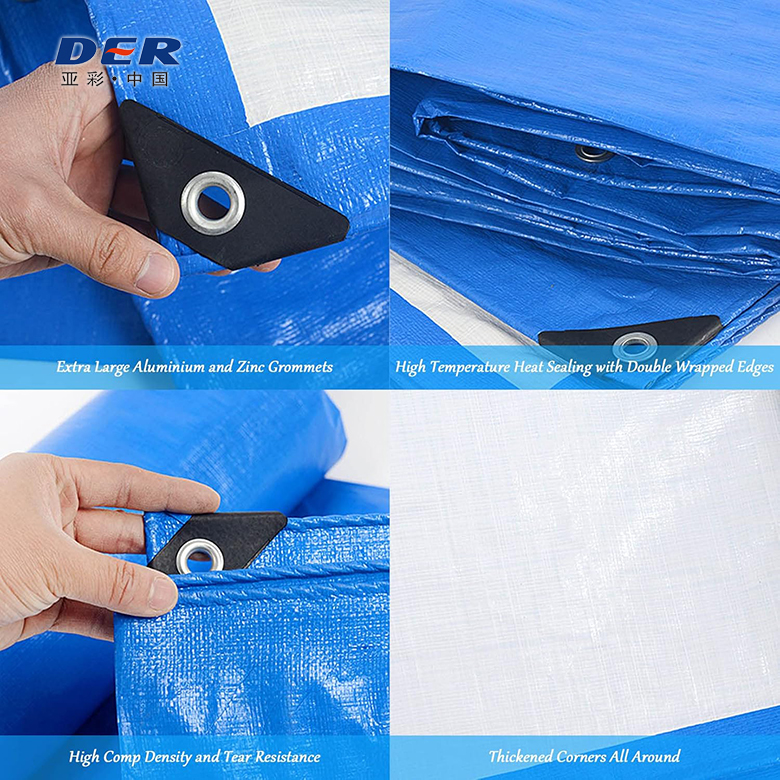
High-wind performance depends on the reinforcement behind the eyelet, not only on the metal grommet.
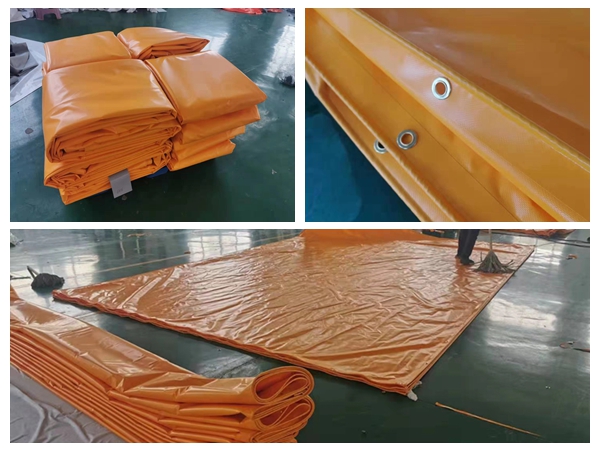
Reinforced hems and repeatable hardware placement make a custom tie-down layout easier to control.
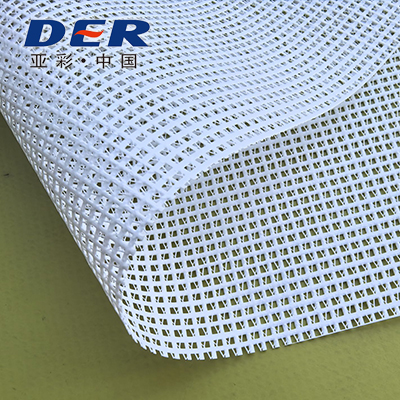
Mesh lets air pass through where full waterproof coverage is not required.
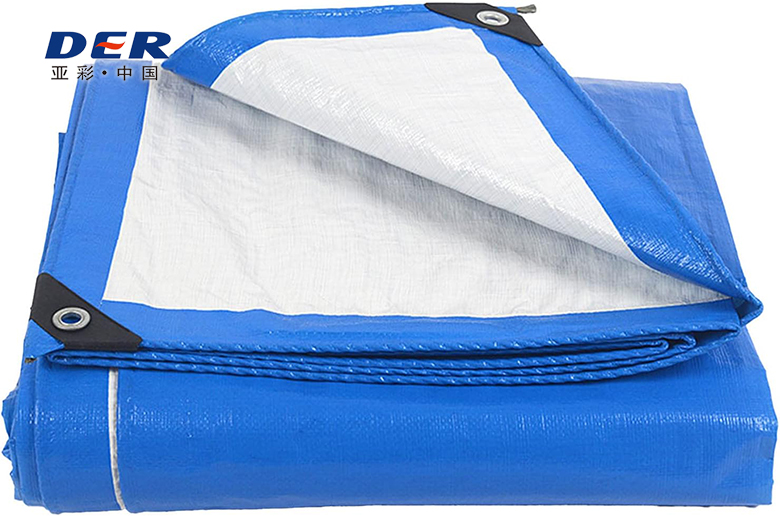
Corner patches and edge build-up help spread pull away from a single point.
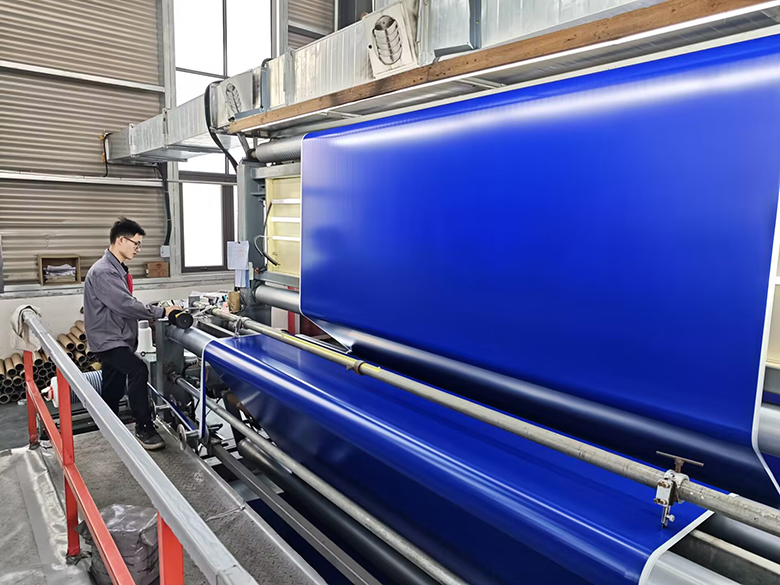
Material structure and finished-cover engineering should be discussed together for repeat B2B supply.
What to Specify When You Need a Tarp for Wind Exposure
For a custom tarp, the most useful RFQ describes the installation and load path rather than asking only for a heavier GSM.
Application & Exposure
Describe the covered object, indoor/outdoor use, expected wind exposure, rain requirement, UV exposure, temperature and handling frequency.
Finished Geometry
Provide finished dimensions, side drops, overlap, frame geometry, anchor locations, photos or a marked drawing for shaped covers.
Fixing & Reinforcement
State grommets, D-rings, webbing, straps, pockets, rope hems, corner patches, wear zones and any required center-to-center hardware positions.
Build the Tarp Around the Real Wind and Anchor Conditions
Send DERFLEX the application, finished size, wind exposure, anchor geometry, preferred material, solid or mesh direction, edge reinforcement, grommet / D-ring layout, quantity, branding and destination. The team can review a practical material-and-fabrication direction for sampling or B2B quotation.
Continue from Installation into Tarp Specification
These six existing DERFLEX pages support adjacent decisions without duplicating the intent of this high-wind installation guide.
Questions About Securing Tarps in Strong Wind
Short, answer-first responses are included for users, Featured Snippet-style extraction and AI overview understanding.
How do you keep a tarp from blowing away in high winds?
Keep the tarp close to the covered object, secure the windward edge, tension opposite corners evenly, and use multiple reinforced tie-down points along the perimeter. Stable anchors and low-flap fit matter more than simply choosing the heaviest tarp.
Should a tarp be completely tight in strong wind?
No. It should be smooth and firmly controlled, but not stretched so hard that one grommet, seam or corner carries excessive load. Controlled elasticity can help absorb gusts in suitable temporary installations.
Are bungee cords or ratchet straps better for a tarp?
Bungees provide shock absorption; ratchet straps provide strong, adjustable restraint. Ratchet straps should be connected through suitable reinforced D-rings, webbing or approved anchor systems rather than used to over-tighten weak eyelets.
How far apart should tarp tie-down points be in windy areas?
There is no universal spacing. Closer layouts such as roughly 12–18 inches are often discussed for exposed or high-control edges, but finished tarp size, reinforcement, anchor capacity, pull direction and actual anchor positions should determine the final spacing.
Can I secure a tarp without grommets?
Yes. Purpose-designed tarp clips or grippers can add temporary attachment points on sound fabric, and custom covers can use D-rings, webbing loops, pockets or straps. Avoid improvised holes in unreinforced fabric because they create a tear starter.
Is a mesh tarp better than a solid tarp in high winds?
Mesh can be better when airflow, shade or debris control is the priority because it lets air pass through and can reduce wind pressure. Solid PVC is better when waterproof protection is required, but it needs stronger control of fit, edges and anchors.
What wind speed can a tarp handle?
A tarp does not have one universal safe wind-speed limit. Performance depends on panel area, orientation, material, reinforcement, hardware, anchor capacity, support structure, terrain and installation. Do not infer a wind rating from GSM or grommet spacing alone.
How do I stop a tarp from tearing around the grommets?
Distribute load across more reinforced points, align each tie with the intended pull direction, avoid over-tightening, reinforce corners and hems, and move high-tension strap connections to D-rings or webbing assemblies when appropriate.