News
Company News

Long Jump Pit Covers | Custom Perimeter Details | DERFLEX

Update:2026/10/20 20:39:07 Views:
DERFLEXCOATED FABRICS & CUSTOM TARPS
Home   /   Long Jump Pit Tarp Covers
Track & field / Custom cover programs

Long Jump Pit Tarp Covers with Custom Perimeter Details

Specify long jump pit covers around the sand pit, the surrounding track and the people who uncover it every day. DERFLEX supports PVC coated fabric and custom tarp programs for athletics facilities, sports contractors, distributors and OEM buyers.

Start with solid PVC or permeable mesh, then define finished size, overlap, reinforced hems and the securing arrangement. Send a dimensioned pit sketch and site photos to discuss a cover construction, including any weighted-edge requirement.

Custom finished sizeMaterial + edge reviewBulk & OEM inquiries
DERFLEX material reference01 / PVC tarp
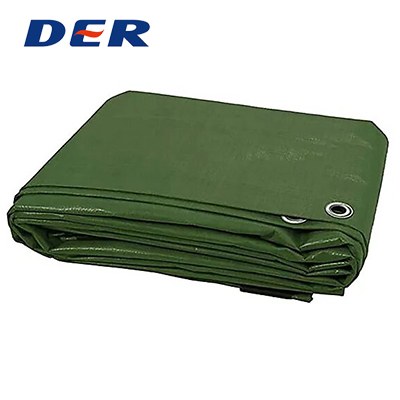
Folded green DERFLEX PVC tarp with reinforced perimeter and metal eyelets
Actual DERFLEX finished tarp reference. Pit-specific geometry, weighted pockets and fittings are agreed separately in the production drawing.
Solid or meshChoose how rainwater is handled
Measured to the siteRim, overlap and clearances
Defined perimeterHems, pockets or fixing points
Practical handlingPanel mass, folding and storage
The buying decision

Protect the sand.
Plan the edges.

A long jump pit cover is a removable sheet used over a closed athletics sand pit to reduce leaves, litter and other debris entering between sessions. A solid cover can also limit rain passing through the fabric; a mesh cover allows water through.

The specification becomes useful when it explains how the cover meets the rim, how each edge is retained and how staff remove it without dragging hardware across the track. A generic rectangle and a fabric weight leave these questions open.

What should buyers specify first?

Decide whether rain should be shed or allowed through, measure the intended finished footprint, and define the perimeter treatment for each side. Then review material strength, panel weight and removal procedure together.

01 / Material selection

Solid PVC or mesh? Follow the water.

Choose solid PVC for a rain barrier through the sheet. Choose mesh for a permeable debris cover over a suitably drained pit. Neither option replaces pit drainage or routine sand maintenance.

Selection matrix for long jump and triple jump pit covers
Site prioritySolid PVC coated polyesterPVC coated polyester mesh
Rain managementLimits rain passing through intact fabric. Specify welded seams and manage water collecting on top.Allows rain through. Confirm the pit's drainage and the selected mesh opening.
Leaves and debrisA continuous sheet helps separate the sand from surface debris while the perimeter stays closed.Retains debris larger than the openings. Fine dust and small particles can pass through.
Daily openingRemove pooled water before lifting. Include wet handling conditions in the operating plan.Permeability reduces water held on the surface, but leaves can block openings.
Wind exposureReview edge lift and the complete securing system for the cover area.Air permeability may reduce pressure differences, but does not establish safe ballast or a wind rating.
Buyer acceptanceConfirm coating, fabric weight, seam construction and any agreed water-barrier check.Confirm opening size, retained debris, edge finish and joining method on a sample.

Review the PVC tarpaulin material range when a solid, weldable cover is required.

Explore PVC mesh tarp options when drainage through the cover is part of the brief. Confirm a pit-appropriate mesh rather than choosing by color alone.

Know before ordering: “Waterproof fabric” describes the sheet material. It does not mean that the installed cover prevents all water entering around its edges or that unsupported fabric will shed standing water.
02 / Fit & measurement

Measure the landing area for the cover.

Record the sand opening and outside rim separately. Finished cover dimensions must account for the surface where the perimeter will actually rest.

Long jump pit cover measurement planTop-view schematic shows a runway at the left, a sand opening inside the outside rim, and a larger dashed cover footprint. Measure length and width, then agree each side's overlap. Runway side Sand openingMeasure separately from outside rim Outside rim length Outside rim width Dashed line = finished cover footprintConfirm overlap and pocket placement on every side.
Illustrative plan only; not to scale. The runway-facing edge may need a different detail from the other three sides.

A useful survey takes four passes.

  1. Measure the pit and the rim.

    Record length and width at several points, both diagonals, rim height and any corners that are not square.

  2. Map the perimeter.

    Photograph the runway approach, drain channels, kerbs, existing sockets and nearby obstructions. Mark the space available beyond each edge.

  3. Agree the finished footprint.

    Show the overlap on each side and the intended location of pockets or fixings. A nominal sand opening is not a finished cover size.

  4. Leave cutting allowances to fabrication.

    State finished dimensions and tolerance on the drawing. Hem folds, welded joints and pocket development are separate manufacturing allowances.

Finished-size & fabric-mass planner

For a rectangular pit with equal overlap on all four sides. Values below are an illustrative calculation, not a standard pit size or material recommendation.

Finished footprint / area9.30 × 3.30 m / 30.69 m²
Fabric-only mass18.4 kg

Length = rim length + 2 × overlap; width = rim width + 2 × overlap. Fabric mass = finished area × g/m² ÷ 1,000. Actual mass adds seam overlaps, hems, pockets, reinforcement, ballast and hardware. This tool does not select ballast or calculate wind resistance.

More on finished dimensions and made-to-measure tarp fabrication →
03 / Custom perimeter details

Write the edge specification side by side.

An exposed outer edge, a runway-facing edge and a storage-fold line perform different jobs. A marked drawing helps prevent a convenient detail on one side becoming an obstruction on another.

DETAIL / A

Weighted pocket concept

A contained ballast pocket can help seat the edge without placing loose weights individually. Confirm pocket position, continuity, corner transitions and whether ballast is removable.

Confirm before production

Ballast type and mass per metre, active weighted length, pocket closure and corrosion protection. Ask whether ballast is supplied with the cover or sourced locally.

DETAIL / B

Reinforced fixing edge

Where an approved attachment system exists, agree hem reinforcement, hardware positions and the pull direction. A grommet layout should follow the surveyed fixing points.

Confirm before production

Hole or ring dimensions, spacing, backing patches and connector compatibility. Keep exposed fittings and loose lines out of routes used by athletes and maintenance staff.

DETAIL / C

Runway-side transition

Show where the cover meets the runway and where its edge will rest while the pit is closed. Check available clearance before specifying a bulky pocket or projecting fitting.

Confirm before production

Edge profile, overlap, identification and removal order. Remove the cover and all loose components before the pit is reopened for athletics use.

See the weighted-edge tarp specification guide for ballast layout and handling considerations. A weighted edge is not a wind-performance guarantee.

Review reinforced tarp hems and grommet options if your approved site fixing system uses eyelets.

Specify the total handling mass. Compare cover body, reinforcement, fittings and all supplied ballast together. For large panels, discuss folding direction, removable components or sectional construction; joins between sections need their own debris and rain-control detail.
04 / Procurement specification

A clearer brief produces a comparable quote.

Use this schedule for a single-facility replacement, a school district tender or a distributor's repeat cover program. Final specifications depend on the agreed drawing and sample.

Project-specific values to confirm with DERFLEX
Specification itemWhat the buyer should defineWhat to confirm at approval
Supply formatFinished cover, cut panels or roll material for local fabricationExactly which fabrication and installation items are included
Fabric constructionSolid PVC coated polyester or permeable PVC mesh; exposure and handling frequencySelected grade, fabric weight, thickness where relevant, color and surface
GeometrySand opening, outer rim, overlap by side and any irregular cornersFinished dimensions, tolerances, corner shape and orientation marks
Joining and seamsPanel layout, fold direction, wet-use requirementsJoining method compatible with the material; seam sample and inspection criteria
Perimeter and ballastEdge-by-edge detail, active weighted length or approved fixing layoutReinforcement, pocket construction, fittings, supplied ballast and total mass
Weather requirementsSun exposure, local temperatures, drainage and site conditionsAny required test method and documented acceptance values for the chosen grade
Branding and packingLogo artwork, facility identification, quantity and storage preferencePrint feasibility, approved proof, folded dimensions, package mass and labels
Commercial termsOrder quantity, destination and required delivery datePrice basis, MOQ, sample arrangement and production lead time in the quotation

No universal GSM, service life, wind rating or installation load is assumed for this product. Ask for evidence tied to the selected fabric and completed construction when a tender requires specific performance.

05 / Real material references

Look at the construction behind the cover.

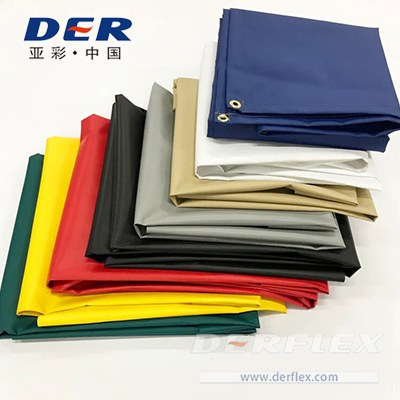
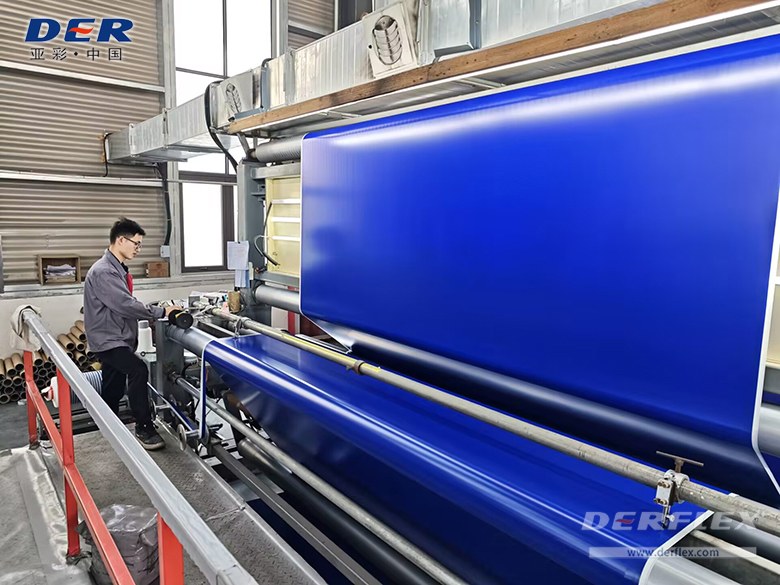
These are actual DERFLEX site images of tarp materials and manufacturing. They help discuss fabric, edge finish and color; the agreed sample defines your pit-cover construction.

06 / Drawing to repeat order

Connect the material brief to the finished cover.

DERFLEX supplies PVC tarpaulin material and custom finished tarp solutions. Buyers can discuss roll goods for their own conversion or a defined finished-cover program.

1. Review the site information

Use the pit drawing, photographs and rain-management brief to identify material, perimeter and handling questions.

2. Confirm the construction

Agree dimensions, edge details, seam layout, included components and any sample or test requirement before bulk production.

3. Keep an approved reference

Retain the signed drawing revision, material sample, color reference and packing specification for replacements and repeat orders.

07 / Avoid specification gaps

Four ordering mistakes worth resolving early.

Ordering only the sand opening

This can omit the rim landing area and leave the perimeter unsupported. Show the opening, outer rim and finished cover as separate dimensions.

Choosing mesh to keep sand dry

Permeable mesh admits rain. Choose it for a debris-control strategy that works with the pit's drainage.

Comparing fabric weight alone

GSM says little about the full handling task. Include reinforcement, hardware, ballast and the storage route.

Leaving ballast out of the quote scope

A pocket-only cover and a ballasted cover are different purchases. State supply responsibility, ballast specification and package weight clearly.

08 / Request for quotation

Send a pit sketch.
Include the perimeter.

A dimensioned drawing and photos are more useful than a nominal size alone. For a replacement, include photographs of the current cover and any recurring edge, seam or handling problem.

Request a project quote

What to include in your inquiry

  • Facility type and destination
  • Number of pits and covers
  • Sand opening and outside rim dimensions
  • Overlap required on each side
  • Runway side, drains and fixing locations
  • Solid PVC or permeable mesh preference
  • Edge details and ballast supply scope
  • Handling, folding and storage limits
  • Color, logo and identification needs
  • Required tests or tender specification
  • Sample and drawing approval needs
  • Quantity and required delivery date

Quotation, minimum order quantity, sample availability and lead time are confirmed after the specification is reviewed.

Buyer questions

Long jump pit cover FAQs

Should a long jump pit cover be waterproof or permeable?

Choose solid PVC when limiting rain entry through the fabric is the priority and surface water can be managed. Choose permeable mesh when rain should pass into a suitably drained pit and debris control is the priority. Mesh does not keep sand dry; a solid cover still needs a runoff and ponding plan.

How do I measure a custom long jump sand pit cover?

Record the sand opening and the outside rim dimensions separately, then measure the intended overlap and available landing space on each side. Mark runway-facing edges, corners, drains and existing fixing points. Submit a drawing that identifies finished cover dimensions; the manufacturer should calculate cutting and hem allowances.

Will a weighted perimeter keep the cover in place in strong wind?

A weighted edge can help seat the perimeter, but it does not establish a wind rating or guarantee retention. Cover area, exposure, edge lift, surface conditions and the fastening arrangement must be reviewed for the site. Confirm the required securing method and weather procedure with the facility's responsible person.

Can the same construction cover a triple jump sand pit?

A cover can be specified for a shared long jump and triple jump landing pit using its actual dimensions and perimeter conditions. Do not size it from the athletics event name or a standard retail size. Record every runway approach and any edge that needs different treatment.

Can DERFLEX supply finished covers or material for local fabrication?

DERFLEX supplies PVC tarpaulin materials and custom finished tarp solutions. Request roll fabric, cut panels or a finished-cover program as appropriate. A weighted pocket, removable ballast, logo printing or special fittings must be confirmed for the proposed construction before ordering.

What determines price, minimum order quantity and lead time?

Price depends on material, finished area, joining, perimeter construction, ballast supply, accessories, printing, quantity and packing. MOQ and lead time are quoted after the specification is reviewed. State whether ballast is factory fitted, shipped separately or sourced locally so quotations can be compared on the same basis.

Your next cover starts with a clear drawing

Build the specification around your pit.

Share the dimensions, site photos, material preference and edge requirements. DERFLEX can review the fabric and fabrication brief for your custom long jump pit cover program.

Send your requirements
Consulting Services
+86-021-54361792 / 54361798
Email
sales@derflex.com