



DERFLEX / Fabrication planning
Heavy Duty Tarp
Panel Layout &
Cutting Yield
A useful tarp panel layout connects finished dimensions, warp and weft direction, weld positions and roll width in one drawing set. For tarp fabricators, OEM cover programs and bulk buyers, that connection makes material consumption reviewable before cutting starts.
Use the dimensioned example below to follow every panel and every square metre. Send DERFLEX your finished size and batch demand to discuss PVC-coated fabric, cut panels or finished-cover supply for your project.
Technical guide · 21 October 2026 · Metric worked example
One plan. Four linked drawings.Orientation → cut list → seam map → batch nesting.
Illustrative finished cover
Paired layout, with warp preserved
The practical answer
Plan the cover before you optimise the marker.
Start with the finished outside dimensions and required fabric direction. Add the consumption of hems, pockets and joints, place seams around the working constraints, then nest the approved pieces within the minimum usable roll width. Measure tarp cutting yield against a clearly stated area basis.
Finished area alone does not tell you how much fabric to buy. Welding overlaps and folded edges remain in the product; trim, rejected defects and retained roll tails belong to different accounting categories. For roll terminology and handling considerations, see the tarp roll size guide.
01 / Fabric direction
Warp and weft are layout constraints.
For the woven coated-fabric roll considered here, warp follows the roll length and weft crosses the roll width. Confirm the actual roll marking and the material data sheet; a balanced yarn description does not prove equal performance in both directions.
| Drawing control | What it means in production | What the buyer should confirm |
|---|---|---|
| Warp arrow on every panel | Maintains the specified fabric orientation through cutting and assembly. | Direction relative to the cover, installed loading and deployment path. |
| Weft across the roll | Restricts how many panels can sit side by side. | Minimum usable width after the agreed edge exclusions. |
| 90° rotation rule | Swaps warp and weft relative to the finished cover. | Allow rotation only after the material and design review. |
| Face and part identification | Prevents an incorrect coated face, mirrored part or print direction. | Face-up instruction, part ID, revision and assembly sequence. |
Do not assume warp is always the direction that should carry the main load. Review the selected fabric's directional results and the finished assembly requirements. For cutting-tool choices and edge handling, use the separate PVC tarp cutting guide.
02 / The complete geometry
From a finished cover to three cut panels.
The example keeps the warp direction along the 8 m finished length. Two longitudinal body seams join three rectangles. No panel is rotated to obtain the paired nesting result.
| Input | Illustrative assumption | Boundary of this example |
|---|---|---|
| Finished cover | 8.000 m long × 6.000 m wide | Measured outside-to-outside after edge finishing. |
| Edge consumption | 0.050 m at each of four edges | A dimensional assumption; a double fold, sleeve or rope pocket may consume more. |
| Assembled blank | 8.100 m × 6.100 m | Before consuming the outside-edge allowances. |
| Body seams | Two laps, 0.040 m overlap each | Geometric assumption, not an approved effective weld width. |
| Roll | 2.500 m nominal; 2.480 m minimum usable | 0.010 m excluded on each side; not a stock-width promise. |
| Small-panel spacing | 0.010 m separation between the two P3 pieces | Shared transverse cuts assumed; no additional length gap. |
| Stock and exclusions | 50.000 m defect-free stock roll | No lead/tail setup loss, shrinkage, process rejection or separate reinforcement consumption is modelled. |

Seam positions must use the same origin as the finished drawing.
Measured down from the finished top edge in PL-01, lap band S1 occupies 2,390–2,430 mm and S2 occupies 4,830–4,870 mm. These are bands, not zero-width lines. The raw panel coordinates include the 50 mm outside-edge allowance, which is why raw and finished coordinates differ.
Before accepting those positions, overlay the actual frame contacts, fold or roll path, pockets, openings, tie-down reinforcement and print areas. Relocating a seam changes the cut widths and can remove a nesting opportunity. If a one-piece body is being considered, compare the meaning and limits of seamless tarpaulin.

Width closes exactly.
2.480 + 2.480 + 1.220 − 2 × 0.040 = 6.100 m. After consuming 0.050 m at each outside edge, the finished width is 6.000 m.
Length closes independently.
8.100 − 2 × 0.050 = 8.000 m. The two body laps run along this length; they do not consume an additional 40 mm at the top and bottom.

No dimensional compensation is assumed. Establish any compensation, measurement condition and tolerances through the actual fabrication trial. Structural membranes and shaped covers require their own engineering pattern development.
03 / Recalculate the marker
Two covers make the narrow panel useful.
For one cover, the two 2.480 m wide pieces use two separate 8.100 m cut windows. The 1.220 m piece needs a third window. For two matching covers, both narrow pieces fit side by side in one shared window.

The usable-width fit check comes first.
1.220 + 0.010 + 1.220 = 2.450 m ≤ 2.480 m usable width. That leaves 0.030 m of usable residual width, in addition to the two excluded 0.010 m edges. The five-window sequence is four wide panels plus a final window containing the two narrow panels.
| Quantity basis | Two covers cut separately | Two covers nested together |
|---|---|---|
| 8.100 m cut windows | 6 | 5 |
| Nominal roll length issued | 48.600 m | 40.500 m |
| Nominal area issued | 2.500 × 48.600 = 121.500 m² | 2.500 × 40.500 = 101.250 m² |
| Accepted cut-rectangle area | 100.116 m² | 100.116 m² |
| Cutting yield / issued nominal area | 82.40% | 98.88% |
| Finished projected area / issued nominal area | 96 ÷ 121.5 = 79.01% | 96 ÷ 101.25 = 94.81% |
| Unissued tail of a 50 m roll | 1.400 m | 9.500 m |
Account for the entire issued area.
| Area category / paired plan | Calculation | Area |
|---|---|---|
| Finished projected coverage | 2 × 8.000 × 6.000 | 96.000 m² |
| Fabric consumed in body laps | 2 covers × 2 laps × 0.040 × 8.100 | 1.296 m² |
| Fabric consumed at outside edges | 2 × (8.100 × 6.100 − 8.000 × 6.000) | 2.820 m² |
| Issued area outside the cut rectangles | 101.250 − 100.116 | 1.134 m² |
| Total issued nominal area | 96.000 + 1.296 + 2.820 + 1.134 | 101.250 m² |
The 1.134 m² comprises 0.810 m² of excluded roll edges and 0.324 m² outside the two P3 rectangles in window 5. Laps and hems remain in the cover; the unissued 9.500 m stock tail remains separate inventory. The cut rectangles total 2 × (2.480 + 2.480 + 1.220) × 8.100 = 100.116 m².
Check another batch quantity
Same drawing, same direction and the same assumptions. Change only the number of identical covers.
40.500 m issued; 9.500 m retained across 1 stock roll. Six complete 8.100 m windows fit in each 50 m roll.
Windows = 2N + ceil(N/2). Cut area = N × 50.058 m². Stock rolls = ceil(windows/6). Odd quantities leave one unpaired P3 window. This is a geometry check, not a production quotation.
A wider roll trades material against seam count.
A hypothetical 3.200 m nominal roll with 3.180 m usable width could use two 8.100 m panels, 3.180 m and 2.960 m wide, with one 0.040 m lap. That gives the same 6.100 m assembled width.
| Layout option | Issued nominal area per cover | Body seams | Finished area / issued area |
|---|---|---|---|
| 2.500 m roll · isolated cover | 60.750 m² | 2 | 79.01% |
| 2.500 m roll · paired batch average | 50.625 m² | 2 | 94.81% |
| 3.200 m roll · stated two-panel alternative | 51.840 m² | 1 | 92.59% |
Compare seam labour, handling, actual roll price, accepted seam positions and retained stock together. The paired average is an allocation across two covers, not a schedulable half-window. Review the resulting cost assumptions with the tarp cost calculator.
04 / Manufacturing notes
What must be settled before cutting.
A high marker percentage is useful only if the resulting cover can be made, inspected and used as specified. Freeze the drawing revision and the material lot before treating an estimate as a production instruction.
Protect the working areas.
Map seams against abrasion contacts, rolling or folding paths, access features and reinforced tie-down zones. Obtain approval for unavoidable seam intersections and thickness changes. A seam being parallel to warp does not establish a safe load rating.
Qualify the actual joint.
The overlap in a drawing does not establish peel resistance, seam strength or water tightness. Confirm compatible surfaces, joining method, effective weld width and an agreed inspection or test on a representative trial.
Keep the marker reproducible.
Record nominal width, minimum usable width, roll ID, defect exclusions, part IDs, face orientation, cut quantity and issue length. Add lead and tail allowances, longitudinal spacing and process losses where the real operation needs them.
Count the additional pieces.
This example covers the three body panels only. Separate webbing, patches, wear strips and hardware belong in the full bill of materials. Do not claim offcut reuse until those pieces actually fit and meet orientation and quality requirements.
For the wider sequence from coated roll goods to converted covers, see the tarpaulin manufacturing process.
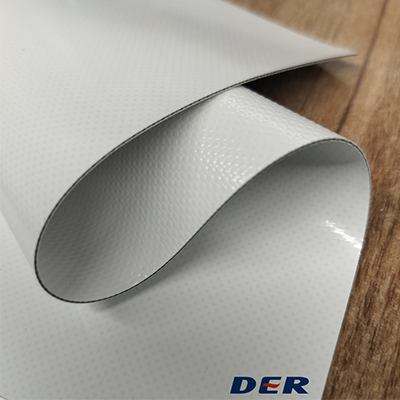
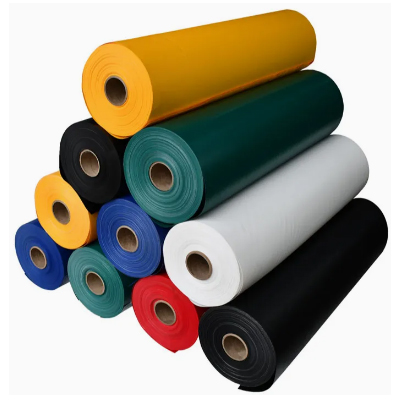
Coated-textile source photo. Verify the actual construction, faces and directional requirements for the order.
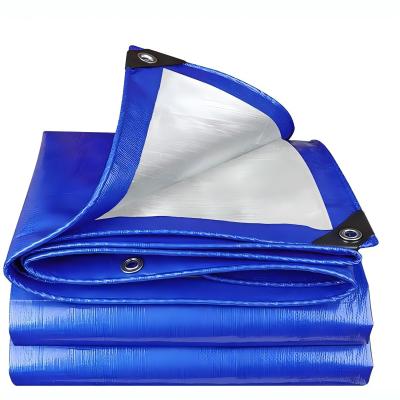
Finished-tarp source photo. Hems and reinforcements affect raw dimensions and the complete bill of materials.
05 / Drawings to quotation
Send the finished dimensions and the batch mix.
DERFLEX's PVC tarp fabric by the roll supply can be discussed alongside conversion requirements. State whether you need roll material, cut pieces, welded panels or a finished cover so the quotation uses the appropriate scope.
- Finished geometry: outside length, width, shape, units, tolerance and measurement condition.
- Order mix: quantity for each size, repeat batches and whether matching parts can be cut together.
- Material: intended application, construction or reference sample, GSM or thickness, colour and required directional data.
- Working constraints: required warp direction, permitted rotation, seam exclusion zones, frame contacts and deployment path.
- Edge and assembly details: hems, pockets, webbing, patches, hardware, print direction and the required coated face.
- Supply conditions: roll-width or machine limits, destination, required delivery date and inspection or documentation needs.
Ask the quotation review to identify the proposed panel split, seam bands, cut dimensions, nominal and usable roll widths, issued area basis, separate accessories and treatment of retained tails. MOQ, sample arrangements, available widths and lead time require confirmation for the selected specification.
Related questions
Panel layout & cutting yield FAQ
What is tarp panel layout?
Tarp panel layout is the coordinated plan for the individual cut pieces, warp and weft orientation, joining seams, edge allowances and nesting positions on a fabric roll. It connects the finished cover drawing to a measurable cutting instruction.
How do you calculate tarp cutting yield?
Divide the total area of accepted cut pieces by the nominal roll area issued to that cutting plan, then multiply by 100. State the denominator: yield based on usable width or purchased full rolls is a different measure. In this example, 100.116 ÷ 101.25 × 100 = 98.88%.
Can tarp panels be rotated 90 degrees to save fabric?
Only when the design permits it. A 90-degree rotation exchanges warp and weft relative to the cover. Check the directional material data, required orientation, coating face, print direction and fabrication specification before changing the marker.
Does a wider roll always give better cutting yield?
No. Panel dimensions, overlap consumption, usable width and order quantity decide the nesting result. In the illustrative comparison here, paired production on a 2.50 m roll uses less issued nominal area per cover than the stated 3.20 m alternative, while the wider option has one fewer body seam.
Is the 40 mm overlap in this example a recommended weld width?
No. It is an assumed geometric overlap used to make the drawings and calculations reproducible. Effective weld width, material compatibility, seam construction and acceptance criteria must be established for the selected fabric and fabrication process.
What should I send DERFLEX for a panel-layout quotation?
Send finished outside-to-outside dimensions and tolerances, application, quantity and size mix, fabric requirements, roll-width constraints, required warp direction, seam exclusion zones, hems or pockets, reinforcement details and destination. Include a dimensioned drawing or CAD file if available.
Start with your drawing
Make the material plan
part of your next RFQ.
Send finished dimensions, the quantity of each size and your assembly constraints. Include a sketch or CAD drawing where available, and ask DERFLEX to review the roll-width and panel-layout options for your supply scope.
Submit a panel-layout enquiry ↗