


Material durability / procurement verification
Heavy Duty Tarp Performance After Weathering
Evaluate weathered tarp strength across the fabric, welded seams and finished edges. Compare matched specimens from the same production batch, then use the results to define a cover for your climate and failure risks.
For OEM buyers, fabricators and project procurement teams, retained seam strength is a separate requirement from new-fabric tensile strength. Discuss PVC coated polyester construction, weld geometry and perimeter reinforcement with DERFLEX before approving bulk supply.
The direct answer
How should weathered tarp strength be measured?
Report the exposure and the remaining capacity together.
Test unexposed controls and weathered specimens from the same batch using the same mechanical method, direction, geometry and conditioning. Report the original and post-exposure values for fabric, seams and edges separately, with sample counts, variation and failure photographs.
100 × mean after exposure ÷ mean before exposure
Use comparable groups for each property, direction and exposure interval. A positive, valid baseline is required. This ratio of group means is not the mean of individual specimen ratios; destructive tests use separate matched specimens.
Accelerated exposure hours describe a laboratory program. They do not directly establish outdoor years, a warranty period or a safe installed wind rating. See method references.
01 / Compare the complete assembly
One batch. Three routes to failure.
A fabric coupon can remain strong while a seam peels or a fastener pulls through an aged hem. Keep these results separate so one favorable average does not conceal a vulnerable detail.
| Test track | Before and after exposure | Keep constant / record | Inspect the failure |
|---|---|---|---|
| Base fabric | Warp and weft tensile strength; tear resistance; elongation where relevant. Assess coating adhesion and water resistance separately. | Construction, color, face, direction, test method, specimen dimensions, grip setup, test rate and conditioning. | Scrim rupture, tear propagation, coating cracking, delamination or grip-related invalid failure. |
| Welded seam | Joint tensile or shear performance under a defined setup; seam peel under a separate setup where opening is a service risk. | Weld method, overlap, effective weld width, load orientation, process record, cure or dwell history where applicable. | Weld separation, coating-to-scrim separation, fabric rupture beside the weld, or failure at a weld transition. |
| Finished edge | Hem and reinforcement performance; eyelet or D-ring assembly pull-out under a documented fixture. | Hem width, reinforcement, hardware, edge distance, fastening arrangement, grip distance and load angle. | Eyelet pull-through, webbing separation, stitching damage where present, edge tear or hardware failure. |
ISO 1421 is a reference for coated-fabric tensile testing; ISO 2411 addresses coating adhesion. Neither should be presented as an automatic qualification of a complete tarp seam or edge assembly.
Start with the PVC tarpaulin material platform. For unweathered joint geometry and load direction, use the separate tarp seam and weld strength guide.
02 / Make the comparison defensible
Match specimens before exposure begins.
Same-batch sampling reduces one source of variation. It does not remove the need to document specimen preparation, repeatability and the manufacturing details that change local strength.
Identify the material
Assign batch, roll and specimen IDs. Record coating and substrate construction, measured mass and thickness, color, production date and sampling position across the roll.
Build the real detail
Fabricate representative welds, hems and fastener zones using the intended production process. Prepare finished seam and edge specimens before weathering when evaluating the aged assembly.
Allocate test groups
Distribute matched specimens across unexposed controls and exposure intervals. Set sample counts for each property and direction using the selected method and the agreed statistical plan.
Condition and test
Record control storage, post-exposure recovery and conditioning. Test comparable groups consistently. Retain every valid result and explain exclusions, interruptions and deviations.
Expose an already fabricated assembly to evaluate its in-service aging. If the question concerns field repair, add a separate repair-weld study. Label these programs distinctly.
For coating, stabilizer and scrim fundamentals, read how UV resistant tarps work. This page focuses on the measured performance remaining after a specified exposure.
03 / Document the exposure
“UV tested” is not a complete test condition.
Select the exposure with the laboratory and buyer. Fluorescent UV and xenon arc programs use different light sources and configurations; the names alone do not define an equivalent test.
ASTM G154 and G155 are exposure apparatus practices. Citing a standard does not prove a DERFLEX product was tested or passed. Confirm the applicable edition and full procedure with the laboratory.
Laboratory exposure record
- Laboratory, report ID, dates, apparatus make/model, selected standard edition, cycle and every deviation.
- Lamp type or xenon filter system; irradiance set point, control wavelength or band, and radiant exposure with units when measured.
- Light/dark schedule; condensation, spray or humidity stages; stage durations and water quality.
- Black-panel or black-standard temperature, chamber air temperature and humidity where applicable; identify each sensor basis.
- Exposure duration, interruptions, calibration/monitoring records, specimen rotation and mounting arrangement.
- Exposed face, orientation, supported or unsupported configuration, and whether specimens were relaxed or loaded.
Natural outdoor exposure record
Record site and coordinates, start/end dates, season, rack angle and orientation, shading, backing, mounting tension and measured environmental data. Report cleaning, contamination and wetting history. State which weather data were measured, sourced from a nearby station or unavailable.
Do not combine results from different cycles or facilities into a single ranking without a supported comparability assessment.
04 / Read the evidence
What must accompany a retained-strength claim?
This page describes a validation framework, not a completed DERFLEX weathering trial. No batch-specific exposure log, original readings, sample counts or matched test photographs have been provided for publication. No retained-strength percentage, exposure-hour rating or pass/fail result is claimed here.
| Report component | Required publication material | Current status |
|---|---|---|
| Exposure conditions | Complete program and log described above; control storage, conditioning and deviations. | Not supplied |
| Original values | Every valid unexposed and exposed reading, unit, method, direction and specimen ID. Include invalid results with the reason for exclusion. | Not supplied |
| Sample counts | Actual n before and after exposure for every property, direction and interval; identify independent assemblies and multiple coupons from the same assembly. | Not supplied |
| Summary statistics | Group means, dispersion and minimums where appropriate; retention calculation and any uncertainty statement with its basis. | Not calculated |
| Photographic record | Matched IDs, exposure interval, scale, exposed face and failure close-ups for fabric, weld and finished edge. | Test photographs not supplied |
| Acceptance decision | Agreed absolute and retained-strength criteria, critical failure modes, report approval and limits of applicability. | Project criteria to be agreed |
Raw-data fields to retain
One record per tested specimen: report ID, batch/roll ID, assembly ID, specimen ID, control/exposed group, exposure interval, test track, direction, method and edition, geometry, conditioning, measured value, unit, failure mode, photo reference and validity note.
Download blank data templateColumn headings only. This file contains no test results.
Interpret two different ratios
Retained seam strength
Exposed seam strength ÷ unexposed seam strength × 100. It tracks change in the same joint construction under the selected program.
Seam efficiency
Seam strength ÷ base-fabric strength × 100 under a defined, comparable load basis. Identify whether both values are unexposed or exposed. Seam efficiency and seam retention answer different questions.
05 / Turn readings into a decision
Retention is useful. Remaining capacity decides the next step.
Set acceptance before testing
Agree both an absolute post-exposure requirement and a retention criterion for each critical component. Define the decision rule, acceptable failure modes and treatment of variability before results are known. A high retention ratio can still leave an assembly below its required capacity.
Do not average warp and weft, combine peel and tensile values, or compare N to N per specified width. A change in strip width, gripping or load direction can make an apparent strength comparison misleading.
Use the performance-based tarp specification guide to translate the agreed evidence into purchasing requirements.
Investigate unexpected patterns
- Fabric stable, weld weaker: review joint separation, overlap, process history and coating adhesion near the weld.
- Fabric and seam stable, edge weaker: inspect reinforcement, hardware contact, edge distance and the pull-out fixture.
- Color stable, strength lower: visual appearance alone cannot release the assembly.
- Retention above 100%: report the reading honestly and investigate variability, conditioning and material response; do not call it proof of improved durability.
These are proposed investigation paths, not diagnoses or observed DERFLEX test outcomes. Coupon results alone do not establish full-cover structural safety.
06 / Construction & documentation
Separate product photographs from test evidence.
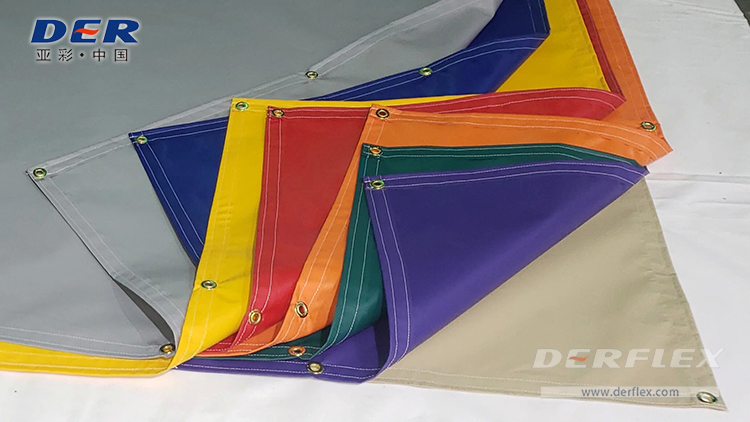
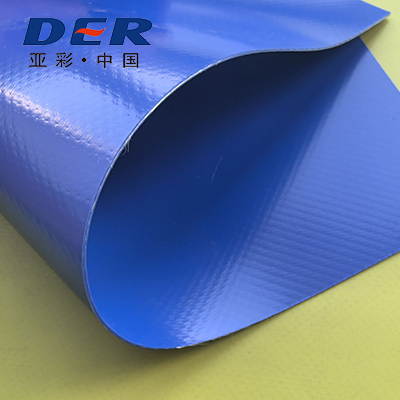
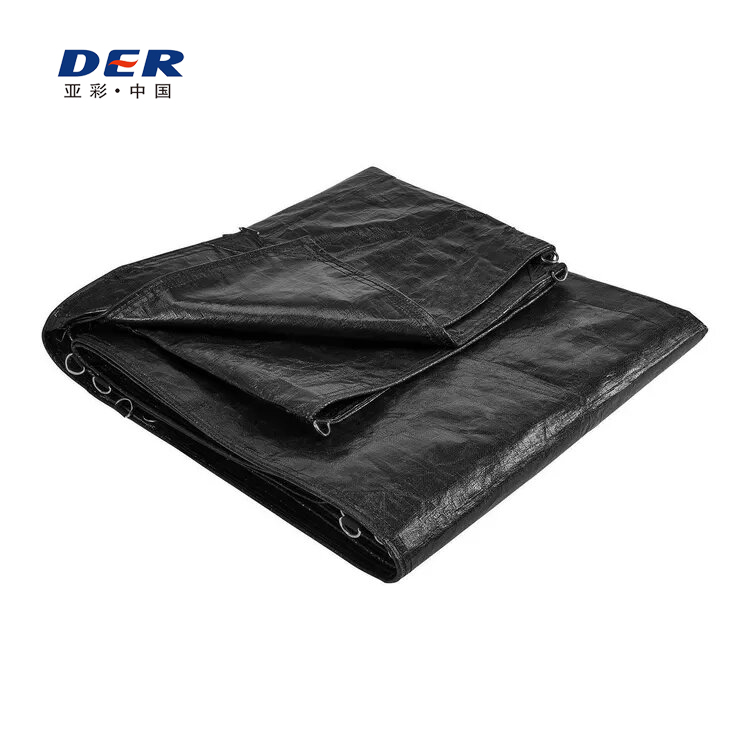
These genuine DERFLEX site images show material and finished-cover details. They do not show specimens from a documented weathering program.
Required before-and-after photo set
- FabricSame face, lighting, scale and specimen ID before/after exposure, plus a close-up of the mechanically tested failure.
- WeldFull overlap and weld transition before/after exposure, then the separated interface or rupture location after testing.
- EdgeHem and hardware geometry before/after exposure, followed by the tear path, pull-through or component failure.
Keep original photo files and captions linked to the raw-data record. Do not use unrelated aged tarps or a digitally created damage scene as laboratory evidence.
07 / Validate for the actual risk
Start with your climate. Add the likely failure mode.
The matrix below proposes a discussion brief for the buyer and laboratory. Exposure durations, specimen numbers, methods and pass limits must be agreed for the selected construction; they are not universal tarp ratings.
| Service environment | Exposure discussion | Follow-up verification |
|---|---|---|
| Hot, dry, high sun | Light spectrum, surface temperature, color, backing and day/night thermal conditions. | Directional fabric and seam retention; coating cracking/adhesion; edge pull-out. Add field exposure where service-life evidence is needed. |
| Hot, humid, frequent rain | Light plus wet/dry exposure, condensation, mounting and drainage conditions. | Fabric, weld and edge strength; coating adhesion and water resistance. Biological or cleaning resistance requires separate relevant evaluation. |
| Cold / seasonal freezing | Weathering followed by defined low-temperature handling; add wet/freezing cycles only where relevant. | Flexing and cracking at folds and weld transitions; fabric, seam and edge performance at an agreed test temperature. |
| Coastal / salt-laden air | Light/moisture exposure and a separate relevant hardware corrosion program; document any sequential exposure. | Hem and fastener assembly after conditioning, hardware condition, weld strength and coating adhesion. Salt spray alone is not a UV durability test. |
| Frequent deployment / abrasive contact | Weathering plus separately specified folding, rubbing and fastening duty. | Residual seam strength and edge pull-out after the agreed sequence; wear at contact points and a representative cover trial. |
For salt and hardware selection, consult the coastal and marine tarp guide. Compare formulation directions on the UV resistant tarpaulin page; confirm batch evidence for the exact specification.
Prepare your validation brief
Choose the dominant environment and consequence of failure. This creates a discussion prompt, not a test certification.
Hot / dry + weld concern
Discuss a light and temperature program matched to the material, color and mounting. Compare already fabricated welds before and after exposure using defined joint-strength and, where relevant, peel setups. Include fabric controls, finished edges, individual readings and failure photographs.
Before approval: agree methods, exposure intervals, sample counts, absolute strength requirements and retention criteria. No laboratory-hour to outdoor-year conversion applies.
08 / Before you enquire
Send the conditions behind the cover.
DERFLEX publishes PVC coated fabrics and custom tarp constructions. Ask for material and fabrication options, then agree the scope and availability of validation for the specific project. The existence of a material page does not establish retained-strength results for your construction.
MOQ, sampling, laboratory scope, costs and lead time require confirmation after the material and test brief are defined.
- Destination, exposure season, sunlight, temperature, moisture and salt conditions.
- Application, finished dimensions, support, slope, tension and attachment layout.
- Material family, color, mass/thickness direction and any existing specification.
- Seam method, overlap, edge reinforcement, hardware and repair requirements.
- Dominant failure risk, intended deployment/handling and consequence of failure.
- Quantity, decision deadline, required report format and acceptance criteria.
- Available failed samples, service photographs, drawings and previous test reports.
For a demanding assembly, agree coupon tests and a representative finished-cover review. Weathering data cannot replace an assessment of anchorage, wind, ponding or installation loads.
Questions buyers ask
Weathered strength, explained.
Clear comparisons help fabricators, importers and project teams ask for the right evidence.
What is weathered tarp strength?
Weathered tarp strength is the mechanical capacity measured after a documented exposure. State the property, method, direction, unit and exposure conditions, then compare it with unexposed controls from the same batch. Fabric, weld and edge results should be reported separately.
How is retained seam strength calculated?
Divide the mean seam strength after exposure by the mean seam strength before exposure and multiply by 100. Both groups need the same joint construction, method, geometry and conditioning. Publish the original readings and actual sample counts with the ratio.
Can accelerated weathering hours be converted into outdoor years?
No universal conversion applies. A service-life prediction would require material-specific correlation with relevant outdoor exposure, matching degradation mechanisms and a validated model. This page makes no outdoor-year prediction from laboratory hours.
Does a UV-resistant label prove that seams and edges will retain strength?
No. A label or exposure duration alone does not establish residual assembly performance. Request mechanical results for the selected fabric, already fabricated welds and representative reinforced edges after the documented exposure.
What retained-strength percentage should a buyer accept?
There is no single percentage suitable for every tarp. Agree an absolute post-exposure capacity, a retention requirement, critical failure modes and the decision rule for the application. Consider variation and the consequences of failure before approving supply.
Are batch weathering results available on this page?
No batch-specific test results are published here. The page defines the evidence needed: complete exposure conditions, individual readings, actual sample counts and traceable photographs. Ask DERFLEX to confirm the report and validation options available for your selected construction.
A project-specific next step
Specify what must remain strong.
Send your climate, cover drawing and likely failure points. Ask DERFLEX to review material and fabrication options and help define a validation scope for your procurement decision.
Include destination, dimensions, attachment details and quantity with your enquiry.