News
Company News

Heavy Duty Tarps for Mining & Quarry Stockpiles | DERFLEX

Update:2026/10/1 19:06:51 Views:
Mining · Quarry · Bulk Material Storage

Heavy Duty Tarps for Mining & Quarry Stockpiles

Control windblown dust, rain exposure and high-abrasion contact around ore, aggregate, crushed stone, sand and mineral stockpiles with a cover system built around the actual pile—not a generic tarp size.

DERFLEX supplies PVC coated polyester roll goods, large welded panels and finished stockpile tarps with reinforced hems, webbing, grommets, D-rings, wear zones and project-specific access details. Final construction should be matched to pile geometry, wind exposure, surface roughness, storage duration and handling frequency.

Answer First

What is a mining or quarry stockpile tarp?

A mining or quarry stockpile tarp is a large protective cover used over outdoor piles of ore, mineral concentrate, crushed stone, aggregate, sand or similar bulk material. A solid waterproof cover can reduce direct rain exposure and reduce wind acting directly on loose surface fines, while a reinforced PVC coated polyester structure can be fabricated into large welded panels for repeated industrial handling.

The tarp itself is only one part of the system. Effective service depends on panel geometry, seam layout, abrasion protection, perimeter reinforcement, anchoring or ballast, drainage, access points and the way crews open, move and recover the cover.

For broader mine-site equipment and transport protection, see DERFLEX mining tarps. This page is intentionally focused on stockpile coverage for mines and quarries.

Failure-Mode Engineering

Mining stockpile covers fail in six predictable ways

Buying a heavier tarp without defining the failure mode can add cost and handling weight while leaving the real weak point unchanged.

Wind uplift & flapping

Large exposed cover area can cycle hems, grommets and panel seams. Fit, anchor spacing, perimeter reinforcement and controlled tensioning must work together.

Rock & aggregate abrasion

Angular material, haul-road grit and repeated dragging can wear through the coating. Wear strips or sacrificial patches should follow the real contact path.

Puncture & tear growth

A small puncture around a sharp stone or protrusion can become a long tear under wind or tension. Surface protection, scrim, padding and local reinforcement all matter.

Water ponding

A waterproof tarp can still perform poorly if the panel layout creates low pockets. Cover geometry must shed water away from access and anchoring zones.

Edge pull-out

Hardware is only as strong as the edge behind it. Grommets, D-rings, webbing, hems and corner backing should be treated as one load-transfer assembly.

Operational damage

Excavators, loaders, conveyors and repeated partial access can create cuts and drag paths. Access flaps and modular panels should be planned before field use.

Selection Matrix

Choose the tarp around the stockpile, not the product label

The table below is a B2B specification framework. Exact GSM, yarn structure and performance values should be confirmed against the approved material and project conditions before bulk production.

Stockpile / Site Condition Material Direction to Evaluate Critical Design Details Buyer Questions Before Approval
Ore or mineral concentrate stored outdoors Heavy-duty PVC coated polyester, commonly reviewed around the DERFLEX 650–900 gsm mining-tarp direction Waterproof welded panels, UV direction, reinforced perimeter, dust closure and drainage How long is storage? How often is the pile opened? Is material moisture-sensitive?
Quarry aggregate / crushed stone with angular contact Heavy coated fabric with localized wear reserve rather than GSM alone Ridge patches, lower wear strips, protected sharp points, controlled drag zones Where does the tarp touch rock? Is it dragged over the pile or lifted into position?
Sand / fine material with dust-control priority Solid waterproof cover where full surface shielding is required; other constructions can be discussed by duty Perimeter closure, anchor continuity, access openings, wind uplift control Is dust control the primary objective? Are partial openings required during daily loading?
High-wind open pit / exposed quarry bench Reinforced large-panel or modular PVC system with project-engineered fixing Load path from fabric → hem/webbing → hardware → anchor/ballast → ground What are site wind conditions, ground conditions and the approved anchoring method?
Short-term temporary stockpile Project-matched PVC or reinforced PE depending on expected reuse and exposure Fast handling, manageable panel size, simple fixing and removal Is the cover reusable? How many installation cycles are expected?
Permanent or repeated seasonal cover program Reusable PVC coated polyester with controlled panel IDs and replacement strategy Modular sections, labeled panels, repeatable hardware coordinates, wear-zone mapping Will the same pile geometry be covered every season? Are replacement panels required?
Important: heavier is not automatically better. A very heavy single panel can become difficult to lift, fold, install and recover. For large stockpiles, panel segmentation and local reinforcement can be more practical than adding weight across the entire cover.
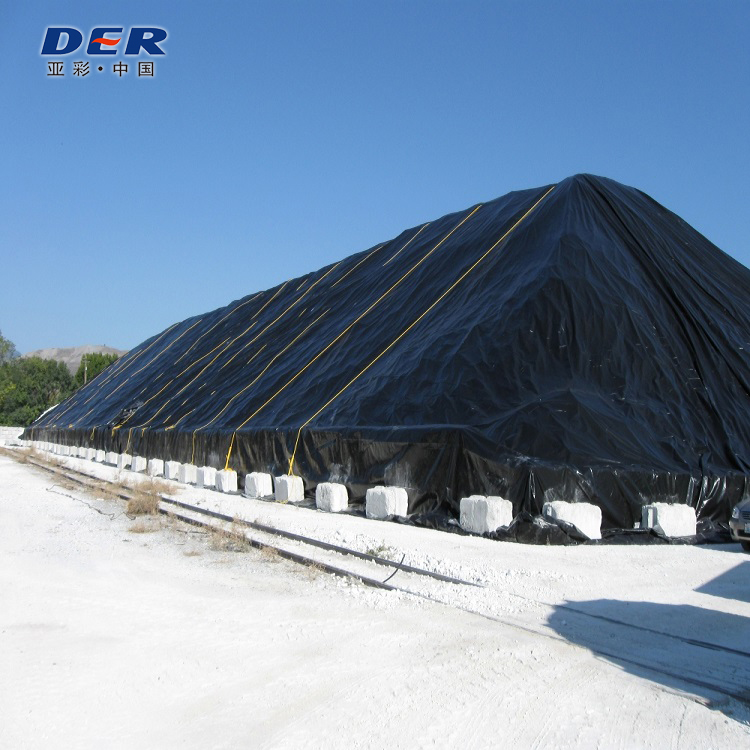
Black heavy duty stockpile tarp secured around a large outdoor mineral or aggregate pile
Material Architecture

PVC coated polyester is useful because it can be engineered as a fabricated cover system

For reusable heavy-duty stockpile covers, PVC coated polyester combines a woven textile reinforcement with a waterproof, weldable coating. That makes it suitable for large fabricated panels where the buyer needs more than a simple sheet.

Base fabric carries mechanical load

The woven polyester scrim contributes tensile stability and resistance to tear growth. Yarn and weave selection should be reviewed together with finished panel size, wind exposure and the way the tarp is tensioned.

PVC coating provides the protective surface

The coating creates the waterproof surface and influences abrasion resistance, flexibility, cleanability, UV weathering and weldability. Surface finish can also affect dirt pickup and handling.

Fabrication determines field performance

Seams, hems, webbing, wear patches, lifting points, grommets and D-rings determine how real loads enter the cover. Buyers sourcing raw material can review DERFLEX PVC coated fabrics; finished projects should freeze the full cover construction after sample or drawing approval.

Configurable Specification

Stockpile tarp specification fields

Specification Item Typical DERFLEX Direction Procurement Note
Primary material PVC coated polyester fabric for reusable heavy-duty waterproof applications Other constructions can be discussed when handling weight, cost or temporary-use requirements differ.
Material weight Approx. 650–900 gsm is a published mining-tarp direction; other weights by project Confirm weight only after panel size, handling cycle, abrasion and wind exposure are defined.
Surface Project-selected matte, glossy, lacquered or other available finish Surface choice affects cleaning, friction, dirt pickup, welding and appearance.
Finished geometry Large flat sheets, shaped panels, modular cover sets or drawing-based custom sections Do not size from tonnage alone. Use measured pile geometry and the required perimeter margin.
Panel joining Compatible hot-air or high-frequency welding according to material and fabrication plan Define overlap / seam width, location and inspection method on the approved production drawing.
Reinforcement Webbing hems, corner backing, ridge patches, wear strips, lower drag-edge reinforcement Place reinforcement where movement or concentrated pull occurs instead of reinforcing every zone equally.
Attachment hardware Grommets / eyelets, D-rings, straps, sleeves or project-specific fixing interfaces Spacing should follow the actual anchor map and expected load direction.
Supply format Roll goods, cut panels, semi-finished sheets, finished tarps or labeled modular kits Select around local fabrication capacity, site installation method and replacement strategy.
Engineering Notes

The cover works only when the load path and handling plan work

These six design decisions create more information value for a stockpile project than simply selecting the thickest available tarp.

01Measure the pile

Provide footprint, top profile, height, slopes, irregular shoulders and anchor margin.

02Map abrasion

Mark ridges, rock contact, loader interfaces, drag edges and repeated fold paths.

03Plan drainage

Orient seams and panels so rain sheds away from access points and anchor lines.

04Segment panels

Balance fewer seams against realistic lifting, installation, repair and partial access.

05Engineer fixing

Connect reinforcement, hardware and anchors as one continuous load path.

06Design access

Include reclaim zones, inspection openings, conveyor interfaces and labeled sections before fabrication.

Abrasion should be treated as a path

Wear is usually concentrated where the cover rubs repeatedly against rock, ground, rails, hardware or machinery. The right wear patch covers the full movement envelope. If repeated damage occurs at one location, targeted reinforcement can be more efficient than increasing GSM everywhere.

Wind assessment belongs to the project

DERFLEX can fabricate reinforced hems, hardware and fixing interfaces, but the final anchor or ballast system must be approved for the actual site wind, cover area, ground conditions and installation geometry by the responsible project team.

60,000㎡Integrated production area published in DERFLEX company profile
450+Full-time employees published in DERFLEX company profile
25+Senior engineers published in DERFLEX company profile
120+Countries and regions served worldwide in the current company profile
Buyer Checklist

What to send for a mining or quarry stockpile tarp quotation

A precise inquiry lets the material, panel architecture and reinforcement be reviewed before price is locked.

1

Pile geometry

Footprint length and width, height, slopes, top profile, photos, survey or dimensioned drawing.

2

Material being covered

Ore, concentrate, crushed rock, aggregate, sand, fines or other bulk material; identify sharp-contact concerns.

3

Storage & climate

Cover duration, UV exposure, rainfall, wind conditions, temperature and installation season.

4

Primary objective

Dust shielding, rain exclusion, moisture control, contamination protection, seasonal storage or repeated reuse.

5

Handling method

Manual, forklift, crane, loader-assisted, tarp roller or other method; state how often the cover is opened.

6

Fixing concept

Ballast, anchors, ropes, straps, grommets, D-rings, sleeves and the expected pull direction.

7

Access requirements

Reclaim areas, conveyor openings, inspection zones, partial-opening sequences, lifting points and labeled sections.

8

Commercial details

Quantity, roll goods or finished panels, color / printing, required test documentation, packaging and destination.

Common Procurement Mistakes

Six errors that create avoidable stockpile-cover failures

Sizing from tonnage alone

The same tonnage can form very different pile footprints and slopes. Measure actual geometry.

Choosing GSM before the panel plan

Heavier material also increases lifting and folding weight. Define panel size and handling first.

Using generic eyelet spacing

Hardware layout should match the anchor map, load direction and reinforced edge construction.

Ignoring abrasion zones

Rock contact, ridge lines and drag edges need specific wear protection, not only a heavier main sheet.

Allowing water pockets

Even waterproof fabric can overload or deform when poor geometry creates ponding.

Cutting access openings in the field

Unplanned cut-outs can interrupt reinforcement and create new tear points. Define access before fabrication.

Related Questions

Mining & quarry stockpile tarp FAQ

Direct answers for procurement managers, mine contractors, quarry operators, fabricators and industrial distributors.

What is the best tarp material for a mining or quarry stockpile?

For reusable heavy-duty waterproof stockpile covers, PVC coated polyester is a common direction because it combines a textile reinforcement with a waterproof, weldable coating and can be fabricated with reinforced edges and hardware. Reinforced PE can also be considered for some shorter-term or lower-weight applications. The final choice should match handling frequency, abrasion, wind, storage duration and required project documentation.

What GSM should a heavy duty mining stockpile tarp use?

There is no single correct GSM. , DERFLEX publishes approximately 650–900 gsm as a common mining-tarp direction, but the correct weight depends on panel dimensions, wind area, rock contact, repeated folding, handling method and reinforcement. A very heavy tarp is not automatically the most practical solution.

Can stockpile tarps help reduce dust at a mine or quarry?

Yes. A solid cover can reduce direct wind contact with the exposed stockpile surface and therefore reduce wind-driven movement of loose fines. The result also depends on perimeter closure, access openings, handling practices and the wider site dust-control plan. A tarp should be treated as one component of site dust management, not a substitute for project-specific environmental controls.

How do you protect a tarp from sharp aggregate and rock?

First identify the repeated contact path. Use protective padding over severe projections and add wear patches, sacrificial strips or reinforced zones at ridges, lower drag edges and recurring rock-contact areas. Local reinforcement can be more targeted than increasing the weight of the whole cover.

How should a large quarry stockpile tarp be anchored?

Anchoring should be designed around site wind conditions, cover area, panel geometry, ground conditions and the approved load path. DERFLEX can fabricate webbing hems, grommets, D-rings, straps, sleeves and reinforced fixing zones, while the responsible site or project team should approve the final anchor or ballast system.

Should a large stockpile use one giant tarp or modular panels?

One large sheet reduces the number of field joints but can become difficult to lift, fold, position and replace. Modular panels can simplify installation, partial access and repair. The right choice depends on pile size, crew handling, lifting equipment, wind, seam strategy and how often the stockpile is opened.

How do I measure a mining stockpile for a custom tarp?

Measure the actual pile geometry rather than estimating from tonnage. Provide footprint length and width, height, side slopes, top profile, irregular shoulders, obstructions, access zones and required anchor margin. For very large or irregular piles, a site survey or 3D measurement is more reliable than a simple rectangular estimate.

Can DERFLEX supply both tarp material and finished stockpile covers?

DERFLEX can discuss PVC coated polyester roll material for local conversion as well as large welded panels or finished covers with reinforced edges, webbing, hardware, wear zones and custom access details. The preferred supply format should be defined around local fabrication capability and installation logistics.

Build the cover around the actual stockpile

Send the pile geometry, material being stored, site exposure, abrasion points, preferred fixing concept, access requirements, quantity and destination. DERFLEX can review a practical material and fabrication direction before quotation.

Consulting Services
+86-021-54361792 / 54361798
Email
sales@derflex.com