



PU Leather
Thickness Guide
How thick should PU leather be for handbags, upholstery, automotive interiors or OEM converting? The answer depends on more than a millimeter value. Learn how to compare total thickness, coating and backing construction, application-specific flexibility, measurement conditions and batch tolerances—then prepare a specification your supplier can actually evaluate.
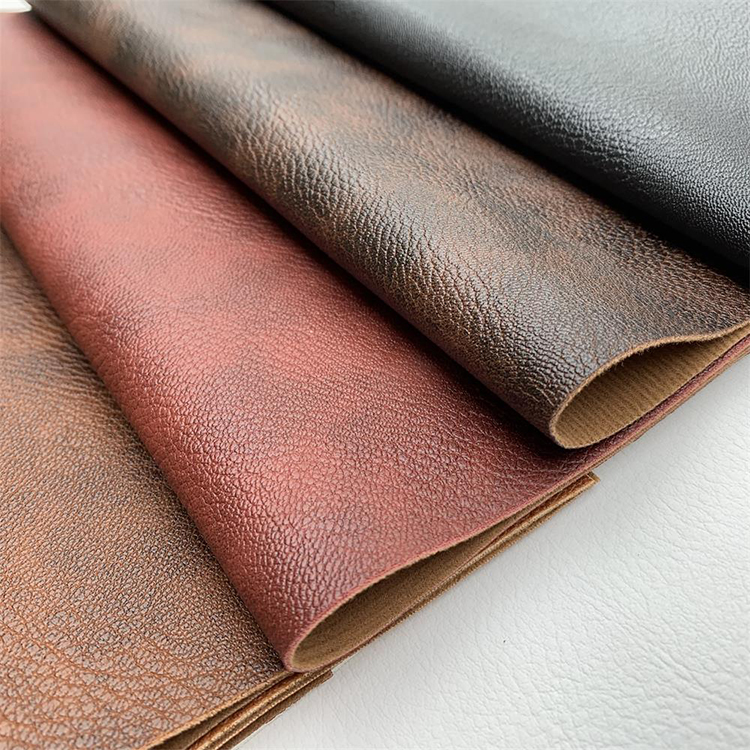
How thick should PU leather be?
A useful starting point for a purchasing discussion—before selecting a specific grade or signing off production.
Specify the complete sheet, not only the PU face.
Commercial PU leather commonly enters sourcing discussions around 0.6–1.4 mm total nominal thickness. Lighter constructions may be easier to fold or wrap, while heavier constructions can add body for some panels. However, a 1.2 mm soft-knit-backed material can handle very differently from a 1.2 mm firm nonwoven-backed material.
For handbags, soft goods, furniture, and car interiors, start from the finished application and conversion process, then agree on a reference sample, measurement method, acceptance tolerance and performance tests.
What the number does—and does not—tell you
Thickness is a geometry measurement. It does not independently certify abrasion resistance, hydrolysis performance, tear strength, colorfastness, cold-flex resistance or flame behavior. The coating recipe, substrate, finish, processing and test conditions all matter.
When a buyer simply requests “1.0 mm PU,” the supplier still needs to clarify whether this is total sheet thickness, a layer-only target or an approximate sales description. That clarification prevents a common source of sample mismatches.
What counts toward PU leather thickness?
A nominal thickness normally refers to the finished layered sheet under an agreed measurement method—not just the visible PU coating.
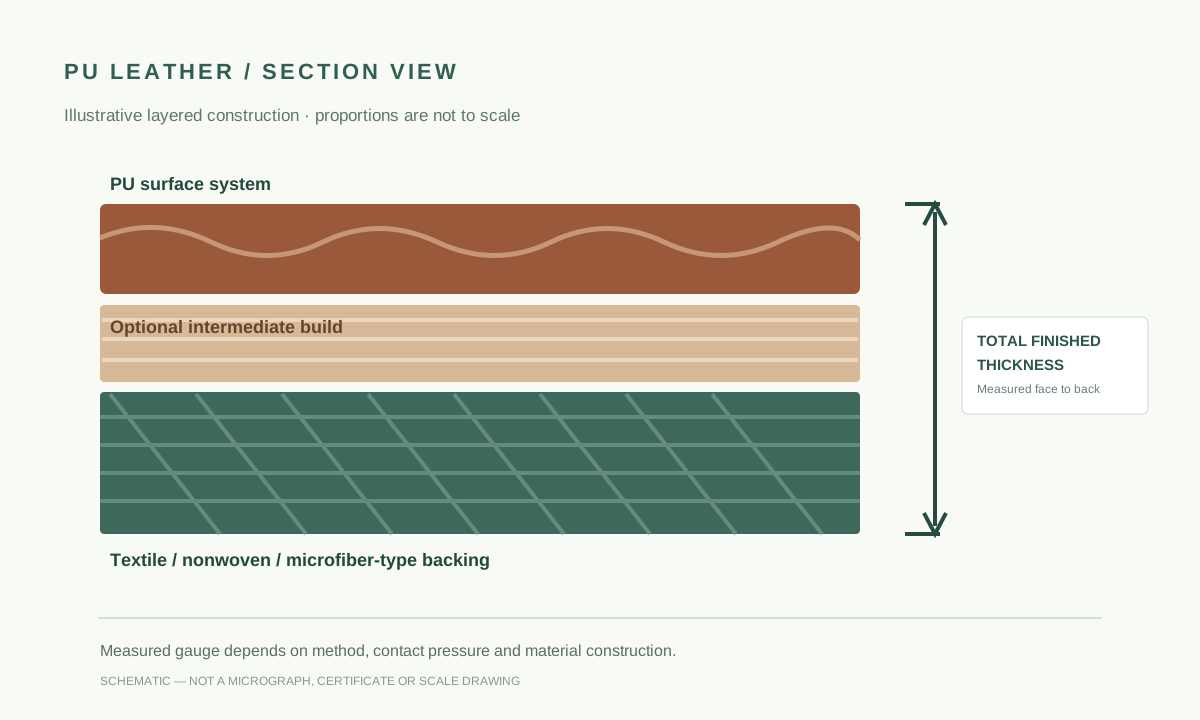
Think in layers
Surface system: The PU-based face provides the grain, color, finish and many surface-contact properties. Its construction varies by formulation and manufacturing process.
Intermediate construction: Depending on grade, an expanded, bonded or supporting layer can influence cushioning, body, surface continuity and the apparent gauge.
Backing: Knitted, woven, nonwoven or microfiber-type support affects stretch, dimensional stability, drape, seam behavior and resistance to tearing. A different backing may change performance even when the caliper value is unchanged.
PU leather thickness by application
The overlapping ranges below are practical starting points seen in commercial sourcing—not fixed DERFLEX SKU specifications, minimum thickness regulations or guarantees of suitability. Confirm the final build against your product sample.
| Application | Initial thickness discussion | What to prioritize | What to verify before ordering |
|---|---|---|---|
| Small accessories, soft wraps and lightweight panels | ~0.6–0.8 mm | Fine folds, low bulk, flexible hand feel | Repeated bending, edge treatment, backing stability and scuff exposure |
| Fashion bags, pouches and flexible bag bodies | ~0.8–1.0 mm | Sewing balance, drape and consistent surface grain | Needle marks, stitch-line tear, seam allowance and reinforcement |
| Structured handbags and soft luggage panels | ~1.0–1.2 mm | Body, panel support and appearance retention | Interlining, fold memory, seam stack and weight of the finished bag |
| Furniture upholstery and office seating | ~0.9–1.4 mm | Comfort, stretch, fit over curves and surface cleaning | Hydrolysis, flex, abrasion, color transfer, backing and upholstery geometry |
| Automotive seats, wraps and interior trim | ~0.8–1.5 mm | Conformability, appearance and component-specific handling | OEM test plan, temperature exposure, emissions where required and fit |
| Firm trim, reinforced panels and special assemblies | ~1.2–1.6 mm or project-specific | Structure and stack-up control, not gauge alone | Folding radius, tooling, lamination, adhesive and finished-part trials |
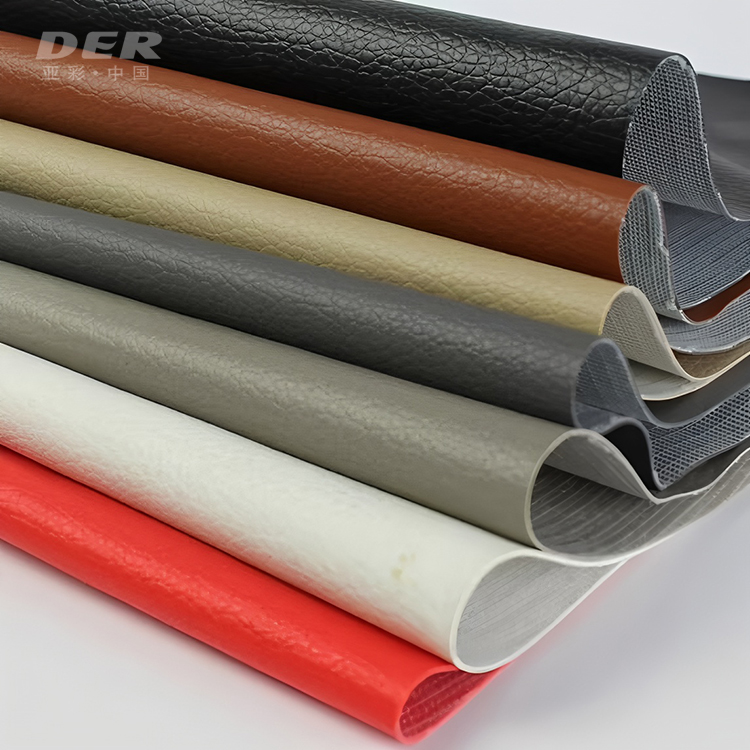
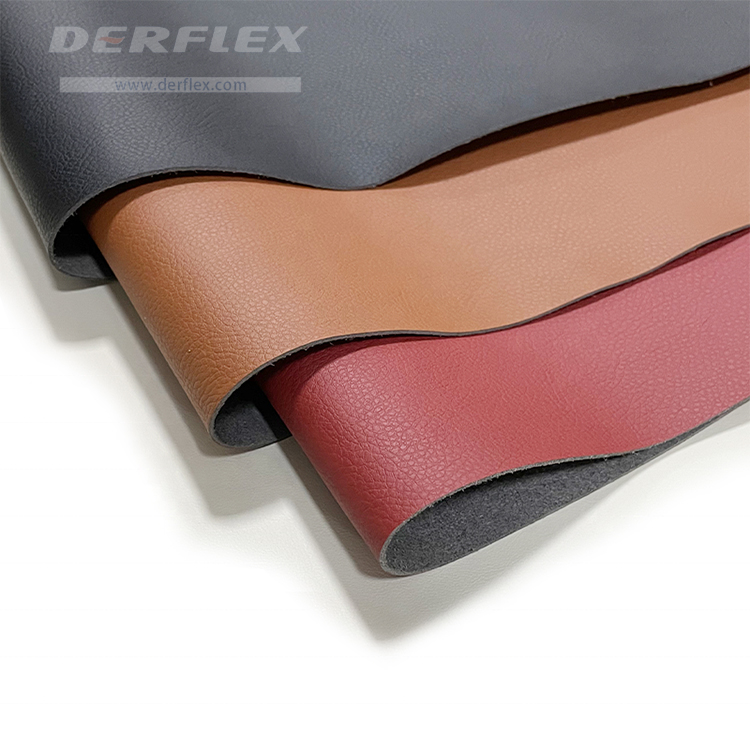
Equal thickness. Different performance.
Choose the right underlying construction for your process; the caliper reading alone cannot predict how a finished product behaves.
Hand feel & drape
A softer backing and coating build may help covers, rounded edges and loose bag shapes. Compare fold lines, recovery and hand feel on full-size swatches—not a tiny color chip.
Body & stability
Structured bags and panels may need a firmer substrate or reinforcement. Increasing the PU face thickness alone is not necessarily the most effective way to add support.
Sewing & wrapping
Check needle holes, tear propagation, edge folding, adhesive bonding and multi-layer seam bulk using the tools and process intended for production.
Thickness vs GSM
mm and mil measure thickness; GSM measures mass per unit area. Two materials with identical gauge can have different weights because of coating density, backing fabric and internal structure. There is no trustworthy universal “GSM to mm” conversion for PU leather.
For purchase specifications, request both total nominal thickness and mass per area only if the latter adds value for cutting, shipping weight or component engineering. Record them as independent measurements.
Thickness vs durability
Durability is a result of the whole material system and use conditions. For repeated flexing, ask for a flex test. For seats, consider relevant abrasion, hydrolysis, cleaning and color-transfer tests. For bags, add seam and tear evaluation. The test method and acceptance level should match the application and approved construction.
A 1.0 mm material is neither inherently “premium” nor inherently “low grade.”
How to measure PU leather thickness correctly
Reproducibility comes from the method, contact pressure, specimen selection and reporting—not just the number on the display.
- 01. Define the measured itemWrite “total finished sheet thickness, face to back,” and identify whether a foam layer, release liner or temporary protective film is excluded.
- 02. Agree on the methodFor a plastics-coated fabric construction, ISO 2286-3:2016 is a relevant reference because it specifies thickness determination at a stated pressure. Confirm applicability to the actual grade.
- 03. Sample representative pointsTake readings at agreed positions across the usable roll width and length. Record the location and avoid creases, seams or damaged areas unless those features are the purpose of the check.
- 04. Report variation clearlyKeep individual readings, sample mean, minimum, maximum, test conditions and allowed deviation. Compare production results against the approved master sample and acceptance plan.
Simple millimeter-to-mil conversion
1 mm = 39.37 mil (approximately). One mil is one-thousandth of an inch, or 0.0254 mm; it is not one millimeter.
| Thickness in mm | Approx. thickness in mil |
|---|---|
| 0.6 mm | 23.6 mil |
| 0.8 mm | 31.5 mil |
| 1.0 mm | 39.4 mil |
| 1.2 mm | 47.2 mil |
| 1.4 mm | 55.1 mil |
| 1.6 mm | 63.0 mil |
Why an ordinary caliper may mislead
A soft or embossed coated sheet can be compressed by a measuring device. Different foot sizes and pressures can give different readings, especially with cushioned constructions. For production specifications, a recognized method and agreed conditions are more useful than a handheld reading made without context.
See ISO 2286-3:2016, determination of coated-fabric thickness. Listing this standard here does not mean a particular DERFLEX material has been tested or certified to it.
Total nominal thickness: 1.00 mm; proposed tolerance: ±0.10 mm; measurement method and pressure: to be agreed; report locations, individual values and batch acceptance rule.A practical specification checklist for repeat orders
Control the characteristics that drive cutting efficiency and finished-product behavior. An approved reference sample is the bridge between a sales description and repeatable production.
- Final use and part geometry: bag body, seat, trim, furniture or panel
- Nominal total thickness, units, measurement method and tolerance
- Backing type, degree of stretch and target hand feel
- Surface grain, gloss, shade, abrasion and cleaning requirements
- Usable roll width, approximate length and packaging preference
- Cutting, stitching, folding, adhesive or lamination process details
- Applicable tests, acceptance criteria and documentation needs
- Color reference, approved master sample and batch matching method
- Expected quantity, order pattern, destination and planned schedule
- Special end-use restrictions, emissions or compliance requirements
From thickness request to approved material
Use a short, evidence-based workflow to reduce specification drift between the first swatch and repeat shipments.
Describe the finished item
Send the application, reference photo or drawing, forming method and target feel. Share any material currently in use and what you want to improve.
Compare construction options
Discuss coating, substrate, gauge, grain and roll format. Ask for corresponding swatches rather than treating a nominal thickness as a complete grade code.
Test the actual conversion
Inspect appearance, stitch or bonding behavior, fold lines and agreed performance criteria. Record the accepted sample and method for measuring thickness.
04 / Release repeat-order specifications
After sample approval, establish the product description, target gauge and tolerance, backing, color and surface reference, inspection points, packing and change-control expectations. With DERFLEX, your inquiry can start with a photo, a rough thickness target and intended use; final construction and availability should then be confirmed for the project.
Common questions about PU leather gauge
Practical answers for OEM buyers, upholstery teams, bag factories and materials procurement.
What is the typical thickness of PU leather?
Many commercial PU leather sourcing conversations start around 0.6–1.4 mm total thickness, but there is no universal standard gauge for every use. The appropriate construction depends on the backing, finish, part geometry and performance requirements. Confirm the selected grade against an approved sample.
Is 1.0 mm PU leather suitable for handbags?
A nominal 1.0 mm sheet can be a sensible starting point for many handbag bodies, but it is not an automatic approval. Evaluate softness, backing, stitch-line strength, folding, edge finishing and any stiffener or interlining in the finished bag.
Does thicker PU leather last longer?
Not necessarily. Thickness alone cannot establish abrasion resistance, hydrolysis behavior, seam strength, flex durability or chemical resistance. Compare relevant tests on constructions with the same intended use and acceptance criteria.
Is PU coating thickness the same as total PU leather thickness?
No. Total finished-sheet thickness may include the PU face, intermediate layers and textile or microfiber-type backing. A coating-only measurement is a different specification and must be stated separately to avoid sample mismatch.
How should buyers measure PU leather thickness?
Define the finished material being measured, agree on a method and contact pressure, take representative readings and report the results with an approved tolerance. ISO 2286-3:2016 is a relevant method for applicable rubber- or plastics-coated fabrics; suitability for the specific construction should be confirmed.
Can I convert PU leather GSM into millimeters?
No universal conversion is valid. GSM is mass per unit area, while mm describes thickness. Coating density, backing and internal structure can produce different weights at the same thickness, so request each property separately where needed.
What thickness tolerance should I use for a bulk PU leather order?
Set a project-specific tolerance after reviewing test capability, the material construction and approved samples. For example, 1.00 mm ±0.10 mm can be used as illustrative purchasing-brief wording, not as an established DERFLEX standard or a guaranteed manufacturing capability.
Choose the thickness for the product you are actually making.
Share your use case, target mm range, reference sample, width, color, backing direction, converting method and approximate order quantity. DERFLEX can review the material direction and discuss suitable options for your procurement program.