



What Finished Tarp Size Is Needed for a Box-Shaped Load?
Measure the top of the load, specify how far the fabric must hang down each of its four sides, and add only the extra reach needed for fastening or overlap. The result is the usable finished size of a flat draped tarp—not the raw cut size and not the panel pattern of a sewn, fitted box hood. Use this guide to avoid short edges, oversized loose fabric and unclear purchase orders.
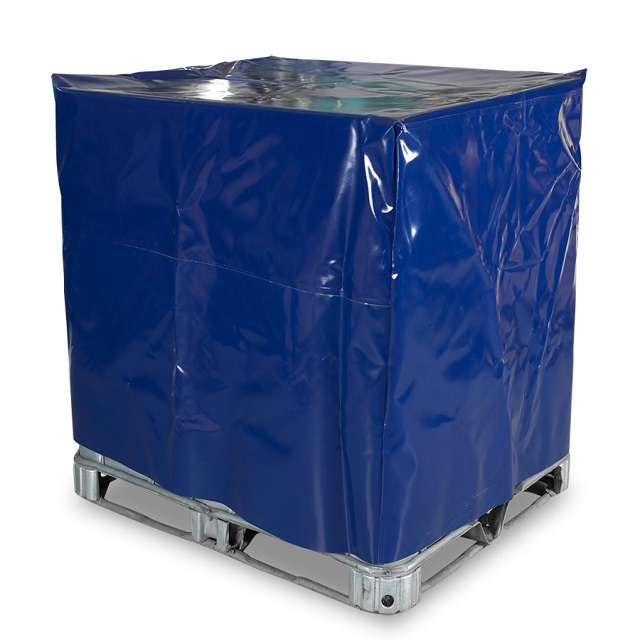
For a simple rectangular load, finished tarp length = top length + front drop + rear drop + any extra end reach. Likewise, finished width = top width + left drop + right drop + any extra side reach. If the top is 4.0 × 2.0 m, all four drops are 1.5 m, and every edge needs another 0.15 m of working reach, order approximately 7.30 × 5.30 m finished. Confirm the actual tie-down position and finished-size tolerance before production.
The Finished-Size Formula for a Box Load
A single rectangular sheet has two overall dimensions. The load itself has three, and the installation adds four independent edge requirements. This simple distinction is what makes the sizing reliable.
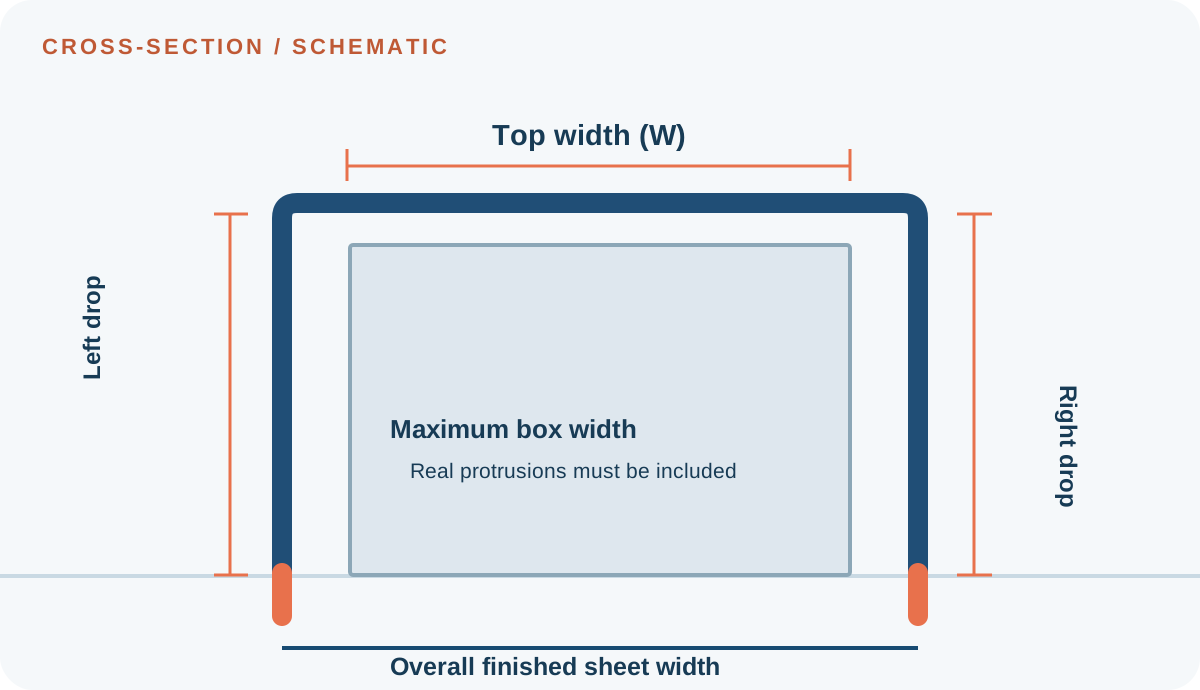
Top dimensions are the maximum outside dimensions across the upper load profile. Drop (D) is the required travel from the top edge down a face to the intended lower covering line. Working reach (A) is fabric beyond that line for a fold, fixing or overlap. If the edge already ends at its attachment line, A may be zero; do not automatically double-count it.
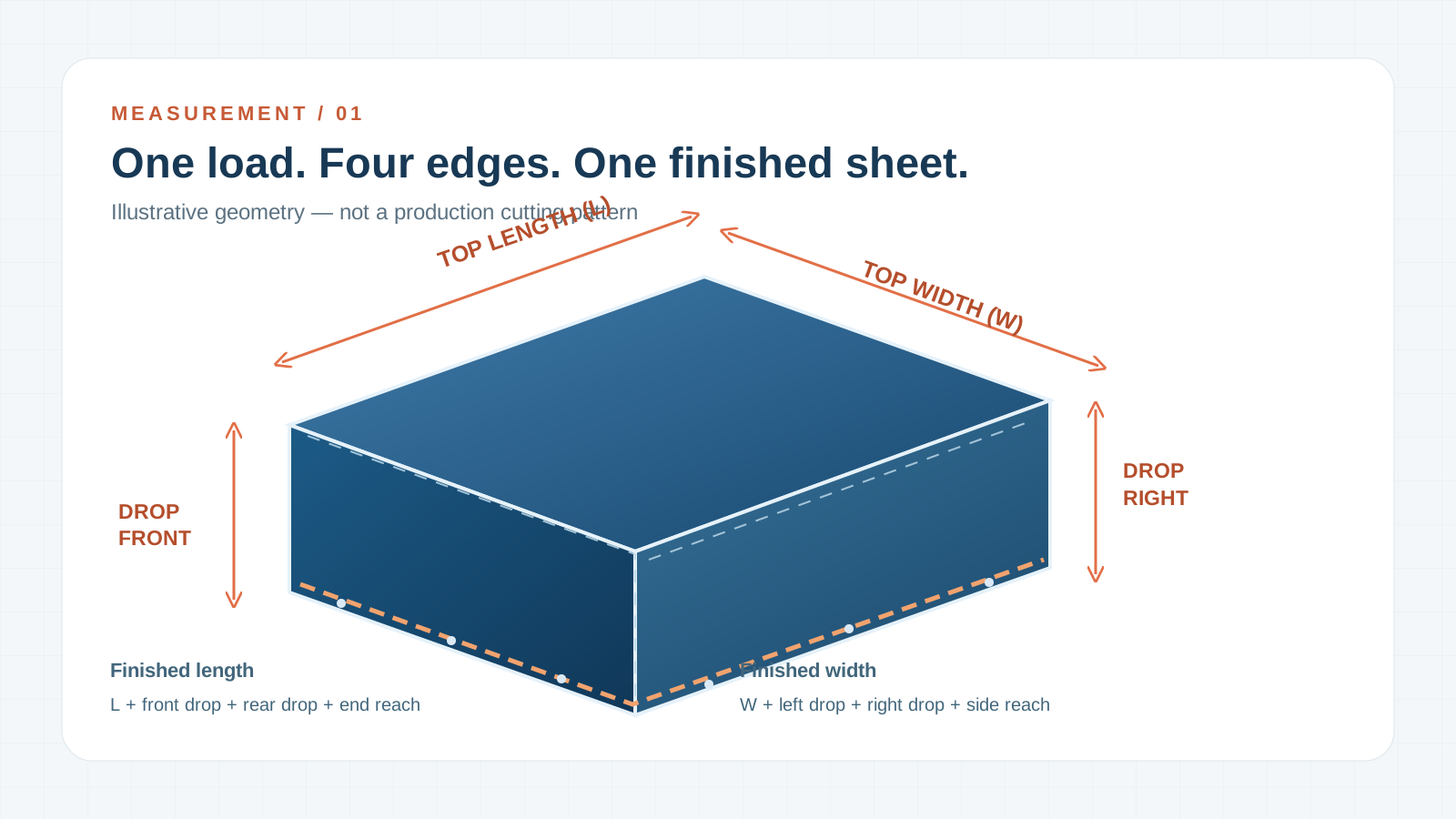
Measure the top
Use the maximum exterior length and width, including crate rims, projections or packaging that the tarp must cross.
Mark the edge line
Decide whether the fabric should cover half the side, reach the base, or pass below a rail to the actual fixing point.
Record four drops
Measure front, rear, left and right separately. A raised deck or uneven load can make them unequal.
Add only useful reach
Allow for the real fold, grip or tie-down geometry, then specify the required dimension after finishing.
Worked Example: Different Drops on All Four Faces
Consider a 4.80 × 2.20 × 1.60 m rectangular load. All four faces must be covered, but its rear and right-hand anchor points sit lower than the load base. The selected drops are therefore front 1.60 m, rear 1.80 m, left 1.60 m and right 1.75 m, followed by 0.12 m of additional working reach at each edge. These are illustrative design inputs, not a universal allowance.
Calculate Your Own Finished Tarp Size
Set the top size and four independently measured drops. For simplicity the estimator uses one extra working-reach value applied to every edge; send a drawing if your reach differs by edge. The result is a planning dimension, not an approved production drawing.
Load & coverage inputs
Numbers are converted when you change the measurement unit.
How Much Side Drop Should You Allow?
The correct allowance depends on the covering task. A tarp that just reaches the sidewall is not automatically long enough to reach the tie-down anchors below it.
| Installation | Measure to | Practical check | Recommended specification |
|---|---|---|---|
| Top protection only | Just beyond the top perimeter | Does wind uplift require an anchoring system? | Top dimensions + specific overhang; no automatic full-height drop. |
| Partial side protection | Specified portion of each wall | Can rain enter below the edge? | Top + measured partial drops + any separate fixing reach. |
| Full-height warehouse cover | Bottom of load or intended base line | Does the sheet drag on the floor or interfere with handling? | Full side height, then only necessary edge clearance. |
| Outdoor cargo or flatbed | Actual hooks, straps or approved fastening zones | Is the load level and are all protrusions protected? | Four measured drops; show the fastening drawing and any flap separately. |
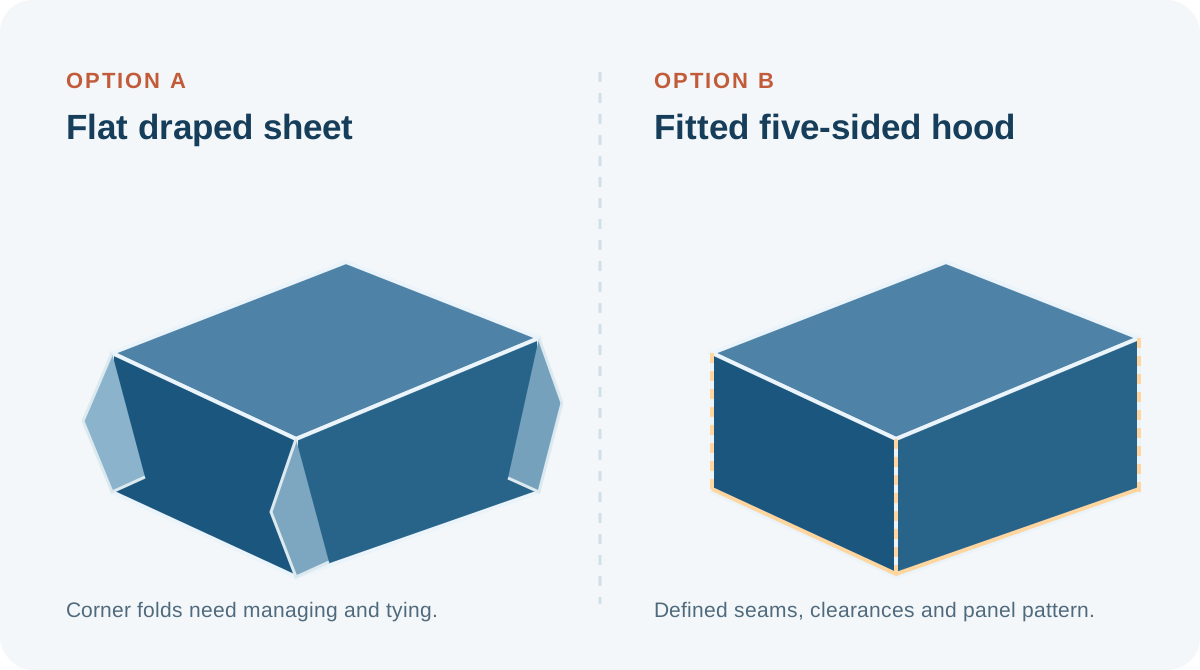
| Repeat OEM fitted hood | Designed lower perimeter of each sewn/welded panel | Are corner seams, fit clearance and openings agreed? | Use a tailored pattern; the flat-sheet formula is not sufficient. |
If the job is a shaped hood, compare DERFLEX fitted box cover configurations. For more complex truck protection, follow the measured attachment layout in the flatbed tarp kit guide.
Finished Size Is Not Cut Size
For a finished 7.30 × 5.30 m cover, the buyer should request those dimensions after hemming, joining and edge fabrication. The converter then determines the larger cut blank or joined panel plan needed to create that usable product. Do not add an arbitrary “hem loss” to your required finished size; that can make the delivered cover oversized.
The measurement condition belongs on the drawing: laid flat, relaxed and measured from finished outer edge to finished outer edge, unless a different approved condition is required. A numerical finished-size tolerance, hardware-position tolerance and inspection method should be agreed for repeat orders.
- Finished size: the actual usable overall dimension, measured after finishing.
- Cut size: the fabric blank or individual panels before fold, weld or seam consumption.
- Fitted-cover panel size: panel-by-panel pattern dimensions, not simply a draped rectangular sheet.
Buyers needing stricter factory language can refer to the DERFLEX tarp buying guide and made-to-measure tarpaulin specification guide.
Size the Tarp, Then Specify the Material and Edges
The same finished dimensions can create very different performance when the cover is repeatedly pulled over corners, exposed to weather or attached under tension. DERFLEX supplies PVC-coated fabric and discusses finished custom tarp construction according to the project scope.
| Decision | What to clarify | Why it changes the order |
|---|---|---|
| PVC coated polyester | Weight and base cloth, coating, flexibility, outdoor exposure and any required test evidence | Handling mass, abrasion response, bending and the chosen joining method. |
| Seams & panel joins | Roll width, welding compatibility, seam direction and overlap placement | Large finished sheets may require multiple production panels even if they drape as one piece. |
| Hems & reinforcement | Welded or sewn perimeter, webbing, corner patches and wear pads | Anchor loads and sharp cargo edges can concentrate stress at the perimeter. |
| Fixing hardware | Grommets or D-rings, center-to-center positions, distance from edge and anchor direction | Hardware coordinates must match actual fixing points rather than stock spacing assumptions. |
| Repeat manufacturing | Approved dimension drawing, revision, tolerances, color, logo and packing method | Consistent repeat orders need more than one nominal length × width label. |
Explore PVC tarpaulin material, custom finished tarps and storage tarp applications when planning a bulk or OEM program.
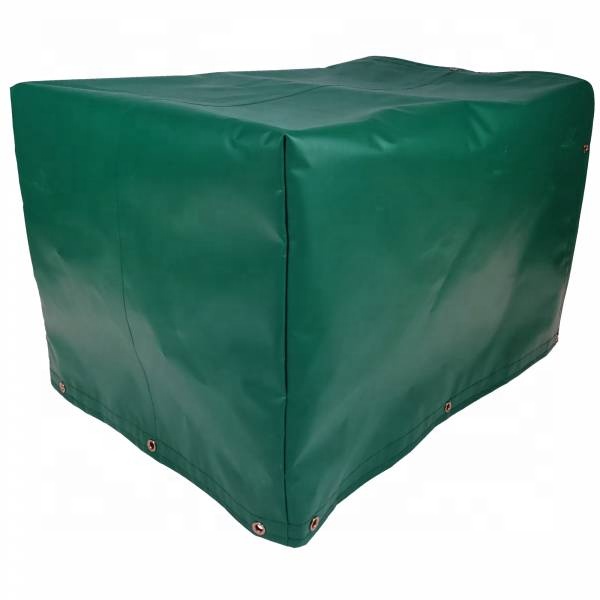 Finished-cover reference
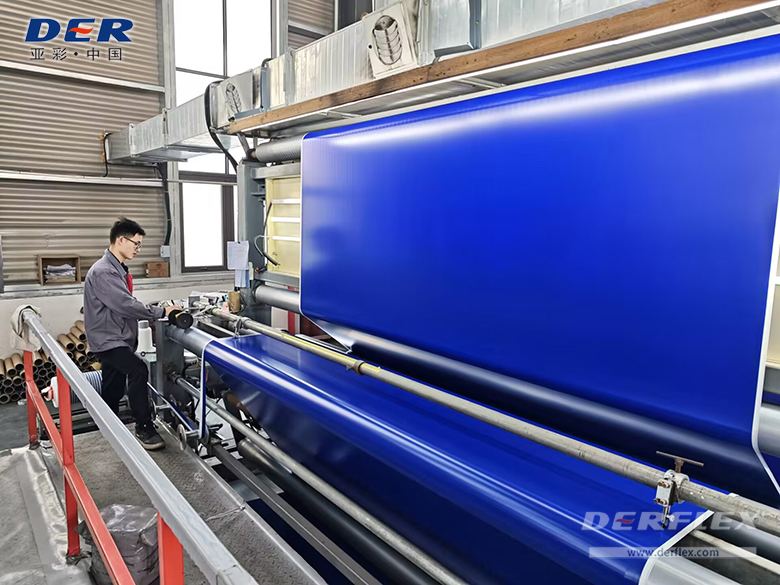 PVC coated roll material
What to Send for a Custom Tarp Quotation
A short sketch with the finished-size convention prevents more misunderstandings than an unqualified request for a “large heavy-duty tarp.”
- Measured maximum top length, width and height, plus photographs of all four faces.
- Front, rear, left and right drop in the same unit; annotate unequal edges.
- Working reach for straps, grommets or overlap, separately from the four drops.
- Intended cover type: flat drape, fitted five-sided hood, truck tarp with flap, or fabric roll.
- Use environment, exposure, expected handling frequency and any technical test requirements.
- Target fabric construction, color, finished hems, corner protection and anchor-point drawing.
- Quantity, desired packing, destination, target schedule and sample/first-article approval needs.
For a standardized palletized load, compare the approach with reusable pallet covers. The general DERFLEX tarpaulin calculator is available for symmetrical drop estimates.
Quotation wording you can reuse
Example only. Adapt the numbers and include a real drawing before committing to production.
Frequently Asked Questions
Answers about finished tarp dimensions, side coverage and production measurement.
How do I calculate finished tarp size for a box-shaped load?
Add the front and rear drops plus any extra end reaches to the measured top length. Add the left and right drops plus any extra side reaches to the measured top width. State the result as finished dimensions after hems and seams, not cut size.
What size tarp covers a 4 × 2 × 1.5 m box completely?
With 1.5 m of drop down all four faces, a simple flat sheet starts at 7.0 × 5.0 m finished. If an additional 0.15 m of working reach is needed beyond the drop on every edge, the finished sheet becomes 7.30 × 5.30 m. Check how the edges will be secured.
Should the tarp drop equal the load height?
Only when coverage must reach the base of the load. Partial protection can use a shorter drop, while tie-downs below the load may require extra working reach. Measure each face to the desired lower edge and fastening line.
Do I add hem allowance to the finished size?
No. If the required dimension is a finished size, the tarp maker should account for material consumed by hems, welded joins and reinforcement in the cutting plan. Agree whether a supplier's stock size means cut size or finished size before ordering.
Can the flat-sheet formula size a fitted five-sided box tarp?
Not precisely. A fitted cover has a top panel, shaped sidewalls, corners, seams and fit clearance. It needs a panel and hardware drawing. The flat-sheet formula applies to a single rectangular tarp draped across a simple box-like profile.
What if the left and right sides have different drops?
Use the actual left and right drops independently, rather than multiplying one assumed height by two. The same applies to front and rear. Mark the direction and measuring datum on a sketch so the cover cannot be installed in the wrong orientation.
Is the calculated tarp size enough for a moving truck load?
No. The flat dimensions are only one input. A truck application also needs a load-profile drawing, specified flaps and hardware, protected sharp edges and a separate cargo-restraint plan that complies with relevant transport rules.
What must a custom tarp quotation say about size?
Specify finished overall length and width, measurement state, outer-edge datums, agreed tolerances and the drawing revision. Add material, corner reinforcements, grommet or D-ring locations, application, order volume and any test requirements.
Make Your Next Tarp Size a Measurable Specification.
Send the load's top dimensions, four drops, photos, intended fixing points and order quantity. DERFLEX can review a suitable PVC fabric and finished-cover construction against the scope of your project.
Material grade, finishing options, MOQ, lead time and any testing are confirmed for each enquiry.