


 Material knowledge / Fabrication detail / B2B sourcing
The specification series / Tarp engineering
Welded Seams. Reinforced Edges. Specified to Perform.
How should a buyer specify welded seams and reinforced tarp edges? Start with the finished cover's loads and dimensions, then define the seam method, joint geometry, perimeter build-up and every tie-down interface. This guide turns vague requests for a “strong waterproof tarp” into drawings, sample approvals and measurable acceptance criteria for PVC-coated fabric and finished custom covers.
01 / Direct answer
Specify the entire load path—not just “heat welded” or “heavy-duty hem.”
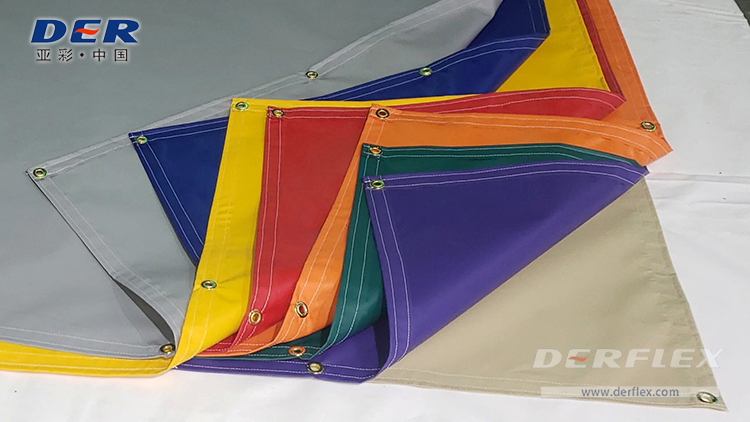
A useful purchase specification identifies the coated fabric grade; exact finished size and panel map; welded seam location, method, effective width and tolerance; edge fold or reinforcement construction; corner and hardware layout; and the agreed inspection and test criteria. The drawing should show which side is outward, where rain drains and in which direction the cover is pulled.
For large-format tarps, the fabric, weld, hem and fixing hardware behave as one assembly. A strong coated textile can still fail when a seam crosses a high-tension zone, a grommet sits too close to a cut edge or a corner patch ends before the tie-down load can spread. Specify these interfaces before approving a sample.
Application photo or sketch; finished length and width; quantity; preferred PVC-coated fabric or service conditions; panel orientation; edge attachment method; expected wind, water, abrasion and handling exposure; and any drawing or sample that must be matched. DERFLEX can then discuss material rolls, cut panels or completed tarps.
02 / Weld construction
Define five properties of every critical seam.
“Heat welded” describes a process family. It does not state the joined area, load direction, joint location or pass/fail standard. Draw the joint first; qualify the fabrication conditions on representative material.
Method & material
Identify PVC coating grade and intended hot-air, hot-wedge or HF/RF process. Verify coating compatibility, surface finish and any treatment that could affect fusion.
Overlap & width
Show lap direction, nominal overlap, effective bonded width and permitted variation. Do not confuse total overlap with bonded width.
Panel & seam map
Dimension each seam relative to finished edges, folds, corners, openings and hardware. Keep high-load transitions visible on the drawing.
Water & movement
Mark the exposed face, flow direction, possible ponding, folding line and abrasion zones. A lap that sheds water in one orientation may trap it in another.
Strength & quality
Agree on coupon sampling, seam-strength direction, minimum value, failure mode, visible defect limits and water-resistance test where relevant.
Repeatability
Use an approved first article and record production settings under supplier control; requalify when fabric grade, equipment, finish or critical settings change.
What method should the buyer name?
Hot-air or hot-wedge welding is often suited to long overlaps on custom large panels. HF/RF welding may be selected for compatible PVC constructions and repeatable defined tooling. Sewing remains useful for non-weldable components, complex attachments and certain repairs, but needle perforations need their own weather-sealing strategy.
Do not copy an equipment temperature, pressure or travel-speed recipe from another fabric. Actual bond quality depends on coating chemistry, fabric thickness, surface treatment, overlap, heat delivery, pressure, speed and cooling. A production trial is the correct place to establish the method and acceptable process window.
Read more about DERFLEX heat-welded tarpaulin options and available conversion stages.
03 / Perimeter engineering
Reinforcement must carry force away from the fixing point.
The exposed perimeter does more than stop fraying. It transfers tension from a grommet, D-ring, strap, lacing rope or track into the panel. The edge design should therefore match the attachment system and the direction of pull.
Specify the edge section
- Folded or welded hem: record finished hem depth, layers, bond route and edge termination.
- Webbing-backed edge: state webbing fiber, width, placement, attachment pattern and end treatment. Do not assume all webbing can be welded directly to PVC.
- Rope-in-hem: define rope material and diameter, enclosure geometry, whether rope is free or captured, and end closure.
- Local patch or wear strip: specify material compatibility, size, placement and how reinforcement transitions back into the main panel.
- Corner construction: detail the diagonal pull direction, patch layers, corner radius and distance between hardware and finished edges.
For available options, see the reinforced-edge tarp construction guide.
“Double hem” and “reinforced corner” are not sufficient acceptance descriptions. A second layer with an abrupt termination can concentrate strain. Show the actual layer stack, attachment route and patch boundary, then load-test a representative corner or fixing assembly where the application requires it.
04 / Procurement control sheet
What belongs on the purchase drawing?
These fields make fabricators' quotations comparable and provide a repeatable inspection reference. Use millimeters for dimensions and state tolerances separately.
| Drawing field | Buyer must state | Why it controls performance |
|---|---|---|
| Material identity | Approved PVC-coated polyester grade, nominal mass or thickness, finish, color, roll orientation and relevant test report reference. | Fusion, tensile and tear performance begin with the actual coating and scrim, not a generic “vinyl tarp” label. |
| Finished geometry | Finished length/width, shape, face orientation, folds, darts, sleeves, openings, datum lines and dimensional tolerances. | Cut size differs from finished size after overlaps, hems and forming; measure from consistent datum points. |
| Welded seam | Welding method, panel/seam map, lap direction, nominal overlap, effective welded width, width tolerance and critical transitions. | Allows panel yield, joint strength, drainage and reproducibility to be checked. |
| Perimeter hem | Single/double fold, finished hem depth, bonded or stitch lines, layer count, whether edges are closed and corner finish. | Controls local rigidity, fold endurance, hardware backing and finished external dimensions. |
| Webbing / rope | Material, width or diameter, path, attachment method, overlap/termination and joint orientation. | Distributes tension through the perimeter rather than concentrating it at one eyelet. |
| Grommets / D-rings | Inside diameter, metal finish, washer type, center-to-center pitch, setback, first/last hole locations, ring/tab orientation and count. | Hardware spacing only helps when it matches real anchors and a reinforced edge. |
| Corners & wear | Patch size, shape, layer stack, local positions at rub rails or sharp contact areas, and transition details. | Corners, abrasion points and cross seams often govern the finished assembly's service life. |
| Acceptance & supply | Approved sample ID, test method and limit, sampling plan, visual defects, packing fold, labels and supply scope. | Makes repeat orders measurable and prevents ambiguity about material rolls versus completed tarps. |
On smaller screens, scroll the table horizontally to review all three columns.
Example: a useful seam note
“Panels to be joined with the qualified welding method for the approved PVC-coated fabric. Seam line, lap direction and effective bond width to follow revision-controlled drawing. Confirm strength, leakage and visual acceptance on approved first-article and production specimens.”
Example: a useful edge note
“Perimeter fold and selected reinforcement to match the approved section detail. Position holes by dimensioned centerlines and offsets from finished edges. Corner patches to align with indicated tie-down directions. Final hardware, materials and tolerances governed by approved sample.”
05 / Tie-down interfaces
Draw grommets and D-rings where the anchors actually are.
A row of evenly spaced eyelets looks tidy but can be structurally inappropriate when a trailer rub rail, temporary frame or machine housing has irregular anchor points. The drawing should specify centers rather than simply “12 grommets per side.” Include the first and last center position, intermediate pitch, hole diameter, metal finish and edge setback.
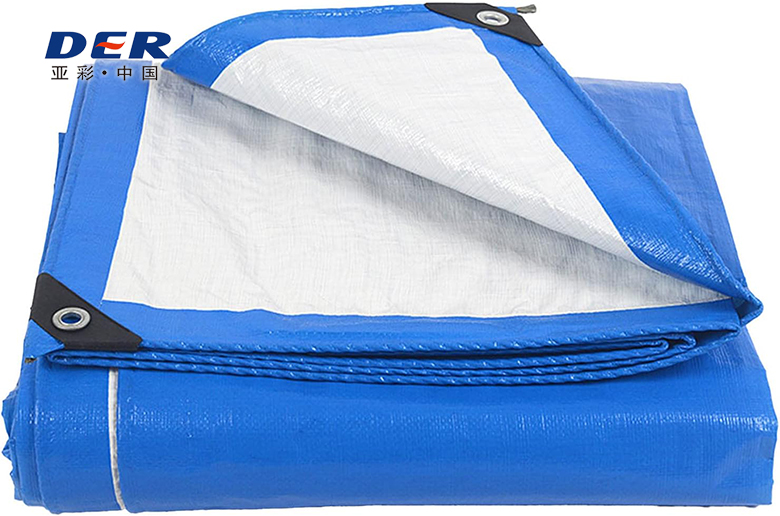
For a D-ring or webbing tab, indicate the pull angle, reinforcement footprint, strap length, stitch or weld route and whether metal touches the coated sheet. At corners, show how two edge load directions combine. When the tarp wraps over a rigid edge, identify contact radius and a replaceable wear layer if needed.
A tighter spacing pattern is not automatically stronger. The effective load capacity depends on the full edge assembly, anchor condition, tensioning method and weather. DERFLEX's tarp-with-grommets page explains hardware choices for finished covers.
06 / Application selection
One seam-and-edge specification cannot fit every tarp.
Truck & trailer covers
Prioritize repeated tensioning, wind exposure, folding fatigue, rub-rail abrasion and predictable anchor locations. Map panels around the main tension path and consider webbing, reinforced tabs and replaceable local wear pads.
Construction & temporary weather protection
Prioritize rain paths, exposed edges, panel joining over large spans and irregular anchoring. Identify potential ponding and drainage before choosing an overlap orientation or adding extra penetrations.
Equipment & warehouse covers
Prioritize machine-contact points, access flaps, edges that are opened frequently and custom pockets. Exact fastener coordinates and finished geometry matter more than a generic square grommet pattern.
Agricultural & outdoor storage covers
Prioritize seasonal exposure, ground restraint, abrasion at corners and handling weight. Agree on UV and cold-flex requirements for the chosen coated fabric grade without assuming a universal life expectancy.
07 / Verification & quality
Build acceptance around representative welded and reinforced specimens.
A visual sample is useful but cannot, by itself, confirm seam strength, water resistance or eyelet pull-out behavior. Agree on methods and limits before manufacturing starts.
| Control stage | Suggested evidence | Buyer decision |
|---|---|---|
| Incoming material | Material grade, batch traceability, mass/thickness, coating face and applicable tensile/tear or coating test records. | Approve the material basis before weld trials; do not transfer results from another PVC grade automatically. |
| First article | Finished-size and seam map measurement; bond-width records; edge cross-section; hardware centers; labeled photos and representative coupons. | Sign a drawing revision and physical sample so repeat production has a single reference. |
| Weld performance | Seam-strength testing in the agreed direction, including observed failure mode; water-pressure or leakage check where applicable. | Specify test standard, conditioning, number of specimens and pass/fail values. ASTM D751 contains coated-fabric seam-strength and hydrostatic-resistance methods. |
| Attachment performance | Representative eyelet, D-ring or tab pull test, checking for washer release, tear propagation, patch separation or webbing failure. | Agree on fixture geometry and pull direction; a coupon cut from the center panel may miss the real failure mechanism. |
| Final lot inspection | Finish dimensions, seam continuity, no unacceptable burn-through/voids, complete hardware count, reinforced corners, labels and fold pattern. | Record sample quantity, defect classification and disposition for nonconforming pieces before shipment. |
Testing must be selected for the actual coated fabric and finished construction. No unverified universal kN value, peel value or water-column threshold is implied.
Inspect the failure mode, not only the peak number.
A tensile result alone cannot explain whether a joint separated adhesively, tore next to the weld, fractured through the fabric or failed at a reinforced corner. Require the test report to identify specimen direction, conditions, and the observed location and mode of failure. Test both straight seams and special intersections if the latter are critical.
For a waterproof cover, visually inspect the seams and ask for a water-resistance or leakage method that reflects intended service. A factory sample test does not simulate every installed loading, pooling or drainage condition.
For a wider raw-material selection framework, consult the DERFLEX tarpaulin technical specification.
08 / Procurement & quotation
Confirm exactly what DERFLEX is being asked to supply.
Material rolls
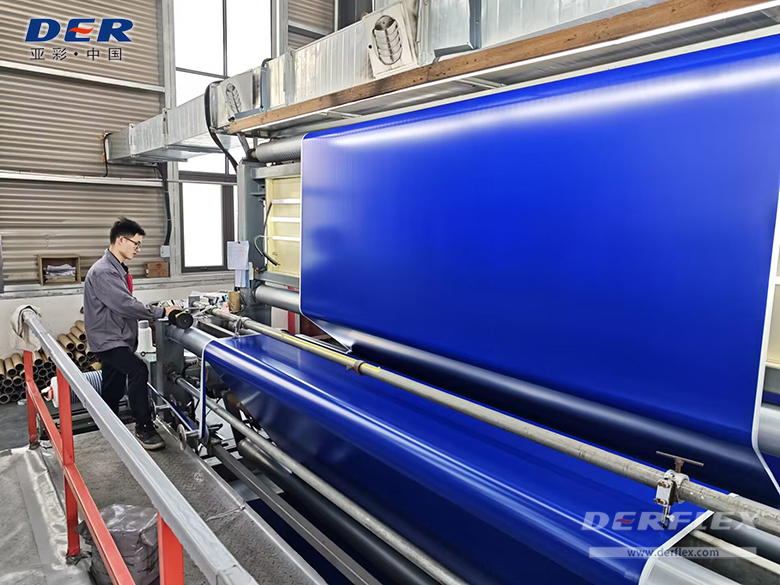
Weldable PVC-coated polyester rolls for a converter that will cut, join, hem and install hardware locally. Ask for coating compatibility and a production-trial sample.
Cut or welded panels
Pre-cut and selected pre-welded components to a controlled drawing, with finishing scope clearly divided between supplier and buyer.
Finished custom tarps
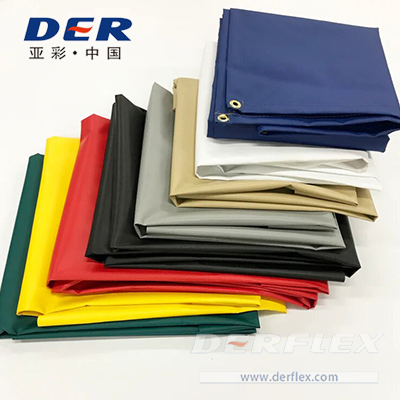
Completed covers with approved panel layout, seams, perimeter build-up, fixing hardware, labeling and packing. Supply scope and sample approval govern the quote.
Send one useful RFQ package.
- Use and service exposure: cargo, equipment, enclosure or storage; water, wind, abrasion and handling cycle.
- Finished-size drawing, face orientation, panel seams, hems, openings and expected quantity.
- Material grade or target properties, color and any regulatory test requirement.
- Anchor map with tie-down method, pull directions, hole size, pitch and corner build-up.
- Acceptance basis: signed sample, relevant test methods and limits, inspection plan, packaging and destination.
Cost depends on coating and fabric selection, roll utilization, number and length of seams, complexity of corner reinforcements, hardware count, sampling and packing. Request a comparable quotation against one revision-controlled specification, then approve production samples. You can also explore custom PVC tarp supply options and tarpaulin fabrication services.
09 / Buyer questions
Welded seam and reinforced edge FAQ
What should a buyer specify for a welded tarp seam?
State the material grade, process, panel layout, seam location, overlap or effective weld width, weld orientation, finished-size tolerance, and agreed strength and watertightness acceptance method. Approve a production-representative sample before bulk fabrication.
How wide should a welded PVC tarp overlap be?
There is no single overlap width suitable for all PVC coated fabrics, equipment and load cases. The supplier and buyer should validate an effective weld width through production trials, then state the nominal dimension and tolerance on the drawing.
Are heat-welded tarp seams automatically waterproof?
No. A qualified weld avoids needle holes along its bond, but leakage can still occur through incomplete fusion, crossings, corners, holes, accessories or the installed drainage path. Specify a water-resistance check appropriate to the intended use.
What is the difference between a folded hem, webbing and a rope edge?
A folded hem reinforces the cut perimeter; webbing spreads tension along a defined load path; a rope-in-hem provides a continuous rounded edge for lacing or perimeter restraint. The correct construction depends on the real fixing method and direction of force.
How should grommet locations and reinforced corners be documented?
Provide a dimensioned plan showing hole inside diameter, material, center-to-center pitch, setback from the finished edge, first/last center locations, backing patch size, corner geometry and direction of pull. The total hardware count alone is insufficient.
Which tests should be included in tarp seam acceptance?
Agree on visual and dimensional checks plus suitable seam-strength and water-resistance testing for production-representative specimens. ASTM D751 includes seam-strength and hydrostatic-resistance methods for coated fabrics. Specify the current applicable method, conditioning, sampling and pass/fail limits in the purchase specification.
Can DERFLEX provide rolls, pre-welded panels and finished tarps?
DERFLEX can discuss weldable PVC coated fabric rolls, cut or pre-welded panels and custom finished tarps. The quotation should explicitly identify which processing, reinforcements, hardware, packaging and installation services are included.
10 / Continue your specification
Related DERFLEX technical and sourcing resources
Build a repeatable custom tarp specification
Share your drawing. Align the seam, edge and hardware details before production.
DERFLEX can review the material direction, welded panel construction and reinforced perimeter options for your application. Include a sketch, dimensions and quantities even if your acceptance specification is not yet complete.