Collapse Margin
Fan static pressure, diameter and duct length determine how much radial support is needed. Larger diameters or stronger suction may require a tighter pitch, heavier wire or shorter sections.



 Flexible Extraction Duct Systems
Custom wire-supported flexible ducting for mine and tunnel extraction, dust collection, fume removal, portable blowers and industrial exhaust routes. DERFLEX coordinates the coated textile body, helix reinforcement, wear protection, connection and suspension as one finished assembly.

A negative pressure ventilation duct carries contaminated or unwanted air toward an extraction fan, dust collector, filtration unit or discharge point. Typical media include dust-laden air, welding fumes, smoke, diesel exhaust, heat and process vapors. Because the pressure inside the duct is lower than the surrounding atmosphere, an unsupported textile tube can flatten and restrict airflow.
A spiral ventilation duct addresses this problem with a continuous steel helix or closely spaced support structure. The reinforcement keeps the cross-section open, while a flexible PVC-coated textile wall provides an airtight passage that can follow temporary or changing routes. The selection is not based on diameter alone: suction level, total run, bends, air temperature, contaminants, movement frequency and acceptable pressure loss all affect the finished construction.
DERFLEX approaches each order as a duct assembly rather than a roll-material transaction. Material grade, wire diameter, pitch, external abrasion strip, seam method, suspension and coupling geometry are reviewed together. This supports more consistent fit-up at the fan, easier section replacement and clearer repeat-order specifications for contractors, equipment builders, distributors and industrial users.
These decisions should be confirmed before fabric weight, color or packaging is finalized.
Fan static pressure, diameter and duct length determine how much radial support is needed. Larger diameters or stronger suction may require a tighter pitch, heavier wire or shorter sections.
Sharp bends, compressed sections, undersized diameters and poorly matched cuffs add resistance. Route planning and internal smoothness matter to airflow as much as nominal duct size.
Dust, moisture, oil mist, fumes, temperature and chemical exposure influence coating formulation, cleanability, seam choice and optional surface treatments.
A suspended line, floor-laid hose and frequently relocated duct do not wear in the same way. Contact zones, lifting points and section lengths should match actual site practice.
High-tenacity polyester with a PVC coating forms a flexible, weldable and cleanable air barrier. Fabric weight and coating formulation are selected according to pressure, wear and environmental exposure.
Continuous spring-steel support maintains the duct opening under suction. Wire gauge and pitch influence collapse resistance, bend radius, compressed length, handling weight and cost.
An external strip can cover the wire path or reinforce identified contact zones. This is useful where the duct touches tunnel walls, floors, machinery or repeated lifting points.
Zipper, hook-and-loop, ring, clamp or soft-cuff systems are coordinated with the airflow direction and equipment connection. Suspension may use single or double lines, tabs, loops or eyelets.
The table is a quotation guide rather than a universal rating. Final values are confirmed against the fan curve, route and required test criteria.
| Item | Reference Options | Selection Consideration |
|---|---|---|
| Product Form | Finished flexible suction / exhaust duct with formed body, spiral support, suspension and specified end connections | Clarify whether the inquiry is for a complete duct or PVC duct fabric by the roll. |
| Body Material | PVC-coated high-tenacity polyester textile; application-specific coating and surface finish | Match to pressure, abrasion, humidity, contaminants, temperature and cleaning method. |
| Material Weight | Approximately 450–800 g/m2 reference range for selected ventilation fabric constructions | Weight alone does not define suction performance; reinforcement and finished assembly design are equally important. |
| Nominal Diameter | 300–3000 mm project reference range | Final availability depends on negative pressure, wire design, section length, transport and handling requirements. |
| Section Length | Custom; 5 m and 10 m are commonly requested, with other lengths reviewed by project | Shorter sections simplify routing and replacement; longer sections can reduce connection count. |
| Spiral Support | Continuous spring-steel wire; wire diameter and pitch configured to duty | Tighter pitch increases support but can increase stiffness and weight. Wider pitch improves flexibility but provides less support per metre. |
| Coupling Options | Zipper, hook-and-loop cuff, ring-to-ring, clamp cuff, soft cuff or equipment-specific connection | Review installation speed, leakage control, airflow direction, fan outlet and replacement practice. |
| Suspension | Single or double line; reinforced tabs, loops, eyelets or project hardware | Diameter, section weight, route geometry and site support spacing influence the design. |
| Wear Protection | Optional external strip over the helix path and local reinforcement at cuffs or contact zones | Recommended for floor contact, dragging, wall contact or frequent relocation. |
| Color & Marking | Orange, yellow, black and project colors; OEM logo, direction arrows, section ID and packing marks | Availability depends on material grade, order quantity and confirmed artwork. |
| Optional Treatments | Flame-retardant, antistatic, anti-cold, anti-mildew, anti-UV or selected chemical-resistance formulations | State the exact standard, test method, acceptance value and required documentation before sampling. |
| Pressure Rating | Confirmed by project rather than represented by one generic value | Provide fan static pressure, airflow, total run, bends, temperature and duct orientation. |
A useful RFQ describes the system duty and installation, not only the required diameter.
| Higher suction or larger diameter | Review tighter wire pitch, higher radial support, shorter sections and more robust suspension. |
| Frequent relocation | Balance support with compressibility; add wear protection and define lifting or dragging points. |
| Multiple bends | Use shorter sections where practical and avoid excessive compression that reduces the effective internal area. |
| Dust-heavy extraction | Prioritize smooth inner surfaces, cleanable construction, leakage control and replaceable sections near collection points. |
| Underground or hazardous zone | Confirm flame-retardant and antistatic requirements using named standards and acceptance criteria. |
| Equipment integration | Provide fan outlet diameter, flange or clamp geometry, photos and allowance for vibration or movement. |
Each application is configured around the fan, contaminant, route and handling conditions.
Local extraction of dust, diesel emissions, blasting fumes and heat from development headings or changing work zones.
Temporary negative-pressure routes connected to fans, filtration equipment or dust collectors during excavation and lining work.
Flexible connections for crushing, drilling, cutting, sanding and material-handling processes where rigid ducting is impractical.
Move smoke and process fumes from temporary workstations, tanks, fabrication areas and confined industrial spaces.
Collapsible hose assemblies for maintenance, emergency ventilation, equipment cooling and mobile extraction packages.
Temporary suction or supply lines for holds, tanks, engine spaces and enclosed work areas, subject to the required material and safety specification.
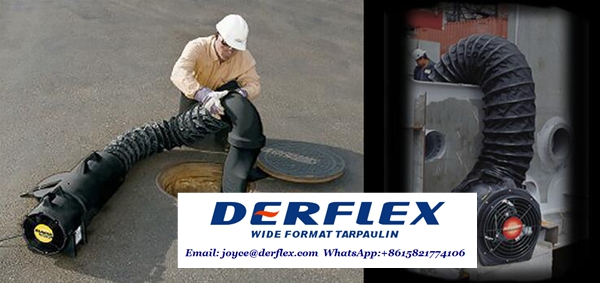
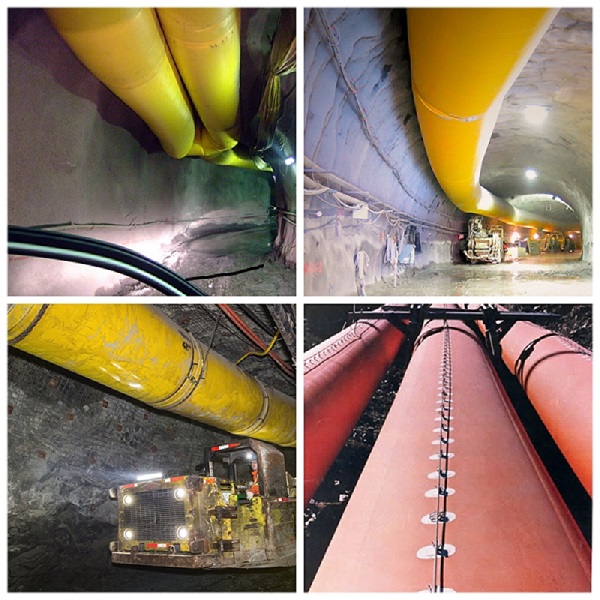
Actual DERFLEX product and application images are used below. Final construction is based on the confirmed project specification.

Quality requirements should be written into the approved specification so inspection is based on measurable criteria.
Confirm fabric grade, coating, color, weight, finish and any specified flame or antistatic treatment.
Measure diameter, section length, wire pitch, cuff size and suspension spacing against the order drawing.
Inspect welded seams, wear-strip placement, support continuity and local reinforcement at high-stress zones.
Check zipper, ring, clamp or soft-cuff geometry against mating sections and equipment-side dimensions.
Record approved artwork, packing, test requirements and critical configuration details for repeat production.
Six related pages connect the finished duct with underground ventilation, fabric selection and alternative airflow configurations.
Answers for project engineers, mine and tunnel contractors, distributors and ventilation equipment manufacturers.
A positive-pressure layflat duct is inflated by air pushed from a fan. A negative-pressure duct carries air toward an extraction fan, so atmospheric pressure pushes inward on the wall. Spiral or ring reinforcement is therefore used to resist collapse and preserve the airflow passage.
The helix provides radial support along the duct length. Without that support, a flexible textile wall may flatten under suction. Wire diameter and pitch are selected according to pressure, duct diameter, bend requirements, handling and section length.
Some project-configured spiral ducts can operate in both directions, but the complete system must be reviewed. Fan pressure, couplings, seams, suspension and the possibility of airflow reversal should be confirmed before production.
Diameter is chosen from required airflow, velocity, total run, bends and allowable pressure loss. Wire pitch is then matched to suction level, diameter and flexibility needs. A tighter pitch generally increases support and stiffness; a wider pitch improves flexibility but provides less support per metre.
Optional flame-retardant and antistatic material grades can be reviewed. The inquiry should state the required standard, test method, acceptance value and documentation so DERFLEX can confirm a suitable construction and testing plan.
Please provide fan model or fan curve, airflow direction, static pressure, duct diameter, total run, section length, bends, temperature, extracted contaminant, installation method, coupling preference and any required safety standard. Connection photos or drawings are useful.
Send DERFLEX the fan data, route sketch, operating environment and connection dimensions. The team can review material, wire support, section length, coupling, suspension and OEM details for a project-specific quotation.