Cold Crack
A pass/fail or acceptance concept tied to cracking after low-temperature deformation under a defined method. Always ask for the test temperature and method.



Cold crack resistance is not simply a “lowest temperature” number. For PVC tarpaulin, real winter performance depends on the coating formulation, the temperature at which the sheet is bent or rolled, the fold radius, seam and reinforcement design, hardware stress, and the test method used to qualify the material.
This guide helps importers, tarp fabricators, truck-cover buyers and industrial procurement teams interpret low-temperature bend data, separate laboratory ratings from service temperature, and write a clearer cold-weather tarp specification before sampling or bulk production.
Procurement principle: specify the minimum temperature at which the finished tarp must move, fold or roll—not only the lowest ambient air temperature.
Cold crack resistance describes the ability of a coated fabric to resist cracking when it is bent or deformed at a specified low temperature under a defined test condition. Low-temperature flexibility is the broader practical ability of the material to remain bendable and usable as temperature falls.
Neither term should be interpreted as a universal finished-tarp service-temperature guarantee. A laboratory specimen may pass a bend test while the finished cover still experiences higher local strain at a welded seam, folded corner, roller pocket, grommet, D-ring or ice-loaded edge. ASTM D2136 itself states that its low-temperature bend result is useful for specification but does not necessarily identify the lowest temperature at which a coated fabric can be used.
A pass/fail or acceptance concept tied to cracking after low-temperature deformation under a defined method. Always ask for the test temperature and method.
How well the coated fabric can bend or move in cold conditions without unacceptable stiffening, surface damage or cracking.
The practical operating envelope of the finished assembly, including seams, reinforcements, hardware, wind, ice, repeated movement and installation geometry.
The temperature at which the tarp must actually be rolled, folded or deployed. For truck and retractable systems, this can matter more than static storage temperature.
For a broader climate selection overview, see DERFLEX's tarp temperature rating guide. For material comparison across PVC, PE, canvas and mesh, use the tarp material guide.
PVC-coated polyester is a composite: the woven textile core carries much of the tensile load, while the flexible PVC coating provides waterproofing, surface protection and weldability. As the polymer system becomes stiffer in cold conditions, the same fold, roll or tie-down movement can create higher localized strain.
A sharp fold concentrates bending strain in a narrow line. Repeated folding at low temperature can be more demanding than a large-radius roll.
Stiff sheet material next to a thicker seam can create a transition zone where repeated flexing is concentrated.
Multiple layers reduce local flexibility. The hem may stay structurally strong while the adjacent coating experiences repeated flex stress.
Attachment hardware turns distributed sheet tension into local stress. Frozen fabric and dynamic wind can magnify this concentration.
Truck and roll-tarp systems add repeated curvature, abrasion and torsion. Qualification should reflect the real roll diameter and duty cycle.
Two important references for coated-fabric low-temperature bend performance are ASTM D2136 and ISO 4675. Both address the ability of coated fabrics to tolerate bending after low-temperature exposure, but buyers should write the exact standard edition, target temperature and acceptance criteria into the purchase specification rather than asking only for a generic “cold crack rating.”
| Reference | What It Addresses | Useful Procurement Interpretation | Important Limitation |
|---|---|---|---|
| ASTM D2136-19(2026) | Low-temperature bend test for coated fabrics; evaluates whether a coated fabric withstands a prescribed bend at an established low temperature. | Useful for setting a repeatable material-level acceptance temperature for a PVC tarp grade. | The standard notes that the result does not necessarily indicate the lowest temperature at which the material may be used. |
| ISO 4675:2017 | Low-temperature bend test for rubber- or plastics-coated fabrics after defined low-temperature exposure. | Useful when an international buyer wants a standardized low-temperature bend criterion in the RFQ or quality plan. | ISO states that no general relationship between the test and service performance can be implied for all applications. |
| Finished-tarp mock-up | Application-specific evaluation of seams, hems, hardware, folds, pockets and actual movement geometry. | Useful for truck tarps, retractable covers, large winter covers and other high-cycle finished assemblies. | Must be defined by buyer and supplier; it is not a substitute for a recognized material test when one is contractually required. |
Do not compare two “-40°C” claims unless the test basis is the same. The temperature alone is incomplete. Confirm test method, material construction, specimen conditioning, acceptance criterion and whether the claim applies to roll material or the finished tarp.
Authoritative references: ASTM D2136 and ISO 4675:2017. Test requirements should be agreed before production; this guide does not claim that every DERFLEX grade has been certified to either method.
A useful winter-tarp RFQ should describe the thermal condition and the movement condition together. “Use at -30°C” is weaker than “roll twice per day at -30°C around a 120 mm roller after overnight outdoor exposure.”
| RFQ Item | What to State | Why It Matters | Common Mistake |
|---|---|---|---|
| Lowest ambient temperature | Expected minimum air temperature during use and storage. | Defines environmental exposure baseline. | Using local weather record as the only requirement. |
| Lowest handling temperature | Temperature when the tarp must be folded, rolled, installed, removed or strapped. | Movement at low temperature drives bend strain. | Testing a static sheet while the real tarp is rolled daily. |
| Movement type | Static / occasional fold / daily fold / roller / flapping / repeated tensioning. | Different deformation modes create different stress concentrations. | Assuming “outdoor cover” describes the duty well enough. |
| Fold or roll geometry | Approximate fold radius, roller diameter, pocket size or storage method. | Sharp curvature is more demanding than a larger bend radius. | Ignoring how the tarp is actually stored and deployed. |
| Qualification method | ASTM D2136, ISO 4675, agreed supplier method or finished-assembly trial. | Makes the temperature claim auditable and comparable. | Accepting an unexplained “cold crack -40°C” statement. |
| Finished construction | Welds, hems, webbing, grommets, D-rings, pockets, straps and corner patches. | The complete tarp can fail where the geometry changes. | Approving only the center fabric specimen. |
| Other environmental loads | Wind, snow/ice contact, abrasion, UV, chemicals, road spray and freeze-thaw cycling. | Winter failure is rarely caused by temperature alone. | Increasing GSM without checking the real failure mode. |
Low-temperature performance is not determined by GSM alone. The PVC formulation and plasticizer system influence how rapidly the coating stiffens as temperature falls; the polyester scrim contributes tensile stability and tear resistance; coating adhesion and surface finish affect how the composite behaves during repeated handling.
Heavier material can improve abrasion resistance or mechanical robustness, but a higher GSM does not automatically prove better cold-crack resistance. For winter projects, the right question is whether the selected material construction has been qualified for the required low-temperature movement.
DERFLEX's PVC tarpaulin material page describes coated polyester construction and available anti-cold directions, while the heavy duty vinyl tarp page provides a broader industrial tarp specification context.
A standardized specimen experiences a prescribed bend condition. A finished cover can see sharper creases, torsion, flapping and hardware loads.
Welded seams, folded hems, webbing and pockets create local thickness changes and different bending behavior.
Cold temperature can occur together with wind, ice, abrasion, road spray, cargo movement and repeated deployment cycles.
DERFLEX currently lists a typical direction around -30°C to +70°C for many PVC tarp grades and separate cold-resistant options for lower-temperature projects. The dedicated cold-resistant tarp route lists -40°C, -50°C and -60°C directions. For procurement, treat those numbers as a starting point for grade selection and confirm the exact material, test basis and finished-tarp duty before approval.
| Application | Movement Profile | Cold-Flex Priority | What to Validate |
|---|---|---|---|
| Truck / trailer tarp | Frequent rolling, folding, tensioning and road vibration. | Very high | Minimum deployment temperature, roller diameter, seams, pockets, straps, abrasion and wind load. |
| Static machinery cover | Mostly fixed; occasional removal. | Medium | Installation temperature, wind flap, frozen contact edges and removal after long cold soak. |
| Construction enclosure | Large sheet, tensioned edges, wind movement, repeated fastening. | High | Wind exposure, seam layout, reinforced perimeter, attachment spacing and cold installation. |
| Agriculture / equipment protection | Seasonal deployment with folds and tie-down points. | Medium to high | Handling after freezing, sharp equipment edges, snow/ice accumulation and reinforcement. |
| Cold-region industrial cover | Project dependent; may be static or high-cycle. | Project specific | Actual minimum temperature, chemicals, abrasion, movement frequency and approved test method. |
For a broader winter-material comparison covering PVC, PE, canvas and insulated systems, review DERFLEX's cold weather tarps guide.
Weight is useful, but it does not define low-temperature flexibility. Ask for the exact cold-flex requirement and test basis.
The tarp may need to be rolled at the coldest part of the day. Handling temperature should be a separate RFQ line.
A tight crease can be more severe than a broad bend. Define the real folding or roller geometry where possible.
Seams, hems and hardware can become the practical weak point even when the center sheet looks intact.
PVC formulations vary. Require the approved construction and do not substitute grades without review.
For demanding winter programs, validate the material and the actual seam/hardware configuration before bulk production.
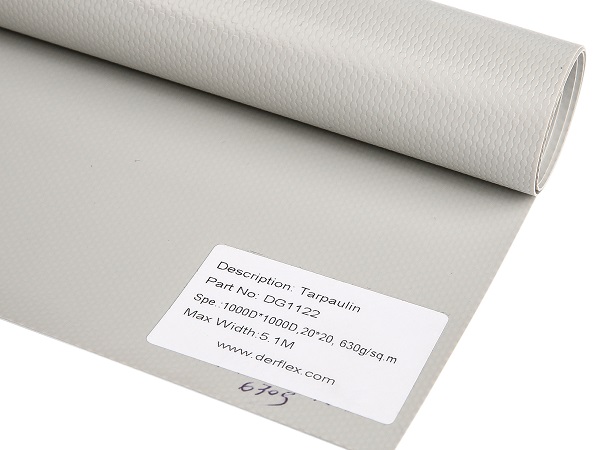
Use real product and manufacturing images with descriptive alt text and captions so Google Images and buyers can distinguish raw tarpaulin material, finished cold-weather applications and the coating process behind the product.
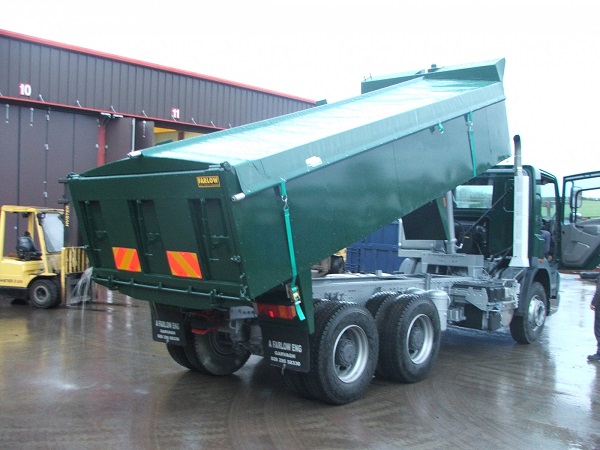
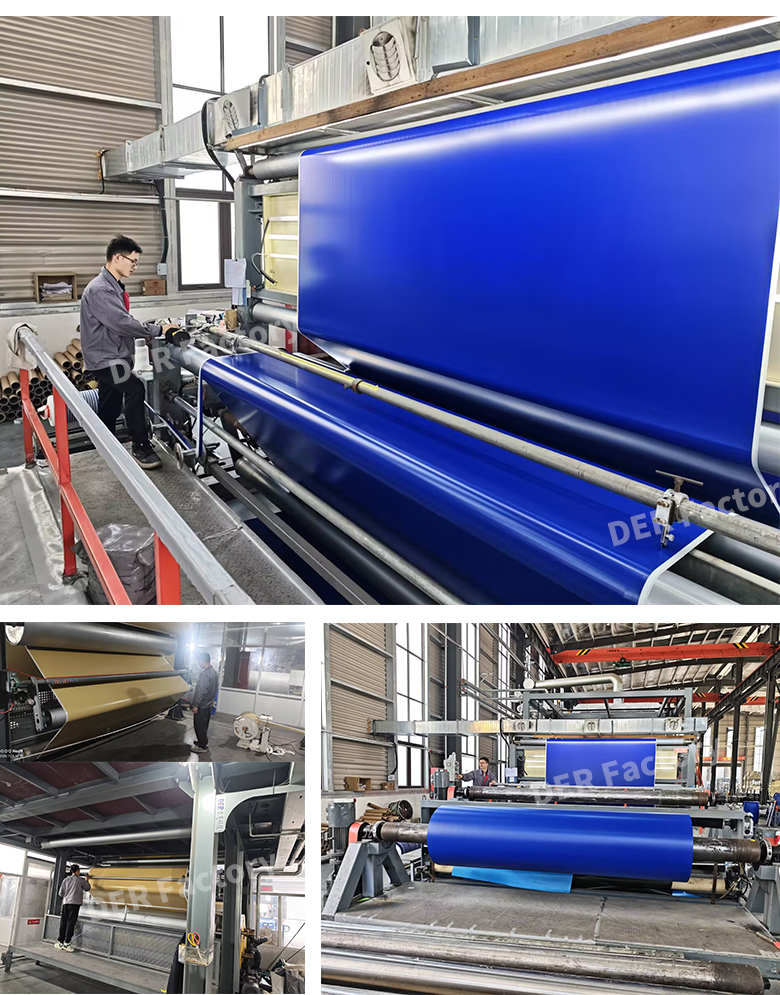
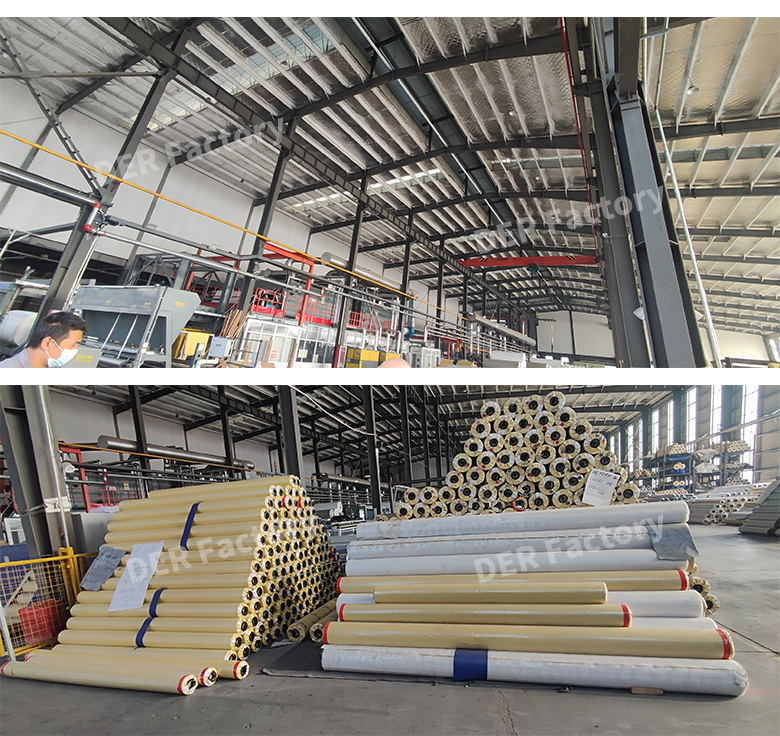
DERFLEX can discuss standard and cold-resistant PVC tarp constructions after technical review. The approved formulation, finished construction and test requirement should be confirmed before production rather than inferred from a generic catalog temperature.
Cold crack resistance describes whether a PVC-coated fabric resists cracking when it is bent or deformed at a specified low temperature under a defined test condition. A useful specification always identifies the temperature and test method.
Cold crack resistance normally refers to a defined crack/no-crack acceptance condition. Low-temperature flexibility is broader and describes how readily the coated fabric can bend or move as temperature falls. Both should be related to the finished tarp's actual movement.
No. A cold-crack or bend-test temperature is a laboratory qualification under defined conditions. Real service adds folds, seams, hardware, wind, abrasion, ice and repeated movement. Confirm the test basis and validate the finished construction for demanding applications.
Not automatically. Higher GSM can increase coating mass or mechanical robustness, but cold flexibility is strongly affected by the PVC formulation and complete construction. Compare approved grades by test evidence and intended duty, not by weight alone.
Both are low-temperature bend-test references for coated fabrics. They evaluate the ability of a conditioned coated-fabric specimen to tolerate bending at a specified low temperature. Buyers should name the required standard edition, temperature and acceptance criteria in the RFQ.
Special cold-resistant PVC formulations can be selected for severe sub-zero projects. DERFLEX currently lists cold-resistant directions at -40°C, -50°C and -60°C, but the final grade, test basis and finished-tarp use condition should be confirmed before production.
Folds create concentrated bending strain. A seam, hem, pocket or hardware transition can make the local geometry even stiffer, so damage often starts at these zones rather than in the flat center of the sheet.
Provide the application, lowest ambient and handling temperature, movement frequency, fold or roll geometry, material target, finished dimensions, seam and reinforcement design, hardware, environmental loads, required test method, quantity and destination.
Send DERFLEX the minimum handling temperature, movement cycle, finished construction and required test method. That gives the material selection and sample approval process a clear engineering target.