


 Industrial Tarpaulin & Coated Fabric Guidance
How Do You Waterproof a Tarp?
Waterproofing a tarp is not a one-spray solution. The right fix depends on whether the cover is canvas, PVC/vinyl, polyethylene (PE), or another coated textile—and whether rain is entering through the surface, a seam, a hole, or a poorly drained installation. Use this step-by-step guide to diagnose the leak, select a compatible treatment, and check the finished tarp before trusting it over cargo or equipment.

Identify the tarp material; inspect seams, holes and edges; clean and dry the cover; patch damage with a material-compatible system; seal stitch holes or leaking joins where appropriate; and apply a suitable water-repellent finish only to fabric designed for that treatment. Let everything cure, then test under controlled water exposure. Intact PVC or PE sheet usually needs a repaired leak path—not an all-over waterproofing spray.
Find the water path before treating the tarp
Water on an item under a cover does not always mean the coated fabric has leaked. Inspect the inside and outside while the tarp is installed in its normal position.
| What you see | Likely cause to check | Appropriate next action |
|---|---|---|
| Localized drip directly below a sewn seam | Needle holes, thread wicking, poorly sealed tape or a failed seam | Seal or reconstruct the seam with a system rated for its coating. |
| A drip at a grommet, buckle or hem | Movement, enlarged hardware hole or failing edge reinforcement | Reinforce the affected panel or remake the fastening area; don't just flood it with sealant. |
| Water spreading through the middle of a canvas panel | Worn water-repellent finish, saturation or untreated fabric | Clean and trial a canvas-compatible reproofing treatment. |
| Moisture droplets across the underside | Condensation on a cool cover over a damp load | Assess airflow, wet cargo and temperature before applying more coating. |
| Leaks below a sagging low point | Ponded water, stretched seam or abrasion under a pooled area | Restore slope, support and drainage; repair any resulting damage. |
For a fuller distinction between material water resistance and assembly waterproofing, compare waterproof versus water-resistant tarps. If a coating is intact yet water is coming from multiple locations, first check the cover's fit and installation geometry.
Which waterproofing method fits your tarp material?
The appearance of a tarp cannot reliably identify its coating chemistry. Confirm the material label or supplier specification before buying a spray, tape, adhesive or seam sealer.
| Tarp construction | What can help | What not to assume |
|---|---|---|
| Cotton or polycotton canvas | Approved canvas water-repellent reproofing plus suitable seam care | A repellent finish equals a pressure-tight waterproof membrane. |
| PVC / vinyl-coated polyester | PVC-compatible patch adhesive or qualified welding; appropriate seam repair | Ordinary fabric spray will restore cracked or delaminating PVC. |
| Woven PE / poly tarp | PE-rated repair tape, patch or developed PE bonding process | Vinyl cement and generic contact adhesive always stick to PE. |
| PU-coated textile | Seam sealer specifically approved for the polyurethane face | Silicone-treated fabric and PU-coated fabric use the same sealer. |
| Silicone-coated textile | Silicone-compatible seam sealing approved for that finish | Conventional urethane sealant will reliably bond to silicone. |
| Open mesh tarp | Repair mesh and preserve intended ventilation | Waterproofing spray will turn open mesh into a watertight cover. |
PVC-coated polyester is a common material choice for reusable waterproof industrial covers. See the waterproof tarp fabric options when the goal is to buy a new roll or cover rather than repeatedly reproof an aging one.
How to waterproof a tarp in 7 practical steps
This process addresses a serviceable tarp. It is not a substitute for redesigning failed structural seams, damaged tie-down points or covers used in safety-critical service.
Identify the material and mark leak locations
Check the label, construction, coated face and current finish. Photograph wet spots, stitch lines, punctures and hardware. Mark a leak map on a sketch before removing the tarp from its mounting.
Clean gently and let it dry as required
Remove dirt, salts, grease and residues using a cleaner approved for the surface. Protect printed and clear sections. Many adhesives require a fully dry surface; some water-based fabric proofers have different application instructions.
Trial the exact treatment on a small area
Use an offcut or inconspicuous edge. Check discoloration, adhesion, stiffness and compatibility after drying or curing. Do not guess that a solvent, heat gun or silicone sealant will suit every coating.
Repair holes and torn coating first
Use a matching patch with rounded corners and adequate sound bonding area according to the repair supplier. For PVC this may mean compatible adhesive or controlled welding; for PE it requires a PE-rated system. See the tarp repair guide.
Seal the actual seam or penetration
On canvas, use a sealer approved for the treated fabric and stitched joins. On coated tarps, use the appropriate seam tape, sealant or fabrication repair. Rebuilding a stressed grommet zone may be more dependable than surface sealing. Read the sewing and seam-sealing guide.
Reproof absorbent fabric only when suitable
If canvas still wets out, apply an approved fabric water-repellent evenly at the maker's recommended coverage, working outdoors or with suitable ventilation. Mask incompatible windows, trim and fasteners. Do not apply a random coating to sound PVC or PE film.
Cure fully, reinstall and verify in sections
Respect the product's stated curing conditions. Mount the cover with drainage and its intended tension. Wet the outside gently, checking the underside at each suspected location. Recheck patch adhesion after normal folding and movement.
For an undamaged PVC-coated tarp, steps 1, 2 and 7 may be all that is necessary; use the diagnostic results to avoid unnecessary chemicals. Learn why PVC tarps already resist rain when properly constructed.
Canvas, PVC and poly tarps need different decisions
The aim is to restore the appropriate function of each material, not to turn every cover into the same rigid, non-breathable sheet.
Restore water repellency
Canvas may shed rain when treated but can saturate over time. Clean first; spot-test a canvas-specific reproofing product; treat the exposed face as instructed; and allow a full cure before a water-beading check. Address stitches separately.
For breathable storage applications, consider how an impermeable aftermarket coating could alter condensation management.
Repair the barrier, not the whole surface
Sound PVC coating already forms the main water barrier. Focus on worn seams, failed welds, punctures, edge abrasion and stretched grommet openings. A matched PVC panel or professional seam rebuild often beats an unapproved surface spray.
If cracking extends across the panel, evaluate new PVC tarpaulin material.
Use PE-specific adhesion
Many polyethylene sheet tarps start with a waterproof film or laminate. A hole or a failed seam is usually the problem. Choose a patch or tape explicitly rated for PE, and test it on the actual surface.
A long, stressed or weathered PE tear can justify replacement instead of repeating temporary field patches.
See the difference between base fabric and a finished cover
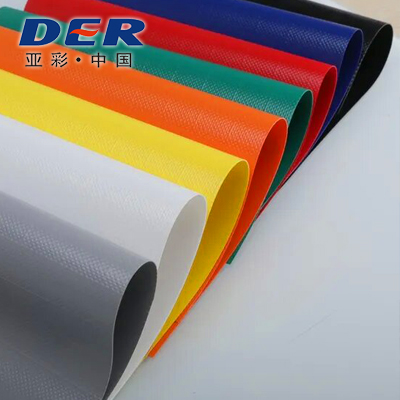
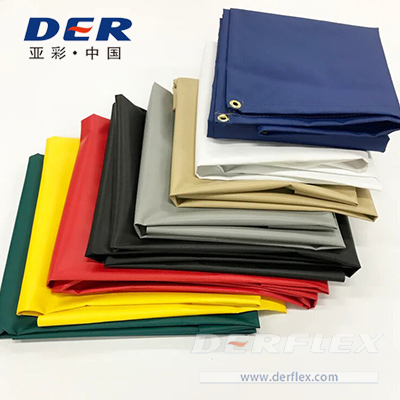
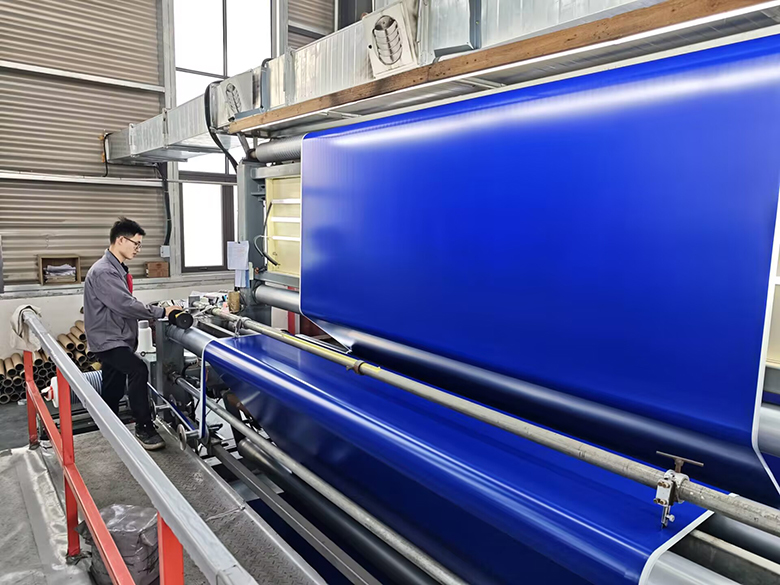
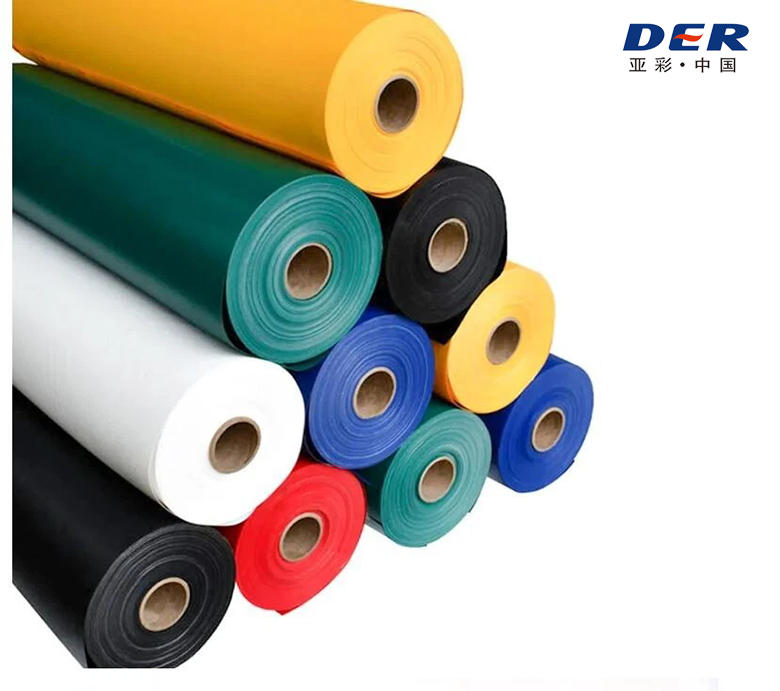
These images show real DERFLEX catalog materials, production context and an application. They are not staged photographs of the reproofing steps or evidence that a particular repaired seam passed testing.
How to check that your tarp is waterproof again
A quick water-beading test can indicate a canvas finish is repelling droplets. It does not validate every seam, reinforced edge or finished cover under service conditions.
Simple on-site rain check
- Wait until every coating, adhesive and sealant has cured.
- Install the tarp with its normal slope, overlap and restraint.
- Place dry absorbent paper beneath previously leaking points, without touching the cover.
- Gently spray or pour water over small exterior areas in sequence; avoid an artificial high-pressure jet.
- Inspect for drips, wicking, patch lifting or edge ingress; recheck after flexing.
Record the location and condition of any remaining leak. If the cover protects valuable goods, agree a suitable finished-cover acceptance test with the buyer.
What counts as a failure?
- Water emerging below a closed seam after the treatment is fully cured.
- Visible patch edge lift or coating separation after folding.
- Water gathering in a low spot despite correct intended installation.
- Grommet or hem movement opening a new leak path under normal tension.
- Continued saturation of a canvas panel when the selected water-repellent treatment should be effective.
Controlled laboratory hydrostatic-head or seam tests may be specified for demanding orders, but results require a stated method and actual test report. No single home shower test proves a universal waterproof rating.
When waterproofing a tarp is not worth repeating
For repeat-use truck covers, industrial equipment and contractor tarps, avoid building a patch collection on top of widespread material deterioration.
| Condition | Usually reasonable | Better direction |
|---|---|---|
| Small isolated puncture in sound coating | Compatible patch plus verification | Repair |
| Canvas absorbs water but remains structurally sound | Surface-specific reproofing and seam care | Reproof & retest |
| Repeated seam leakage or failed tie-down reinforcement | Qualified workshop rebuild | Reconstruct or replace panel |
| Widespread cracking, delamination, brittleness or scrim failure | No broad spray restores structural integrity | Replace the affected cover |
When a new cover is needed for repeated service, review heavy-duty waterproof tarp construction rather than specifying waterproofness in isolation. Weight, flexing, abrasion, exposure and joining methods also matter.
Buying a tarp that needs less emergency waterproofing
For OEM brands, contractors, fabricators and distributors, specifying a finished-cover system early is often more reliable than trying to fix leak paths on site.
DERFLEX can discuss PVC-coated tarp material supply, application-specific fabric choices and custom-cover requirements subject to the agreed project specification. For a broader overview of material families and applications, see the tarpaulin buying hub. A quote may cover roll goods or finished covers; it should not be read as including installation, framing or field waterproofing chemicals unless specifically confirmed.
Frequently asked questions
Short answers to common waterproofing decisions—without treating a surface coating as proof that a whole cover is leak-free.
Can you make an old tarp waterproof again?
Sometimes. If the base fabric is sound, cleaning, a coating-compatible repair, sealed seams or a fabric-specific water-repellent treatment may restore useful rain protection. A brittle, cracked or delaminating tarp is usually a replacement candidate.
What can I spray on a tarp to make it waterproof?
Use a treatment explicitly approved for the tarp material and existing finish. A fabric water-repellent may help suitable canvas, but ordinary sprays do not rebuild a cracked PVC barrier or reliably bond to polyethylene. Always test a small area first.
How do you waterproof canvas tarps?
Clean the canvas, allow it to dry or remain damp as the chosen product requires, spot-test a canvas-compatible treatment, apply it evenly according to its label, let it cure and check for water beading. Repair stitched seams and damage separately.
Do PVC or vinyl tarps need waterproofing spray?
Intact PVC-coated tarps generally do not. Their coating is already the water barrier. Focus on holes, worn seams, damaged coating, grommet zones, drainage and compatible patching or welding instead of applying an unapproved all-over spray.
Can you seal a leaking tarp seam with silicone?
Only when the sealant is rated for that actual surface and seam construction. Silicone sealants are not universal: adhesion can be poor on PVC, PE, PU or finished canvas. Match the chemistry and test before treating a long seam.
Why is there moisture under a tarp that is waterproof?
Moisture may be condensation on the underside rather than rain penetration. Water can also enter through stitching, grommets, uncovered edges, pooled areas or abrasion holes. Dry the load, improve airflow where appropriate and locate the actual water path.
How do you test a waterproofed tarp after treatment?
After the product has fully cured, mount the tarp at its intended slope and gently wet the exterior in sections. Check the interior and seam undersides for visible seepage, inspect patch edges and repeat after flexing. Avoid pressure washing as a substitute for an application-specific test.
When should a business replace rather than reproof a tarp?
Replace or professionally rebuild a cover when its coating is widely cracked or peeling, its scrim is weak, multiple seams fail, or high-tension grommet areas cannot be reinforced reliably. For critical cargo, qualify a sample or finished-cover test before purchase.
DERFLEX · Technical buyer guide · Prepared November 5, 2026. This content covers tarp care and specification; it does not claim a test result for any individual SKU or installation.