


 Contact DERFLEX
Truck Curtain Edge Reinforcement and Straps
Truck curtain edge reinforcement connects the flexible PVC-coated panel to the webbing, tension straps and hardware used by a curtain-side body. The critical purchase decision is how that connection transfers force through the finished assembly. DERFLEX supplies PVC-coated polyester curtain materials and supports drawing-based panel and reinforcement discussions for truck body builders, curtain fabricators and replacement programs. Define the edge construction, coated strap compatibility, buckle position and test specimen before comparing an offer. A strong base cloth or strap alone does not establish the capacity of the completed curtain.
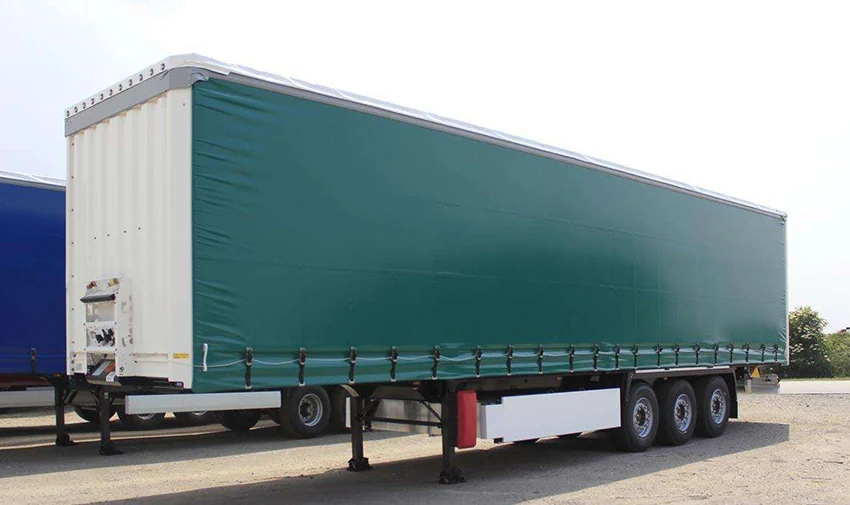
Reinforce the path between the panel and the buckle
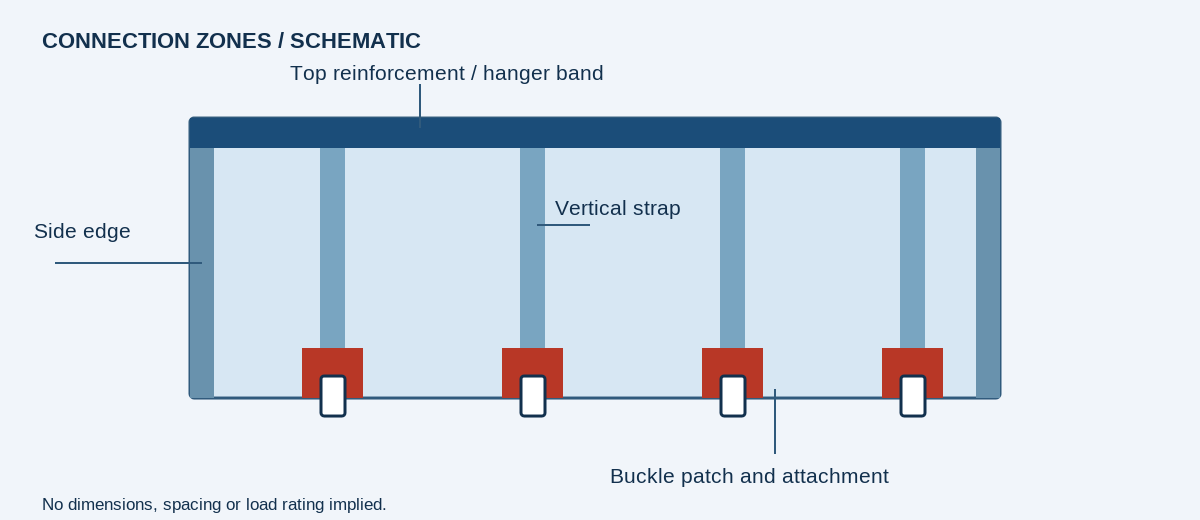
Truck side curtain reinforcement should spread concentrated attachment forces into a larger, compatible area of the curtain. Simply adding a narrow strip at a buckle can leave a sharp change in stiffness at the strip end. The drawing should show where force enters, how it travels through the strap or patch, and where the reinforcement terminates.
Separate the reinforcement functions
A top-edge band supports the hanger interface. A vertical strap carries force toward its attachment. A lower buckle patch supports a local connection. A chafing strip protects against rubbing. These components may overlap, but their functions and inspection criteria should remain identifiable.
For the parent material, start with the truck side curtain tarpaulin guide. Specify the curtain construction before choosing reinforcement materials.
Define the hardware interface
Record buckle type, slot size, strap routing, adjustment travel and the surrounding contact surface. Check the closed and opened positions. A correctly welded strap can still be damaged by an incompatible slot, a sharp corner or repeated contact with the bodywork.
Hardware strength, installation torque and body attachment requirements belong to the hardware and vehicle specifications. Include their drawings in the material review.
| Zone | Construction question | Check on the sample |
|---|---|---|
| Top edge / hanger line | How are hanger loads distributed through the band and curtain? | Alignment, hole or slot geometry, local tearing and free movement |
| Vertical reinforcement | Is the strap fixed, pocketed or locally attached? | Weld continuity, strap routing and transition at both ends |
| Lower buckle zone | Where does the buckle load enter the coated fabric? | Patch overlap, edge lifting, pull direction and hardware clearance |
| Leading / trailing edge | How does the edge engage the tensioning interface? | Pocket dimensions, end reinforcement and repeated closure |
| Post or rail contact | Does a replaceable wear strip suit the contact geometry? | Scuffing, fold stiffness and obstruction during opening |
Specify buckle strap fabric as a compatible component
In a curtain inquiry, “buckle strap fabric” may mean PVC-coated weldable polyester webbing, a fabric sleeve over a structural strap, or a curtain patch surrounding a buckle. Identify the intended component. A generic PVC strip does not establish a rated strap assembly, and an uncoated webbing should not be assumed to weld directly to PVC.
Match the coated surfaces
Review the curtain face, strap coating and patch material together. Lacquer, print layers, contamination and different coating formulations can change the bond. Request representative material from the same faces and construction intended for production, rather than approving a weld on an unrelated offcut.
Use the PVC-coated fabric overview to frame the material discussion. Relevant comparisons include coating adhesion, flexibility and the surface actually entering the joint.
Develop the joint on the production process
Hot-air and high-frequency welding need equipment-specific trials. Record material stack, overlap, tooling, pressure, dwell or travel speed, cooling and the selected machine settings. A universal welding temperature is insufficient to reproduce a validated joint.
Approve the folded edge and patch transition as well as the flat weld. Excess bulk can affect buckle adjustment, folding and the packed curtain thickness.
Control the installation sequence
Agree whether reinforcement is applied before or after panel joining and graphics. Mark curtain face and orientation, keep strap positions referenced to a consistent datum, and protect bond areas from handling contamination. If sewing is included, define stitch pattern, thread, edge distance and sealing treatment separately. Inspect the effect of needle holes and seam placement on weather protection.
At chafing points, investigate the contacting part before increasing fabric mass. The abrasion-resistant curtain material guide provides context for reviewing contact wear alongside the reinforcement design.
Four checks answer four different questions
A complete reinforcement specification distinguishes material properties from connection performance. Ask for the specimen identity, orientation, width, conditioning, test speed, units and failure description with every result. Test names alone do not establish an acceptance limit or show that a particular curtain assembly has passed.
| Check | What it evaluates | What the purchase specification should record |
|---|---|---|
| Base-fabric tensile test | Strength and elongation of the coated fabric | Agreed method, warp / weft, specimen geometry and required limits; ISO 1421 is a coated-fabric tensile reference |
| Coating adhesion / peel | Bond between the coating and its textile support | Face, direction, width, conditioning and failure mode; ISO 2411 addresses coating adhesion |
| Welded strap or patch joint | Separation or tensile behavior of the selected welded construction | Representative overlap, weld process, pull geometry and agreed joint acceptance method |
| Buckle / strap / panel assembly | Behavior of the combined attachment under its intended loading | Actual hardware, installed routing, fixture, loading direction and limits established for that assembly |
A coating adhesion result must not be relabelled as a welded strap result. Similarly, strap breaking strength must not be presented as the working capacity of its buckle attachment. During trial testing, distinguish coating separation, weld separation, webbing rupture, base-fabric tearing and hardware failure; each points to a different corrective action.
Retain a first-article reference
Keep an approved reinforcement sample with its drawing revision, material batch, welding record and inspection photographs. Define production sampling and rejection rules in the order agreement. An average result can hide an unacceptable individual connection, so decide in advance whether minimum individual values or other statistical rules govern release.
If the finished curtain is intended to contribute to a vehicle body performance claim, the body or system owner must establish the applicable evidence. Material tests and a reinforced edge do not independently certify the complete vehicle.
Method references: ISO 1421:2016 and ISO 2411:2024. These identify test subjects; no DERFLEX test result is implied.
Make the connection detail reproducible
Provide an overall curtain drawing and enlarged details for each different attachment. A photograph helps explain the vehicle, but it cannot define hidden overlaps, tolerances or the loaded direction. Use one datum for strap and buckle positions so cumulative spacing errors do not move the last attachment out of alignment.
Show on the drawing
- Finished curtain length and height, datum and dimensional tolerances
- Top band, side pockets, lower hem and vertical strap locations
- Strap width, coating, face orientation and termination geometry
- Patch outline, overlap, weld lines and any permitted stitch lines
- Buckle part reference, routing, adjustment range and installation clearances
- Graphic boundaries, labels, repair zones and revision identification
Attach to the inquiry
- Curtain material reference or an existing material sample
- Body and hardware drawings, with the intended supply boundary
- Expected opening pattern, contact points and operating environment
- Acceptance methods, required limits and required records
- Quantity by design, color and curtain hand
- Delivery destination, packaging preference and requested schedule
Before you order
Confirm whether the request covers roll material, reinforcement-compatible samples, cut panels or fabricated curtains. List loose buckles, rollers and structural straps separately if required. The quotation should identify which components are included and which remain with the converter or body builder.
Compare the broader truck side curtain fabric options and the PVC tarpaulin material range when selecting a base construction. Review the tarpaulin quotation variables when separating material, welding, hardware and packing costs.
Read the material in its application
Compare the visible panel shape, material surface and attachment layout with your own drawing when preparing a sample request.
Frequently asked questions
What is the purpose of truck side curtain reinforcement?
It distributes forces from hangers, straps, buckles and tensioning edges into the curtain panel. Chafing strips provide a separate wear-protection function. The approved drawing should identify each component and its connection.
Can any polyester webbing be welded to PVC curtain fabric?
No. The webbing needs a compatible weldable surface, and the actual curtain, strap coating and joint process must be trialled together. Uncoated polyester webbing is not automatically a directly weldable component.
Does a peel test prove the strength of a buckle attachment?
A coating peel test evaluates coating adhesion. A buckle attachment requires its own representative joint or assembly test with defined hardware, overlap, routing and loading direction.
Is there a standard strap spacing for every curtainsider?
There is no spacing that should be assumed for every body and curtain. Positions depend on the approved body design, attachment geometry and performance requirements. Supply the datum and individual positions or the agreed pitch.
What should I send for a reinforcement quotation?
Send finished curtain dimensions, reinforcement details, buckle and strap references, material requirements, quantity and the intended acceptance tests. State whether you need material, panels or fabricated curtains and identify any loose hardware separately.
Can a reinforced curtain be treated as a cargo restraint?
Its role must be established by the vehicle or system specification and the relevant assembly evidence. Reinforced fabric, strap strength or a material test alone does not establish the cargo-restraint performance of the completed vehicle.
Bring the connection drawing into the material review.
Share the curtain dimensions, buckle interface and required test evidence. DERFLEX can review the material and fabrication scope against your specification.