



Winter roll supply / Application-led qualification
Low Temperature
PVC Tarpaulin
Choose winter tarpaulin roll material around the coldest handling conditions, the movements it must tolerate and the evidence for the exact grade. DERFLEX supplies PVC tarpaulin materials for commercial cover fabrication. This guide helps importers, converters and transport-cover buyers define cold-bend requirements, separate storage from service conditions, and approve a representative sample before a bulk order.
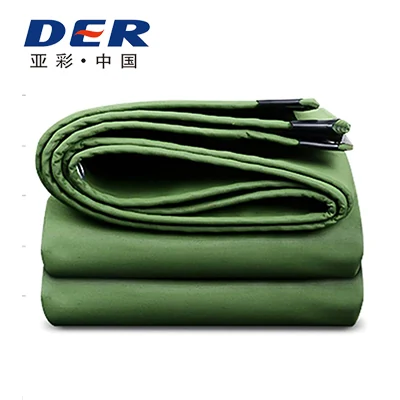
Cold conditions / Clear specifications
Specify the conditions.
Qualify the material.
- Cold exposureWhere, how cold, and for how long?
- HandlingStored flat, unrolled, folded or tensioned?
- EvidenceWhich grade, method and documented result?
Material selection
What makes a PVC tarp suitable for winter handling?
A cold crack PVC tarp needs evidence for a defined deformation at a defined temperature. Neither a heavier construction nor a generic “winter grade” label establishes that performance.
Flexible PVC coatings can become stiffer as temperature falls. Sharp folds, repeated rolling and local stress near hardware can therefore become important failure locations. Material selection starts with the compound and coated-textile construction, then moves to the finished cover and the way it is handled.
The supply discussed here is PVC tarpaulin roll material for downstream cutting and fabrication. A quotation for rolls does not automatically include a finished tarp, fasteners, a roll-off mechanism or installation. Start with the PVC tarpaulin material range when comparing the broader construction options.
Cold-bend result
A documented observation for a particular specimen, method, exposure and deformation. It supports a material acceptance requirement when the ordered grade and sample identity are clear.
Permitted use range
An application decision that also considers duration, ageing, load, movement and the fabricated details. Establish it through an agreed qualification route; do not copy a laboratory temperature into a service-range promise.
Evidence and methods
Read the cold-bend test with its conditions.
Two relevant method references are ISO 4675:2017 and ASTM D2136-19(2026). Both concern low-temperature bending of coated fabrics. Their published descriptions limit how results can be related to real service; neither supplies a universal temperature rating for every tarp.
Ask the testing laboratory to confirm that the selected procedure applies to the proposed construction and thickness. Use the agreed edition and its full procedure. The overview below is a buyer’s review checklist, not a substitute for the standard or a laboratory instruction.
| Report item | What to check | Why it changes the comparison |
|---|---|---|
| Sample identity | Grade, color, finish, nominal construction and batch or sample reference. | A report for another formulation cannot qualify the ordered material. |
| Method and edition | Exact ISO or ASTM reference and any deviations. | Different procedures cannot be treated as interchangeable. |
| Exposure conditions | Specified temperature, conditioning and exposure time. | A temperature without a defined exposure is incomplete. |
| Specimen and deformation | Direction, tested face and bending conditions as required by the method. | Orientation and local strain affect what the result represents. |
| Observed damage | Assessment criteria, recorded observations and stated result. | “Pass” needs a defined damage rule and traceable evidence. |
| Relevance to service | New or aged material; material-only or assembly evaluation. | One fresh sample does not represent every condition in service. |
On small screens, scroll the table horizontally.
For a deeper explanation of the method and report wording, use the PVC tarpaulin cold crack test guide. Request the applicable report or controlled document through the technical documents center. No grade-specific result or extreme-temperature claim is asserted on this page.
Winter transport and field handling
Match the material to the movement.
| Scenario | Condition to describe | Qualification priority |
|---|---|---|
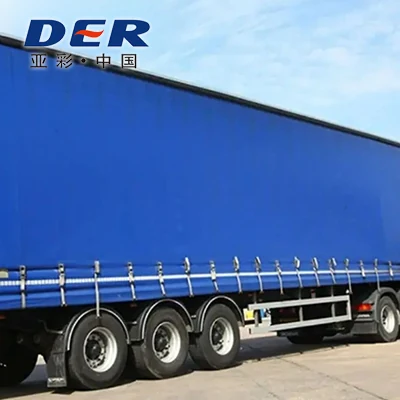
| Repeatedly handled truck cover | Route minimum, time outdoors, rolling or folding, strap tension and contact points. | Trial the cover’s movement and inspect seams, corners and attachment zones after the agreed exposure. |
| Curtain or sliding cover | Opening frequency, track movement, roller radius and low-temperature impacts. | Assess bending at hardware interfaces; review the complete curtain and mechanism separately. |
| Outdoor equipment cover | Fixed exposure, access openings, abrasion and snow or ice management. | Check material and fastening details. Cover fabric alone does not establish structural or snow-load capacity. |
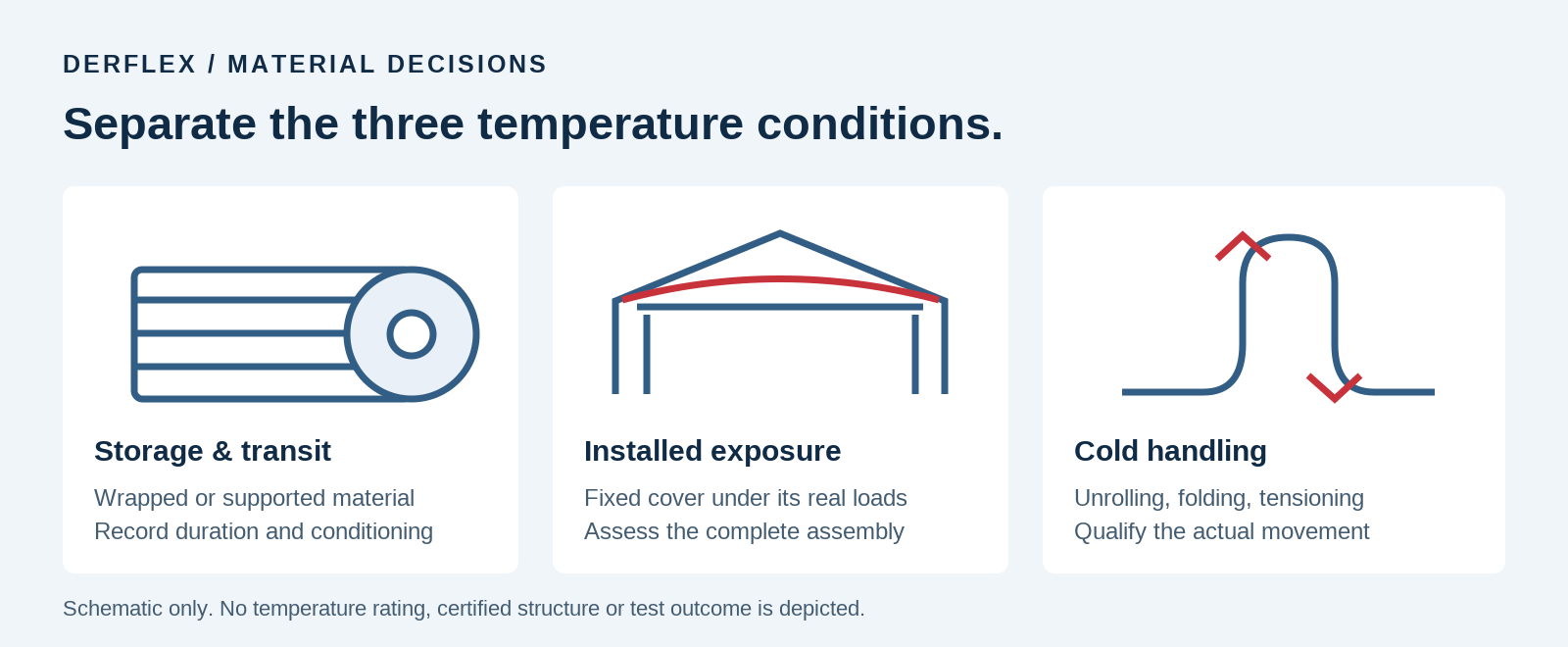
| Cold shipment of roll goods | Transit duration, supports, wrapping, condensation risk and arrival handling. | Agree packing and conditioning before unwinding or fabrication. |
| Temporary winter enclosure | Installation weather, repeated relocation and contact with frames. | Evaluate folds, seams and securing points; confirm other required properties independently. |
On small screens, scroll the table horizontally.
Write down the real cold task.
“Used in winter” leaves too much unanswered. Tell the supplier whether the tarp stays installed or is folded daily, how long it remains cold and where it rubs against the vehicle or frame.
For example, a buyer can specify a required test temperature together with the route, movement cycle and inspection criterion. That temperature is a buyer requirement until a matching result and application approval exist.
For seam-specific evaluation, continue to the weld seam strength guide.
Roll specification
Define the grade beyond its temperature claim.
GSM measures mass per unit area. Thickness measures a different property; neither is a direct cold-flex rating. Compare construction, physical properties and cold-bend evidence together, using like-for-like test conditions.
| Specification field | What to put in the enquiry |
|---|---|
| Material and construction | PVC-coated textile, base-fabric preference, nominal GSM or thickness, visible face and finish. |
| Cold requirement | Required exposure, intended movement, selected method and damage criterion; request matching evidence. |
| Dimensions and yield | Nominal roll width and length, usable coated width, edge condition and agreed tolerances. |
| Fabrication | Proposed welding process, seam layout, hems, reinforcement and hardware interfaces. |
| Other performance | Required tensile, tear, adhesion, weathering or fire behavior, each with its own evidence. |
| Supply and identification | Quantity, color, core requirements, winding direction, packaging and batch labels. |
On small screens, scroll the table horizontally.
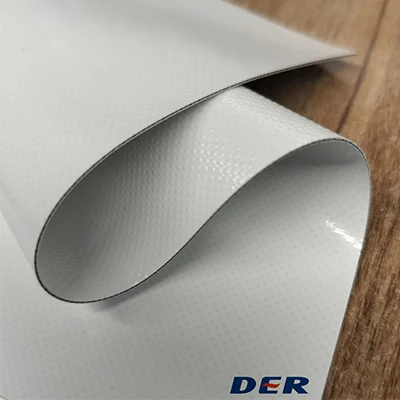
Approve the actual combination.
Changing coating build, color, surface treatment or base fabric can change the product being purchased. Ask whether an existing test report covers the exact proposed grade and configuration.
Approve the formulation reference and the sample identity used for repeat orders. Keep the agreed batch and dimension tolerances with the purchase specification, rather than relying on the appearance of an earlier sample.
Keep claims separate.
Cold-bend acceptance does not prove fire performance, chemical compatibility, waterproof seams or the strength of a complete cover. Request evidence for each property that matters to the application.
Before you order
Move from sample to repeatable supply.
Describe the exposure.
Record the location, route, cold duration and whether handling occurs at the lowest exposure. Identify abrasion, folding and tension points on a sketch.
Agree the material qualification.
Match the proposed grade to a test method, conditions and result criteria. Ask for traceable evidence or a testing plan where a matching report is unavailable.
Trial the fabricated details.
Use representative seams, hems and attachments. Inspect movement and damage under agreed conditions before committing to a full cover programme.
Freeze the purchasing specification.
Record the approved grade, dimensions, tolerances, sample reference and packing. Confirm MOQ, lead time and test-document scope in the quotation.
Material cost depends on the specified construction, roll dimensions, ordered quantity, packing and required qualification work. Request a project quotation rather than comparing an unsupported price per square metre for unlike winter grades.
Buyer questions
Frequently asked questions
What is low temperature PVC tarpaulin?
It is PVC-coated textile selected and qualified for a defined cold exposure and handling task. A useful specification identifies the grade, required test method, test temperature and damage criterion; the phrase alone does not establish a minimum service temperature.
Does passing a cold-bend test prove the minimum operating temperature?
No. A laboratory result applies to the reported sample and test conditions. Actual use may involve repeated movement, tension, seams, abrasion and ageing. Validate the complete cover for its intended handling and exposure before assigning a service range.
Is heavier winter tarpaulin always more cold resistant?
No. GSM describes mass per unit area, not cold flexibility. PVC formulation, coating construction, base fabric and thickness affect bending behavior. Compare qualified samples under the same method and conditions instead of ranking cold resistance by weight.
Should a winter tarp be tested before or after welding?
Qualify the roll material first, then evaluate representative welded seams, hems and attachment zones for the intended task. A material-only bend result does not prove that every finished joint will perform the same way.
Can a cold-stored roll be processed immediately on arrival?
Follow the approved material and processing instructions. Keep the roll supported, document its arrival condition and allow controlled conditioning when required. Do not force a stiff roll open or apply direct localized heat to accelerate conditioning.
What should I send when requesting a winter tarpaulin roll quote?
Send the application, destination and route, expected minimum exposure, handling operations, roll dimensions, construction preferences, quantity, required test method and available drawings. State whether the request covers roll goods or a separately fabricated cover.
Your winter roll specification
Tell us how the material will be handled in the cold.
Send your application, route, cold exposure, movement, roll dimensions and quantity. Request evidence for the proposed grade, then agree sample and fabrication approval.
DERFLEX material procurement guide. Temperature requirements must be agreed for the exact grade and application. Photographs are material or application references; schematics are explanatory.