



Roll goods / Receiving and conversion quality
PVC Tarpaulin
Roll Edge Quality
A clean surface is only part of a usable roll. Edge alignment, winding condition, relaxed web behavior and core integrity affect mounting, cutting yield and welding preparation. Use this guide to define PVC tarpaulin roll edge quality, record defects consistently and agree practical acceptance rules with DERFLEX before production and shipment.
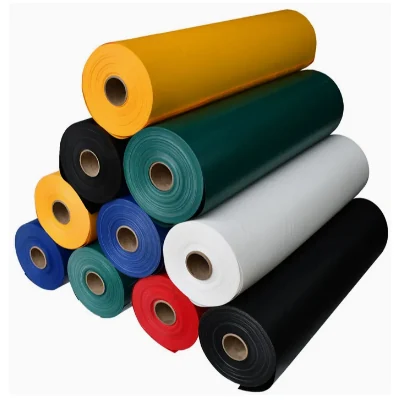
Edge condition / Usable yield
Inspect the roll.
Protect the usable width.
- Roll geometryAlignment, telescoping and end-face damage.
- Unwound webWavy edges, curl and persistent creases.
- Handling interfaceCore bore, labels, supports and packing.
Defect identification
Separate the wound roll from the relaxed web.
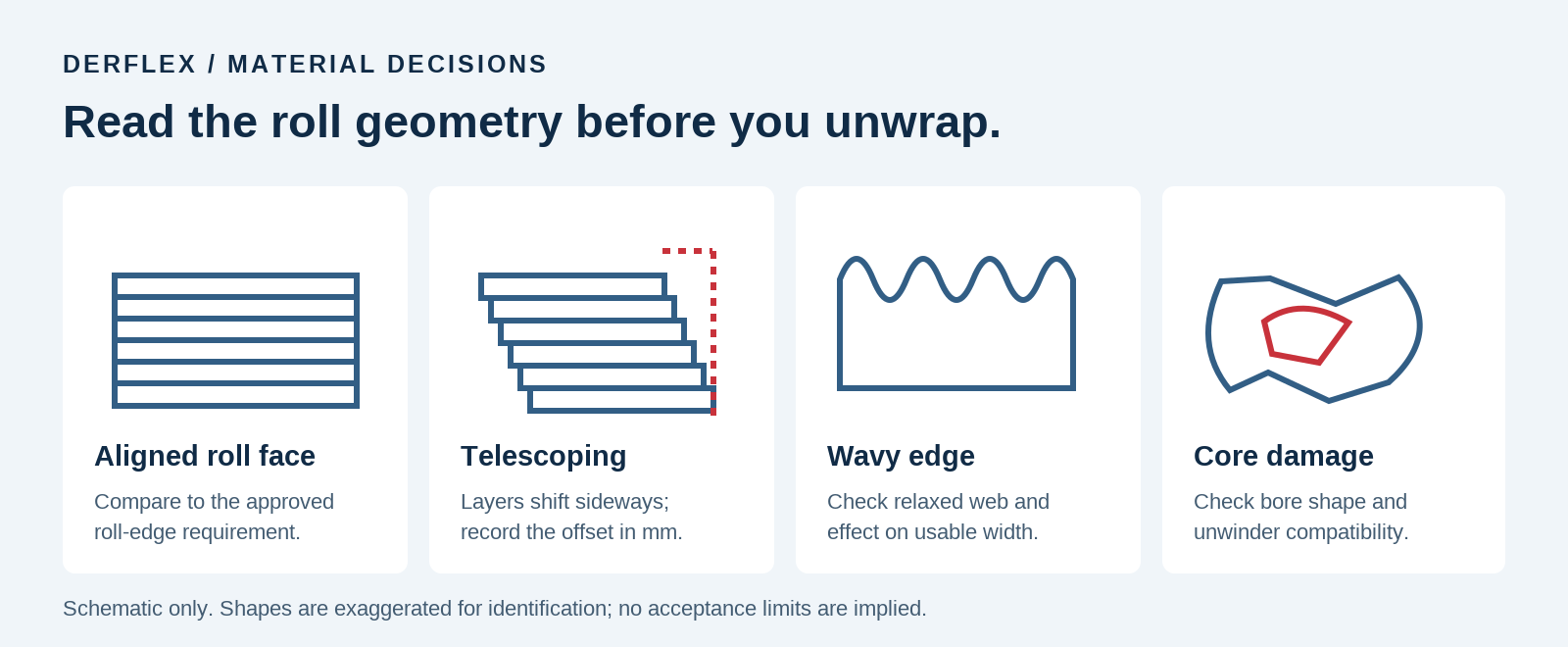
Roll-edge quality includes the geometry of the wound package and the condition of the fabric after unwinding. Record both: a neat wrapper can hide damage, while an uneven roll face does not by itself describe the usable fabric.
Telescoping edges, wavy edges, edge curl and creases are different observations. Treat them as descriptive findings first. The cause and acceptance decision need the roll identity, measurements and downstream requirements; a photograph alone is rarely sufficient.
| Observation | How it appears | What to check next |
|---|---|---|
| Telescoping | Wound layers shift sideways along the axis, leaving a stepped roll face. | Measure the offset from the agreed reference; assess stability and unwind tracking. |
| Wavy or baggy edge | Repeated edge ripples remain on a supported, relaxed web. | Record the affected length and width, relaxation conditions and effect on cutting or welding. |
| Edge curl | One or both web edges turn out of the web plane. | Record curl direction and extent without forcing the material flat. |
| Wrinkle or crease | A fold or deformation runs across or along the coated web. | Distinguish a transient ripple from a persistent crease; inspect for coating damage. |
| Crushed core | The tube bore is oval, split, collapsed or locally compressed. | Check mounting compatibility and whether the roll can be supported and unwound correctly. |
| Transit damage | Abraded edges, tears, wet wrapping, punctures or flattened roll ends. | Compare package and material condition; preserve arrival evidence and identify affected layers. |
On small screens, scroll the table horizontally.
For the full release inspection covering material identity, dimensions and documents, use the roll pre-shipment inspection guide. This page focuses on the edge and roll-geometry details that can affect conversion yield.
Measurement and usable width
Make an edge observation repeatable.
Define the reference, instrument and inspection condition before specifying a limit. A measurement taken on the wrapper, a loose outer layer or the core end can describe different things. Keep photographs square to the measured area and place a scale in the same plane.
| Item | Measurement approach to agree | Record with the result |
|---|---|---|
| Axial layer offset | Use the agreed roll-face reference and measure the layer displacement along the roll axis in millimetres. Record both ends. | Which face, reference location, maximum observed offset and any protruding loose wrap. |
| Usable coated width | Measure across a supported web without extra stretching, using agreed inspection points. | Nominal width, actual coated width and edge zones excluded by the purchase specification. |
| Wavy edge or curl | Observe an agreed unwound length after the specified conditioning and relaxation period. | Face up/down, support, affected edge, length and any agreed height or extent measurement. |
| Wrinkles and creases | Map each observation to the distance from the roll start and its position across the width. | Direction, affected dimensions, persistence after agreed relaxation and visible coating damage. |
| Core condition | Check the ordered core dimensions and inspect bore shape, tube ends and crushing. | Measured dimensions, mounting requirements, photographs and support condition. |
On small screens, scroll the table horizontally.
Nominal width is not guaranteed yield.
Edge trim, a damaged zone or a persistent crease can reduce the width available for a planned panel. Measure the usable width required by the cutting layout, including seam allowances and any excluded margins.
Keep dimensional limits consistent with the PVC tarpaulin batch tolerance specification. Do not invent a universal allowable loss at each edge.
A symptom is not a root cause.
Winding tension, web condition, cooling, supports and handling can all be relevant to a roll problem. Treat them as investigation topics rather than diagnosing a production fault from appearance alone.
The PVC tarpaulin manufacturing process guide gives the broader process context.
Receiving inspection route
Check the package, then the material.
Capture the unopened arrival.
Photograph the container or delivery condition, wrapping, straps, supports and labels before removing them. Note punctures, moisture, edge impacts and displaced rolls.
Match every inspected roll.
Record roll ID, batch, grade, color, stated dimensions and packing-list reference. Keep the identity with photographs and measurements, including any representative samples.
Inspect both end faces and the core.
Look for telescoping, crushed edges, unsupported protrusions, tube damage and loose outer wraps. Assess handling stability before mounting the roll.
Unwind under agreed conditions.
Use suitable equipment and supports. Inspect a specified length with controlled tension and relaxation, then record edge behavior and creases without stretching them away.
Map findings and decide disposition.
Separate affected rolls, mark defect positions and compare the findings with the approved limits. Agree release, further evaluation, rework or rejection with the responsible parties.
Sampling must reach the risk.
Inspection of the first exposed metre cannot establish the condition of an entire roll. Agree the number of rolls, roll-selection method, unwound length and internal defect-record requirements before shipment.
Where a converting trial is needed, record the unwinder, core fit, tension setting and web path. Keep machine setup observations separate from the material observations so the investigation can distinguish them.
For construction and finish selection, return to the PVC tarpaulin roll materials overview.
Acceptance and disposition
Agree limits before the purchase order.
There is no single telescoping limit established by this guide for all PVC tarp rolls. Acceptance depends on the ordered roll size, core, usable width, packaging route and converting equipment. Put measurable criteria in the order specification and attach photographs or an approved reference where useful.
| Finding | Decision route | Evidence to keep |
|---|---|---|
| Within agreed limits; no functional issue observed | Release under the agreed receiving plan. | Inspection record, roll IDs and sampled measurements. |
| Appearance variation; functional impact unclear | Hold the affected rolls and agree a controlled unwinding or converting evaluation. | Scale-referenced images, location map, trial conditions and observations. |
| Persistent crease or damaged edge reduces usable width | Assess affected material and required panel yield before disposition. | Unusable-zone dimensions, defect positions and cut-layout impact. |
| Core or roll stability prevents normal mounting | Keep segregated; agree a safe evaluation and disposition route. | Core dimensions, support condition, roll-face images and equipment requirements. |
| Transport damage or possible contamination | Preserve packaging and arrival evidence; follow the agreed claim process. | Delivery records, unopened-package photographs and identified affected layers. |
On small screens, scroll the table horizontally.
Distinguish the inspection decision from the investigation of responsibility. A defect map shows where material is affected; it does not by itself establish when the condition occurred. Compare pre-shipment records, packing, supports and arrival observations before assigning a cause.
Before you order
Build roll quality into the supply specification.
| PO field | What to agree with DERFLEX |
|---|---|
| Roll and core | Ordered width and length, roll size or handling constraints, core dimensions and unwinder compatibility. |
| Edge acceptance | Required usable width, excluded margins, alignment reference, telescoping limit and defect rules. |
| Inspection conditions | Conditioning, supported length, relaxation, tension, sampling and measurement locations. |
| Fabrication needs | Cutting layout, print-face orientation, seam allowances and flatness needed for the intended process. |
| Packing and support | End-face protection, wrapping, support arrangement, handling marks and route-specific protection. |
| Traceability and response | Roll IDs, batch references, defect mapping, retained samples and agreed claim information. |
On small screens, scroll the table horizontally.
Agree support and stacking instructions for the actual roll mass, size and transport route. Do not assume a paper core can support every handling method or that a neat outer wrap protects an exposed end face. Protect labels so the receiving team can connect each roll to its specification.
Changing the required edge trim, core, protection or roll dimensions may affect price and usable yield. Compare quotations using the same supply basis. Request applicable material documentation through the technical documents center and review the seam evaluation guide when persistent edge deformation may affect welding preparation.
Buyer questions
Frequently asked questions
What are telescoping edges on PVC tarpaulin rolls?
Telescoping is sideways displacement of wound layers along the roll axis, producing a stepped or extended roll face. Record the offset using an agreed reference and check roll stability, usable width and unwinding behavior before deciding disposition.
Are wavy edges the same as edge curl?
No. A wavy edge has repeated ripples along the web edge, while edge curl turns the edge out of the web plane. Inspect both on an agreed supported length after the specified conditioning and relaxation period, without stretching the material flat.
What is the acceptable telescoping tolerance for a PVC tarp roll?
There is no single acceptance figure specified by this guide. Agree the measurement reference, limit, sampling plan and functional checks in the purchase specification. Requirements should reflect the roll size, core, packaging route and converting equipment.
Can I accept a roll if the wrapper is damaged?
Wrapper damage alone does not establish the condition of the fabric. Photograph the unopened package, identify the roll, inspect the core and exposed layers, and assess any contamination or material damage under the agreed receiving procedure.
Should wrinkles be removed by pulling the fabric tighter?
Do not use extra tension to hide a defect during inspection. First inspect the supported, conditioned web using the agreed method. Persistent creases, coating cracks or downstream tracking problems require documented evaluation before release.
What evidence helps resolve a roll-edge quality claim?
Keep the purchase specification, roll and batch labels, arrival photographs, both roll faces, core details, scale-referenced measurements, defect positions along the roll and conversion observations. Segregate affected rolls and agree disposition before trimming or rewinding.
Your roll acceptance specification
Tell us what your converting line needs.
Send roll dimensions, usable-width needs, core details, defect criteria, quantity and destination. Include your unwinder requirements or photographs when available.
DERFLEX material procurement guide. Apply the written order specification to final acceptance. Photographs are material or application references; schematics are explanatory.