


 Contact DERFLEX
Flatbed Tarp Fabric for Converters
Flatbed tarp fabric for converters is roll material selected for cutting, joining and reinforcing lumber, steel and general freight covers. The most useful comparison considers the mass of the finished panels, wear exposure, usable roll width and processing yield. DERFLEX supplies PVC-coated polyester tarp material and can discuss cut-panel or fabricated-cover scopes separately. For wholesale purchasing, approve the material construction, panel layout, welding process and batch acceptance before booking repeat rolls. The lightest fabric and the lowest roll price do not necessarily produce the most suitable finished tarp.
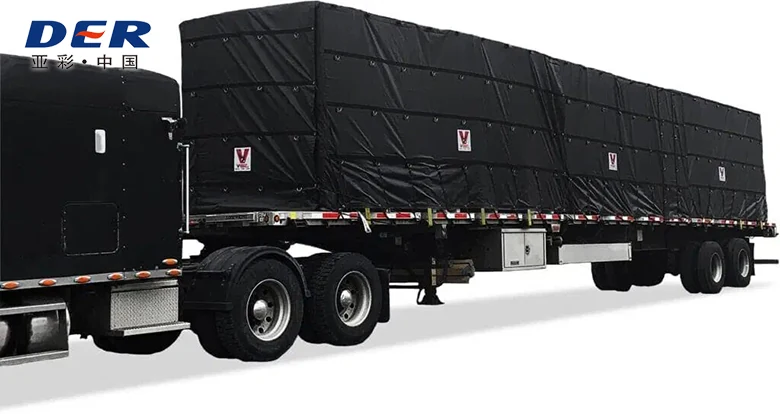
Compare lightweight handling with local wear requirements
A converter buying lumber tarp material needs more than a finished-tarp catalog. Define the top panel, side drops, end flap and reinforcement patches as separate cutting parts. That makes it possible to compare an all-over construction with a zoned design while keeping the same coverage geometry.
| Strategy | Practical value | Trade-off to validate |
|---|---|---|
| One construction throughout | Fewer material references and simpler stock control | Finished handling mass and whether each panel needs that construction |
| Lower-mass side panels | May reduce raw fabric mass across large drops | Joint compatibility, tear behavior, flutter and the actual wear exposure |
| Higher-duty top panel | Targets the material choice at the main cargo-contact zone | Transition seams, fold stiffness and compatibility with the side material |
| Local wear patches | Places additional material at mapped contact points | Patch position, attachment, trapped moisture and repairability |
| Two- or three-piece tarp set | Splits handling into separate covers | Overlap area, extra trim, packing and the individual piece weight |
These are design approaches, not a list of confirmed stocked grades. Match the candidate construction to the target test requirements and a first conversion trial. Do not describe a PVC material as a parachute nylon fabric unless its construction actually supports that identity.
Lumber tarp conversion
Deep side drops and end flaps can make up a large share of the material area. Their mass affects handling, while the top and corners may face concentrated cargo contact. Start with a panel area breakdown before changing GSM. The lumber tarp application guide helps define coverage and finished-cover requirements.
Steel and mixed freight conversion
Shorter drops do not eliminate puncture or abrasion risks around edges and projections. Specify protective interfaces and reinforcement where needed; heavier coated fabric alone does not make an uncovered sharp edge acceptable. Compare the finished designs in the flatbed tarp range.
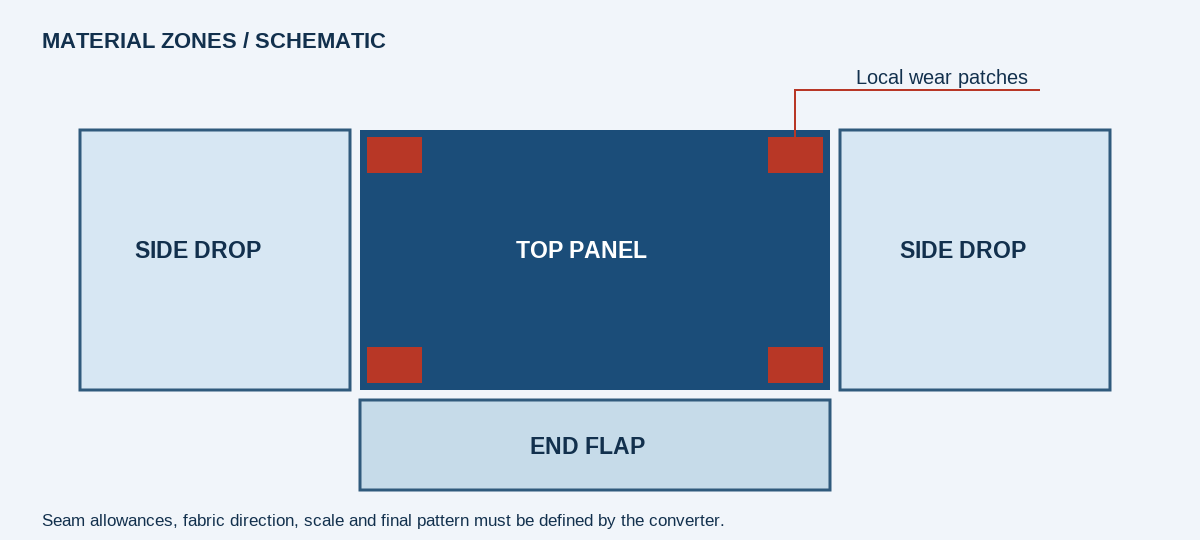
Calculate the raw panel mass before comparing grades
Raw fabric mass in kilograms equals panel area in square meters multiplied by GSM and divided by 1,000. For several constructions, calculate each panel group separately and add the results. Count flap area, overlap and reinforcement once at the correct material mass.
GSM and oz/yd² both describe mass per unit area: 1 oz/yd² is approximately 33.906 g/m². They do not directly describe thickness. A roll advertised in ounces needs an area basis; it should not be confused with the weight of the entire finished tarp.
Raw panel mass comparison
Enter the areas actually retained in the panels. Example values are illustrative and do not identify supplied grades.
Raw fabric only. Excludes additional seam area, patches, webbing, hardware, cutting waste and packaging. The difference is arithmetic, not a performance recommendation.
The default arithmetic example uses 30 m² at 650 g/m² plus 40 m² at 500 g/m²: 39.5 kg of raw panels. Using 650 g/m² for the same 70 m² gives 45.5 kg. The 6.0 kg difference is a calculation only, not an approved product design or a measured handling result.
Keep finished weight and purchasing quantity separate
Webbing, D-rings, grommets, extra seam overlap, patches and packing add mass. Cutting waste increases the quantity purchased but is not all retained in the finished tarp. Record these separately to avoid adding a waste percentage to a promised finished weight.
A zoned design also adds process questions. Check whether the two fabrics weld consistently, whether the seam has an abrupt stiffness transition, and whether different stretch behavior affects the assembled cover. A useful development trial records handling and seam behavior as well as calculated mass.
Review PVC-coated fabric construction when comparing candidates. Coating adhesion, base cloth and surface finish need consideration alongside nominal mass.
Buy usable output, then control the repeat specification
Flatbed tarp fabric wholesale should be quoted against an agreed roll specification and conversion plan. Nominal roll width can overstate the width available for production if edge trim, surface defects or joining allowances are not considered. Confirm usable width and map the cutting parts against it.
Build the cutting plan
Record panel dimensions, fabric orientation, overlap, trim and any matching requirement. A wider roll may remove a seam, but the benefit depends on actual nesting and the converter’s equipment. Compare material utilization, seam labor, machine limits and packed roll handling together.
For mixed top and side constructions, use separate material references and purchase quantities. Do not combine them into one undifferentiated square-meter total.
Set the roll acceptance basis
Agree nominal and usable width, roll length measurement, mass tolerance, color reference, surface requirements and the treatment of splices or defects. State whether rolls need individual measured lengths and defect maps. Define how short rolls or unusable sections are reported and reconciled.
Discuss core, roll winding, wrapping and pallet requirements against the unwinder and warehouse handling method.
| Purchase field | Record in the order | Why the converter needs it |
|---|---|---|
| Material identity | Construction reference, approved sample, face and finish | Prevents a GSM-only substitution |
| Width and length | Nominal / usable width, roll length and agreed tolerances | Supports nesting and production allocation |
| Color and batches | Reference sample, viewing conditions and lot arrangement | Helps control visible panel consistency |
| Defects and splices | Inspection method, marking, limits and settlement basis | Reduces unexpected cutting losses |
| Traceability | Roll ID, batch reference and inspection records | Connects complaints and reorders to actual material |
| Commercial scope | Quantity by construction and color, packaging and delivery terms | Separates material cost from conversion and freight |
MOQ, sample quantity, trial-order arrangement and production timing depend on the selected construction and order. Request them for the actual mix of materials and colors. The PVC tarpaulin quotation guide explains the main cost variables without treating an indicative material price as a finished-tarp quotation.
Approve a small fabrication run before bulk cutting
Run the intended material through the converter’s cutting and joining process before releasing a large production order. Use the actual panel faces, seam orientation, reinforced edges and hardware patches. A weldable material still needs a suitable process window on the machine that will make the covers.
Verify incoming rolls
Match roll labels to the specification. Inspect surface, width, length records, color and agreed material properties. Quarantine a disputed roll before cutting mixes it into multiple finished products.
Trial the critical joints
Check panel-to-panel welds, mixed-construction seams, webbing attachment and D-ring patches. Record joint geometry, equipment settings and failure observations. A base-fabric tensile result does not prove the capacity of a sewn or welded hardware attachment.
Inspect the first complete cover
Measure finished size and drop, verify flap direction, check seam placement and inspect reinforcement at the intended contact zones. Assess folding and packing. Where weather protection is required, assess the completed seam and cover construction as well as the base material.
Freeze the repeat reference
Retain the approved sample, bill of materials, drawing revision and conversion record. Define notification requirements for material or process changes, and identify the batch records needed with subsequent deliveries.
Before you order
Send the target tarp type, panel drawing, candidate material weights or performance targets, usable width requirements, monthly or order quantity, colors and destination. Existing converters can also send a material offcut and photographs of the current seams. Clarify whether DERFLEX is quoting rolls only, cut panels or a separate finished-tarp program.
The PVC tarpaulin material hub provides the broader roll-material context. If a moving enclosure is involved, review the sliding flatbed cover application before using a manual lumber tarp construction as its replacement.
A freight cover should be specified for its agreed covering function. Cargo securement, sharp-edge protection and vehicle equipment requirements need to be addressed in the finished product and operating system.
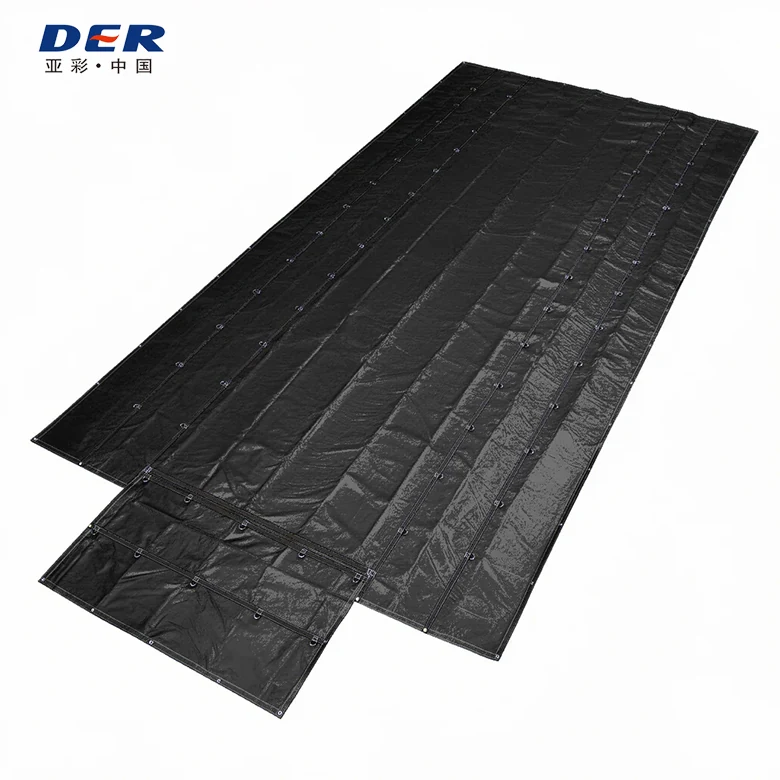
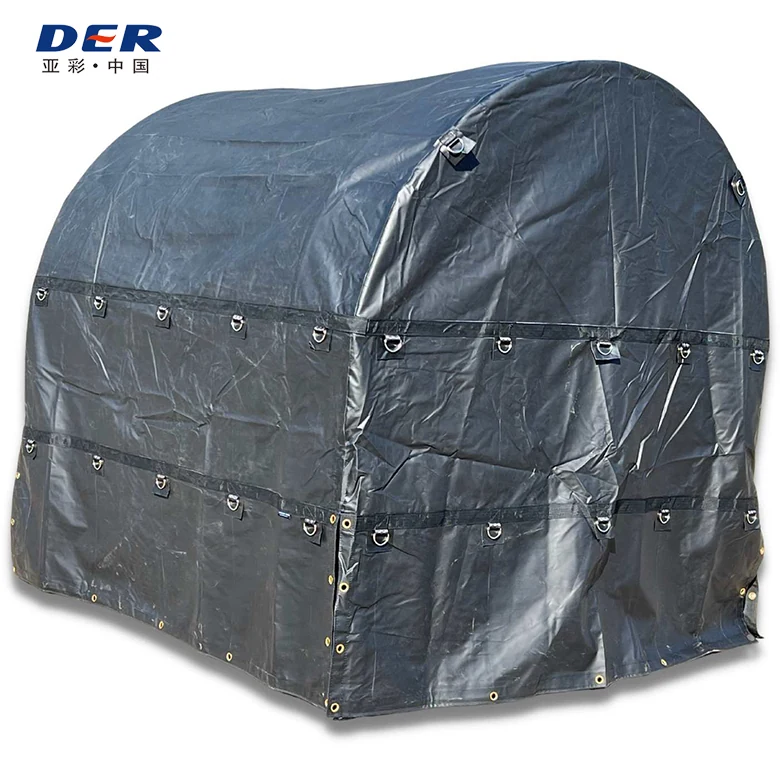
Read the material in its application
Compare the visible panel shape, material surface and attachment layout with your own drawing when preparing a sample request.
Frequently asked questions
What is the best fabric for a lumber tarp converter?
There is no universal best construction. Compare the required coverage, handling mass, cargo contact, seam process and performance targets. A top-and-side material strategy needs joint and finished-cover validation before production.
Can lighter side panels reduce the finished tarp weight?
They can reduce the calculated raw panel mass when the same area uses a lower GSM. Actual finished weight also includes seams, reinforcement, webbing and hardware, and the design still needs durability and compatibility checks.
How do I convert tarp fabric ounces to GSM?
For mass per unit area, multiply oz/yd² by approximately 33.906 to obtain g/m². This conversion does not establish thickness or the total weight of a finished tarp.
Should I order the widest available roll?
Compare usable width with the cutting plan and your equipment. A wider roll may remove seams or improve yield, but it may also create offcuts or handling constraints. Calculate utilization for the actual panel geometry.
Can two different PVC fabrics be welded into one tarp?
Potentially, but the specific coatings, surfaces and material stack need a trial on the intended equipment. Validate the mixed seam, stiffness transition and performance of the finished construction.
What information is needed for a wholesale fabric quotation?
Send the construction or approved sample, target mass and performance, nominal and usable width, roll length, quantity by color, cutting plan if available, packaging preference and delivery destination. State whether the scope is roll goods, cut panels or finished tarps.
Turn the cutting plan into a controlled roll order.
Share your panel drawing, preferred material construction and order mix. Request a roll-material quotation and a sample plan for your conversion process.