


 Contact DERFLEX
Sliding Truck Curtain Fabric Selection
Sliding truck curtain fabric must tolerate repeated gathering, unfolding and tensioning while protecting freight from weather. Choose it around the movement pattern, local rubbing surfaces, operating temperature and attachment design. A side curtain running on hangers and a retractable cover moving with bows create different fold and contact conditions. DERFLEX supplies PVC-coated polyester materials and drawing-based cover components for these applications. The fabric review should be coordinated with the system builder, who defines the rails, rollers, bows, operating forces and completed vehicle requirements.
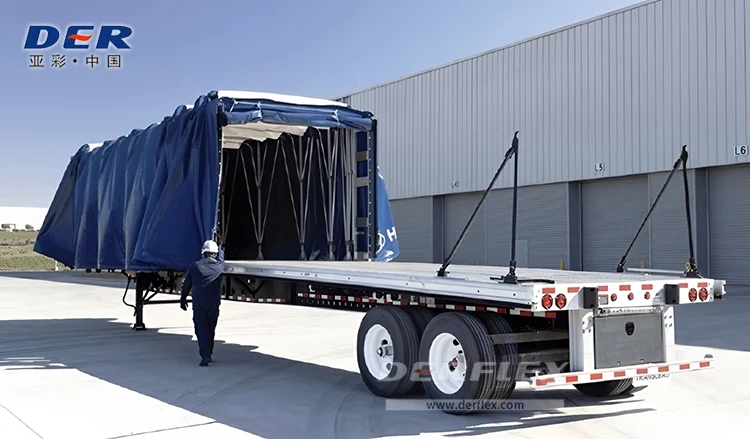
Follow the fabric through a complete opening cycle
Before requesting sliding tarp trailer fabric, identify what actually moves. A hanging side curtain gathers along a longitudinal rail. A bow-supported retractable enclosure folds between supporting frames. A sliding roof collects fabric above the load. They share material concerns, but they should not share a specification merely because all three slide.
Side curtains
Map the top hanger band, vertical posts, lower buckle line and the leading and trailing closures. Observe how the curtain gathers, where folds sharpen, and whether reinforcement interferes with the stacked curtain. A lighter panel can reduce handling mass, but the whole connection and durability requirement still applies.
Use the curtain-side material guide for the base fabric discussion. Confirm which face touches posts and other body parts.
Retractable flatbed covers
Record the bow spacing, pockets, travel path and the available packed length. Review roof and side panels separately: their geometry, tension and weather exposure differ. The reinforcement needs to follow the moving interfaces without creating an unintended stiff hinge.
The sliding flatbed cover material overview describes the associated cover application. A fabric order should retain the specific system drawing and revision.
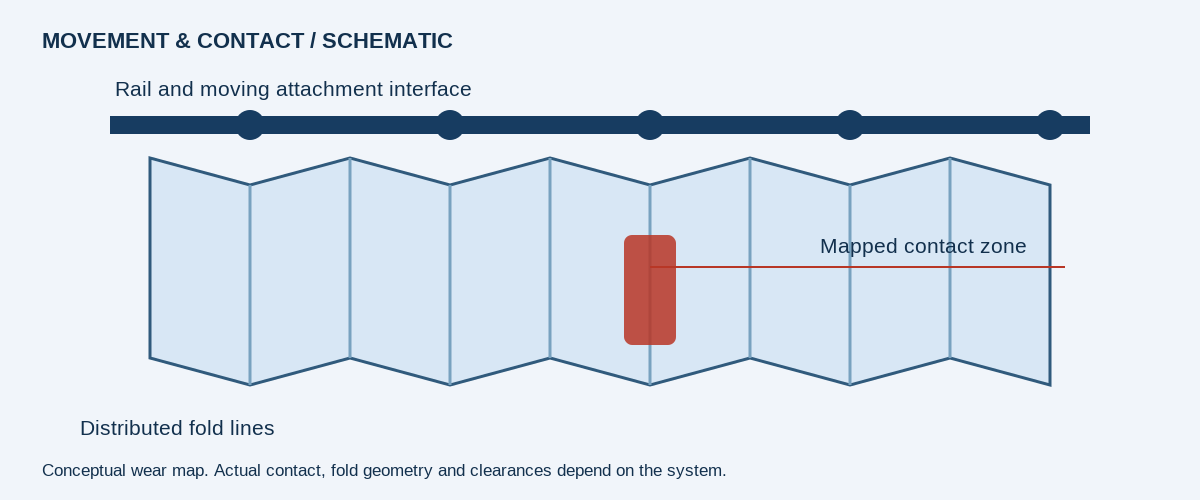
Distinguish a contact problem from a fabric problem
In many designs, rollers run in the rail while the fabric is attached to a hanger or bow. The fabric is not intended to act as the rail bearing. If it rubs directly against a rail edge, identify the contact location, alignment, clearance and surface condition before selecting a tougher coating. A burr or trapped fold may require a system correction.
Balance flexibility, wear resistance and connection quality
GSM describes mass per unit area. It does not specify fold fatigue, coating adhesion or sliding effort. Two fabrics with the same mass can use different base yarns, coating distribution and surface finishes. Compare candidates through the selected construction and a consistent set of tests.
| Operating condition | Material priority | Qualification question |
|---|---|---|
| Frequent opening and close packing | Flexibility, fold recovery and fatigue resistance | Does the coated fabric tolerate the agreed repeated-flex method and the actual packed geometry? |
| Local rubbing at posts or attachments | Surface wear behavior and compatible wear patches | What surface, pressure, motion and debris are represented in the abrasion comparison? |
| Cold-weather opening | Low-temperature bending and joint flexibility | Have the material and fabricated joint been evaluated at the specified temperature? |
| Large tensioned panel | Tensile behavior, elongation and dimensional control | Are warp and weft data matched to the installed panel orientation? |
| Printed fleet curtain | Ink / finish compatibility and fold durability | Do graphics retain adhesion after the agreed folding and cleaning trial? |
| Multi-layer pockets or patches | Weld consistency, local thickness and packed bulk | Does the finished interface move freely and remain intact after cycling? |
Start the wear review with the abrasion-resistant curtain material guide. Do not turn a laboratory rotation count into a promised number of years or vehicle openings. A controlled comparison needs the abrasive contact, load, motion and failure endpoint.
Why maximum fabric mass can be the wrong shortcut
Increasing mass changes the moving cover weight and may also change stiffness and packed volume. That can influence opening effort, fold formation and hardware loading. Select enough performance for the duty cycle, then verify the completed cover with the system builder.
Why the lightest candidate also needs proof
A lower-mass construction may be attractive for handling, but it still needs adequate tear behavior, attachment strength and weather protection. Reinforcement patches cannot compensate for an unsuitable panel across the entire cover.
Review construction variables in the PVC-coated fabric range. Use approved samples for hand, surface and processing comparisons rather than relying on a product name alone.
Qualify the fabric, then qualify its movement in the assembly
Use a staged approval process so a material substitution does not become an uncontrolled vehicle trial. The following sequence is a proposed purchasing workflow; it is not a claim that a selected DERFLEX grade has already completed your tests.
Document the baseline
Identify the current cover or target drawing, fabric orientation, contact points, route climate, cleaning practices and opening frequency. If a cover has failed, send photographs of the first damage location and the contacting hardware, not only the final tear.
Screen material samples
Compare tensile and tear behavior, coating adhesion, flexibility, surface finish and relevant environmental properties under agreed conditions. Retain sample identity and report units. Test the faces and directions that correspond to the installed panel.
Make representative interfaces
Fabricate seams, bow pockets, hanger bands and reinforcement transitions using the intended production equipment. Inspect local bulk, joint integrity and the fold geometry around those interfaces. Repeating an approved flat seam is not enough to approve every pocket construction.
Run a pilot cover
The system builder should define cycling, opening effort, packed clearance, closure operation and inspection intervals. Examine scuffing, cracks, coating whitening, yarn exposure and weld lifting. Record the environment and cycle conditions with the observations.
Separate repeated flexing from cold bending
ISO 7854 describes methods for assessing damage from repeated flexing of coated fabrics. ISO 4675 addresses bending at specified low temperatures after defined exposure. They answer different questions. Neither a material flex test nor a cold-bend result alone establishes the operating life of a retractable trailer cover.
Method references: ISO 7854:1995 and ISO 4675:2017. Specify the applicable method and conditions in the test request.
Define wear and movement acceptance separately
A pilot may move freely while developing unacceptable localized wear, or retain its surface while becoming difficult to gather. Record both movement observations and material condition. Agree the damage classification, rejection criteria and the required evidence before the trial begins.
State who owns each part of the finished system
| Scope | What to define | Approval needed from |
|---|---|---|
| Fabric or cut panels | Construction, face, width, color, orientation and agreed material tests | Material buyer and converter |
| Fabricated cover components | Finished dimensions, seams, pockets, reinforcement and interfaces | Converter and system builder |
| Rails, bows, rollers and drive | Geometry, alignment, clearances, operating forces and maintenance | System / vehicle builder and hardware supplier |
| Completed vehicle performance | Installed cover behavior and any required assembly evidence | Responsible vehicle or system owner |
DERFLEX's material and fabricated-cover discussion does not automatically include structural frames, drives, rail installation or vehicle certification. List the exact purchased components and the interfaces supplied by others. This keeps the quote comparable and makes sample approval meaningful.
Before you order a replacement
Provide the system make or drawing, cover measurements, attachment details and photographs in both the open and closed positions. Identify repairs or altered hardware. Measuring only an old stretched panel can carry installation errors into the new cover; agree the finished dimensions against the intended system geometry.
If the design uses a bead-and-track edge, review the keder fabric information and supply the profile drawing. A keder interface is not interchangeable with every roller or curtain hanger arrangement.
Plan production and repeat orders
Request material width, usable width, roll length, batch traceability and packing appropriate to the converter. Tie repeat orders to a controlled specification and approved sample rather than color and GSM alone. Confirm which changes require a new weld trial or pilot cover.
Explore the PVC tarpaulin range for related material constructions. For each inquiry, send quantity, required color, destination, target schedule and the material or cover scope.
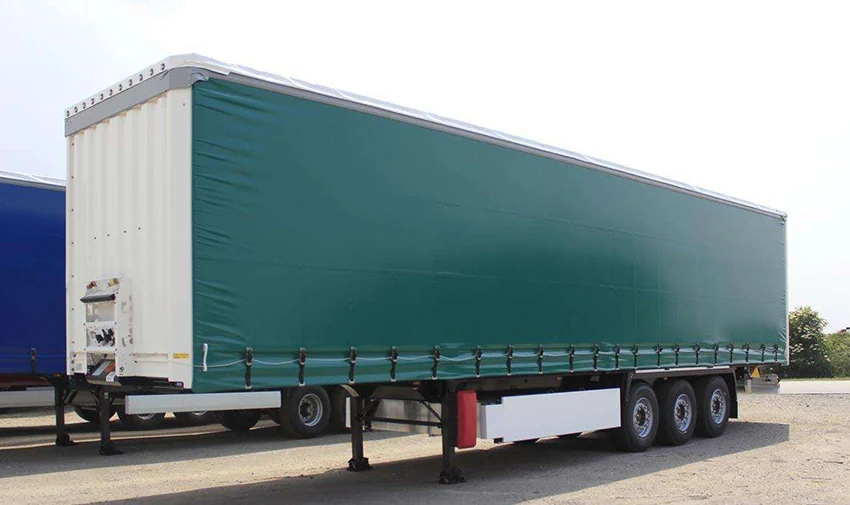
Read the material in its application
Compare the visible panel shape, material surface and attachment layout with your own drawing when preparing a sample request.
Frequently asked questions
What material is used for sliding truck curtains?
PVC-coated polyester is a common construction. The selected grade must suit the fold pattern, attachment design, wear points, climate and fabrication process of the particular side curtain or retractable cover.
Is sliding tarp trailer fabric the same as side curtain fabric?
The constructions can overlap, but the duty is different. Bow-supported covers, hanging side curtains and sliding roofs create different folds, interfaces and contact conditions, so the system drawing should guide selection.
Does a heavier curtain always slide better or last longer?
No. Fabric mass does not define flex fatigue or abrasion performance. Added mass and stiffness can also change packed bulk and operating effort. Compare relevant tests and verify the fabricated cover in the intended system.
Can an abrasion test predict the service life of the cover?
It can support a controlled comparison under defined contact conditions. It does not directly predict years of service because hardware condition, alignment, debris, tension, climate and maintenance change the exposure.
Does DERFLEX supply rails and complete drive systems with the fabric?
This material inquiry covers fabric and any separately agreed fabricated cover components. Rails, bows, rollers, drive equipment and installation must be itemized and confirmed in the quotation.
What is needed before approving a material substitution?
Retain the baseline drawing and sample, compare material properties, trial the actual welded interfaces and complete the system builder’s pilot-cover approval. Record the revision and the acceptance conditions before volume production.
Specify the movement before you specify the fabric.
Send the cover drawing, operating pattern and wear photographs. Request a material review coordinated with your converter or system builder.