


 DERFLEX / INDUSTRIAL TEXTILES
Detachable PVC coated fabric panels / frame-mounted closures
Tarp Panels with Turn Button Fasteners for OEM Enclosures
Specify reusable tarp panels that fasten to a rigid enclosure frame with matched oval eyelets and rotating turn-button bases. DERFLEX can review PVC-coated fabric, panel cutting, reinforced hems and drawing-based fabrication for OEM programs. Correct results depend on the fastener model, frame geometry, edge reinforcement, hole positions, opening cycle and weather exposure—not just the fabric weight. Share your drawing or existing hardware sample to confirm the intended supply scope and trial fit before repeat production.
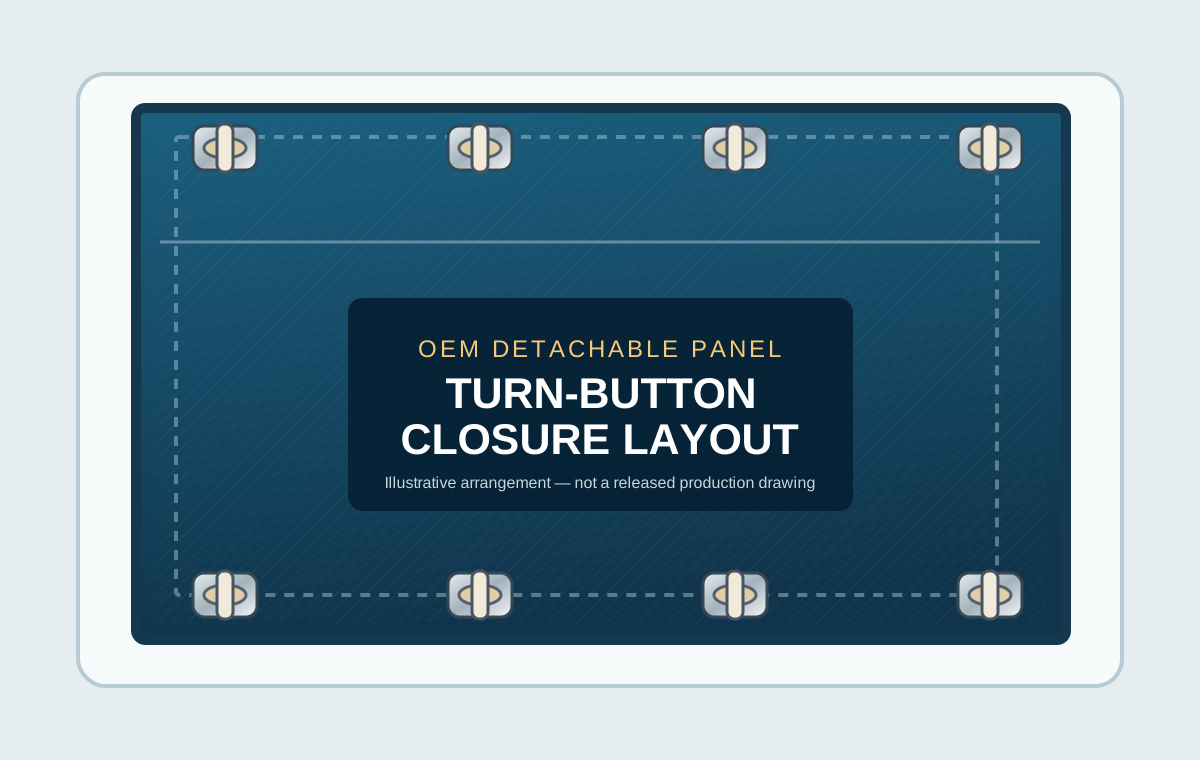
A turn-button closure provides a positive, hand-operated panel-to-frame interface. Unlike a rope-through-grommet fastening, the removable fabric panel mates with dedicated frame studs. The closure does not independently prove wind resistance, waterproofness or frame capacity.
01 / Product definition
Specify the panel and the hardware as one interface.
The fabric opening, reinforcement and frame-mounted part must align in size, orientation and installed thickness. A generic ‘turn button’ label is not a complete purchasing specification.
Fabric panel
Coated textile with defined cut shape, finished edges, seams, any transparent sections and surface orientation.
Eyelet assembly
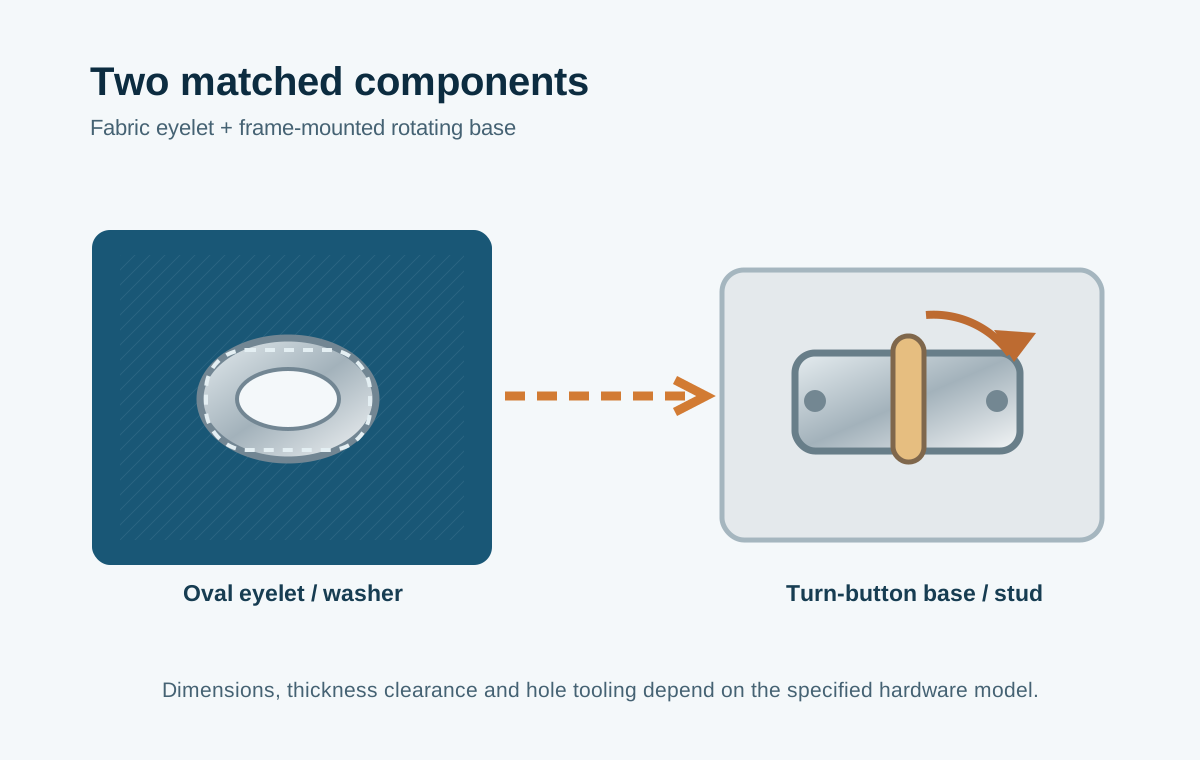
Oval eyelet fitted to the panel with its matched washer or clinch component through an approved reinforced zone.
Frame base
Rotating button and its specific base fixed to a suitable support. Stud height and mounting method must match the assembly.
A quarter-turn fastening system is not automatically interchangeable with every twist-lock or panel-latch product. Confirm the actual manufacturer series and mating dimensions.
02 / OEM technical specification
Seven decisions that control repeatable fit.
Use these fields on the panel drawing and the sample-approval record. Enter verified hardware data rather than assuming universal eyelet or stud dimensions.
| Specification field | What buyer and supplier must agree | Why it matters |
|---|---|---|
| Finished panel geometry | Installed width and height; drops, cut-outs, diagonals, hem returns and dimensional tolerance at a named measurement condition. | Prevents a correctly cut flat sheet from failing to fit the installed frame. |
| Coated-fabric construction | Approved PVC-coated polyester material, weight in g/m² if known, color, finish, weather and handling requirements; relevant material test data by grade. | Weight alone does not define tear-out, weld strength or low-temperature flex. |
| Fastener identity | Approved base/eyelet/washer series, manufacturer reference, orientation and corrosion suitability for the actual environment. | Similar-looking quarter-turn parts may not mate. |
| Stud clearance and stack | Measured reinforced-edge thickness, eyelet/washer stack and chosen base/stud height after setting. | Too little clearance prevents closing; excessive slack can cause flutter. |
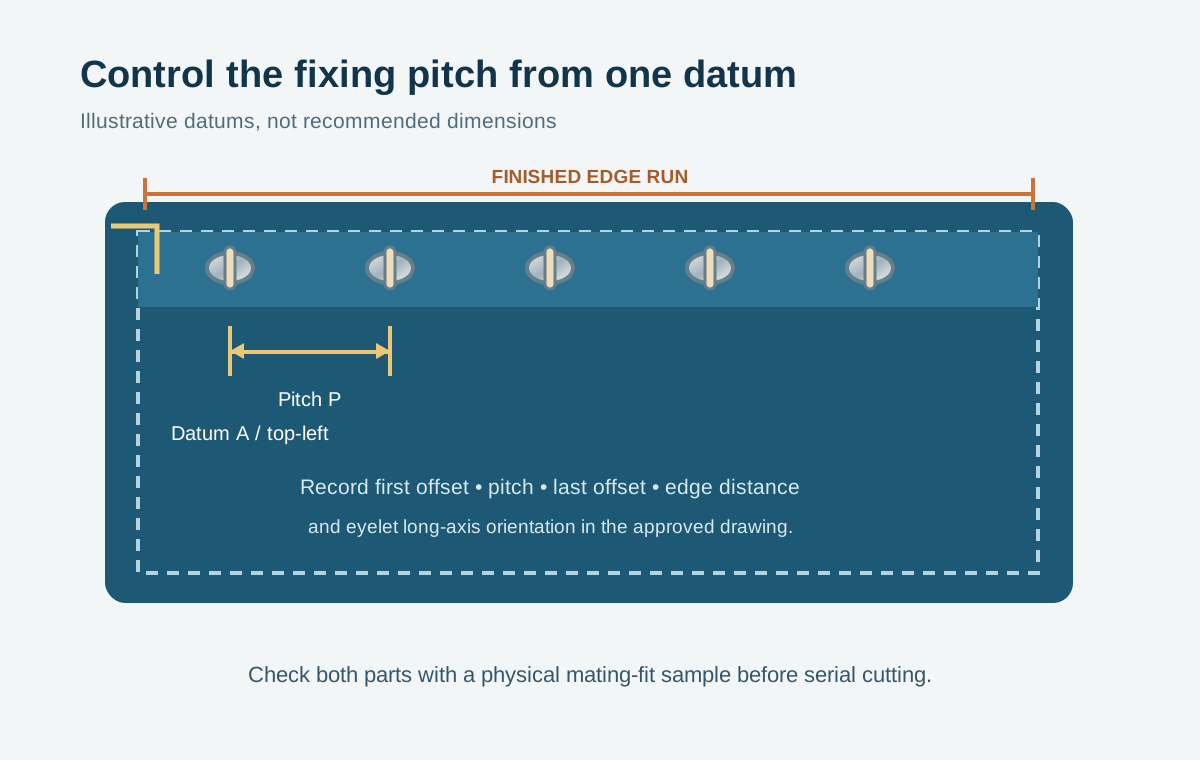
| Hole and pitch layout | Datum corner, X/Y coordinates or pitch, first and last offsets, edge distance and eyelet long-axis alignment. | Stops accumulated location errors across long panels. |
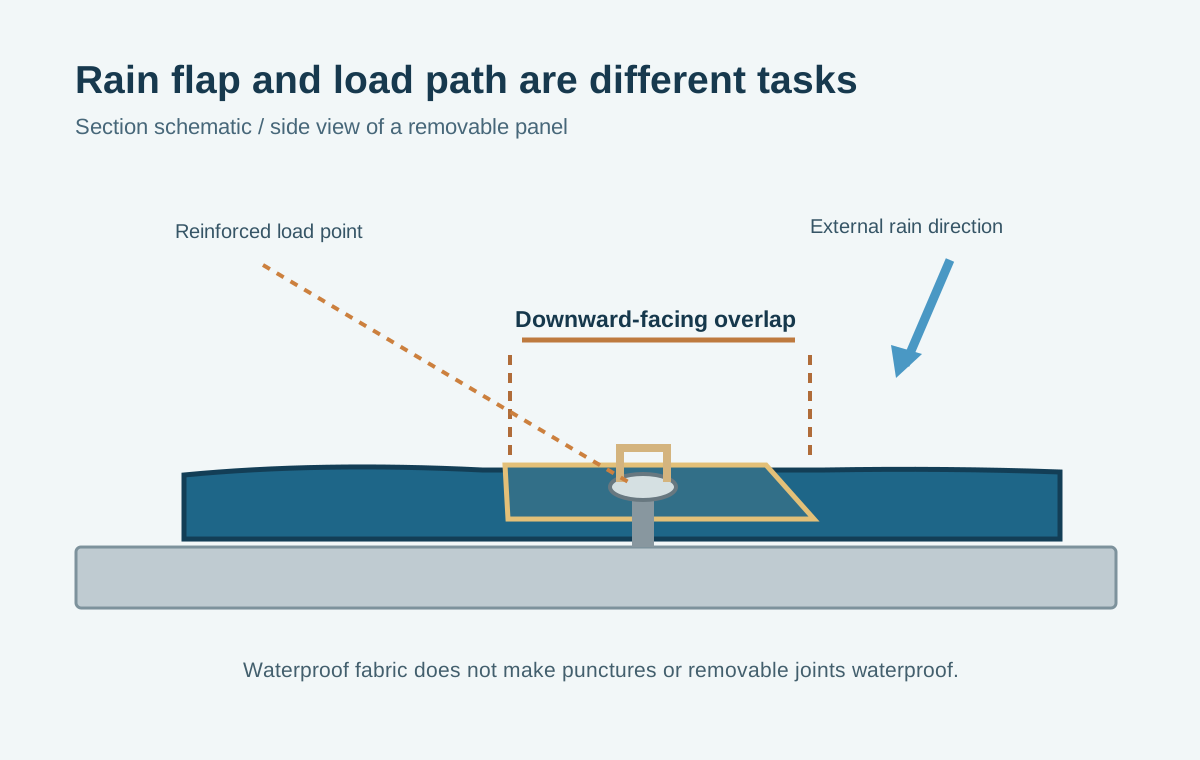
| Edge and rain detailing | Hem method, localized patches, weld/sew layout, overlap, flap direction, drainage and clear access for operating buttons. | Distributes interface loading while addressing leakage separately. |
| Order / acceptance record | Panel ID, revision, quantities, scope of supplied hardware, sample fit check, labeling and inspection points. | Supports replacement panels and repeat-order consistency. |
03 / Hole position & reinforcement
Measure from a datum, not from the previous hole.
For an enclosure that must be removed and reinstalled, hole coordinates and eyelet rotation need the same control as panel dimensions.
Map the support
Record the real frame, fixing surface and any hinges, rails, corners or obstructions.
Set the edge
Choose hem construction and patches, then establish the usable setting zone for each oval eyelet.
Fit a mating pair
Trial the actual eyelet, washer, button base and screws against the finished thickness.
For larger segmented covers, review modular tarp panel replacement planning before freezing mating-edge revisions. PVC roll selection can be coordinated against PVC tarp material and fabrication options.
04 / Exposure & service
Keep the button accessible—and the rain path controlled.
A turn button keeps a panel attached at its fixing point. Flaps, seam design, backing support and water shedding must be considered independently.
Outdoor equipment housing
Check corner wind action, abrasion, frame edges and whether the inspection panel needs a weather-facing flap.
Workshop partitions
Focus on repeated access, cleaning, visibility and snag resistance; compare industrial curtain material systems.
Loading-bay covers
Review vehicle clearance and wear surfaces. See dock shelter PVC fabric selection.
Canopies and temporary walls
Identify owner of anchoring, wind design, means of egress, applicable fire requirements and site assembly.
05 / Closure selection
Turn buttons vs snaps, grommets and zippers.
The best fastening method depends on the frame, load path, opening frequency and rain protection plan—not on whichever component has the shortest installation time.
| Closure | Useful when | Main constraint to solve |
|---|---|---|
| Turn-button / twist-lock | Removable panel needs a hand-operated attachment to fixed mounting points. | Matched oval eyelet/base, clearance, reach, opening direction and frame installation. |
| Press snap fastener | Small or light access flaps with repeated open/close cycles. | Pull-off direction, material tear-out, repeat-cycling wear and wet/cold handling. |
| Round grommet and lacing | Flexible edge tensioning around a perimeter without proprietary studs. | Lacing method, tension distribution, time to release and exposed openings. |
| Zipper under cover flap | Continuous access opening or a detachable edge with a suitable separating zipper. | Slider access, debris, shear loading, termination and rain flap design. |
| Hook-and-loop | Convenient secondary flap retention and light-duty access. | Peel forces, dirt accumulation, engagement area and long-term wear. |
For a broader construction comparison, see DERFLEX tarpaulin materials and completed-cover directions. Different applications may favor hardware-free reinforced sheet formats rather than dedicated frame fittings.
06 / Sample, fit, repeat
Build the OEM approval around a real installation trial.
A matching sample is more useful than a quotation based on fabric area alone. Record what has been approved so later replacements fit the same enclosure.
Share the actual interface
Provide frame photos and substrate, hardware reference if available, panel outline, planned usage and weather exposure.
Test the difficult fixing
Approve a short fully finished edge with several correct holes and the mating base; verify that fingers can rotate the button.
Retain the approved revision
Confirm dimensions, closure sequence, rain flaps, inspection method, panel labels, hardware inclusion and spares before volume orders.
07 / Before you order
Send an enclosure sketch and the hardware details you have.
You do not need a completed CAD package to start. A dimensioned sketch, photographs and sample part are enough to identify which requirements need confirming.
Minimum RFQ input
- Application: industrial enclosure, curtain, equipment access or replacement cover; indoor/outdoor duty and anticipated release frequency.
- Panel schedule: overall width, height, shaped edges, openings, quantity, colors and required finished-dimension tolerances.
- Hardware interface: photos, part numbers or physical samples of oval eyelet and base; frame material and available fixing points.
- Performance: rain exposure, cleaning, UV, abrasion, temperature and any project-required test report or fire classification.
- Commercial scope: roll goods versus cut/prepared versus finished panels; which hardware is included, destination, packing, desired delivery window.
What changes the price?
Fabric type and usable width, number of patterns and seams, hem layers and patches, fastener count, punching and installation operations, sampling, inspection, labels, packaging and transport terms.
For covers exposed to changing outdoor conditions, read the all-weather tarp construction guide when selecting an appropriate fabric and reinforcement approach.
08 / OEM project enquiry
Make the turn-button interface repeatable.
Tell DERFLEX what the panel covers, how the frame is fixed and which component you already use. We can review coated-fabric choices and a drawing-based fabrication request, then confirm sampling and the actual quoted supply boundary.
- Frame / panel drawings or photographs
- Fastener sample, model or close-up dimensions
- Quantity, site exposure and destination
09 / Buyer questions
Turn-button tarp panel FAQ
Practical answers on hardware compatibility, layout, weather exposure and replacement purchasing.
What is a turn-button tarp fastener?
It is a matched mechanical closure: an oval eyelet is set into a reinforced fabric edge and placed over a frame-mounted turn-button base. Rotating the button typically about a quarter turn retains the panel. The eyelet and base must be selected as a compatible set.
Can turn buttons be used with ordinary round grommets?
No. Conventional circular grommets do not provide the shaped opening required by a standard turn-button system. Specify the matching oval eyelet, washer or clinch component, stud and fixing base from the same approved hardware family.
How far apart should turn buttons be on a tarp panel?
There is no universal safe spacing. Set the pitch after reviewing panel dimensions, wind and handling loads, available frame points, fabric reinforcement and the chosen fastener. Put the first and last offsets, pitch and reference corner on the approved drawing.
Do turn-button closures make an enclosure waterproof?
Not on their own. Penetrations, panel overlap, wind-driven rain and runoff direction can allow water into the joint. Specify a weather-facing flap and verify the assembled sample under the project’s actual exposure requirements.
Can DERFLEX match a replacement panel to an existing frame?
An existing frame can be a starting point if the buyer supplies actual measurements, close-up hardware photos, the fastener model where known, panel orientation and the intended access sequence. A mating-fit sample should be approved before bulk fabrication; interchangeability is not assumed.
Are the metal turn-button studs and frame installation included?
Hardware supply, drilling, on-site fitting and frame installation must be agreed separately in the quotation. A request for PVC fabric or prepared panels alone does not establish that bases, screws or installation services are included.