



Tarps with Snap Fasteners for Detachable Panels
A snap-on tarp panel opens where access is needed, without removing an entire protective enclosure. DERFLEX can discuss custom PVC tarpaulin panels with defined snap locations, reinforced attachment edges and mating hardware requirements for equipment covers, partition openings and OEM replacement programs. Start with the existing stud pattern, panel tension, opening frequency and weather exposure—not snap spacing alone.
Project-based supply · No universal snap spacing, holding force or lead time is implied.

What makes a snap-on tarp panel different?
A snap fastener is a mating closure normally formed from a fabric-mounted cap-and-socket assembly and a corresponding stud, either fixed to another fabric layer or mounted on a suitable rigid surface. It clicks into place and releases through a defined pull action.
Unlike a grommet or clamp tie-down, a snap is mainly useful where one part of the cover is intentionally opened and reattached. The panel can sit on a frame perimeter, over a service access opening or against an adjacent PVC curtain. A good design coordinates the snap with the backing patch, outer flap, supporting frame and independent restraints.
Engineer the fabric, fastener and backing together.
A stronger base sheet does not compensate for a poorly set snap. The local punched zone, patch and opposing stud location determine how repeated removal behaves.
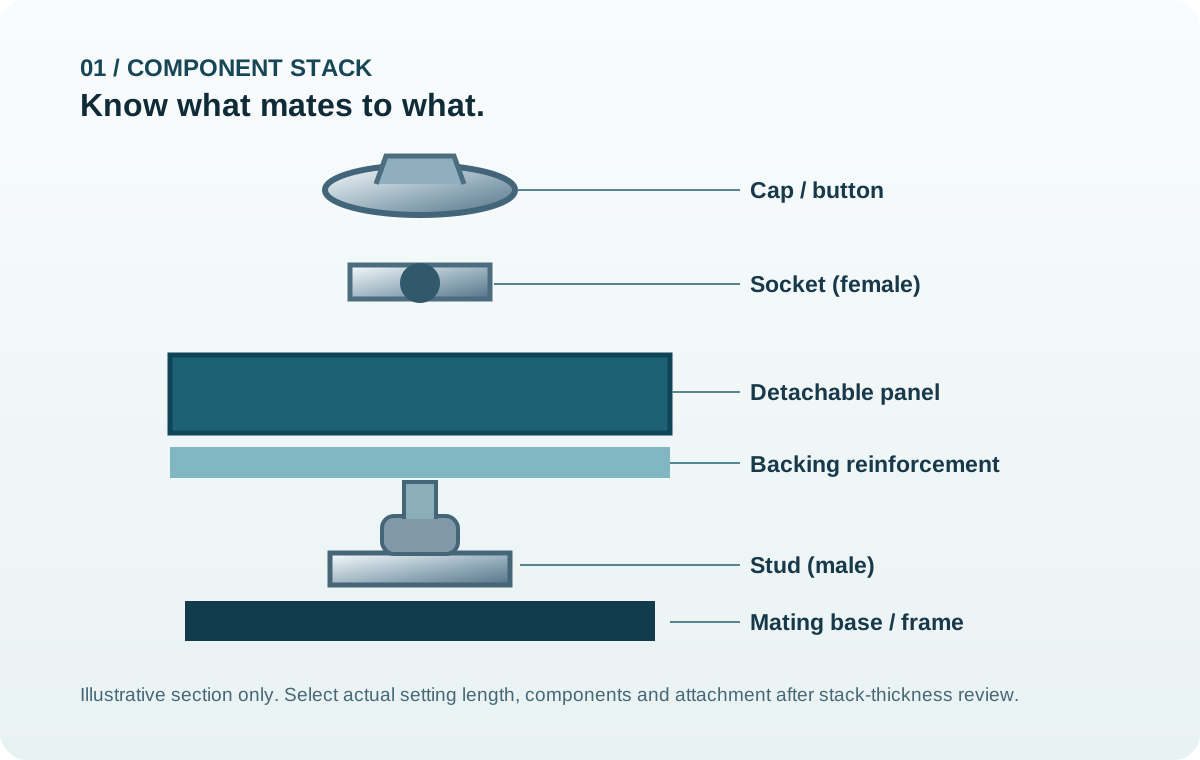
Cap + socket on the removable sheet
Choose a matching fastener family and post length for the total layer stack. Confirm whether the selected setting tool and die can install the assembly without crushing the fabric.
Stud on a compatible base
Specify cloth-to-cloth studs or studs mounted to an appropriate frame or substrate. Record base thickness, fastener orientation, access to the fixing and any galvanic-corrosion exposure.
Localized backing reinforcement
Use a patch, webbing or folded hem to spread removal force beyond the hole. Review patch bond or stitching with the selected PVC grade; avoid placing punched holes directly in a loaded seam.
Independent cover restraint
If the enclosure needs wind, suspension or cargo restraint, route that load through appropriate support hardware rather than assuming the snap line will carry it.
Three panel arrangements, three purchasing tasks.
Choose the opening path first. The correct fastener count and orientation follow from the installed geometry, not a generic catalogue interval.
Hinged inspection opening
One side remains attached while the opposite edges snap open. Useful for gauges, service points and low-frequency inspection.
Fully detachable panel
Snaps follow the panel perimeter so a damaged or seasonal section can be removed without disassembling adjacent fabric.
Frame-mounted sidewall
A flexible PVC curtain or equipment cover meets a fixed frame with a defined stud pattern for repeat closure.
How to measure a detachable tarp panel for snaps.
The single most common replacement mismatch is a cover whose overall dimensions are correct but whose sockets do not align with the installed studs.
1. Establish a stable datum
Photograph the installed frame and mark a fixed corner or reference edge as datum A. Identify which side of the cover faces out.
2. Record every snap center
Measure each stud's center from the datum, and record center-to-center pitch, edge setback, corner offsets and any irregular positions. Do not assume a used frame is perfectly square.
3. Allow for the actual material stack
Confirm hem folds, backing patches, clear-window transitions, fabric stiffness and the required cap-barrel reach. Material stretch or shrinkage can affect alignment.
4. Test the installed prototype
Use the approved hardware on the real frame; check snap engagement and removal sequentially, without excessive edge tension or prying the fastener from the fabric.
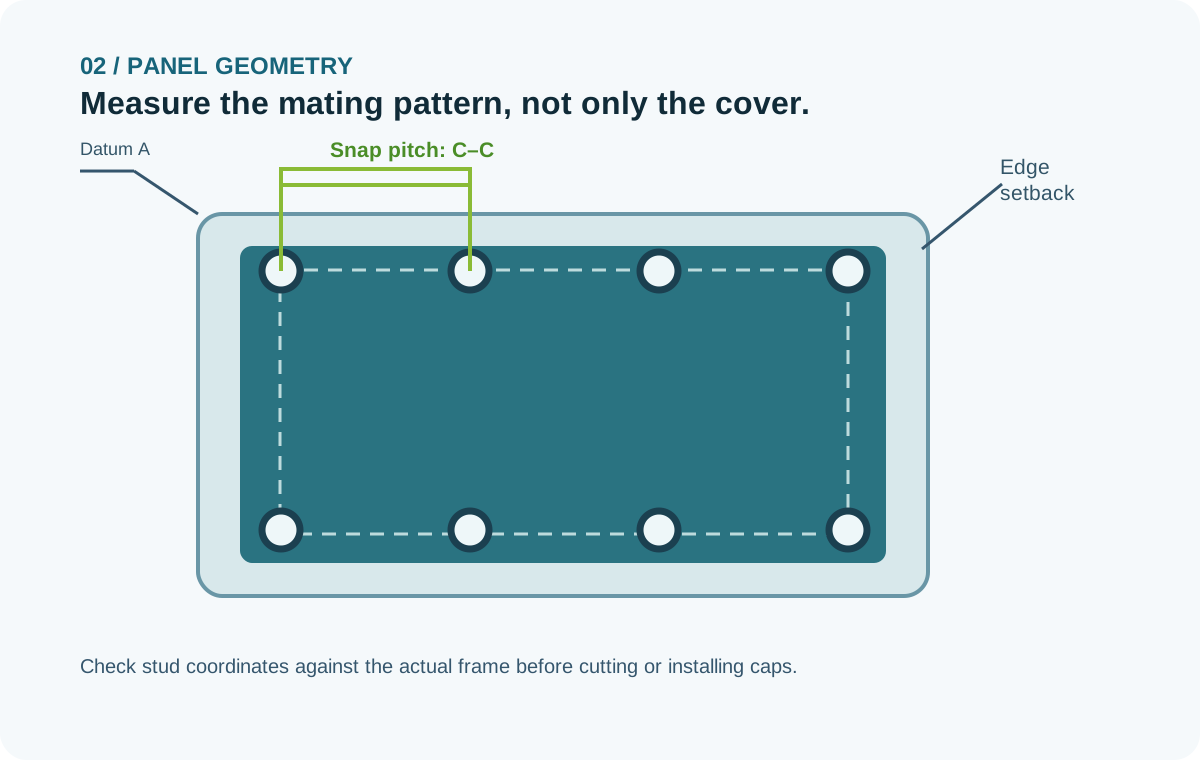
Snap-on tarp specification checklist.
These are design decisions and quotation inputs, not a fixed product grade or performance certificate. Start with the intended service duty and PVC coated tarp material family.
| Specification item | What to decide | What to verify |
|---|---|---|
| Tarp substrate | PVC-coated polyester, project-matched opaque grade; clear PVC section if visibility is necessary. | Handling, flexibility, abrasion, exposure, material identity. |
| Finished size | Width × height, border geometry, overlaps, access openings, corner relief and attachment face. | Actual frame dimensions and finished-size tolerance. |
| Snap family | Matching cap, socket, stud and base style; standard or directional release where justified. | Actual component model and mating compatibility. |
| Hardware metal | Project-specified brass, plated brass or suitable stainless grade when available. | Salt, humidity, cleaning agents and dissimilar metals. |
| Snap layout | Absolute stud coordinates, center-to-center pitch, edge distance and hand of installation. | Sample fit before committing to tool-setting locations. |
| Setting stack | Fabric thickness + layers + reinforcement + cap barrel/setting method. | Secure clinch and no cracking or tearing after setting. |
| Reinforcement | Folded hem, bonded/welded patch or webbing; local corner treatment as needed. | Removal-force direction, substrate compatibility, seam clearance. |
| Weather edge | Overlap direction, shedding flap, drainage path and optional independent restraints. | Water ingress through the actual installed opening. |
| Supply & OEM | Roll goods, cut sheets or completed snap-fitted panels by project review; marking and packing. | Approved sample, panel ID, replacement-stock component reference. |
No universal snap pull-off force, corrosion class, approved fastening interval, tested seam rating or minimum order quantity is asserted here. Confirm any required standard against the approved assembly and actual test report.
Where detachable snap panels make sense.
Snap layouts are most useful in well-defined openings with manageable handling loads and a repeatable mating surface.
Equipment inspection covers
Remove a local guard flap for scheduled checks while the main fabric cover stays in place. Keep covers clear of hot, rotating and energized hazards.
Industrial curtain access panels
Use snap-on subpanels within an independently suspended partition. Confirm working clearance, visibility and traffic patterns; review industrial curtain materials and applications.
Outdoor equipment sidewalls
Specify frame-mounted stud locations, outward overlap and corrosion resistance. Snaps do not substitute for designed wind bracing or rated site anchors.
OEM seasonal replacement kits
Control the panel drawing, left/right orientation and hardware model so a future replacement mates with the existing installed frame and stock.
Keep water and structural loading away from the snap line.
A PVC-coated panel may be waterproof as a sheet, while the openings around hardware and the detachable joint still allow ingress. An outside-facing flap and deliberate runoff path improve the design but are not themselves proof of watertightness.
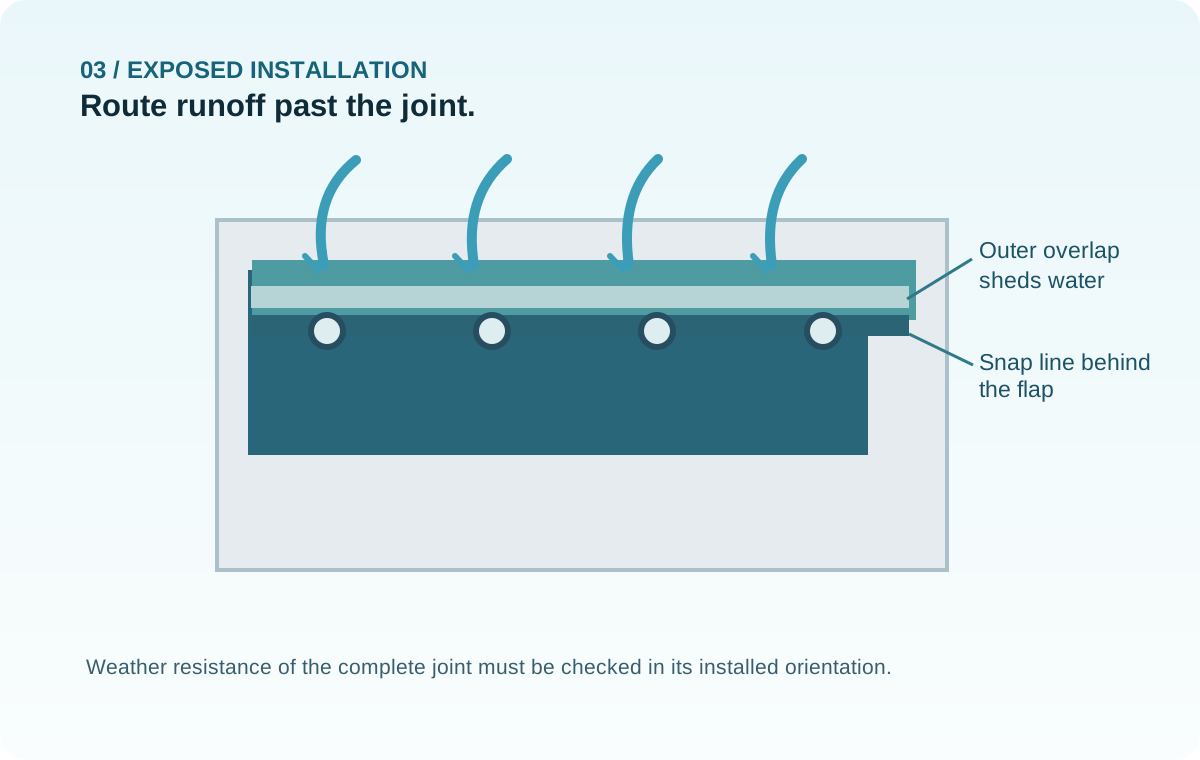
Expose the overlap, protect the hardware
Place the outer face so water travels over the detachable joint rather than under its leading edge. Inspect folds where runoff could pool.
Keep holding loads independent
Use reviewed hems, support bars, straps, grommets or frame fixings where the cover is tensioned. See the tarp hardware selection guide for restraint choices.
Plan removal and maintenance
Release near the fastener rather than pulling from a distant panel corner. Inspect bent studs, damaged backing fabric and corrosion before reinstallation.
Snap fasteners vs other tarp closures.
Choose by how often a panel opens, whether a fixed mating pattern exists, and whether the attachment must carry tension.
| Closure type | Most useful for | Critical trade-off |
|---|---|---|
| Snap fasteners | Small-to-medium access flaps, registered detachable panels, fixed stud patterns. | Point loads, alignment tolerance and incomplete weather seal. |
| Hook-and-loop | Quick adjustable flaps with more tolerance for edge mismatch. | Dust pickup, peeling direction, wear of textile surface. |
| Zippers | Long defined doorway or frequent line-shaped opening. | Exact track alignment, slider wear and weather flap need. |
| Grommets + tie-downs | Perimeter restraint when the load path is designed around the tie. | Slower removal, fixed ties and separate sealing detail. |
Closures can be combined: for example, a detachable service flap with an independent lower restraint. The entire assembly—not one fastener—must be evaluated.
Control the first sample and the next replacement order.
For repeat-order programs, the approved reference should record how the snap mates with the chosen fabric and frame—not merely the overall cover dimensions. DERFLEX can review finished-cover requirements within its custom tarp manufacturing program.
Lock the input drawing
Specify the frame, stud part reference, positions, access hand, overlap, panel function and separate restraints.
Review the real assembly
Check cap setting, backing patch, engagement force, pull-off direction, clearance and repeated opening.
Freeze critical references
Record material grade, component IDs, tolerances, panel labels, packaging and agreed inspection criteria.
Tests are project-specific: where purchase acceptance requires corrosion, cyclic operation or snap pull-off evidence, agree the method, number of specimens and conditions before testing. A supplier hardware catalogue is not a finished-panel test report.
Send enough detail to quote the opening—not just the tarp.
A dimensioned drawing or a marked-up photo is a good starting point. Buyers do not need to know every hardware part number if a representative sample and installation photos are available.
Snap Fastener Tarp FAQ
Direct answers to removable-panel design, alignment and procurement questions.
What is a tarp with snap fasteners?
It is a tarpaulin or enclosure panel fitted with mating push-on, pull-off snap hardware at specified locations. The snaps allow an access flap or removable cover section to detach while the surrounding tarp or frame remains in place.
Are snap fasteners waterproof?
No. A metal or plastic snap is an attachment, not a continuous water seal. For rain-exposed panels, orient a protective overlap to shed runoff away from the snap line and validate the installed joint against the required water exposure.
Can snap fasteners replace grommets for wind loads?
Not automatically. Snap fasteners are useful for detachable access, but concentrated wind, lifting and panel-tension loads generally need independent anchors and a reviewed reinforcement design. Verify the finished assembly for its actual loading direction.
Can I replace a panel without changing the existing studs?
Possibly, if the replacement sockets fit the existing stud system and the new panel matches its exact center-to-center coordinates, orientation and supported stack thickness. Send a hardware sample or exact part reference plus a measured stud-location drawing.
How do I choose brass or stainless steel snaps?
Compare the exposure to humidity, cleaning agents, salt spray and dissimilar metals, together with the manufacturer’s actual alloy or plating specification. Corrosion-resistant hardware may be appropriate outdoors; do not assume every brass-plated or stainless-labeled part performs alike.
What details are needed for a custom snap-on tarp quotation?
Provide panel dimensions, photos or drawings, the fixed mounting surface, existing stud details if any, snap coordinates, installation side, use frequency, weather exposure, tarp material preference, reinforcement, quantity, packaging and destination.
Technical illustrations are conceptual, not test evidence, installed-project photography or a fixed production drawing. Fastener family and panel approval remain application-specific.