News
Industry News

Underground Mine Ventilation Duct | Mine Ducting | DERFLEX

Update:2026/8/14 16:23:23 Views:
Auxiliary Airflow for Advancing Underground Work

Underground Mine Ventilation Duct

Flexible mine ducting configured around the airflow route—not selected as a generic tube.

DERFLEX supplies underground mine ventilation duct for forced fresh-air delivery, localized exhaust and changing mine headings. Duct form, diameter, section length, reinforcement, couplings, suspension and safety-related material options can be organized around your fan, route geometry and project specification.

Positive Pressure Layflat forcing duct for fresh-air delivery toward headings
Negative Pressure Shape-supported duct for suction and localized extraction
Low Headroom Round or shaped concepts coordinated with equipment clearance
Project Safety Options Flame-retardant / antistatic configurations to named criteria
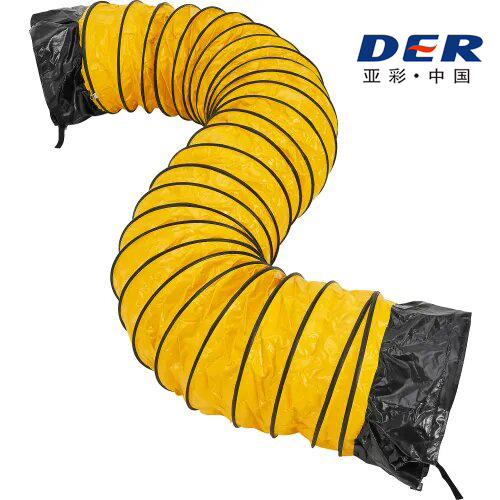
DERFLEX yellow spiral reinforced underground mine ventilation duct product
Product view: flexible wire-supported duct construction for routes that need shape retention.
The Product in the Mine Air Path

A duct section is only useful when the air still reaches the working zone.

Underground auxiliary ventilation often changes as development advances. The fan may remain at a practical location while the duct line grows section by section toward the active face, crosscut, stope, decline or service area. That makes the duct a repeated mechanical and airflow interface rather than a one-time fabric purchase.

On long runs, the purchasing details accumulate: every joint is a possible leakage point, every bend adds resistance, every hanging point affects bore shape, and every added section must connect quickly without creating an avoidable restriction. A practical underground ventilation duct specification therefore considers the complete route from fan outlet to final discharge or pickup point.

DERFLEX can organize both finished flexible duct sections and PVC-coated ducting material. This supports mine operators buying ready-to-install sections, ventilation contractors assembling project packages, fan companies matching accessories, and local converters that fabricate from roll material.

Engineering note: the responsible mine ventilation engineer should determine required airflow, pressure, duct diameter, fan duty and legal acceptance for the site. DERFLEX uses that project information to configure the product construction and manufacturing specification.

Three Underground Duct Architectures

Match the construction to pressure direction and available clearance.

The same mine can use more than one duct type. Separating the airflow duty first helps avoid specifying a convenient fabric tube that is structurally wrong for the fan mode.

01

Layflat forcing duct

A collapsible flexible tube that inflates under positive pressure. It is suited to fresh-air supply where compact transport and repeated route extension are important.

  • Positive-pressure auxiliary ventilation
  • Compact folded transport underground
  • Long headings with repeated extensions
  • Zipper, ring, cuff or project-defined coupling
02

Spiral wire-reinforced duct

A helix-supported bore that resists collapse when air is being drawn through the line and can also be considered where tighter bends or equipment connections demand shape retention.

  • Negative-pressure extraction
  • Localized dust, heat or fume pickup routes
  • Fan and equipment connection sections
  • Optional external wear protection
03

Low-clearance / shaped duct

Where loaders, drill rigs, cable trays, pipes or conveyors compete for roof space, the useful question is not only “what diameter?” but “what occupied envelope can the route accept?”

  • Headings with restricted roof clearance
  • Round or shaped project geometry
  • Custom suspension spacing
  • Interfaces coordinated with site constraints
Airflow, Pressure Loss & Leakage

Do not size an underground mine air duct from diameter alone.

An initial duct diameter can be related to required airflow and selected air velocity, but a real mine route also requires fan-curve review, pressure-loss calculation, leakage allowance, bends, couplings, elevation, installation condition and future extension.

Useful first-pass relationship

For a round airway, cross-sectional area and nominal diameter are related to airflow and average velocity:

A = Q / v    and    D = √(4Q / πv)

This is only a starting geometry check. A smaller bore may be easier to suspend but generally raises air velocity and friction effects. A larger bore can reduce resistance but needs more clearance and may change suspension loads, handling and connection design.

Long flexible duct runs deserve particular attention to joint leakage, damaged sections, kinks, partially collapsed areas and bends. These factors can reduce the airflow available at the working face even when the fan itself has adequate capacity.

What to verify before issuing a PO

  • Fan duty: outlet geometry, operating pressure and intended airflow point.
  • Run development: current length plus likely extension as mining advances.
  • Route losses: bends, tees, reducers, transitions and localized restrictions.
  • Leak control: connection overlap, zipper / ring / cuff sealing and repair practice.
  • Bore stability: suspension spacing, sag, helix support and negative-pressure collapse resistance.
  • Maintenance plan: replacement sections, repair kits, identification and compatible spare interfaces.
Real Product & Underground Views

Choose the duct around handling, installation and actual route conditions.

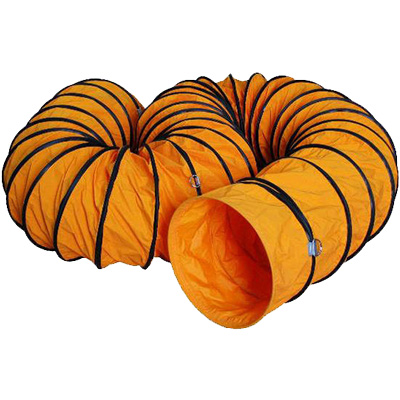
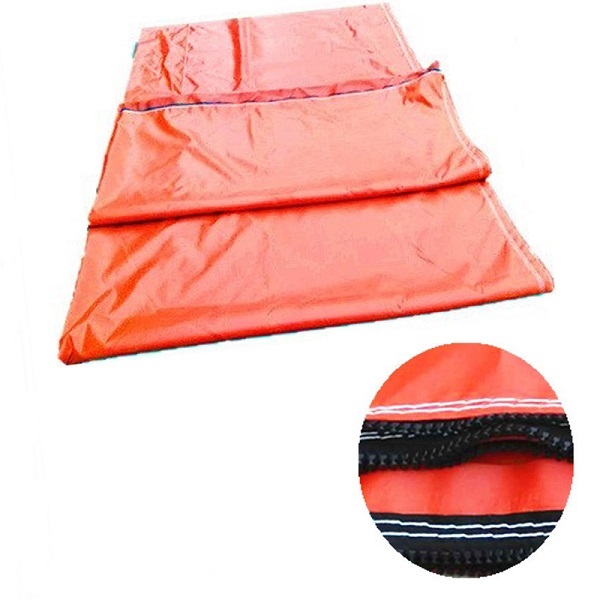
Product construction has to work before installation, during installation and after the heading moves. These DERFLEX product and application views illustrate the difference between compact sections, installed mine ducting and connection details.

Quotation Specification

Turn the mine route into a repeatable manufacturing specification.

The table below is intentionally written as a procurement framework rather than a fixed catalog size. It lets operators, contractors and distributors compare quotations on the same technical basis.

Product form Finished flexible duct sections, accessories, PVC-coated duct fabric, or a combined supply package.
Airflow duty Positive-pressure forcing, negative-pressure extraction, or separately specified sections for mixed systems.
Duct architecture Layflat round, spiral wire-reinforced, low-clearance / shaped construction, or project-specific transition pieces.
Body material PVC-coated high-tenacity polyester textile; formulation and reinforcement selected around mechanical and specified safety requirements.
Diameter / profile Project-defined from fan outlet, airflow design, allowable pressure loss, route clearance and installation geometry.
Section length Project-defined for underground handling, extension frequency, storage and coupling count.
Connections Zipper, ring, cuff, clamp, hook-and-loop or custom interface. Replacement orders should include mating-end photos and dimensions.
Suspension Single or double hanging line, reinforced eyelets, webbing loops, welded suspension fin or custom arrangement.
Performance options Flame-retardant, antistatic / static-control, visibility, wear strip, identification and other project-defined treatments.
Fittings Reducers, bends, tees, wyes, transitions, fan adapters, repair sections and end closures can be coordinated with the duct package.
Documentation Agree test method, acceptance criteria, sample approval, inspection scope, marking and traceability before production.
Where the Product Is Used

Underground ventilation ducting for different mine development conditions.

The duct body may look similar from project to project, but the buying priorities change with mine layout, mobile equipment, contaminants, route length and how frequently the airflow line moves.

Hard-rock development headings

Forced-air layflat ducting can be extended as drilling and blasting advance, with suspension and section length selected around access, loaders and service lines.

Coal mine auxiliary ventilation

Where the project requires documented flame and static-control performance, the exact acceptance method should be specified before the coated textile and finished duct construction are confirmed.

Metal and non-metal underground mines

Round forcing duct, extraction duct and localized equipment connections can be combined where different areas of the mine have different airflow tasks.

Declines, shafts and underground chambers

Long or changing routes may require careful handling of diameter, bends, suspension loads, wear points, transition fittings and spare-section compatibility.

From Drawing to Repeat Order

How DERFLEX can organize a custom mine duct supply program.

The objective is not merely to manufacture one acceptable section. It is to create an approved construction record that purchasing, maintenance and project teams can reuse when the mine needs compatible replacements or additional route length.

Collect route data

Review fan interface, pressure direction, airflow duty, route length, clearance, bends and underground handling constraints.

Define construction

Select layflat, wire-supported or shaped geometry together with fabric body, suspension and connection concept.

Lock interfaces

Confirm coupling dimensions, overlap, zipper / ring / cuff format, fan adapters, hanging points and fitting compatibility.

Agree QC evidence

List required test method, sample approval, inspection items, labeling, batch identification and requested documents.

Build repeat-order record

Keep the approved dimensions and construction details consistent so additional sections can integrate with the existing route.

Why Source This Product from DERFLEX

Coated textile knowledge and finished duct fabrication in the same product family.

Underground duct performance starts in the reinforced coated textile but finishes at seams, reinforcement, suspension and connections. DERFLEX can discuss both levels instead of treating the body material and the fabricated air route as unrelated purchases.

Material-to-product coordination

PVC-coated textile selection can be reviewed together with welding, reinforcement, cuffs, helix and suspension details.

Custom interfaces

Diameter, section length, connection geometry, hanging arrangement, fittings, color and identification can be project-defined.

OEM / contractor supply

Finished sections, converter roll material and project accessories can support different procurement and fabrication models.

Specification-first approach

Safety-related claims are tied to the agreed material construction, named test method and requested documentation rather than generic labels.

Important: terms such as “FRAS,” “flame-retardant,” “antistatic,” “heavy duty” or “high pressure” should not replace the project’s actual test method, acceptance value and operating condition. Ask suppliers to quote against the same written specification.
Buyer FAQ

Underground Mine Ventilation Duct Questions

Practical answers for mine operators, ventilation engineers, EPC contractors, fan suppliers, distributors and procurement teams.

What is an underground mine ventilation duct used for?

It forms an auxiliary air path between a fan and an underground work area. Depending on the system, the duct can force fresh air toward an advancing heading or extract contaminated air from a localized zone. The mine ventilation engineer determines the required airflow and system arrangement; the duct is then selected to suit that pressure direction and route.

What is the , difference between positive-pressure and negative-pressure mine ducting?

Positive-pressure layflat duct inflates when the fan pushes air through it, so it can be compact when not pressurized. Negative-pressure extraction tends to collapse an unsupported flexible tube, so suction duty normally requires rings, a continuous helix or another shape-supporting construction.

How should I choose the diameter of mine ventilation duct?

Start from the airflow required at the work area and an appropriate design velocity, then review fan pressure, friction, leakage, route length, fittings, bends, clearance and future extensions. The final diameter should be checked as part of the complete ventilation design rather than selected only from the fan outlet size.

Can DERFLEX supply flame-retardant and antistatic underground mine duct?

Project-configurable flame-retardant and static-control options are available. The inquiry should name the required test method, acceptance criteria, market or mine requirement, document format and any marking or traceability needs. Final compliance depends on the confirmed construction and verification requested for the project.

Can existing mine duct sections be copied for replacement?

Replacement sections can be reviewed from measurements, photos and interface details. Send the mating-end diameter or profile, coupling style, overlap, suspension spacing, section length, fan / fitting interfaces and any existing labels or drawings. An approved sample is useful where compatibility is critical.

What should a contractor include when requesting a quotation?

Include mine type and location, airflow direction, fan data, total duct run, diameter or clearance envelope, bends and branches, section length, coupling, suspension, safety/test requirements, fittings, quantity, spares, packing and identification. This gives the manufacturer enough information to quote a comparable project specification instead of a generic PVC duct.

Prepare the Air Route Before Asking for a Price

Send your fan data, mine layout and interface requirements to DERFLEX.

We can review the duct body, pressure-specific construction, diameter, section length, connections, suspension, fittings and requested safety documentation as one quotation package.

Technical notice: mine ventilation performance, product suitability and legal acceptance depend on the complete ventilation design, fan selection, operating environment, installation, maintenance, named test methods and local requirements. Reference configurations on this page are for quotation and product-selection discussion; final values should be confirmed in the approved project specification.

Consulting Services
+86-021-54361792 / 54361798
Email
sales@derflex.com