



Bulk procurement · Material comparison
Virgin vs Recycled PVC Tarps: What Bulk Buyers Should Compare
A resin label is only one part of a tarp specification. Compare the coating formulation, polyester reinforcement, seam performance and batch evidence before committing to a bulk order.
This guide helps importers, distributors and fabricators evaluate PVC tarpaulin for truck covers, industrial protection and reusable outdoor covers. DERFLEX supports custom roll goods and tarp programs; recycled-content options require confirmation for the selected construction and application.
Which material should a bulk buyer choose?
Choose the finished PVC tarp that meets your documented performance and sourcing requirements. Virgin PVC offers a new-resin starting point. Recycled PVC can be suitable when its feedstock, formulation and finished-fabric performance are controlled. Neither label proves waterproofing, UV durability, cold flexibility or service life. Approve comparable samples and repeat-order controls before choosing by price.
Understand the construction
Three different claims that buyers often confuse
A PVC tarp is a composite of textile reinforcement and a plasticized coating or laminated layer. Identify which component a supplier is describing. Vinyl tarps and PVC tarps commonly refer to the same PVC-coated material family; “vinyl” does not identify whether the resin is virgin or recycled.
Virgin or recycled coating
Virgin PVC resin is newly manufactured polymer. Recycled PVC has been recovered and reprocessed; a coating may blend both. The compound also contains plasticizers, stabilizers, pigments and other ingredients. “100% virgin resin” does not mean the complete fabric is 100% PVC.
Virgin or recycled polyester
The base fabric may use virgin polyester or recycled PET yarn. A tarp with recycled polyester and virgin PVC is not automatically a recycled-PVC tarp. Yarn properties, weave and fabric construction need their own specification.
Reused or repurposed tarp
A used advertising banner or recovered truck cover is an existing sheet used again. It is not the same purchasing category as a newly manufactured tarp containing recycled material. Prior exposure, holes, coatings and repairs require separate assessment.
Ask for a component-level declaration. Resin origin, recycled polyester content and qualifying recycled mass should be stated separately. DERFLEX discusses selected material options on its sustainable tarpaulin page; confirm the actual grade, evidence and availability for your order.
Side-by-side evaluation
Virgin vs recycled PVC tarps: compare what changes the order
The meaningful comparison is between two finished-fabric specifications with the same intended use. Do not compare one premium construction with a different low-cost construction and attribute every difference to resin origin.
| Buying factor | Virgin PVC option | Recycled PVC option | What to verify |
|---|---|---|---|
| Material origin | New PVC resin; specify any permitted rework or blended inputs. | Recovered PVC feedstock, potentially blended with new resin and additives. | Source category, coating layer, percentage basis, batch records and treatment of internal rework. |
| Strength & tear | Still depends on yarn, weave, coating adhesion and finished construction. | Needs the same fabric and mechanical evaluation; the label alone does not predict strength. | Warp and weft values using the same method, specimen geometry, units and conditioning. |
| Outdoor durability | Needs a suitable stabilizer system and performance evidence. | Needs controlled inputs plus weathering evidence for the offered formulation. | Exposure protocol, retained strength, cracking, discoloration and application-specific field evidence. |
| Cold flexibility | Determined by the compound and the specified test conditions. | Confirm plasticizer system, processing history and low-temperature results. | Cold bend or crack testing at the agreed temperature, including representative seams where relevant. |
| Welding & adhesion | Qualify the coating, finish and welding process together. | Qualify the actual blend on the intended fabrication equipment. | Coating adhesion, seam strength, seam leakage and production welding window. |
| Color & surface | Agree shade, gloss, finish and defect limits; virgin resin alone guarantees none of these. | Feedstock may constrain shades or variation; agree the acceptable range. | Approved physical standard, surface inspection and repeat-lot color tolerance. |
| Chemical requirements | Check additives and the finished grade against the destination specification. | Include source history and relevant chemical screening of recovered inputs. | Current, applicable reports tied to the actual product, not a generic supplier statement. |
| Price & value | Evaluate landed cost, fabrication yield and replacement frequency. | Savings are not automatic; sorting, reformulation and verification can affect cost. | Like-for-like quote, usable area, manufacturing losses and cost per service cycle. |
GSM is not a resin-origin test. Two 650 g/m² tarps can use different textile weights, coating masses and formulations. Extra filler or coating mass is not equivalent to stronger reinforcement. Start with the actual construction and performance requirements for heavy-duty PVC tarpaulin.
Percentage, source & scope
What does “30% recycled PVC” actually mean?
A recycled-content percentage is useful only when the numerator, denominator and qualifying source are defined. A percentage of PVC resin, coating compound and complete coated fabric describes three different quantities.
- Pre-consumer / post-industrial material
- Material diverted from a manufacturing waste stream. Ask whether it is segregated scrap, recovered compound or another input, and how the selected claim scheme treats it.
- Post-consumer material
- Recovered material from products after their intended use. Request source segregation, identification and input-control evidence relevant to the proposed coating.
- Internal rework or regrind
- Material fed back into the process that generated it may be excluded from qualifying recycled-content claims. Confirm the applicable definition instead of counting all reused factory scrap as certified recycled input.
- Resin-only vs compound-level content
- A claim about recovered PVC polymer cannot be converted into a coating-mass percentage without knowing the resin share and how additives are accounted for.
A recycled-content or chain-of-custody document does not establish tarp strength or outdoor service life. Check certificate scope and batch evidence separately from performance reports.
Check a coating-to-fabric claim
Illustrative calculation: a 650 g/m² fabric contains 400 g/m² of coating compound. If 30% of that coating mass is verified qualifying recycled input, the recycled contribution is 120 g/m², or 18.5% of the coated fabric.
This calculator assumes only the coating contributes recycled mass. It excludes hardware and added reinforcement. The input percentage must apply to coating mass, not just PVC resin. Illustrative values are not a DERFLEX product declaration.
Approve the material, then the process
The sample tests that make two quotes comparable
Use the same conditioning, method and acceptance limits for both candidates. Test the coated fabric and a representative finished seam; a resin declaration does not replace either evaluation.
| Check | Specify before testing | Look for in the result |
|---|---|---|
| Weight & dimensions | GSM, thickness, usable width, roll length and agreed tolerances. | Actual results and distribution across the material; a small swatch may miss wider variation. |
| Tensile & tear | Method, specimen dimensions, test direction and minimum values. | Warp/weft results and failure mode. Do not mix grab, strip and different tear methods. |
| Coating adhesion | Relevant procedure, specimen face and conditioning; ISO 2411 is one reference. | Bond performance and whether failure is in the coating, textile or interface. |
| Water resistance | Fabric and finished-seam test conditions, pressure or head, duration and acceptance limit. | Leaks, pinholes, capillary paths at seams and any relevant exposed textile edges. |
| Cold & repeated handling | Temperature, conditioning time, bend/flex protocol and intended folding conditions. | Cracking, delamination and loss of flexibility under the selected conditions. |
| Weathering & heat | Exposure equipment, cycle, duration and properties measured before and after exposure. | Retained mechanical properties, coating damage, blocking and appearance change. Test hours are not automatically outdoor years. |
| Seam & attachment | Weld overlap, equipment settings, reinforcement and hardware construction. | Seam strength, leakage and attachment failure under the application-specific loading arrangement. |
| Chemical & claim evidence | Destination requirements, relevant substances, claim definition and traceability scope. | Reports and declarations identifying the offered grade and applicable production lot. |
Useful references: ASTM D751 provides a range of coated-fabric test methods, and ISO 2411 addresses coating adhesion. Select the applicable procedure with your laboratory and agree acceptance limits. DERFLEX describes incoming, production and final-roll checks in its quality control system; request the test package relevant to your specification.
A practical sample-to-bulk approval sequence
Match the two candidates
Record formulation identity, substrate, GSM, finish and declared recycled input. Explain any construction differences.
Trial the fabrication
Weld on the intended equipment. Check strength and sealing over a usable process range, not a single favorable setting.
Run a pilot order
Check cutting yield, folding, printing where needed, hardware attachment and real handling conditions.
Lock repeat-order controls
Keep an approved sample and specification. Require traceable lots and agreed reapproval when inputs or formulation change.
Application comes first
Where each material option needs closer scrutiny
Either resin route can be evaluated for a suitable application. Increase the depth of qualification when failure would damage cargo, interrupt production or require expensive replacement.
| Your application | Priority evidence | Material decision |
|---|---|---|
| Truck covers & repeated outdoor handling | Tear, abrasion, cold handling, seam performance and reinforced attachment design. | Require proven results for the offered grade and a fabrication trial before substituting either formulation. |
| Seasonal agricultural or storage covers | Water resistance, local UV exposure, folding and repair requirements. | A documented recycled-content candidate can be evaluated against the same acceptance limits and service conditions. |
| Industrial curtains & indoor protection | Flexing, weldability, appearance and any specified fire or indoor-environment requirements. | Compare the complete compound and required documents; a resin-origin declaration does not establish fire or emissions performance. |
| Printed or color-matched OEM products | Shade tolerance, surface finish, ink compatibility and repeat-lot consistency. | Approve physical color and print standards. Ask whether recycled inputs constrain the selected shade or finish. |
| Long-exposure shelters or project covers | Weathering, seam durability, relevant fire requirements and project design criteria. | Use a fully qualified construction. Treat formulation changes as an engineering and procurement review. |
For fleet applications, compare the reinforcement and fabrication requirements in DERFLEX truck tarps. For prolonged sunlight exposure, review the material direction for UV-resistant tarpaulin and request evidence for the actual grade.
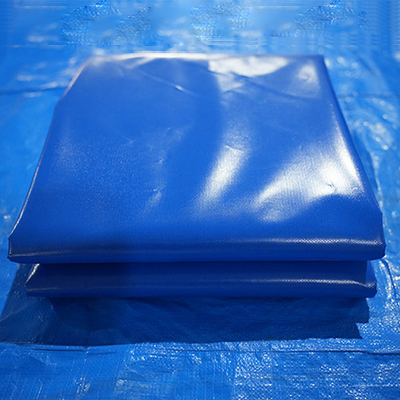
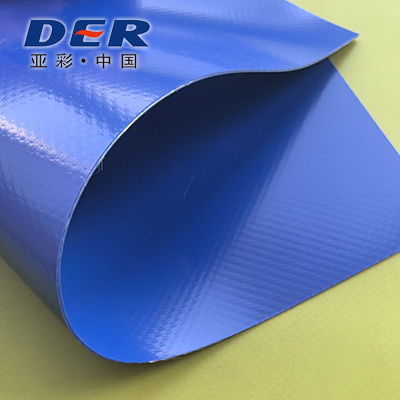
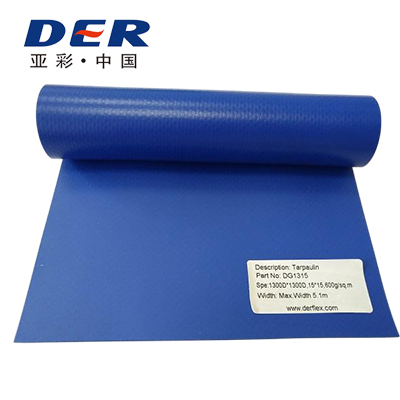
These are DERFLEX product photographs, not verified virgin/recycled sample pairs. Photos cannot establish the recycled content of the pictured materials.
Commercial value
Is recycled PVC tarpaulin cheaper over its working life?
Sometimes, but neither a lower purchase price nor a recycled-content claim establishes lower total cost. Compare usable material, fabrication losses, qualification expense, repairs, replacements and downtime over the same service period.
For wholesale and private-label tarp programs, roll width and usable cutting yield may change the economics as much as the resin price. Request the same supply format, packing and delivery basis in both quotations.
Do not equate recycled with recyclable
A tarp containing recycled material still needs a suitable collection and processing route at end of life. Textile reinforcement, coatings and hardware can complicate recovery. Lower environmental impact requires evidence with comparable boundaries and service assumptions; recycled percentage alone is insufficient.
Compare cost per usable service cycle
Total allocated cost ÷ verified usable cyclesInclude purchase, freight, fabrication, qualification, maintenance and disposal costs relevant to your decision. Add failure-related costs where you can substantiate them.
Illustrative purchase-only comparison
Cover A costs $100 and completes 100 comparable cycles: $1.00 per cycle. Cover B costs $80 and completes 60 cycles: $1.33 per cycle.
If the two have equal other costs, an $80 cover must deliver at least 80% of a $100 cover’s usable cycles to match its purchase cost per cycle.
Hypothetical arithmetic, not DERFLEX pricing or durability data. Use your pilot results; do not assume either resin route has the illustrated lifespan.
From comparison to purchase specification
What to send a PVC tarp manufacturer before a bulk order
Send one common specification for both candidates. Ask the supplier to identify every difference in material origin, construction, performance, documentation and price.
Your bulk-buying checklist
- Use and exposure: application, climate, installation, handling frequency and expected service conditions.
- Supply format: coated fabric rolls, cut panels or finished tarps; dimensions, usable width and tolerances.
- Construction: GSM, thickness, polyester yarn/weave, coating route, color and finish.
- Origin requirement: virgin resin, allowed recycled inputs or qualifying recycled-content target; state the mass basis.
- Performance limits: strength, tear, water resistance, adhesion, cold flexibility, weathering and seam criteria.
- Fabrication details: welding method, hems, webbing, grommets, D-rings or other attachment requirements.
- Evidence: grade-specific reports, material declaration, lot identification and any required chain-of-custody documents.
- Commercial terms: quantity, repeat demand, destination, delivery requirement, packing and private-label needs.
Copy a concise quotation request
Please compare virgin-PVC and recycled-content PVC tarpaulin options for:
Application / exposure: [ ]
Roll goods or finished tarp: [ ]
Dimensions / width / GSM / color: [ ]
Base fabric and coating requirements: [ ]
Recycled source / target / percentage basis: [ ]
Required performance tests and limits: [ ]
Seams / reinforcement / hardware: [ ]
Quantity / repeat demand / destination: [ ]
Required documentation / delivery date: [ ]

Please state construction differences, material availability, sample process, MOQ, lead time, packaging and quotation basis. Identify any specification that needs further confirmation.
DERFLEX supply scope: custom GSM, width, color, finish, roll goods and finished-tarp support can be discussed for OEM and bulk programs. Recycled input type and percentage, test results, MOQ, sample terms and lead time must be confirmed for the selected specification. Ask for written change control if a new source, blend or finish is proposed after approval.
Three purchasing shortcuts that create avoidable uncertainty
Buying by resin label alone
Add substrate, formulation identity and finished-fabric acceptance limits. Neither “virgin” nor “recycled” replaces a specification.
Accepting a generic test report
Match the report to the offered grade, construction and relevant production lot. Recheck when a material change affects the approved product.
Approving a swatch, skipping fabrication
Trial seams, cutting and reinforcement before volume production. A good-looking swatch cannot establish manufacturing yield or attachment performance.
Buyer questions
Virgin and recycled PVC tarp FAQ
Is virgin PVC always better than recycled PVC for tarps?
No. Virgin resin provides a new-polymer starting point, but the finished tarp also depends on additives, polyester reinforcement, coating adhesion and fabrication. A controlled recycled-content formulation may meet the same application requirements. Compare test results for the actual grades instead of assuming quality from the label.
Can recycled PVC tarps be waterproof and suitable for outdoor use?
Yes, a suitably formulated and manufactured recycled-content PVC tarp can provide a water-resistant coating system and qualify for outdoor use. Confirm fabric water resistance, finished-seam sealing and weathering performance for the selected grade. Recycled content alone establishes none of these properties.
What recycled PVC percentage is acceptable in a heavy-duty tarp?
There is no universal acceptable percentage for every heavy-duty application. Define the percentage basis, input source, construction and performance limits. Then qualify the proposed material and seams under the intended conditions. A resin-only percentage and a whole-fabric percentage are not directly comparable.
Can buyers identify recycled PVC by color, smell or touch?
No. Color, odor and hand feel may help flag differences for investigation, but they do not prove resin origin or recycled content. Request source and batch records, a clearly defined material declaration and independent verification where your procurement requirement calls for it.
Can virgin and recycled PVC tarpaulins use the same welding settings?
Do not assume so. Coating formulation, thickness, surface finish and equipment affect the usable welding window. Qualify the offered material on the intended hot-air or high-frequency process, then check seam strength and leakage. Reassess the process when the approved formulation or finish changes.
Does recycled polyester make a tarp a recycled-PVC tarp?
No. Recycled polyester describes the textile reinforcement; recycled PVC describes the coating input. A tarp may contain one, both or neither. Specify each component separately and state whether a recycled-content claim refers to resin, coating compound, coated fabric or the complete finished tarp.
Make the next order comparable
Send the application.
Build the material specification.
Ask DERFLEX to review virgin-PVC and selected recycled-content directions against your fabric, fabrication and documentation requirements. Start with your dimensions, quantity, exposure conditions and destination.
For importers, distributors, tarp fabricators and OEM procurement teams.