What is the cover supposed to control?
Odor collection, algae control, rainfall exclusion, debris protection, evaporation reduction and vapor capture lead to different cover details.



 Flexible cover systems for municipal & industrial wastewater projects
Custom flexible covers built around tank geometry, odor-control airflow, maintenance access and outdoor exposure—not just a generic tarp size.
DERFLEX supplies reinforced PVC coated membrane materials and project-oriented cover fabrication options for clarifiers, equalization tanks, sludge tanks, treatment basins and process-water systems. Custom dimensions, reinforced edges, hatches, penetrations, welding direction and OEM supply can be matched to the project drawing.
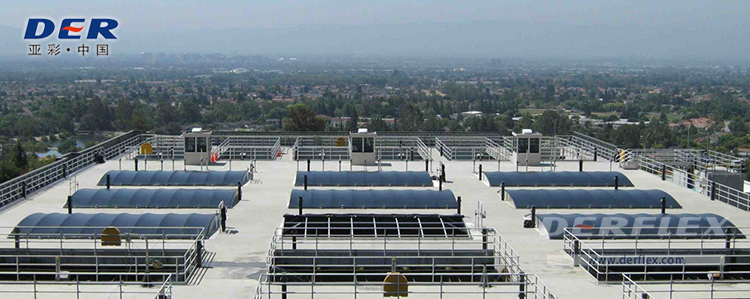
An open wastewater tank exposes the process to sunlight, rainfall, wind-blown debris and uncontrolled air exchange. In odor-sensitive applications, it can also increase the volume of air that must be collected and treated. A well-specified wastewater tank cover creates a controlled boundary while preserving the access operators need for inspection, cleaning and equipment service.
DERFLEX focuses on flexible reinforced cover construction using PVC coated polyester membrane. Compared with rigid roof systems, flexible membrane covers can be attractive when the project values lower shipping volume, adaptable geometry, welded fabrication and customized access details. Final suitability still depends on span, support structure, wind/snow load, chemical exposure and local engineering requirements.
These decisions usually have more impact on cover performance than simply choosing the heaviest fabric available.
Odor collection, algae control, rainfall exclusion, debris protection, evaporation reduction and vapor capture lead to different cover details.
Define hatches, roll-back sections, sampling ports, mixer openings, pipe penetrations and inspection zones before panel fabrication.
A center post, cable system, structural frame, perimeter beam or liquid surface changes the membrane loading and seam layout.
Municipal sewage, food wastewater, textile effluent and chemical-process wastewater can create very different coating exposure conditions.
UV intensity, wind, rainfall, temperature range and snow should be reviewed with the cover-system engineer before final material selection.
Factory welding, site welding, modular sections and perimeter clamping require different seam, packaging and handling strategies.
DERFLEX membrane materials can be adapted to several common flexible-cover concepts. Structural calculations, anchoring and installation details should be confirmed by the project designer.
Membrane tensioned across a frame, cables or perimeter structure for odor control and weather protection.
Multiple fabricated panels allow selected areas to be opened without removing the entire cover.
Useful where frequent inspection, cleaning or process-equipment access is part of normal operation.
Flexible membrane supported by the liquid surface, commonly considered for basins, lagoons and storage ponds.
Where wastewater treatment also involves anaerobic digestion, membrane requirements may extend to gas-tight or double-membrane systems.
DERFLEX’s common wastewater-cover direction uses high-tenacity polyester reinforcement with PVC coating. Surface treatment and total weight can be adjusted to the project environment.
A heavy duty wastewater tank cover should not be defined by GSM alone. Reinforcement strength, tear behavior, coating adhesion, welding compatibility, UV formulation and the actual support spacing all influence the final cover design. For chemical-vapor or long-term outdoor projects, surface options such as PVDF-oriented finishes may also be discussed after the exposure conditions are known.
Discuss Material DirectionSelected to match outdoor exposure, cleanability and appearance expectations.
Provides the waterproof barrier, weldable surface and a configurable chemical-resistance direction.
Reinforcement contributes tensile, tear and dimensional stability to fabricated panels.
Supports large panel construction, reinforced zones and custom penetrations after process confirmation.
| Specification item | DERFLEX project direction | What the buyer should confirm |
|---|---|---|
| Product type | Wastewater tank cover / flexible odor-control cover / membrane cover panel | Tank drawing, cover concept and operating purpose |
| Base reinforcement | High-tenacity polyester fabric | Required tensile/tear level and support spacing |
| Coating | PVC coated membrane; surface treatment can be customized | Chemical vapor, UV, cleaning method and expected exposure |
| Typical weight direction | Approx. 650–1500 g/m2, project dependent | Cover span, load, handling method and fabrication design |
| Waterproof construction | Weldable coated membrane panel | Seam process, field joints, drainage and penetrations |
| Color | Common industrial colors or customized | Heat reflection, appearance and project marking needs |
| Optional treatments | UV, anti-aging, anti-mildew and FR directions available by specification | Required test method and acceptance criteria before production |
| Supply format | Roll material, cut sheets, fabricated panels or OEM project packaging | Fabricator workflow, container plan and site installation sequence |
Technical ranges above are for project discussion only. Final specification, structural design, chemical compatibility, flame-retardant requirement and service conditions should be confirmed from drawings, samples and agreed test criteria.
Images below use DERFLEX-hosted project/product assets so the page does not depend on unrelated stock photography.
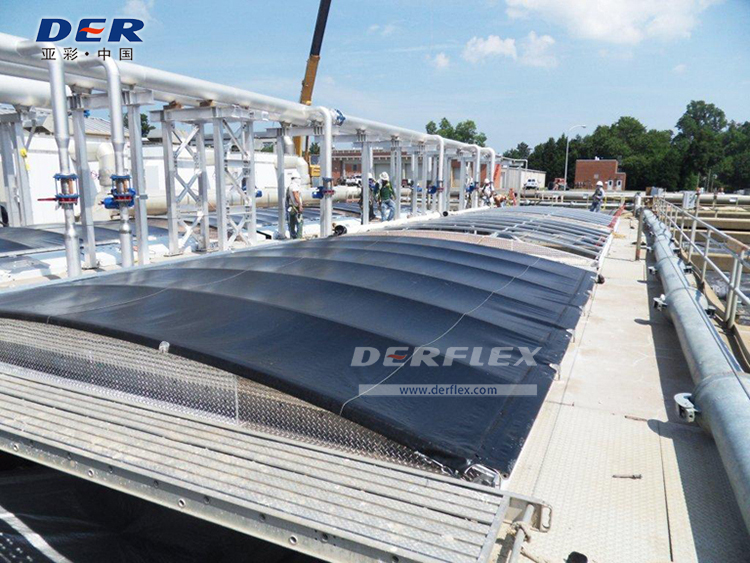
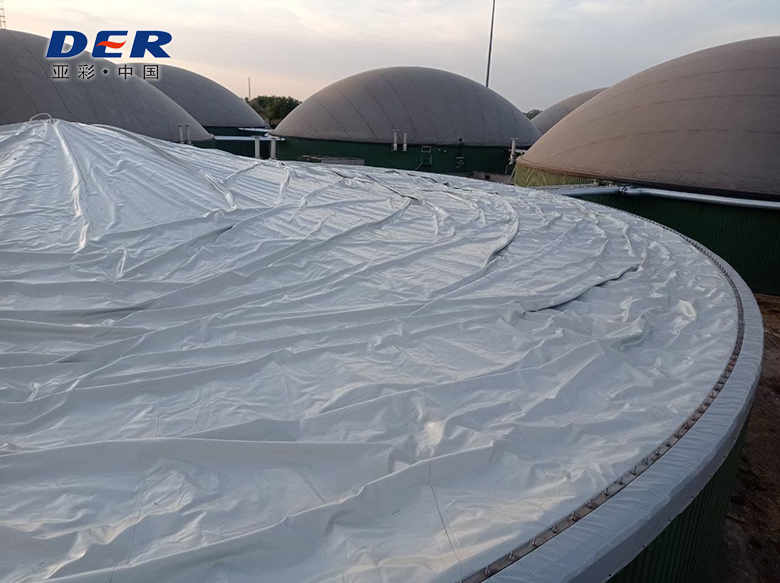
A good RFQ gives the cover manufacturer enough information to match the membrane, fabrication and access details before production.
Provide diameter or L × W, wall/rim details, elevations, supports and photos or drawings of existing equipment.
State whether the priority is odor containment, algae control, rain exclusion, vapor capture, evaporation reduction or a combination.
Show hatches, probes, pipes, valves, mixers, ducts, walkways and maintenance zones on the drawing.
List wastewater type, expected gases, cleaning chemicals, outdoor climate and any test or documentation requirements.
Review membrane weight, surface option, reinforced zones, welding process and the proposed anchoring or support concept.
Where required, evaluate material appearance, welding behavior and relevant performance data before bulk production.
Choose roll supply, prefabricated sections or custom panels based on field access, transport and installation sequence.
For OEM and wholesale programs, lock the agreed material code, color, panel detail and packaging format for easier reordering.
The right choice depends on the cover function, span, access, site logistics and lifecycle plan. A flexible cover is not automatically the answer for every tank.
| Decision factor | Flexible membrane cover | Rigid FRP / aluminum cover |
|---|---|---|
| Shipping & handling | Compact roll/panel logistics can simplify international transport | Rigid components may require more freight volume and lifting coordination |
| Irregular geometry | Often adaptable through custom patterning and welded panels | Possible, but component fabrication may be more structural and project-specific |
| Walkable deck | Normally requires a separate engineered walkway/support system | Some rigid systems are designed as walkable covers |
| Maintenance access | Can use removable, roll-back or custom hatch details | Can use hinged/removable panels and structural access systems |
| Corrosive atmosphere | Coating chemistry must be matched to exposure | FRP is often selected for corrosion resistance; metals need suitable material/coating selection |
| Retrofit flexibility | Can be practical where lightweight fabricated sections are preferred | May be preferred when a rigid structural roof is required |
The same membrane platform can be adapted to different tank functions, but each application should be specified from its actual process and exposure data.
Flexible cover direction for odor-sensitive tanks, process basins and plant retrofit programs.
Light-blocking cover systems can help limit sunlight exposure while preserving maintenance access.
Covering can reduce direct air exchange, rainfall entry and wind-blown debris around balancing tanks.
Custom openings can be planned around pipework, mixers, vents and inspection points.
Material selection can be discussed for food, textile, paper, manufacturing and other process-water systems.
Floating or supported membrane directions may be evaluated for evaporation, odor, debris and surface-exposure control.
DERFLEX supports buyers who need a material supply relationship rather than a one-off retail cover.
Common buyer profiles include wastewater equipment suppliers, cover fabricators, EPC contractors, tank manufacturers, distributors and industrial-treatment integrators.
Once the project has an approved material and fabrication direction, repeat orders can be organized around a consistent specification.
These six internal resources support engineers and procurement teams who need to compare adjacent membrane systems.
A wastewater tank cover creates a controlled boundary over a treatment tank or basin. Depending on the design, it can help contain odors, limit sunlight and algae growth, reduce rainfall and debris entry, support vapor collection and protect the process surface.
DERFLEX can support project-based membrane selection and custom fabrication directions using tank dimensions, cover type, access points, welding requirements, color, operating environment and quantity. Final structural and installation details should be confirmed with the project designer or cover-system contractor.
A common DERFLEX direction is reinforced PVC coated polyester membrane. Typical project weights can fall around 650–1500 g/m2, but the final choice should be based on span, support arrangement, mechanical load, chemical exposure, climate and fabrication method.
PVC coated fabric is inherently suited to waterproof membrane construction. Actual cover waterproofing also depends on welded seams, penetrations, edge details, drainage, anchoring and installation quality, so the complete system should be reviewed rather than the fabric alone.
DERFLEX supports bulk and repeat procurement for fabricators, OEM brands, distributors, EPC contractors and wastewater-system integrators. Supply can be discussed as rolls, cut material, prefabricated sections or project-specific packaging.
Send the tank shape and size, cover purpose, support concept, access openings, wastewater/process environment, climate, preferred material or weight direction, color, welding or fabrication method, quantity and destination. Drawings and photos are especially useful for retrofit projects.
DERFLEX can review the tank geometry, intended cover function, access points, exposure conditions and procurement format, then discuss a practical membrane and fabrication direction for quotation.
Product descriptions are for general selection guidance and commercial discussion. Project engineering, structural loads, chemical compatibility, local regulations and required test standards should be confirmed for the actual installation.