Warp and weft relief
A repeating grid or rib pattern can appear through the PVC. It shows how the textile skeleton is arranged beneath the surface and whether the sample looks visually uniform.



Under magnification, a 1000D PVC tarpaulin does not look like one solid sheet of plastic. You begin to see the textile geometry underneath the surface: repeating warp and weft ridges, PVC-filled valleys, the coated surface skin, and—at a cut edge—the polyester reinforcement embedded between PVC layers.
The key sourcing point is equally important: 1000D describes yarn linear mass, not finished GSM, thickness, coating weight or measured strength. The visible structure must be read together with weave density, coating construction and physical test data.
You typically see a regular textile pattern expressed through or beneath the PVC surface, not a featureless plastic film. At the surface, the coating can partially mask the weave. At a cut or frayed edge, the polyester yarn bundles become much clearer. With a cross-section, the most useful mental model is PVC surface layer → woven polyester scrim → PVC layer, with optional lacquer or surface finishing depending on the grade.
Magnification is useful because it separates what the eye normally merges together: surface finish, PVC coating, reinforcement geometry and local coating distribution.
These clues help compare samples and spot inconsistency, but they do not replace tensile, tear, adhesion, weathering or flame-performance tests.
A repeating grid or rib pattern can appear through the PVC. It shows how the textile skeleton is arranged beneath the surface and whether the sample looks visually uniform.
Magnification can show whether the coating looks continuous across yarn high points and low valleys, or whether there are obvious pinholes, exposed yarns, contamination or surface defects.
A clean cut edge can reveal the coating-to-textile relationship: the PVC skins on the outside and the woven polyester reinforcement within the composite.
Comparing several points across a roll can reveal changes in texture, coating uniformity, embossing, gloss or visible textile pattern that may deserve further QC review.
A strong procurement specification keeps these variables separate instead of treating “1000D” as a complete performance grade.
| Specification term | What it tells you | What magnification can show | What it cannot prove |
|---|---|---|---|
| 1000D | Nominal yarn linear mass. One denier is one gram per 9,000 m of textile strand. | Thick yarn bundles may be visually obvious at an exposed or frayed edge. | Actual denier cannot be reliably measured from a picture alone. |
| 1000D × 1000D | Nominal denier used in both principal fabric directions. | Warp/weft intersections can be visually tracked where the coating allows. | It does not specify thread density, GSM, tensile or tear strength. |
| 20 × 20 / 30 × 30 | Supplier-reported weave density or construction count. | Relative spacing and frequency of yarn crossings may be visible. | Counting convention and actual density still need specification control. |
| Finished GSM | Total mass of the finished coated fabric per square meter. | A heavier coating may look fuller or smoother, but appearance is not a scale. | You cannot determine GSM accurately from magnification. |
| PVC coating / surface finish | Barrier surface, color, weldability, abrasion protection and application-specific functions. | Surface texture, continuity, embossing and obvious coating defects. | Chemical formulation, UV package, FR performance or service life. |
| Test values | Tensile, tear, adhesion, hydrostatic pressure, cold flex and other measurable performance. | Magnification may help explain a failure after testing. | Mechanical performance cannot be certified visually. |
Related technical reference: DERFLEX explains the complete construction of PVC tarpaulin composition and manufacturing, including the role of the polyester reinforcement and PVC layers.
Use a loupe or digital microscope as a comparison tool. Use the TDS, approved sample and physical testing for performance decisions.
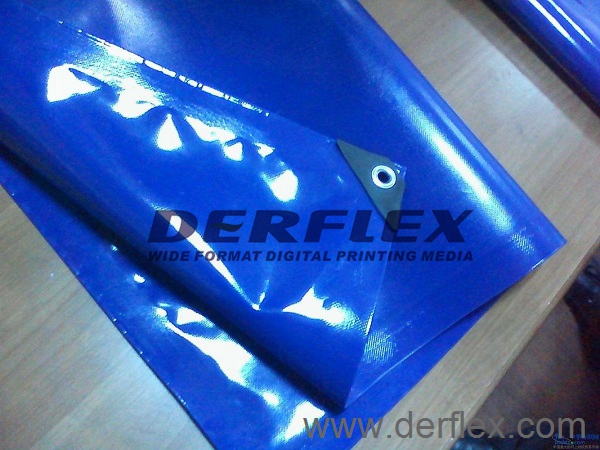
These real product images complement the engineering diagrams above. Magnified textile structure is easier to understand when surface appearance and real roll material are shown together.
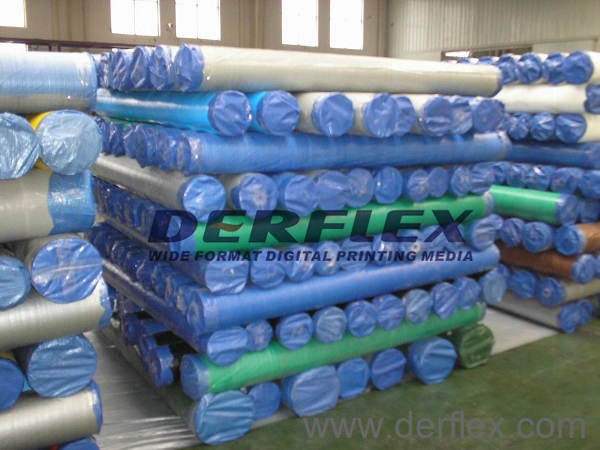
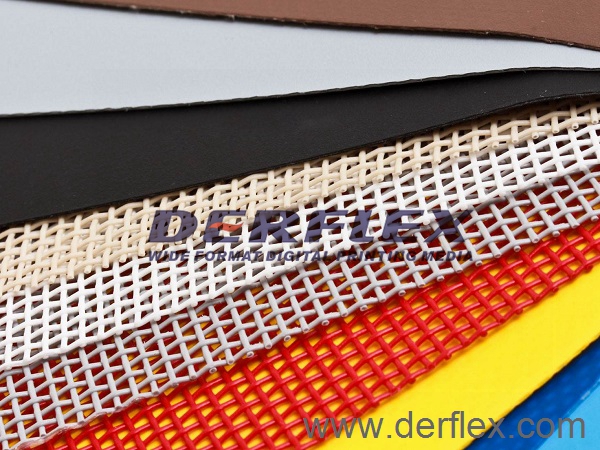
DERFLEX publishes 1000D × 1000D examples with different weave densities and finished weights. That is the practical reason buyers should never use “1000D” as the entire specification.
| Published construction direction | Example finished weight direction | What changes visually | Buyer interpretation |
|---|---|---|---|
| 1000D × 1000D / 18 × 18 | Around 610 gsm in published DERFLEX examples | More open reinforcement spacing than denser 20 × 20 or 30 × 30 constructions. | Useful reminder that yarn size and weave count are separate specification variables. |
| 1000D × 1000D / 20 × 20 | Published examples span roughly 610–680 gsm depending on grade | The weave may read as a regular square structure beneath the coating. | Coating route and total PVC add-on can change GSM without changing the nominal denier. |
| 1000D × 1000D / 30 × 30 | Around 900 gsm in a published dense construction | Denser reinforcement and fuller material body can be expected. | Higher density can support a different strength/stiffness balance, but final performance still comes from test data. |
Published examples are sourcing references, not universal standards. Final yarn, density, coating, GSM, tolerance and test values should be confirmed on the approved technical data sheet and sample. For a broader comparison, see the heavy-duty PVC tarpaulin specification guide.
Surface uniformity is not created at one step. Yarn, weaving, coating, thermal processing and finishing all shape what the buyer eventually sees.
Polyester yarn linear mass, weave density, yarn tension and fabric uniformity establish the geometry of the reinforcement before any PVC is applied.
PVC application and thermal processing determine how the coating fills around the textile, builds the surface and bonds with the reinforcement.
Lacquer, embossing, matte or gloss targets can change what magnification reveals even when two materials share the same nominal base fabric.
For the full production logic, read Tarpaulin Manufacturing Process: From Yarn to Finished Tarp and How PVC Tarpaulin Is Knife Coated.
Magnification is valuable when it triggers better questions—not when it replaces the specification.
Incorrect. Denier measures yarn mass per length; GSM measures finished sheet mass per area.
Surface smoothness may come from finish or coating build. Strength depends on the full textile/coating system and measured test results.
Not necessarily. Some grades intentionally show more textile relief. Judge continuity and performance, not relief alone.
Extra coating can change weight, stiffness, abrasion behavior and cost. The target should match fabrication and service conditions.
It cannot. A finished tarp can leak through poorly welded seams, hardware penetrations, vents or incorrect installation.
Compare multiple roll locations and production lots, especially when repeat-order consistency matters.
A useful quotation request describes the application and measurable performance target, not only the yarn denier.
These verified DERFLEX pages expand the topic from yarn and coating anatomy into sourcing, specification and manufacturing decisions.
At low magnification, you normally see a repeating textile relief under the PVC surface. At a cut edge, the polyester yarn bundles and the surrounding PVC layers become easier to distinguish. The exact appearance changes with weave density, coating build, embossing and surface finish.
Often yes, especially when side lighting or magnification makes the yarn ridges more visible. A heavier or differently finished coating may mask more of the weave. Visible weave relief by itself is not proof of insufficient coating.
No. 1000D refers to yarn linear mass: 1,000 grams per 9,000 meters of yarn. GSM refers to the total mass of the finished coated fabric per square meter. A 1000D base can be used in many different finished GSM constructions.
1000D × 1000D describes the nominal yarn denier in the two main fabric directions. The 20 × 20 part describes the supplier's weave-density convention. Buyers should confirm the exact counting basis and combine it with GSM, tensile, tear and coating data.
It can help identify visible issues such as inconsistent surface texture, contamination, exposed yarns or obvious coating defects. It cannot certify tensile strength, tear strength, coating adhesion, UV resistance, flame performance or long-term weathering. Those require controlled specifications and tests.
Sometimes the interface and layer geometry can look different, but visual inspection alone may not reliably identify the production route. Supplier process records, the technical data sheet and controlled cross-section analysis are more dependable.
Confirm base fabric direction, weave density, finished GSM or thickness, coating route, surface finish, roll width, color, welding behavior, tensile and tear targets, coating adhesion, required functional treatments and any market-specific test requirements. Then keep an approved sample for repeat-order comparison.
Send DERFLEX your current sample, application, target GSM, width, color, welding method, climate, quantity and required test direction. The quotation can then be matched to the complete construction instead of one number on a label.