01
Pressure-Retention Support
A continuous coating layer helps control air leakage through the field membrane. Actual envelope leakage also depends on weld quality, doors, foundations, penetrations and installation workmanship.




A heavy-duty PVC-coated polyester membrane with a PVDF surface direction, developed for fabricators and air-dome integrators building enclosed, column-free agricultural storage spaces.
The 1200gsm construction is intended for projects that require a robust outer envelope, reliable welded seams, outdoor weather resistance and stable pressure retention. DERFLEX supplies the membrane material in rolls and supports project-specific selection, sampling and fabrication trials.
An agricultural air dome warehouse is not supported by internal beams or roof trusses. The building envelope is stabilized by controlled positive air pressure, while the membrane transfers wind, snow and operational loads through its fabric structure, cable system, edge details and anchoring interface.
This makes the membrane more than a weather cover. It functions as the roof, wall, pressure barrier and exterior protective skin at the same time. For a mobile sealed warehouse, material uniformity, low air permeability, tensile behavior, seam compatibility and surface durability must be considered together rather than purchased as separate features.
DERFLEX positions the 1200gsm PVDF-surface membrane for air-dome manufacturers, agricultural engineering contractors and fabricators who need roll material for large panels, reinforced edges, airlocks, equipment penetrations and pressure-retaining seams.
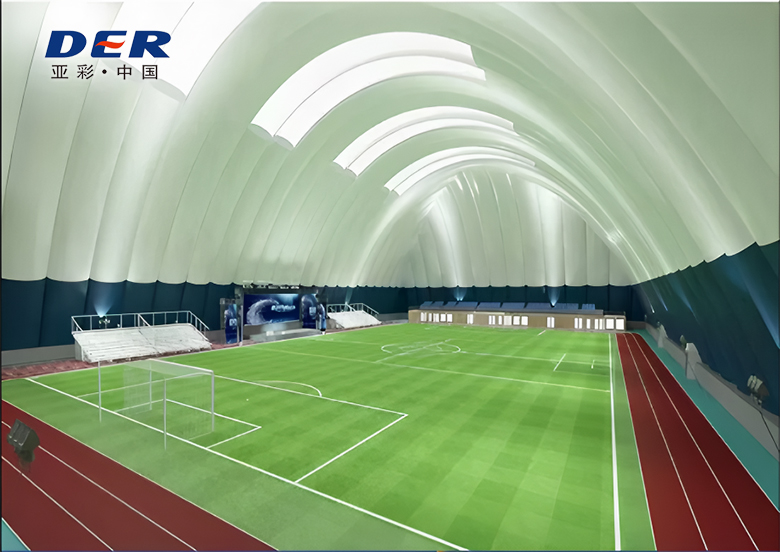
Material weight alone does not determine structural safety, but a well-engineered 1200gsm construction provides more coating volume and reinforcement capacity for projects where durability, seam design and repeated outdoor exposure are important.
A continuous coating layer helps control air leakage through the field membrane. Actual envelope leakage also depends on weld quality, doors, foundations, penetrations and installation workmanship.
High-tenacity yarn and dense reinforcement can be specified for tensile and tear targets established by the structural engineer, cable layout and local load calculation.
Stable coating thickness and roll geometry support repeatable overlap welding, patching and reinforcement work after the fabricator validates machine settings and seam geometry.
A PVDF surface direction can improve resistance to soiling, weather exposure and color change, reducing the frequency of aggressive surface cleaning.
At 1200gsm, designers gain a robust envelope while retaining the foldability and roll-process advantages needed for large factory-fabricated membrane panels.
Flame-retardant, cold-resistant, anti-wicking, blackout or translucent directions can be discussed according to local code and the intended agricultural storage environment.
Exterior finish selected for weatherability, surface cleanliness and visual stability.
Flexible weatherproof layer formulated around UV, temperature and welding requirements.
Woven reinforcement that carries tensile loads and helps control dimensional behavior.
Pressure-facing layer designed for low permeability and compatible seam fabrication.
Anti-wicking, anti-mildew, low-temperature or custom interior finish subject to project review.
A reliable mobile sealed warehouse requires coordinated engineering across the membrane, inflation equipment and site interface. DERFLEX supplies membrane material and supports material selection; the complete building system should be designed and approved by qualified air-dome professionals.
The table below is a procurement framework, not a universal certified data sheet. Final construction and test values are defined in the approved technical specification for each order.
| Item | DERFLEX Project Direction | Buyer Confirmation Point |
|---|---|---|
| Product | PVDF-surface PVC-coated polyester membrane fabric | Confirm whether the material is for the outer envelope, inner liner or double-layer system. |
| Nominal Weight | 1200 g/m² project grade | Weight tolerance is stated on the final TDS and purchase specification. |
| Base Fabric | High-tenacity polyester scrim with project-matched yarn and weave | Structural designer to define tensile, tear and elongation requirements in both directions. |
| Coating Structure | Double-sided PVC coating with exterior PVDF surface direction | Confirm top/bottom identification, surface finish and compatible cleaning method. |
| Airtightness | Low-permeability coating formulation for air-supported envelopes | System leakage criteria must include seams, doors, foundations and penetrations. |
| Color & Light | White or custom colors; translucent, opaque or blackout directions can be discussed | Balance daylight, internal heat gain, nighttime light spill and stored-goods sensitivity. |
| Width | Custom roll-width discussion according to coating line, panel design and shipment plan | Confirm usable width, edge trim, roll length, core and container-loading plan. |
| Fire Performance | Flame-retardant formulation and test direction available for project review | Select the required standard and classification before sampling; compliance is not interchangeable between codes. |
| Weathering | UV, rain, temperature-cycle and outdoor-aging options | Provide location, elevation, exposure, cleaning plan and target service interval. |
| Seam Fabrication | Hot-air or high-frequency welding direction after trial | Fabricator should approve seam width, temperature, speed, pressure and peel-strength target. |
| Functional Options | Anti-wicking, anti-mildew, cold resistance and custom lacquer directions | Choose only functions supported by the actual storage environment and test plan. |
| Supply Form | Bulk rolls, labeled packaging, batch traceability and export packing | Confirm inspection level, sample retention, documentation and shipping marks. |
Important: building span, wind resistance, snow load and overall safety cannot be inferred from fabric weight alone. These depend on the complete engineered system.
The value of an air-supported warehouse is strongest where clear span, rapid site deployment and a controlled enclosure matter more than a conventional framed building.
Temporary or semi-permanent capacity for bagged grain, palletized products or protected bulk handling, with ventilation and moisture-control systems designed for the commodity.
Column-free indoor space for feed bags, flexible packaging, pallets and farm consumables that benefit from rain, dust and sunlight protection.
Large-volume enclosure for baled agricultural materials, subject to fire separation, airflow, heat monitoring and moisture-management requirements.
Protected storage for packaged fertilizer, substrates and other inputs, with chemical compatibility and ventilation evaluated before membrane selection.
Open internal planning for tractors, harvesters, implements and mobile maintenance areas, including vehicle airlocks and exhaust-management provisions.
A relocatable building concept for harvest peaks, logistics disruption or temporary project demand where a permanent warehouse is not immediately practical.
These images show DERFLEX membrane applications and material direction. Final agricultural warehouse geometry is customized by the project integrator.
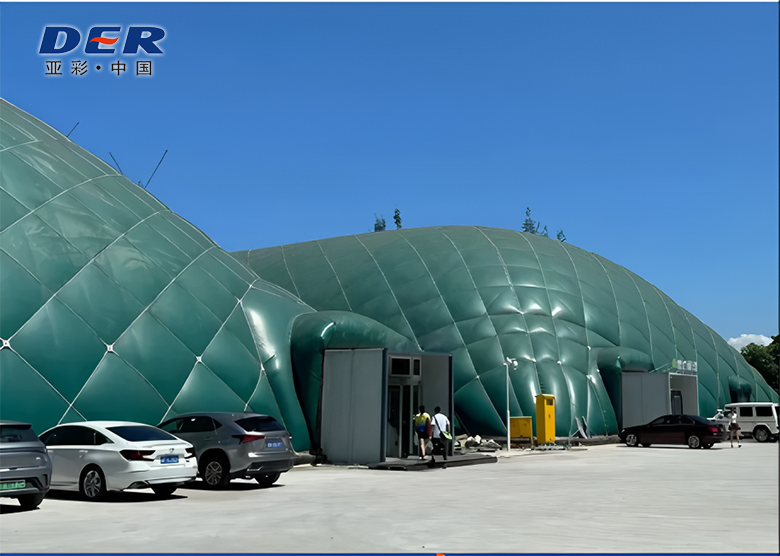
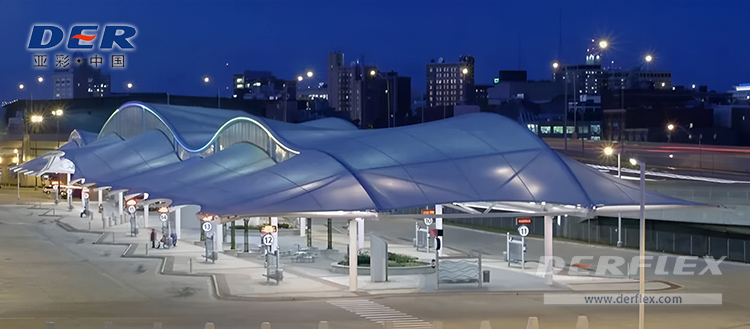
A productive inquiry contains more than area and color. The following information allows the membrane construction, sample and quotation to be aligned with the real warehouse duty.
Identify grain, feed, fertilizer, machinery, hay, packaging or mixed use, including dust, odor, corrosion and moisture risks.
The expected deployment cycle affects panel size, folding, edge details, repair planning and surface specification.
Provide design wind, snow, temperature, elevation and exposure. The engineer uses these values for shape, pressure and cable design.
Define ventilation, dehumidification, insulation and condensation-control strategy before choosing opaque or translucent layers.
State the country, project type and required test method. A general “fireproof” request is not a sufficient specification.
Share machine type, seam design, expected peel strength and fabricator experience so a production-representative trial can be prepared.
Define TDS, batch inspection, test report, color standard, packing label, retained sample and traceability requirements.
Neither system is universally better. The right choice depends on time horizon, operating controls, site conditions, local approval and the value of a clear internal span.
| Decision Factor | Air-Supported Warehouse | Conventional Steel Warehouse |
|---|---|---|
| Internal Layout | Column-free space can simplify bulk handling and vehicle circulation. | Structural columns may influence storage lanes and equipment movement. |
| Deployment | Factory-fabricated panels can support rapid enclosure after, foundations and equipment are ready. | Typically requires a longer sequence of frame, roof and wall construction. |
| Relocation | Some systems can be dismantled and redeployed, subject to panel condition and foundation design. | Usually treated as a fixed asset. |
| Envelope Control | Positive pressure and airlocks can create a controlled enclosed space. | Conventional sealed-wall and mechanical ventilation strategies are familiar to most operators. |
| Power Dependency | Requires continuous pressure management, standby blowers and a planned backup-power system. | The structural frame remains standing without inflation power. |
| Maintenance Focus | Membrane inspection, seam repair, blower service, sensors and anchoring checks. | Corrosion control, roofing, fasteners, drainage and structural maintenance. |
| Approval | May require specialist review for air-supported buildings and emergency systems. | Often follows familiar local warehouse design pathways. |
The workflow is designed to reduce specification gaps before bulk production and to give fabricators a clear approval path.
Use, location, size, climate and code requirements.
Weight, scrim, coating, surface and functional options.
Color, finish, hand feel, thickness and preliminary testing.
Fabricator validates seam method and production settings.
Controlled coating, inspection, roll identification and packing.
Export packing, documents and batch-based follow-up.
Agricultural warehouse performance depends on consistent material from the first roll to the last, not only on a single laboratory sample.
Six related pages provide broader air-dome, tensile-structure and architectural membrane context.
Practical answers for project buyers, fabricators and agricultural warehouse integrators.
It can be a suitable heavy-duty material direction for a mobile or semi-permanent air-supported warehouse when the complete system is engineered around the site loads, internal pressure, cable reinforcement, anchoring, access doors and stored goods. Fabric weight by itself is not a structural approval.
DERFLEX focuses on coated membrane material supply. We support material selection, samples, roll specifications and fabrication discussion. Structural design, blowers, controls, foundations, cable systems, installation and local approvals should be coordinated by a qualified air-dome integrator.
A PVDF surface direction is commonly selected to improve outdoor weathering, surface cleanliness and color stability. The exact performance depends on the coating system, exposure, cleaning practice and approved specification.
Yes, opacity and light-transmission directions can be discussed. The selection should consider crop or product sensitivity, internal heat gain, lighting energy, nighttime light spill and the design of any inner insulation liner.
Please provide project location, stored goods, membrane role, nominal weight, required standards, color, translucency, roll width, total quantity, welding method, target delivery schedule and any available drawings or technical specification.
Project-specific flame-retardant and low-temperature directions can be discussed. The buyer should identify the applicable test method, classification, minimum service temperature and documentation requirement before sample development.
Send DERFLEX your agricultural storage use, project location, membrane drawings and welding process. Our team will help organize a 1200gsm PVDF membrane proposal for technical review and sampling.