Fine sand & crusher fines
Prioritize a closed surface, rain-shedding slope, well-controlled overlaps and reduced exposure at perimeter gaps. Repeatedly opened sections need practical re-covering and secure temporary stowage.



Custom sand pile tarps and aggregate covers that fit the way your yard stores, protects and reclaims bulk material.
DERFLEX supplies PVC coated polyester tarp rolls, custom welded panels and finished stockpile covers. Specify rain shedding, dust shielding, abrasion zones, loader access and reinforced perimeter details before the cover is manufactured—not after it fails in service.
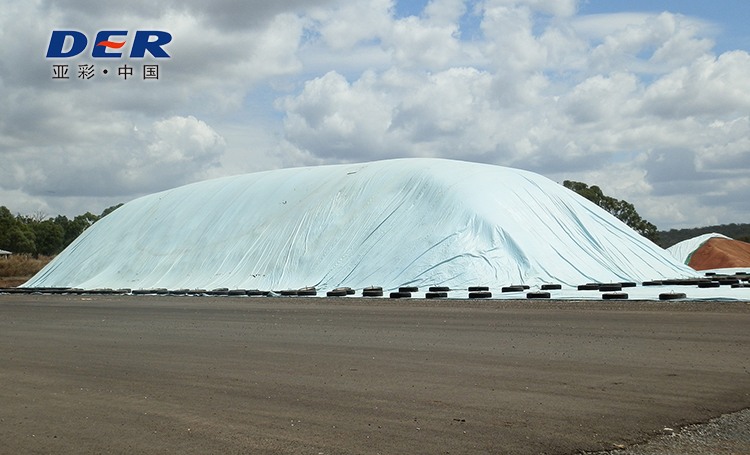
It is a protective sheet or fitted cover placed over stored sand, gravel, crushed stone or other aggregate to reduce direct exposure to rain, wind and unwanted debris.
A solid aggregate stockpile cover can keep direct rainfall off exposed surfaces and limit wind acting directly on fine material. A sand pile tarp is often specified for consistent moisture management and cleaner material handling at ready-mix plants, block factories, precast operations and construction supply yards.
A cover does not make wet sand dry, eliminate ground seepage, certify dust-control compliance or guarantee stable moisture content. Those outcomes also depend on the storage base, drainage, opening frequency, weather and site operating plan.
Procurement rule: define the material being covered, whether the goal is rain exclusion or mainly surface containment, and how often crews need to uncover the loading face. Those three inputs determine the most useful cover configuration.
For an overview of covering other industrial bulk materials, see the DERFLEX industrial stockpile cover range.
Different gradations and operating cycles create different failure risks. The material selection should follow the intended job—not only the requested tarp color or weight.
Prioritize a closed surface, rain-shedding slope, well-controlled overlaps and reduced exposure at perimeter gaps. Repeatedly opened sections need practical re-covering and secure temporary stowage.
Prioritize puncture and abrasion risk. Identify sharp crown contact, ridges, drag edges and loader travel routes; add local wear protection where the cover rubs against rough stone.
Keep graded materials separated and map routine access to each storage bay. A cover may help limit rainfall-driven moisture variation but cannot replace actual aggregate moisture measurement in batching.
Temporary and changing piles favor practical deployment speed, easy folding and a controlled method of moving sections as the stockpile height changes.
Review UV exposure, rain duration, surface cleaning and secure perimeter restraints. Finished-cover durability depends on weather, fabric construction and installation practice.
Develop repeatable sizes, material grades, marked section sets and packaging for regional dealers, site contractors and stockpile-cover fabricators.
A heavy duty aggregate tarp is not always the heaviest sheet. Confirm the needed weather barrier, re-use cycle, sharp-contact exposure, installable panel weight and fixing method together.
| Situation | Cover direction to evaluate | Most important details | Purchaser's verification question |
|---|---|---|---|
| Fine dry sand; rain is the priority | Solid waterproof PVC coated polyester with a controlled seam and overlap system | Water-shedding layout, lower-edge sealing concept, seam continuity | Where can rain enter at seams, loading-face openings or low edges? |
| Sharp, coarse aggregate with prolonged contact | Heavier reinforced PVC fabric plus localized pads or wear strips | Crown, ridge, lower drag edge and repeated contact points | Which surfaces touch angular stones when the pile changes shape? |
| Frequently reclaimed sand or gravel | Numbered modular panels or draw-back loading-face section | Section mass, temporary hold-open fixing, overlap direction, replaceability | Can one working face open without removing the whole cover? |
| Temporary, low-contact material pile | Project-matched reinforced PE/PP or lighter PVC, depending on actual duty | Handling weight, UV requirement, reuse plan and seam method | Is repeated industrial use needed or is a short-term cover enough? |
| Dust shielding without rainfall exclusion | Solid cover or selected containment fabric depending on dust and site exposure | Perimeter closure, safe airflow, handling and wider site control plan | Is a waterproof top layer required, or only surface wind shielding? |
| Wind-exposed quarry or high pile | Reinforced sections designed around an engineer-approved restraint system | Load path, tie-down interface, exposed area and maintenance access | Who is responsible for approving wind loads, ballast and anchoring? |
These are selection directions, not universal performance approvals. If the project extends to mining operations or highly abrasive ore yards, compare DERFLEX mining tarp material and use conditions before fixing the specification.
Often the practical choice for welded, reinforced and reusable stockpile covers.
Can be useful when low mass, short-term coverage or straightforward deployment takes priority.
These are DERFLEX manufacturing and custom fabrication directions—not a fixed, pre-approved SKU. Agree final values against the actual location, material and reference sample.
| Specification | DERFLEX supply / design direction | Confirm before ordering |
|---|---|---|
| Primary product | Aggregate cover, sand pile tarp, gravel stockpile tarp, custom bulk storage cover | Application, stored gradation, supply format |
| Main waterproof material | PVC coated polyester woven fabric | Approved construction, coating, base fabric |
| Material weight | Approx. 550–900 gsm is a published DERFLEX stockpile-cover direction; 650–900 gsm is a common heavy-duty mining direction | Exact available grade, weight tolerance, finished panel mass |
| Roll width / finished cover size | Roll material and custom welded large-size panels | Usable roll width, welded overlap, developed shape, size tolerance |
| Waterproofing | Waterproof PVC material with compatible welded joining when required | Actual seam process, leak-control requirement, draining design |
| Wear protection | Localized backing, edge strips, ridge patches and reinforced contact zones | Fabrication drawing showing location and dimensions |
| Perimeter fastening | Webbing hems, grommets, D-rings, rope edges, straps or pockets | Hardware and spacing against approved fixing layout |
| Finish & color | Project-matched color, finish and identification printing | Physical sample, visibility, cleaning needs, panel codes |
| Performance documents | UV, tensile, tear, coating adhesion, cold-flex or special testing can be discussed as required | Named test method, acceptance limits and currently available evidence |
| Supply / OEM | Roll goods, cut fabric, finished covers, modular section kits and private labeling | Drawing revision, packing plan, quantity, MOQ and lead time by quotation |
For base-fabric construction, weldability and width options, review DERFLEX PVC tarpaulin material specifications. Material data alone does not certify the completed anchoring system or installation.
Aggregate storage is dynamic. A tarp that works on installation day can become impractical once loaders, conveyors and changing stock levels enter the picture.
Concept only — not a fabrication, lifting or wind-engineering drawing. Align section seams to drainage and reclaim operations.
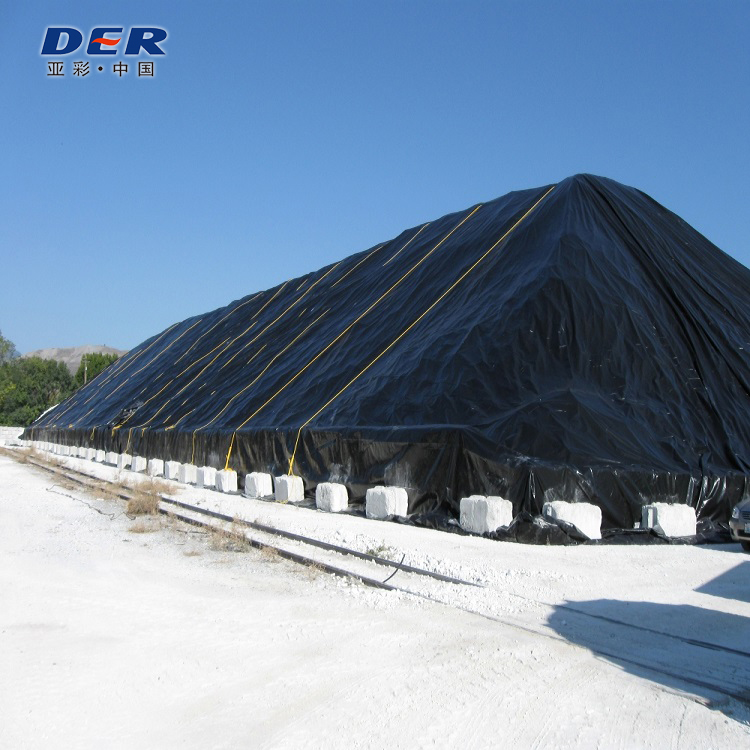
Place seams and overlaps so rainfall sheds away from open loading edges. Avoid pockets and low points that retain water.
Protect rough ridge lines, sharp stones, lower dragging areas and where a retracting section crosses the material.
Number panels, define fold direction and decide where crews secure an opened section safely during reclaim work.
Review fabric, reinforced edge, hardware, anchor or ballast and ground conditions together. Site approval is required.
For projects needing finished irregular-shaped covers, reinforced hems or labelled OEM sections, see DERFLEX custom tarp fabrication options.
The footprint width of a windrow is shorter than the tarp path up one slope and down the other. For a simplified symmetrical triangular cross-section, use:
Developed sheet width =
2 × √[(ground width ÷ 2)² + pile height²] + 2 × side allowance.
Multiply by the planned cover length to estimate rectangular surface area. At 650 gsm, a 12 m-wide, 3 m-high windrow with a 25 m sheet length and 1 m allowance each side needs roughly 15.42 m developed width, 385.4 m² of fabric and 250.5 kg of fabric mass before hems, overlaps or hardware.
That is a planning illustration only. Conical stockpiles, nonuniform ends and changing slopes require a proper template or survey. Large-panel mass may call for mechanically assisted handling or smaller modules.
Enter project dimensions to estimate developed width, rectangular area and base fabric mass.
Approx. 62.6 kg fabric per equal-area section before finishing.
Assumes a symmetric triangular constant profile and rectangular plan. Excludes sloped end faces, seam overlap, straps, wear pads, seam allowances, packed mass and wind/anchor calculations.
All photographs below are existing images hosted on derflex.com. Actual material samples and approved project drawings should determine a new order.
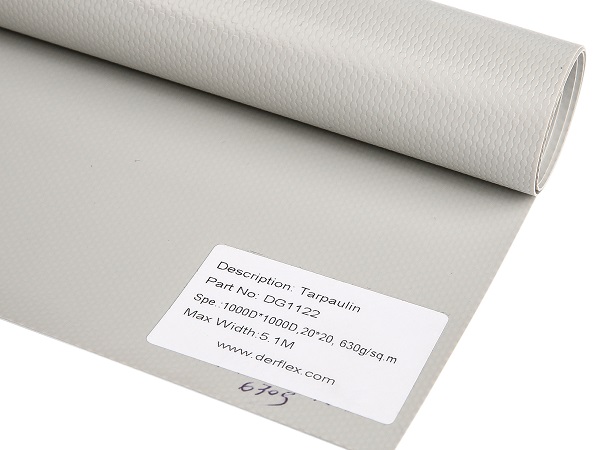
For recurring orders, align the approved material sample with the seam detail, reinforcement drawing, grommet positioning, panel labelling and packing sequence.
Inspect directional tensile and tear properties, coating adhesion and a representative welded joint where required by the buyer's inspection plan. Under real outdoor use, a reinforced corner or replaceable wear zone can determine whether crews repair a panel or replace the entire cover.
See DERFLEX guidance on PVC tarp waterproofing and seam design when full rain protection is critical.
One tonnage can correspond to very different pile footprints and slopes. Use a measured cross-section, max height and actual coverage length.
A quoted 900 gsm fabric is not automatically better for every job. Check yarn structure, tear performance, seam construction and how workers will lift the cover.
If the loader must reclaim material daily, specify a safe removable section, place to stow it and planned replacement details.
Rain still may enter from open ends; water may migrate from the ground or collect beneath the tarp. Drainage and stockpile management remain necessary.
Grommets are fastening interfaces, not a wind rating. The responsible site engineer should review wind area, anchoring and ground capacity.
Normalize quotes to the same finished size, material, seam layout, reinforcement, hardware, marking, packaging and expected site handling.
A clear RFQ reduces sizing ambiguity and makes price comparisons more meaningful. DERFLEX can discuss roll supply, fabricated panels or finished cover kits depending on the project.
MOQ, sample availability, production lead time and final test scope depend on the selected construction and order; request confirmation rather than assuming a fixed number. For broader yard equipment and storage applications, review the storage tarps and outdoor material covers product overview.
Direct answers for quarry contractors, concrete plants, stockyard operators, importers and distributors.
If the goal is to keep direct rainfall off the pile, a solid waterproof PVC coated polyester cover with appropriate welded seams and a rain-shedding layout is a common reusable industrial direction. Confirm size, perimeter protection, access frequency and site fixing. Light reinforced PE/PP can suit some short-term projects.
Covering the exposed stockpile surface can reduce direct wind contact with loose surface fines. The degree of dust reduction depends on open edges, loading activity, cover integrity and the wider site dust-control plan. A tarp by itself does not establish regulatory compliance.
Start with stone sharpness, repeated tarp movement, intended panel size and exposure. DERFLEX discusses approximately 550–900 gsm for stockpile-cover applications, with 650–900 gsm a common heavy-duty mining-tarp direction; the approved fabric structure and localized abrasion protection are more informative than GSM alone.
Measure across the actual pile surface and include the required side allowances. Do not use the ground width as the finished cover width. For a symmetrical triangular windrow, developed width is twice the slope length plus both side allowances. Irregular or conical piles need a shaped drawing or survey.
A suitable rain cover may reduce direct rainfall entering the exposed pile, but it cannot guarantee constant material moisture. Initial moisture, floor drainage, seepage, condensation, access and material movement still affect conditions. Ready-mix operators should continue aggregate moisture testing and batching adjustments.
A single sheet reduces connections but may be difficult to deploy or move. Numbered modular panels can improve daily loader access, replacement and packing where overlaps, runoff, restraining of opened edges and panel mass are designed correctly. Compare the entire operating cycle, not only seam count.
The restraint must match the site wind exposure, projected tarp area, pile shape and ground conditions. DERFLEX can supply reinforced hems, D-rings, eyelets, straps and pockets, but final wind loads, ballast quantity and anchoring require approval by the responsible site engineer or competent project team.
DERFLEX supplies PVC coated fabric rolls and supports fabricated tarps with project-defined dimensions, panel layouts, hardware, reinforcement, colors, branding and packing. Send your dimensions, quantity, desired format and destination for confirmation of material availability, quotation and production timing.
Confirm the sample ID, agreed fabric construction, target GSM, surface finish and relevant directional strength or adhesion tests using named methods.
Approve seam construction, finished dimensions, wear patches, hardware coordinates and any opening or connector detail against the purchase drawing.
Identify each panel and its orientation. Agree the folding sequence, package dimensions, gross weight, drawing revision and shipment records before dispatch.
Share a site photo, a top view and the intended coverage duty. DERFLEX can review material direction, panel fabrication and reinforcement details for your sourcing project.
Project-specific technical requirements and availability are subject to confirmation before order acceptance.