


 Industrial fabric engineering · OEM supply
Drain Tarps & Roof Leak Diverter Systems for Industrial Facilities
A drain tarp catches overhead leakage and guides it through a controlled outlet and hose to a designated collection point. For facilities, safety-equipment brands and OEM buyers, the important decision is not just tarp size: the wet-area footprint, drain fitting, hose route, attachment loading and verified flow performance must work together. DERFLEX supports PVC-coated fabric and custom-fabrication enquiries, with complete kit components and performance subject to drawing and supplier confirmation.
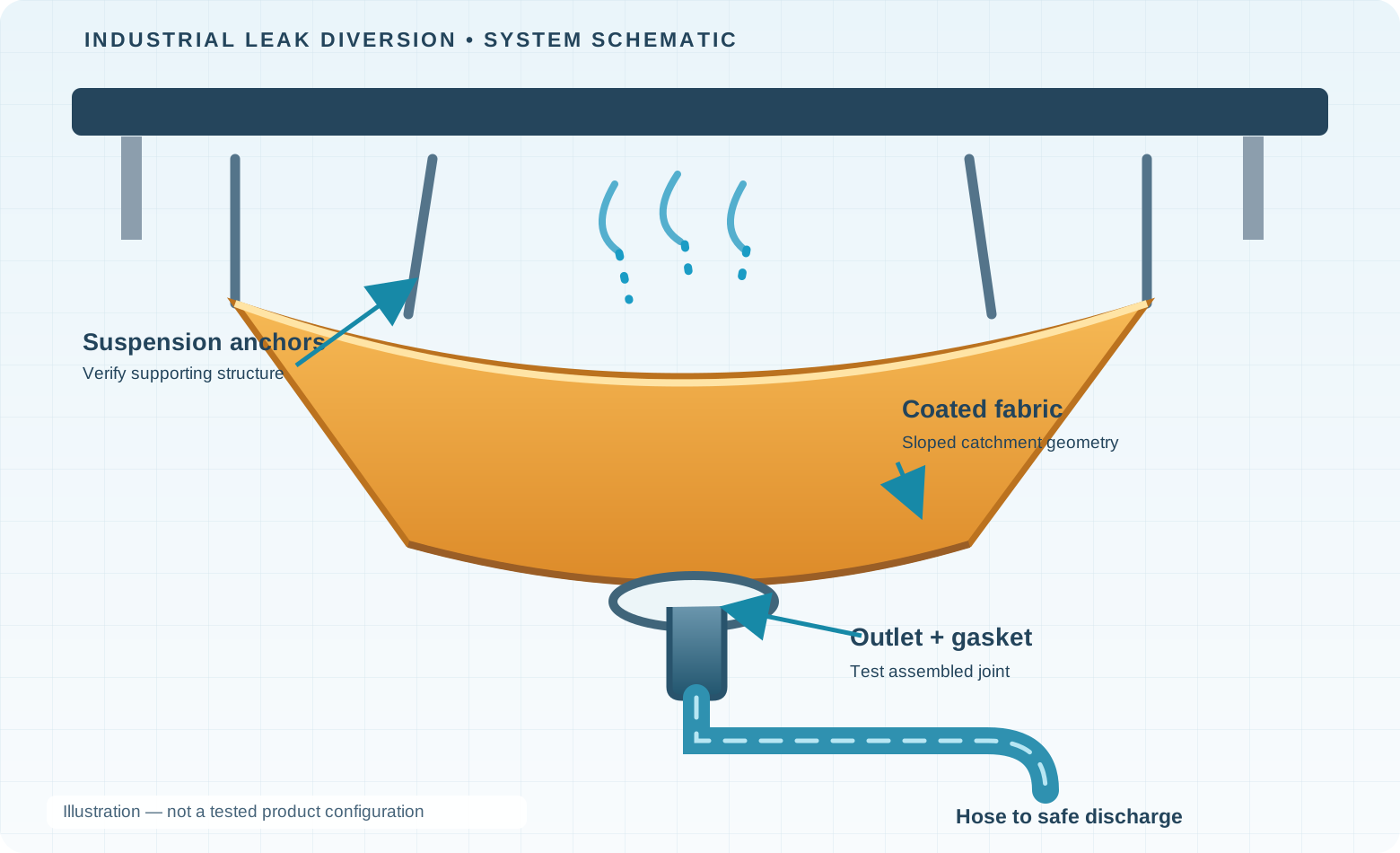
What Is a Drain Tarp—and What Is Actually Being Purchased?
A drain tarp is a suspended waterproof collection surface with a controlled low-point outlet. Water falls into the tarp, moves toward the outlet under gravity and passes through a fitting and hose to a safe drain or container. It is an interim indoor leak-management measure, not an exterior roof membrane or a permanent repair.
A finished roof leak diverter is an assembly, not merely a piece of waterproof PVC fabric. The fabric has to be cut and shaped to form a reliable catchment. Its edges need a fastening strategy. The drain area needs an integrated fitting or mechanically sealed penetration. A compatible hose must reach an acceptable discharge point, and the supporting structure must be independently approved for the loading.
PVC-Coated Fabric & Seams
Choose coated polyester for flexible waterproof catchment construction, with project-matched base cloth, surface, seam routing and fold behavior. Material strength alone does not verify a completed diverter assembly.
Drain Outlet & Seal
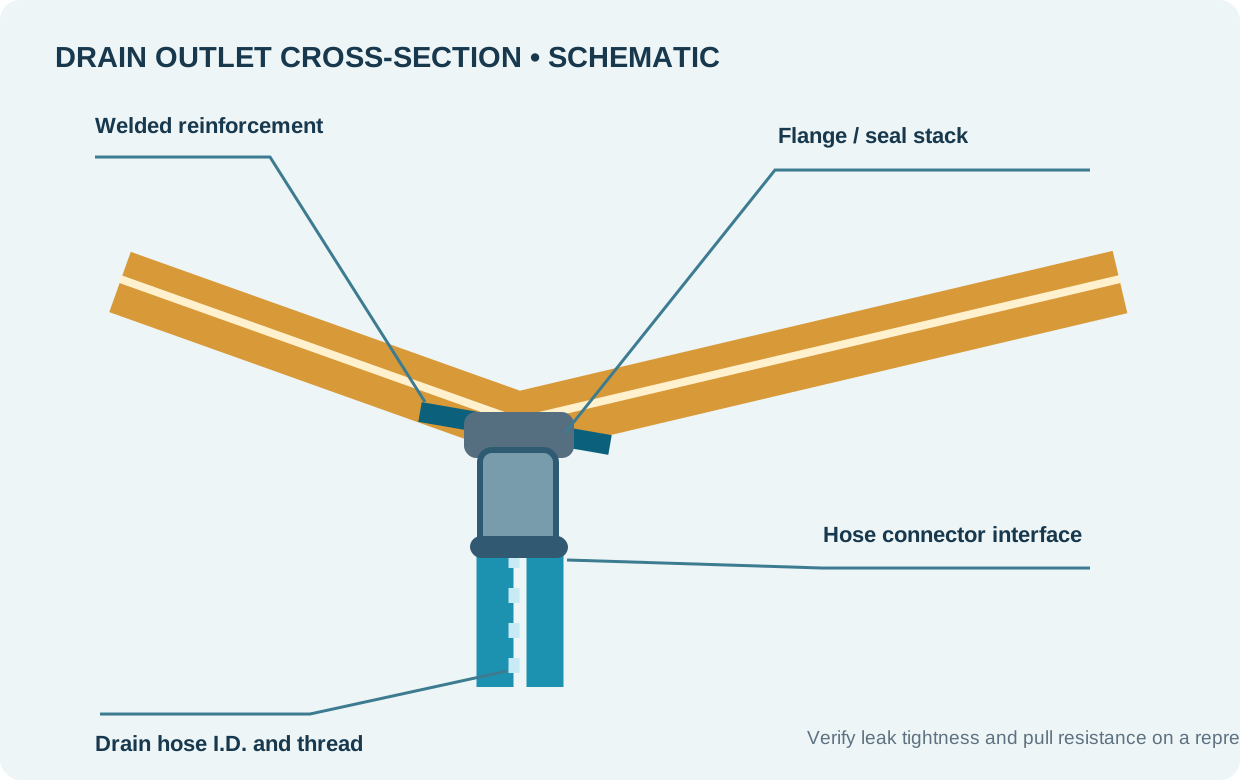
Define outlet position, flange construction, penetration reinforcement, gasket or weld method, outlet bore and mating thread. Ask for sample-level joint integrity checks.
Reinforced Suspension Points
Specify hanging points, patches, hems, straps, D-rings or grommets by a drawing. Anchor approval belongs to the facility or qualified installer, not a generic tarp weight rating.
Hose, Route & Collection
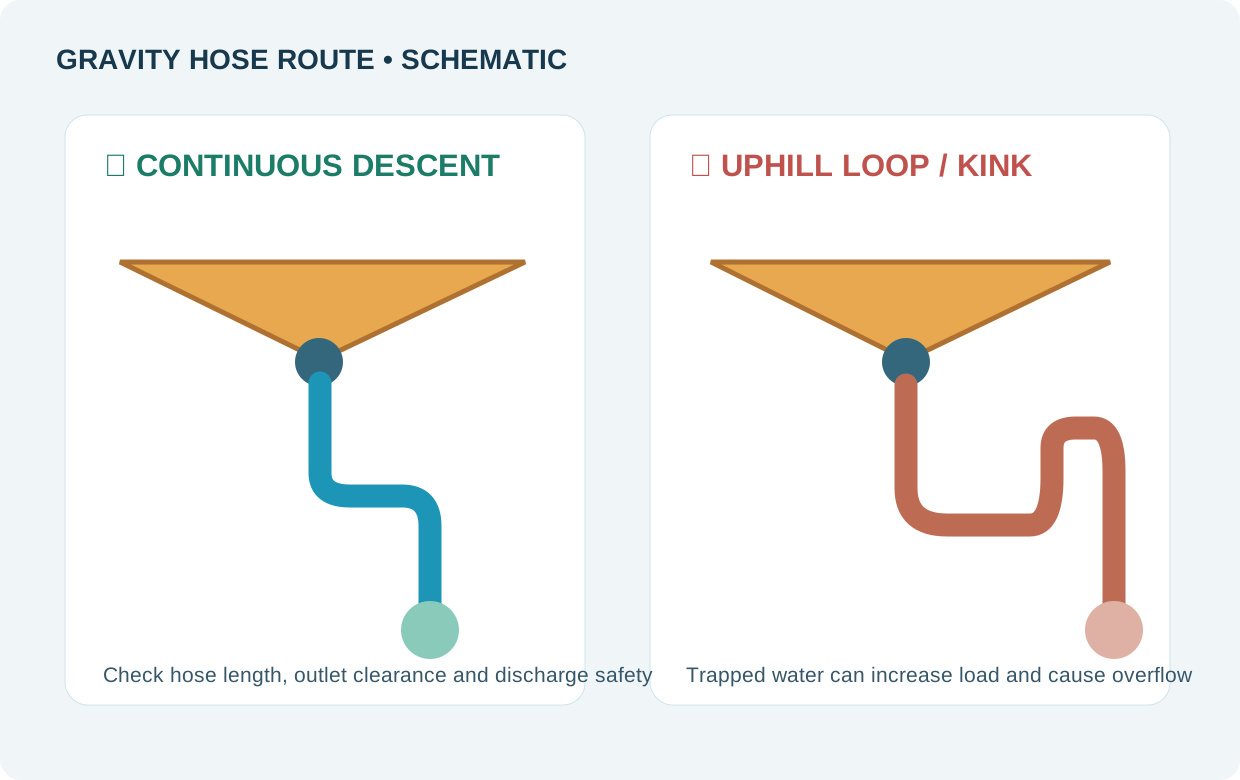
Hose inner diameter, overall length, height drop, bends and discharge destination affect actual flow. Clarify whether a complete hose kit is included or sourced separately.
For a general overview of product types, see DERFLEX's existing water diverter tarp page. This guide concentrates on drainage engineering and acceptance criteria for custom procurement.
Size the Collection Footprint Around Water Migration
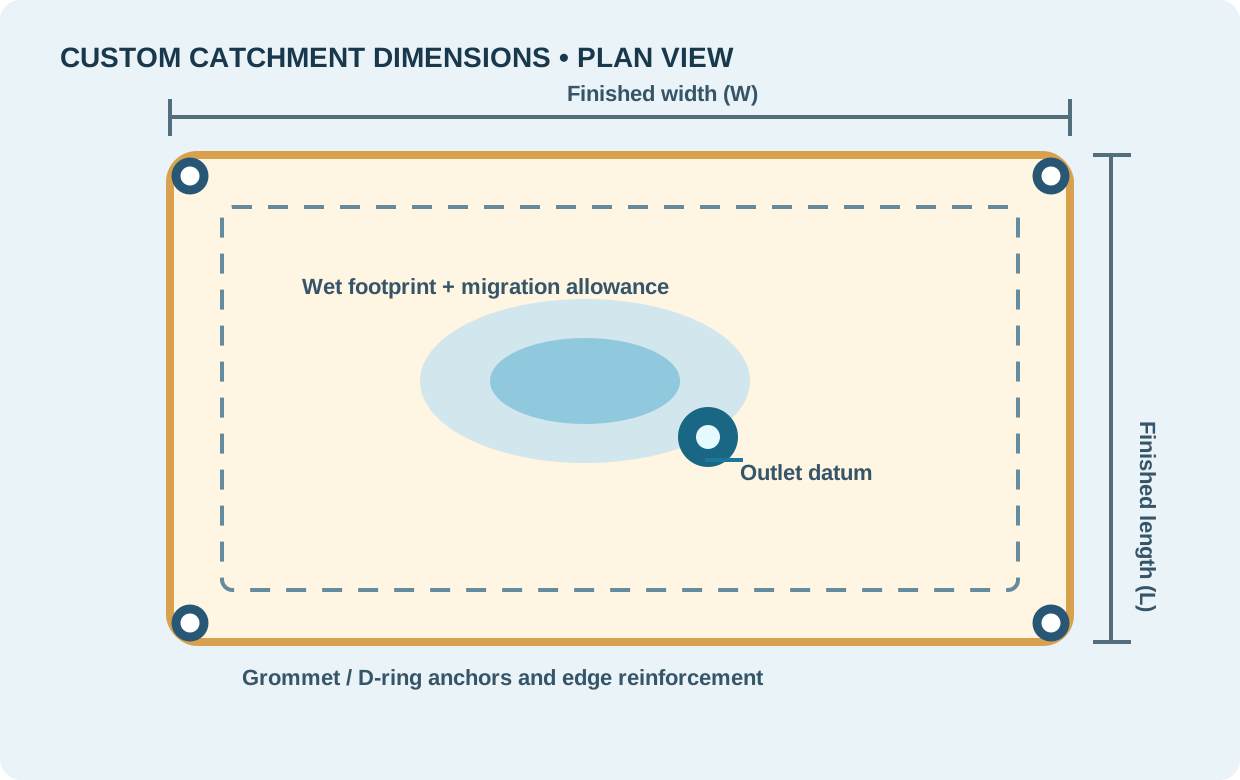
Water does not always fall directly below the damaged roof panel. Drips can migrate along a joist, insulation layer or pipe, and the visible zone can expand during different rainfall conditions. A custom drain tarp should therefore be designed around the observed wet footprint and feasible attachment points—not selected from square footage alone.
Survey the active area
Mark drips, spray and migration paths; record nearby services.
Add coverage margin
Use a project-agreed allowance, not a universal fixed percentage.
Find the true low point
Confirm sag depth, headroom, slope and seam clearance.
Position the outlet
Align with the feasible hose route and safe discharge destination.
Draw the finished width and length, not only the cut-sheet dimensions. Include the reinforcement footprint, hanging-point offsets, ceiling or rack clearances and location of the fitting measured from two datum edges. A site photograph with a dimensioned sketch is usually more helpful than a verbal request for a “large roof tarp.”
Where the ceiling is obstructed by ducts or lighting, a rectangular or asymmetric catchment may be more practical than a centered square. A shallow funnel profile, however, may leave insufficient slope if ceiling headroom is restricted. Evaluate this before cutting material.
Outlet Diameter Does Not Equal a Verified Flow Rating
Flow is a system property. It depends on the smallest clear passage, fitting geometry, hose inside diameter, bends, elevation drop, potential debris and how the installed tarp maintains its shape. A claimed “1-inch outlet” cannot by itself establish a gallons-per-minute or liters-per-minute capacity.
Estimate the Required Inflow, Then Verify the Complete Discharge Path
If a facility has an observed flow measurement, note the peak and conditions of the measurement. Where possible, a safe controlled collection sample gives an initial planning value: Q = collected volume ÷ elapsed time. For example, 12 liters collected in 2 minutes equals 6 L/min, or approximately 1.6 US gallons per minute. This is only an illustrative calculation—not DERFLEX system test data or a recommended maximum.
Rainfall events, overflow from other equipment and short surges may produce greater inflow than the initial sample. State the design inflow and how much uncertainty the facility engineer requires. Have the proposed fitted tarp and hose configuration tested under representative height drop, hose length, bends, outlet location and intended water condition. Never reuse another manufacturer's published flow rating for an untested DERFLEX assembly.
| Design variable | Specify in RFQ | Why it matters | Sample check |
|---|---|---|---|
| Outlet position | Center, offset or end location with two datum measurements | Maintains gravity drainage at installed pitch | Confirm true low point under test load |
| Fitting interface | Thread / adapter drawing; male or female; seal type | Prevents incompatible connectors and leaks | Fit check with intended mating hose |
| Clear bore | Minimum internal passage, not just nominal outside size | Controls restriction and clog sensitivity | Measure clear passage after assembly |
| Hose specification | Inside diameter, length, material, bends and drop | Changes friction loss, kinking and effective capacity | Flow test with representative hose |
| Drain destination | Approved floor drain, monitored vessel or other permitted point | Avoids moving the hazard to a new area | Verify overflow management and access |
| Liquid & debris | Water quality, temperature, solids and contamination assumptions | Changes compatibility, clog risk and safe disposal | Inspect blockage risk and material suitability |
No flow guarantee is stated here. Final values and any test method must be linked to the selected material, fitting and completed system drawing.
Why water accumulation matters: one liter of water contributes approximately one kilogram of mass. If a 6 L/min inflow continues while the hose is blocked for five minutes, approximately 30 kg of water could accumulate before leakage or overflow, excluding the tarp and fittings. This arithmetic is a hazard illustration—not a permissible tarp load or anchor capacity. Do not allow an overhead system to be treated as a storage tank.
Choose a Diverter Configuration by Site Constraints
Industrial leak control calls for different geometry in a warehouse bay, an office drop ceiling, a pipe chase or a plant room. Before quoting, identify the surfaces that can safely support the assembly and the path by which the intercepted water can leave the affected area.
| Situation | Likely configuration to review | Primary decision | Review boundary |
|---|---|---|---|
| Single overhead drip in open warehouse bay | Compact suspended funnel with low-point outlet | Accessible hanging points and hose drop | Water migration outside the visible drip |
| Wide roof seam above stored goods | Extended rectangular or multi-panel catchment | Perimeter reinforcement and no flat pooling zones | Multiple drips, shifting conditions and span loads |
| Pipe or HVAC condensate area | Narrow catchment or pipe-specific diverter geometry | Access to valves, filters and condensate lines | Heat, contaminated condensate, maintenance access |
| Suspended ceiling in occupied space | Low-profile ceiling-specific arrangement | Approved mounting and visible housekeeping | Ceiling tiles/grid often are not rated anchors |
| Production line or electrical workspace | Custom route away from protected equipment | Hazard isolation and discharge beyond work zone | Site electrical controls and facility engineering |
| Distributor emergency response kit | Repeatable kit with defined fabric, hose and labels | Compatible parts, pack count and instructions | OEM component capability must be confirmed |
The relevant product family is industrial tarps, but overhead drainage involves additional interface verification beyond ordinary protective-cover construction. For areas where an exterior roof cover is required to reduce new water ingress, consult the separate roof leak repair tarp selection guide.
OEM Drain Tarp Specification: Define the Material and the Interface
For B2B sourcing, the specification should separate material attributes, fabricated tarp construction and complete system acceptance. These are different purchase levels. DERFLEX's established PVC-coated fabric offering is a useful starting point; exact hardware, supplied hose components, assembly test and any applicable certification require confirmation for the order.
| RFQ field | What to provide | How to accept it |
|---|---|---|
| Supply level | Coated fabric roll / pre-cut panel / fitted tarp / kit with hose and hardware | Signed bill of materials and stated exclusions |
| Finished footprint | Length × width in mm, outlet datum, tolerance and clearance | Dimensional inspection of a hung sample |
| Material structure | PVC-coated polyester grade, finished weight, surface and required reports | Approved reference sample and grade-specific data |
| Seam construction | Seam type, location, overlap/weld detail and reinforcement zones | Visual checks and agreed seam test criteria |
| Outlet penetration | Flange, gasket, welding, seal and fitting thread drawings | Assembly leak test, inspection of joint and thread fit |
| Suspension system | Grommet/D-ring position, patch layout and attachment hardware scope | Drawing review and approved sample; building anchors assessed separately |
| Hose & destination | Hose ID, length, material, mating ends, destination | Representative installed-route flow demonstration |
| Fire / other performance | Site rule, test standard, material grade and evidence requirements | Applicable test report; no automatic whole-system certification |
| OEM program | Unit quantity, labels, spare parts, packaging and repeat-batch control | Sample seal, BOM, drawing revision and packing audit |
PVC-coated polyester is a material option, not a universal specification
Fabric weight, base cloth and coating affect flexibility, seam processing, cleaning and fold endurance. Compare DERFLEX industrial PVC coated fabric and PVC tarpaulin fabric rolls when deciding whether the order begins with roll goods or a fabricated component.
Clarify what “complete kit” means
Ask whether the quotation includes outlet body, seals, hose, clamps, straps, hooks, inspection label and packaging. Do not assume hardware or an installation service comes with a PVC-coated tarp. Full-system flow, support and site compliance must be checked separately.
Install for Continuous Drainage, Then Monitor the Temporary Control
Control the work area
Assess electrical hazards, potential contamination, safe access and the chance of falling ceiling material before handling water.
Verify support points
Use anchors and attachment methods reviewed by the facility. Do not hang from sprinkler pipework or a damaged ceiling grid.
Build the drainage route
Attach the correct hose and seal, keep the route descending where feasible and protect the approved discharge area.
Trial and inspect
Observe representative water flow, seam and flange leakage, outlet location and potential pooling before leaving the system in service.
Before You Order
- Send the actual overhead dimensions, leak footprint, obstruction positions and ceiling height.
- Identify permitted attachment points and the person responsible for load assessment.
- Specify where water must discharge; confirm container monitoring or drain capacity.
- Ask which fitting and hose components are included in the order.
- Declare any hot, oily or contaminated liquid. Ordinary water-drip protection does not establish chemical compatibility.
- Agree how the finished system will be sampled, tested, cleaned, folded and stored.
Not a permanent repair or pressure vessel
Drain tarps do not repair leaking roofs, pipes or HVAC assemblies, do not control uncontrolled pressurized releases, and are not approved structural load-bearing devices. Unexpected inflow, blockage or poorly supported geometry can create overhead water accumulation. Stop, isolate and escalate conditions exceeding the facility's emergency plan or the verified installed design.
Acceptance Plan: Test the Finished System, Not Just the Fabric
OEM programmes should freeze a reference assembly only after verifying the actual joint, hanging geometry and hose route. A coated-fabric datasheet may provide tensile, tear or coating information, but it cannot prove that a particular flange and hose connection will remain tight after handling. Likewise, passing a seam coupon test does not certify the overhead supports of a building.
- Material check: identify exact fabric grade, thickness/weight if reported, surface, sample batch and applicable test method.
- Fabricated panel check: review welded or otherwise sealed seams, edge reinforcements, dimensions and outlet position.
- Joint check: trial the matching hose connector, check sealing and resistance to an agreed service-handling condition.
- Whole-system check: install on independently approved supports and witness representative water throughput, pooling, overflow and safe discharge.
- Repeat-order check: retain approved drawings, outlet component IDs, labels, packaging details and deviation handling.
Buyer and factory should agree the intended test conditions and acceptance criteria in writing. If qualified third-party documents are needed, request the actual report for the relevant material or component rather than assuming a generic grade claim applies.
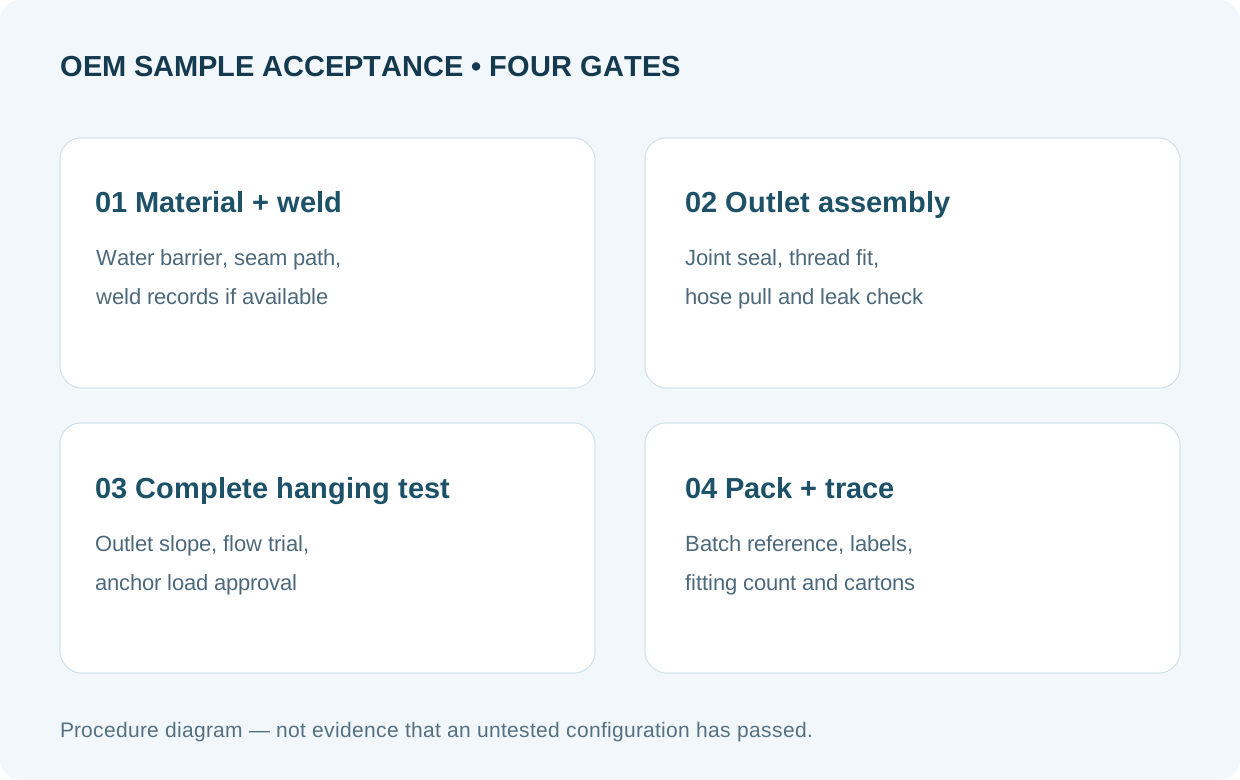
Four Views to Check Before Production
These purpose-made schematics visualize design questions that are easy to miss in a product photograph. They are explicitly illustrative; for a real DERFLEX product example and PVC material photographs, see the existing product and material pages linked below.
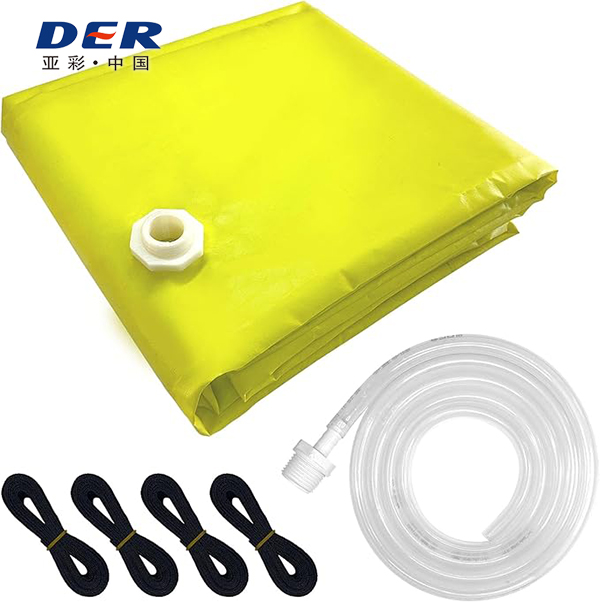
The existing site shows a yellow leak diverter tarp with an outlet and hose accessory set. That published image demonstrates the product family but does not verify the flow capacity or attachment loads of a new custom order. View the existing DERFLEX product image or consult PVC coated tarp material options.
How DERFLEX Can Support a Drain Tarp OEM Programme
DERFLEX already presents PVC-coated polyester materials, custom tarpaulins and leak diverter tarps across its product catalogue. For this specific application, a practical procurement workflow starts with identifying whether the customer requires only the fabric, a fitted catchment panel or a matched kit. The feasibility of a special outlet, accessory sourcing, test plan or installation package must be confirmed for the actual purchase order.
Select & document
Define material grade, color, weldability, flexibility and any project-specific evidence requirements. Use PVC-coated tarp details as a fabric-level reference.
Agree an assembly drawing
Review final shape, seams, reinforcements, hanging-point layout and flange geometry. Custom tarp fabrication explains the broader finishing capabilities.
Qualify before repeat orders
Approve an actual fitted sample, mating accessories, test conditions, reference photograph and BOM before batch quotation or an OEM reorder programme.
For recurrent projects, issue one controlled drawing revision and change log. A smaller material cost is not useful if a different thread standard or untested hose arrangement causes a failed installation. Quote comparisons should therefore itemize material, fabricated seams, outlet fittings, suspension accessories, tubing, packaging and any agreed validation work.
Drain Tarp & Roof Leak Diverter FAQs
What is the difference between a drain tarp and an ordinary waterproof tarp?
A drain tarp has a planned catchment geometry, integrated outlet and hose connection, plus reinforced hanging points. An ordinary waterproof sheet may resist rain but does not automatically provide controlled overhead water collection or validated joint performance.
How do I select the drain outlet and hose size?
Start with the required peak inflow, hose inside diameter, run length, bends, height difference and fitting interface. Then test the proposed complete assembly in a representative routing configuration. The nominal outlet diameter alone is not a verified flow rating.
Can a roof leak diverter tarp collect water without draining?
It should not be used as an overhead water storage vessel. The design should promote continuous controlled drainage. A blocked hose can cause rapid pooling and increased load on seams, fittings and supports, so site monitoring and overflow procedures are essential.
Does DERFLEX supply a full hose-and-hardware leak diverter kit?
DERFLEX has existing leak diverter tarp and custom coated-fabric offerings. For a proposed kit, submit the required bill of materials so DERFLEX can confirm whether the finished tarp, specific drain connector, hose and attachment accessories are included in its quotation.
Is a flame-retardant PVC fabric enough for a regulated facility?
No. The facility must define the applicable material or installed-assembly requirement. Any flame-retardant test evidence needs to match the selected grade and relevant test method; fabric evidence alone does not certify the complete suspended system.
What documents are useful for OEM sample approval?
A dimensioned drawing, material identification, outlet and hose connection drawing, agreed acceptance checks, component bill of materials, installation limitations and a signed reference sample are more useful than an unsupported claim of universal capacity.
Product and Engineering Resources
Request a Drain Tarp Specification & OEM Quotation
Share the leak-area photo or sketch, finished dimensions, installation height, approved hanging points, expected water condition, desired outlet and hose interface, quantity, destination and any required test documentation. DERFLEX can review the material and proposed supply scope and clarify which parts of the finished assembly require sample confirmation.