



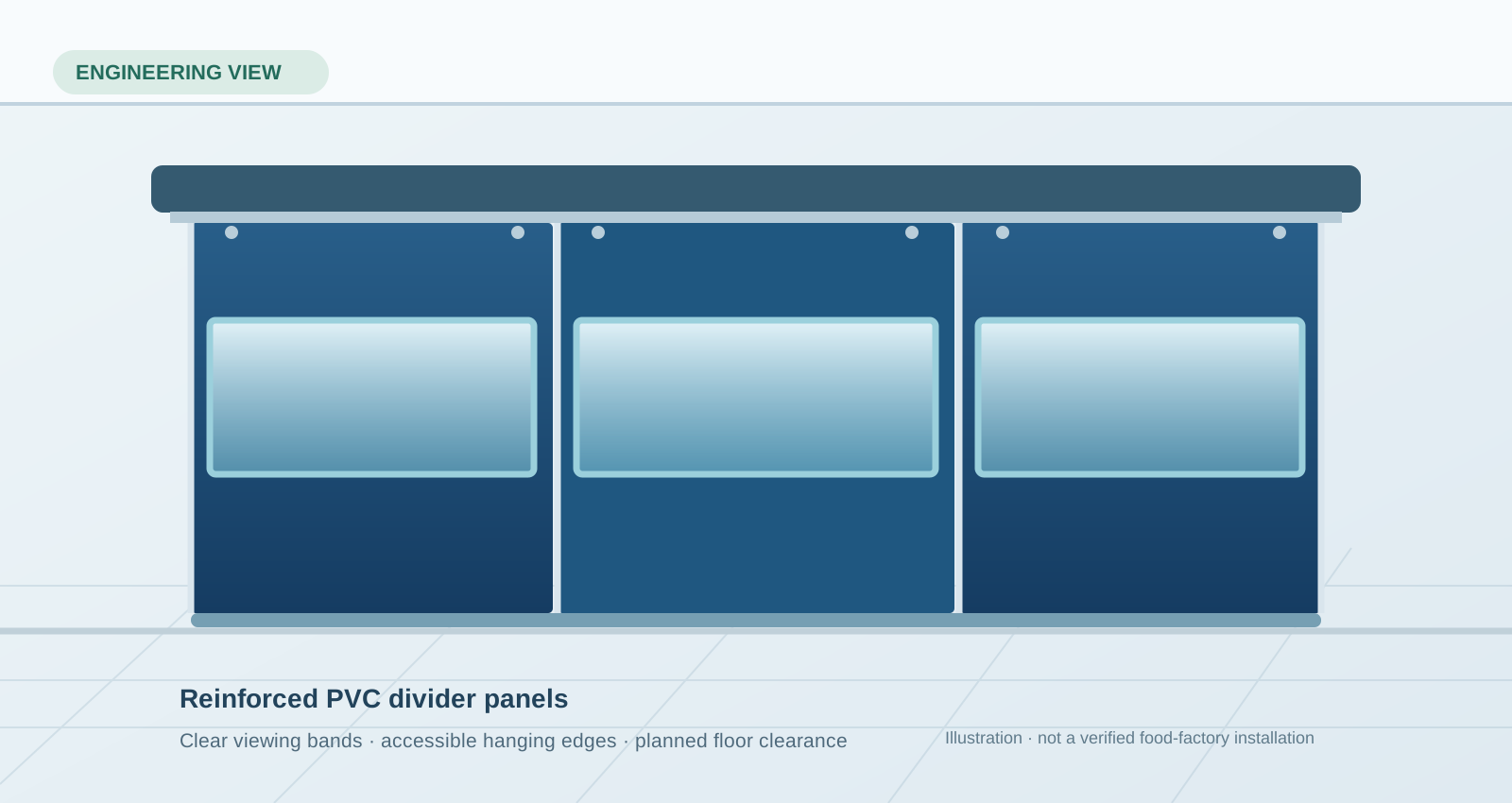
What are food processing industrial curtains?
Food processing industrial curtains are flexible PVC-based divider panels used within factory work areas to create physical separation, manage movement and help limit incidental splashes where the plant layout permits. They can be opaque, transparent or combined panels and may be fixed, removable or designed for movement.
Unlike a general warehouse divider, a curtain specified for food processing needs an agreed plan for sanitation access, cleanable interfaces, minimum and maximum temperature, and any potential contact with food or food-contact surfaces. Fabric selection is only one part of this review.
DERFLEX's broader industrial door and curtain fabric portfolio provides a material starting point. For movement through narrow access openings, the industrial PVC strip curtain range is a separate construction choice rather than an interchangeable food-hygiene approval.
Three questions before selecting PVC
- Where? Which processes and hygiene zones sit on either side?
- How is it cleaned? What detergent or sanitizer contacts the whole panel and hardware?
- What must be proved? Does the application require non-contact suitability, food-contact documentation or a validated facility control?
Choose the curtain by process risk—not color or thickness alone
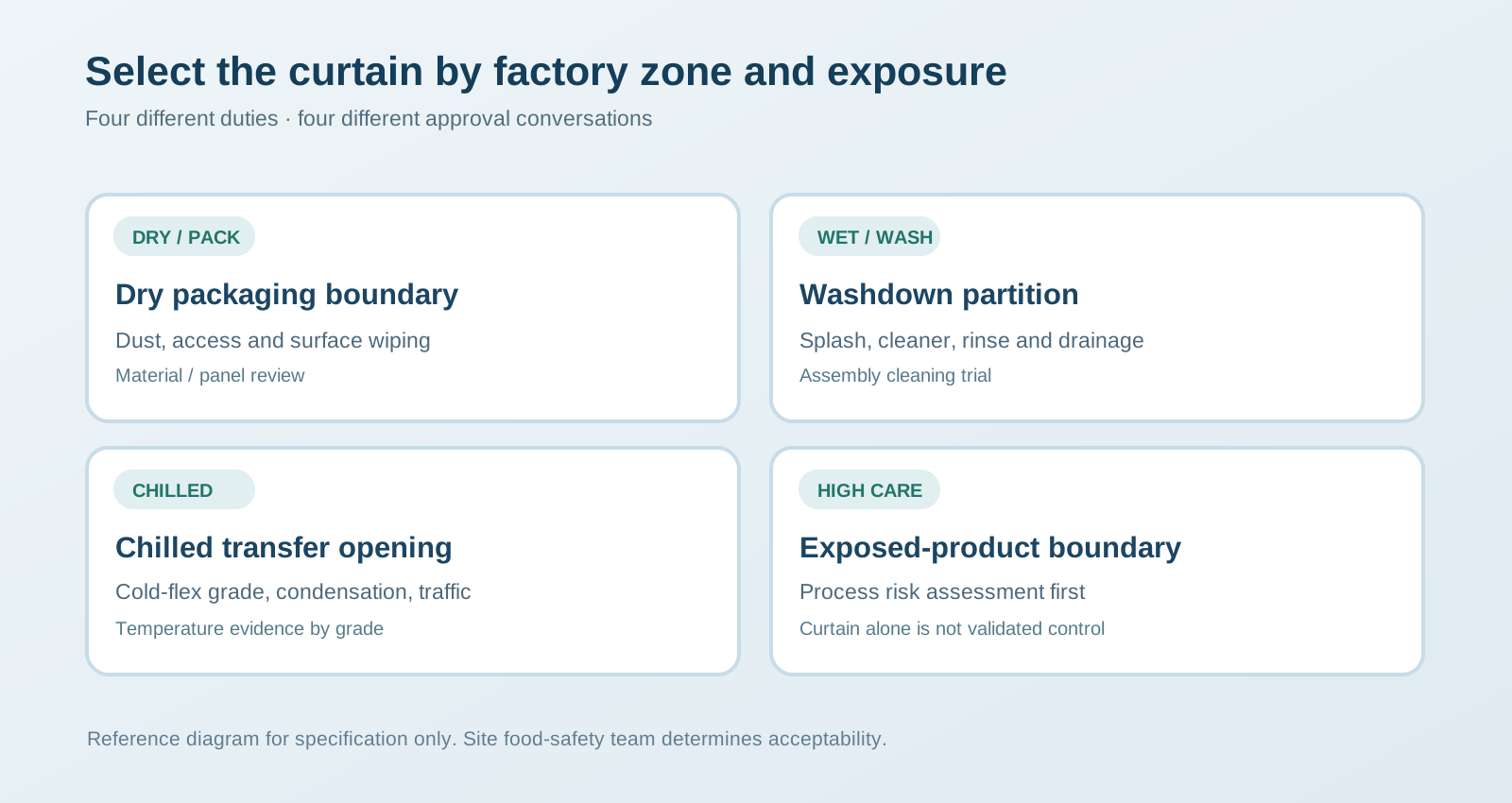
One plant can contain different duty classes. Match the panel and approval process to the specific boundary; a high-care production edge may need more than a flexible divider.
| Zone or use | What to evaluate | Decision that remains with the plant |
|---|---|---|
| Secondary packing / dry area | Opaque or clear-view reinforced panels, dust removal, traffic clearances | Cleaning access, packaging exposure and separation objective |
| Wet preparation or washdown | Smooth coated surfaces, accessible welds, removal plan, spray and sanitizer exposure | Cleaner compatibility, drying and drainage process |
| Chilled product-transfer zone | Grade-specific cold flex, condensation, repeated door movements | Lowest operating temperature and approved traffic solution |
| Exposed product / high-care | Risk assessment first; consider whether a flexible boundary is appropriate | Allergen, airborne and product-contact control validation |
On small screens, scroll the comparison table sideways to view all columns.
Reinforced PVC, clear PVC and cleanable panel interfaces
The right construction balances panel strength, line of sight, repeated operation and the ability to inspect all surfaces and joints after cleaning. There is no universal GSM or thickness that makes a divider suitable for every food facility.
PVC-coated polyester
Reinforcement supports the hanging loads of larger panels while the coating forms the exposed face. Confirm a smooth finish, coating integrity, edge treatment, chosen grade and cleaning trial. Weight alone does not establish a hygiene rating.
Clear flexible PVC
Useful where staff need visibility. Request grade-specific clarity, flexing behavior, cleaner resistance and compatibility at the window-to-body joint. Clear film must be reviewed independently of an opaque coated textile.
Seams, hems and fasteners
Arrange reinforcement and joints so wash water and soil are not trapped in inaccessible folds. Confirm the edge finish, whether sections can be removed, and which corrosion-resistant components are supplied by which party.
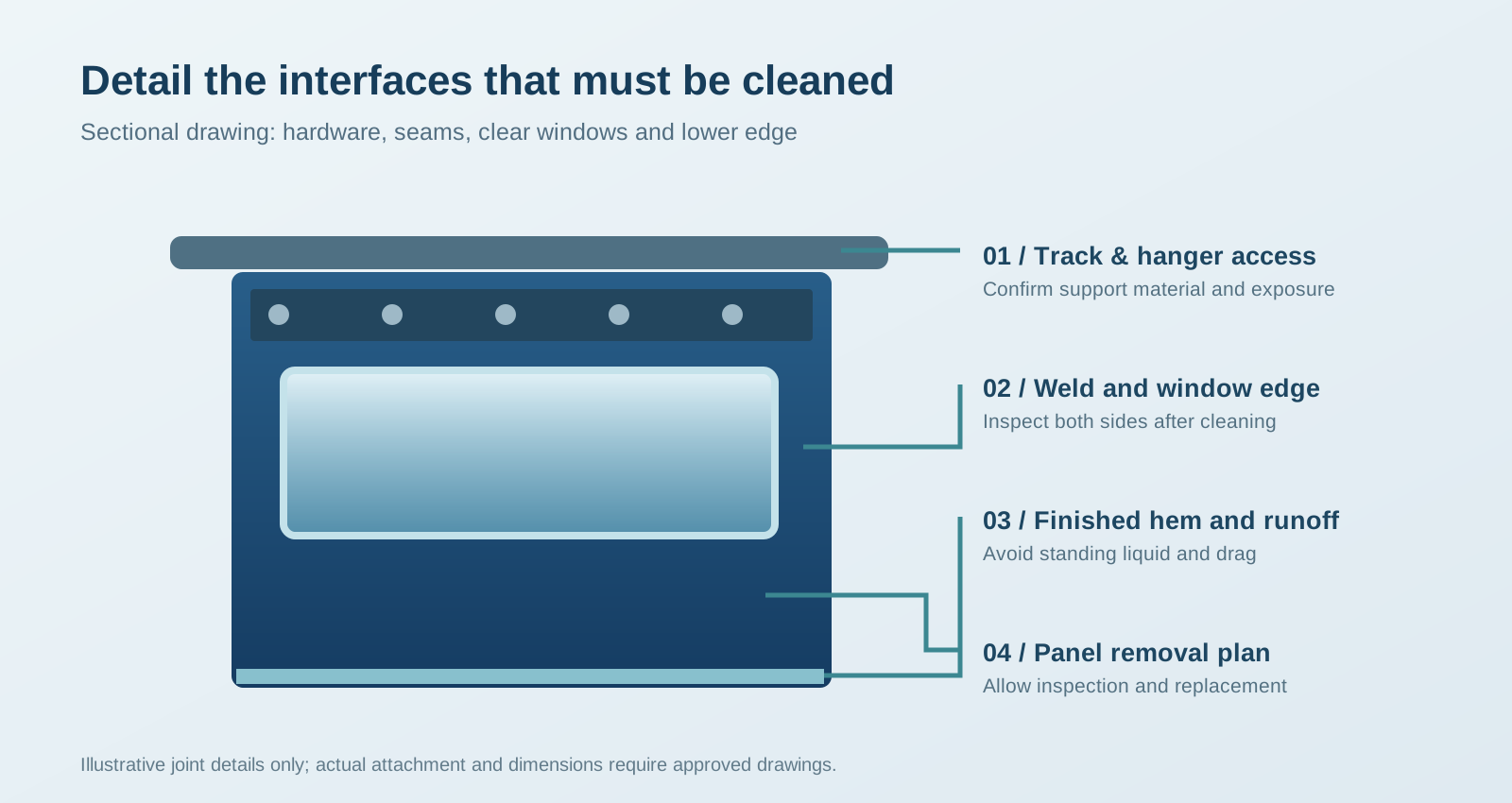
Design the inspection interfaces
- Overhead: Allow inspection behind hangers, carriers and any retained track.
- Joints: Review the actual welded seam for soil entrapment, strength and cleaning exposure.
- Windows: Place transparent bands at real sightline heights; account for cleaner-induced haze and creasing.
- Lower edge: Avoid dragging through pooling liquids; coordinate with drainage and cleaning equipment.
- Access: Define pull edges, overlaps and a removable or retractable cleaning position.
See the related roll-up industrial divider curtain design guidance for repeated vertical opening; a roll-up mechanism must be separately verified for a food-zone installation.
Will PVC divider panels survive repeated washdown?
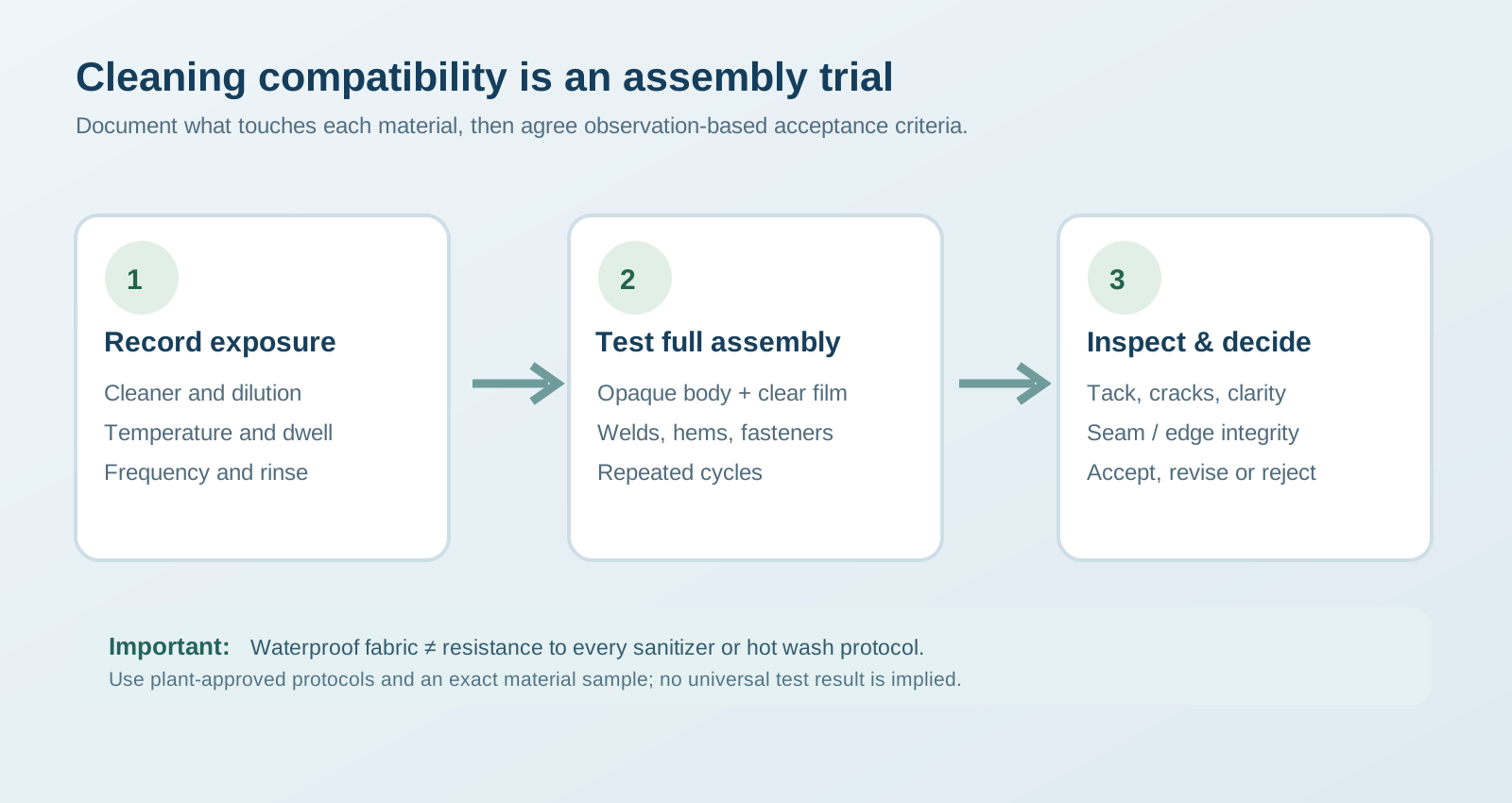
Only when the selected material and assembled joints are evaluated against the actual cleaning regime. Water resistance does not establish resistance to alkaline cleaners, oxidizing sanitizers, hot rinse, pressure spray or repeated flexing after cleaning.
Build a representative sanitation trial
- Define exposure. Record the product name, active ingredients where available, working dilution, water temperature, contact time, spray or wiping method, frequency and rinse conditions.
- Include every component. Test the opaque material, clear window, weld, hem, print, fastener and any edge seal relevant to the job.
- Repeat to match use. Agree the number of wash and dry cycles and flexing/parking pattern with the plant before approving the test.
- Inspect changes. Record swelling, tack, cracking, delamination, loss of clarity, color shift, open seams or damaged coatings.
- Approve a limit. Set measurable acceptance criteria in the purchase specification and document when the panel must be repaired or replaced.
For general industrial surface chemistry without food-zone implications, see DERFLEX's industrial dust containment curtains as a different application category; do not transfer its performance claims to a food processing site.
Food-area use and direct food contact are different approval questions
Do not treat “food grade”, “FDA approved” or “REACH compliant” as interchangeable claims. Document requests depend on the actual grade, whether food or food-contact surfaces may touch the panel, the contact conditions and the destination market.
| Intended service | Evidence to request | What cannot be concluded |
|---|---|---|
| Non-food-contact factory divider — segregation between secondary packaging or work areas | Material identification, intended-use statement, cleaning compatibility information and agreed site trial | General factory use does not make a material approved for direct food contact |
| Potential incidental contact — splash or possible contact with unpackaged food / food-contact equipment | Exact formulation/grade traceability; assessment of foreseeable contact route; any applicable market-specific regulatory evidence | Do not infer suitability from another PVC film or a generic third-party brochure |
| Intended direct food contact — a curtain designed to touch food during normal use | Relevant jurisdictional compliance basis and declarations, applicable migration assessment and specified contact time, temperature and food type | Do not promise direct-contact use without a complete, grade-specific review |
| High-care / allergen / air-handling boundary — part of process controls | Facility risk assessment, operating procedures and validation of the complete separation approach | A curtain panel or food-contact statement alone does not validate contamination control |
United States: FDA contact-status review
The FDA evaluates the substances in a food-contact material in the context of intended use. A plant curtain should not be described as FDA approved simply because PVC is used in other food-contact products. Identify the actual regulatory basis and use restrictions before making a claim.
Reference: FDA — Regulatory status of food-contact components.
European Union: grade-specific migration evidence
Where EU plastic food-contact rules apply, Regulation (EU) No 10/2011, as amended, addresses declarations and migration under defined use conditions. Regulation (EU) 2025/351 has updated parts of this framework. Ask which rules apply to the specific article and intended contact.
Reference: EU 10/2011 and EU 2025/351 amendment.
Specify service temperature and wash temperature separately
Chilled processing and refrigerated logistics may expose clear PVC or coated fabric to lower temperatures while it is flexed repeatedly. Higher temperatures can occur only during sanitation. These are different conditions and should not be compressed into one generic “temperature resistance” value.
Ask for the cold-flex behavior of the actual grade at the lowest expected service condition, together with its normal opening and closing cycle. Record hot rinse or cleaning exposures with their duration and frequency. For mixed clear-and-opaque panels, the weakest joint or material can govern the practical limit.
Air movement, condensation, stack position and access traffic also influence the installed assembly. Compare a flexible full panel with warehouse divider tarps for broad zoning requirements, but do not assume the warehouse rating answers food-area questions.
Temperature information to include in your RFQ
- Lowest service temperature (°C or °F) and duration
- Typical operating temperature on both sides of the curtain
- Highest rinse/sanitation temperature and dwell time
- Flexing frequency during chilled or hot conditions
- Exposure to refrigeration condensate or standing water
- Clear-film visibility requirements after repeated cycles
Acceptance rule: agree the permitted changes in flexibility, windows, seams and hanging edges after the agreed representative trial.
A quote-ready specification without invented universal numbers
Send a finished panel schedule and a separate use-condition sheet. Any material mass, thickness, tensile value, service limit or compliance document belongs to the selected grade—not the product category in general.
| RFQ field | Buyer should state | Acceptance document / review |
|---|---|---|
| Area / food exposure | Production type; packed vs exposed food; zones on each side; incidental contact route | Plant-approved intended-use statement |
| Material definition | Opaque coated body, transparent film, required visual quality and color | Approved exact grade samples and available data sheets |
| Finished panel schedule | Each width × drop; quantities; clear-window coordinates; clearance; overlap and access side | Signed drawing revision and tolerance schedule |
| Suspension and joints | Fixed/slide/removable; header holes; seams; welding method; exposed cut edges | Representative sample and supply-scope statement |
| Cleaners / sanitation | Product names, dilution, temperature, dwell, spray pressure, rinse and cleaning frequency | Application-specific compatibility trial criteria |
| Service temperature | Lowest/normal temperatures, flex cycles and condensation; distinct hot-wash duty | Grade-specific review or test evidence |
| Regulatory documents | Country, intended contact conditions, required declaration or migration evidence if applicable | Documents matched to specific formulation and scope |
| Commercial supply | Roll goods, cut sheets or finished panel request; accessories; packing; quantity; delivery country | Written itemized quotation, MOQ and lead-time confirmation |
The table is a buyer specification worksheet. It is not a DERFLEX published technical data sheet or a claim of available certified grades.
Work with a material-led OEM partner—not an assumed complete system
DERFLEX's documented industrial product range includes flexible PVC curtain materials, coated textiles and custom industrial divider-panel directions. This material focus helps converters, distributors and end users evaluate panel construction and repeat-order consistency.
Finished curtain panels, windows, custom edges, hooks, track, hardware and on-site installation must be separately listed in the offer. The final specification should define which organization approves installation loads, hygienic layout, sanitation SOPs and local regulatory compliance.
Where the panel shares functions with general industrial partitions, compare the custom bay-divider curtain approach for clear windows and fabricated edges—while keeping food-factory cleaning and contact review in this page's scope.
DERFLEX supply scope: confirm in writing
- Material: exact grade, rolls, cut lengths and traceable lot references
- Fabrication: whether fully welded custom panels are available for the required drawing
- Options: clear windows, reinforcements, sleeves, eyelets and packaging
- Not assumed: track systems, structural design, installation or hygiene validation
- Documentation: product-specific reports actually available and valid for the requested use
How to qualify sample, drawing and repeat shipment
A curtain used in a documented sanitation plan should be purchased against observable acceptance criteria, not only a color sample and nominal thickness.
Review the duty
Agree zone purpose, food exposure, cleaning chemicals, temperature envelope and buyer-required evidence.
Test the assembly
Review representative opaque/clear materials, seam, hem and fastener details against the sanitation cycle.
Approve the drawing
Lock panel IDs, finished size, window coordinate, mounting interface, tolerances and packaging instructions.
Verify the delivery
Review agreed inspection records and lot identification; retain approved sample and revision for reorder.
Possible inspection findings
Document exposed reinforcement, cracks, tack, persistent odor, clouded windows, open welds, inaccessible folds, permanent deformation or hanging-edge tears. Establish repair, cleaning re-test and retirement triggers before the plant starts using the panels.
Illustrative project decision
A wet-area divider with a clear viewing band may pass a dry fit check but fail repeated cleaner exposure at the welded window edge. In that case, revise the material pairing or seam before releasing a bulk order. This is an example workflow, not a DERFLEX customer case or test report.
What to send for a food processing curtain quotation
A clear specification lets the supplier respond with material options, sample needs, documentation status and a realistic fabrication scope. Send the items below with your enquiry.
Plant and design brief
- Plant area and intended process separation
- Photographs, marked drawing and panel schedule
- Clear/opaque layout and viewing-band coordinates
- Track type, hanger interface, access and floor gaps
- Expected operation / removal frequency
Exposure and commercial brief
- Cleaning chemicals and concentrations; sanitation frequency
- Minimum operating and maximum rinse temperatures
- Food-contact status and destination compliance requirement
- Requested test reports / samples and acceptance criteria
- Quantity, supply scope, destination and target delivery
Food processing curtain FAQ
Practical answers to questions raised during hygienic divider procurement.
Are all PVC industrial curtains suitable for food processing?
No. A curtain may function as a factory divider without being suitable for every food-handling zone. Review the exact formulation, use location, cleaning chemistry, contact risk, temperature and required documents before plant approval.
Can DERFLEX supply FDA-approved or food-grade curtains?
Do not assume an FDA approval or a food-contact grade from a generic PVC material name. Ask DERFLEX which specific grades and supporting documents are currently available for your intended use; any food-contact claim must match the formulation and conditions of contact.
Do I need migration testing for a non-contact divider curtain?
Not automatically. Determine whether the finished article is intended or reasonably expected to contact food, and what local rules apply. If food contact is relevant, request the applicable declaration or migration evidence for the exact material and use conditions.
Can I wash PVC panels with hot water, alkaline cleaners or sanitizer?
Only within the proven compatibility of the selected assembly. Provide cleaner names, concentration, wash temperature, contact time, method and repetition. Assess the coated body, clear film, seams, edges and hardware—not the base sheet alone.
What thickness or fabric weight is best for a food factory divider?
There is no single answer. Select around finished size, suspension loads, traffic, washdown exposure, service temperature and flexibility. Approve nominal thickness or mass and tolerances for the selected grade and representative panel sample.
Can flexible curtains guarantee allergen containment or hygiene separation?
No. They can support physical segregation, but a curtain alone does not validate allergen control or airborne contamination prevention. The facility must evaluate openings, air movement, people and material flows, sanitation and the entire control plan.
Should a cold-area curtain be selected by its wash temperature?
No. State the lowest working temperature and the sanitation temperature separately. Review cold flexing and repeated opening for the exact material alongside any short-duration hot cleaning exposure and the welds between clear and opaque sections.
Does the quote include rails, installation and food-safety validation?
Not by default. Request an itemized quote defining rolls, cut pieces, finished panels, clear windows, headers, hardware and services separately. Installation safety, track engineering and site hygiene validation require clearly assigned responsibilities.
Build a curtain specification that your plant can approve.
Send the factory zone, cleaning regime, service temperature, material direction, required documents and panel drawing. We can review available materials and project-specific custom panel options for an itemized quotation.
Extend the technical review
Material selection
Industrial Door Curtain Fabric — compare flexible clear PVC and reinforced textile directions.
Traffic patterns
Industrial PVC Strip Curtains — review overlapping strip doorway designs.
General zoning
Warehouse Divider Tarps — compare broader partition objectives.
Regulatory references are supplied for background only and do not certify any DERFLEX material or completed hygienic installation. The facility's qualified compliance team should review current requirements.