



Flame Retardant Heavy Duty Tarps for Industrial & OEM Applications
A flame retardant heavy duty tarp combines reinforced PVC-coated polyester construction with a project-specified flame-performance requirement. DERFLEX works with distributors, fabricators and industrial buyers on FR vinyl tarp material, cut panels and custom finished covers. The right choice starts with the applicable test route, then balances fabric strength, seam design, outdoor exposure and documentation. Share the intended use, country, size and requested report before selecting a material grade.
What Makes a Heavy Duty Tarp Flame Retardant?
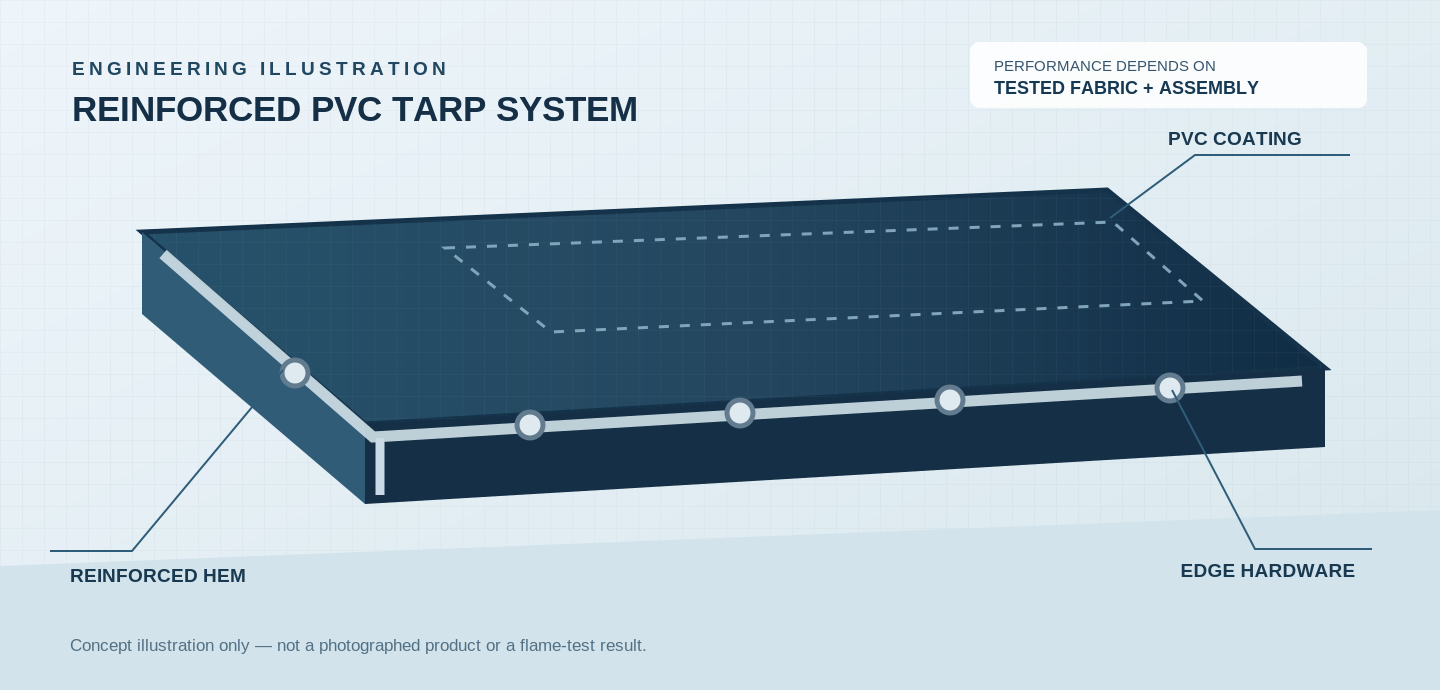
Heavy duty describes the physical duty of a cover; flame retardant describes a separate behavior measured under a specified fire test. A thick ordinary vinyl tarp does not become an FR tarp by weight alone. A purpose-designed formulation may limit ignition or flame propagation under test conditions, but its result must be documented for the specific product.
Mechanical duty
High-tenacity polyester reinforcement, PVC coating, edge reinforcement and correctly located tie-downs help address tearing, handling, folding and abrasion. Ask for warp and weft strength, tear results and finished seam quality rather than GSM alone. See DERFLEX's heavy duty tarp overview for the wider industrial product family.
Flame-performance duty
The FR compound, substrate, coating weight, finish and application govern the tested response. A report should identify its method, result, construction and conditions. For the difference between ordinary and FR covers, read when a fire retardant tarp is needed.
NFPA 701, B1 and Other FR Routes: What Should Buyers Request?
There is no universal FR mark valid for every tarp, destination country or installation. Ask the project authority, venue, insurer or specifier which test and edition are required; then obtain evidence for the matching material. The terms below are requirements to investigate, not claims that every DERFLEX grade has passed.
| Test / class | What it addresses | Buyer must verify | Important boundary |
|---|---|---|---|
| NFPA 701 (2023) | Flame propagation of textile and film specimens. Method selection depends on material and application. | Edition, Method 1 or 2 as applicable, specimen definition, lab report and authority acceptance. | Not a blanket building, tent or finished assembly approval; NFPA 701 Method 2 includes tarps in its stated scope. |
| DIN 4102-1 B1 | German reaction-to-fire classification: schwerentflammbar (flame-retardant building material). | Exact B1 classification, relevant product build, test setup and intended installation. | Not interchangeable with NFPA 701 or automatically equivalent to an EN Euroclass. |
| EN 13501-1 | European classification of reaction-to-fire performance for construction products. | Requested Euroclass plus smoke and flaming-droplet suffixes, where applicable. | A DIN B1 claim alone does not identify a specific EN 13501-1 class. |
| French M1 / M2 or other local route | Regional reaction-to-fire requirements may arise for temporary enclosures, venues and coated textiles. | Exact local standard, class, report validity and approval scope. | Class labels from different national schemes must not be treated as synonyms. |
For detailed regional terminology, consult the DERFLEX PVC tarpaulin flame-test standards guide. Normative sources: NFPA 701 and DIN 4102-1. Confirm current applicable editions with the competent authority.
Heavy Duty FR Vinyl Tarp Specifications to Lock Before Sampling
DERFLEX's existing catalogue discusses a broad 420–1200 g/m² FR PVC tarpaulin design range. This is a discussion window, not a verified list of simultaneously available certified SKUs. The final fabric code, colour, coating formula, roll width and test-report coverage must be confirmed for each order.
| Field | Design or supply discussion | Acceptance decision |
|---|---|---|
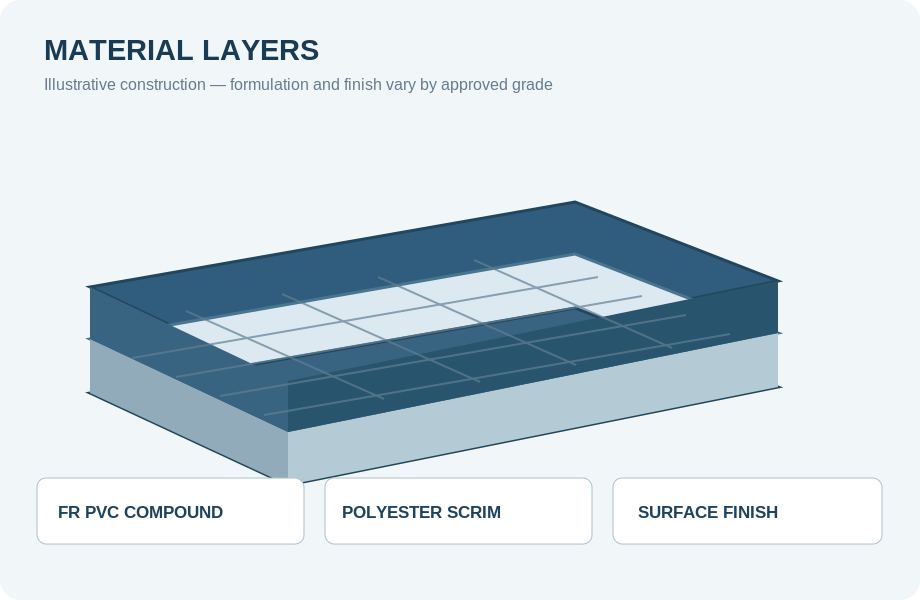
| Substrate and coating | Woven polyester scrim with PVC coating or lamination and an FR formulation route. | Approved build, coating sides and material code. |
| Weight / thickness | Catalogue planning window: approx. 420–1200 g/m²; thickness to be specified independently in mm. | Grade-specific nominal value, tolerance and actual test document. |
| Reinforcement | 500D, 1000D or other project-defined polyester yarn structures are discussed in DERFLEX's existing range. | Warp / weft tensile, tear test method and required limits. |
| Roll width / color | Project-dependent rolls, colours and surface finishes. | Usable width after trimming and report coverage for the supplied variant. |
| FR requirement | NFPA 701 route, DIN B1 or authority-specified classification as applicable. | Method, edition, report number, tested build and acceptance authority. |
| Finished tarp | Cut panels, welded joins, hems, eyelets, webbing, corner patches and OEM packaging. | Finished drawing, seam design, installed orientation, dimensional tolerance and inspection plan. |
| Service environment | Outdoor UV, rain, cold folding, cleaning and abrasion considered separately. | Evidence where specified; no lifetime guarantee inferred from FR testing. |
For the basic textile construction and coating options, explore DERFLEX PVC tarpaulin materials. Weight is not a substitute for tensile strength, tear resistance or FR testing.
Why the entire construction matters
- PVC formulation: changes to additives or plasticizer can alter flame behavior.
- Textile scrim: influences tensile and tear behavior, particularly around edges.
- Surface finish: lacquer, print and pigments should remain within the tested evidence scope.
- Fabrication: welded seams, repairs and accessory materials can require additional review.
- Outdoor use: UV exposure and cleaning should be checked against project service conditions.
For raw textile rolls rather than finished covers, see the FR tarpaulin fabric manufacturer page.
Where Are FR Heavy Duty Tarps Used?
Use the site hazard assessment and applicable code to decide whether an FR PVC tarp is suitable. A materials test can support selection, but it does not certify the safety of the entire enclosure, truck system or tent.
Construction enclosures
Weather covers and scaffold-related barriers may need a specified fire test. Confirm mounting, ignition exposures, local regulations and whether the application is considered a construction product.
Warehouse partitions
Flexible bay dividers and temporary zones require review of traffic, air movement, clearances and the applicable fire requirements. FR does not create a rated fire barrier.
Industrial equipment covers
Protect stored equipment from dust or rain while avoiding direct heat sources and moving parts. Confirm abrasion, venting, drainage and access points.
Transport covers
Truck and cargo covering can require tear strength, waterproof seams and tie-down reinforcement. FR performance is optional and must match the actual contract.
Temporary tents and event covers
Request the precise venue or local authority standard. Fabric compliance does not on its own approve the structural or fire performance of a tent installation.
Distributor / OEM programs
Private-label ranges benefit from controlled materials, labels, packaging, drawing revisions and report-to-SKU traceability; avoid blanket certificates across mixed grades.
From Tested Fabric to Finished Tarp: Control the Critical Details
Procurement teams often buy a certified-looking material, then alter seams, labels, patches or coatings in conversion. Avoid that gap by recording what is included in the tested item and what changes during fabrication.
Four details to approve on a finished cover
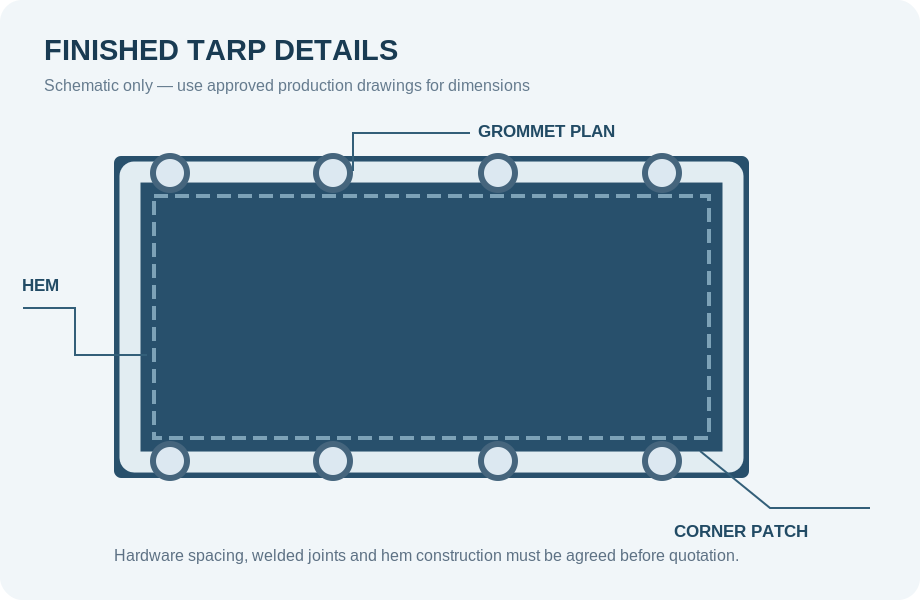
- Seam construction: compatible weld method, seam overlap, joint continuity and inspection.
- Edge load path: hem width, webbing, corner patch and tie-down stress.
- Accessory compatibility: metal hardware, rope, adhesive labels and print layers.
- Traceability: the finished label and production record linked to the approved material grade.
A material-only report should not be described as a full system approval. The manufacturer and buyer should check whether the specified finished configuration requires separate evidence.
| Document | Generally supports | Does not automatically prove |
|---|---|---|
| Raw material FR test report | Flame behavior of described test specimen and construction. | Every color, print, welded edge or installed enclosure. |
| Material tensile / tear report | Measured properties of specified textile material in named directions. | Grommet pull-out strength or wind resistance of a finished cover. |
| Finished fabrication inspection record | Dimensions, workmanship, hardware and approved layout. | Fire classification unless the finished configuration was assessed. |
| Installed system approval | Only what the actual approval document states for that configuration. | Different supports, conditions, jurisdictions or future modifications. |
How to Verify an NFPA 701 or B1 Tarp Test Report
For specification-controlled industrial sourcing, the most useful evidence is the chain connecting the sample, test report and material delivered. Ask these questions before accepting a claim on a product listing or export document.
End use, jurisdiction, standard edition, test method or class, and responsible authority.
Identify base fabric, coating formula, weight, color, finish and test conditions.
Check lab identity, report reference, date, results, limitations and scope.
Approve the sample and retain batch codes and change records for later production.
Document packet to request
- Relevant third-party or accepted laboratory report for the exact grade.
- Technical specification with finished/roll supply scope.
- Approved material code and retained physical reference sample.
- Fabrication drawing with hardware and seam requirements.
- Batch identification and change-control agreement where applicable.
Questions that signal a mismatch
- The report lists a different GSM, coating structure or finish.
- The claimed B1 classification comes from an unrelated DIN or GB/T route.
- A report for Method 1 is shown although the tarpaulin's required route differs.
- A printed or welded finished tarp is asserted to be covered without supporting scope.
- The customer needs a current local approval but only marketing text is supplied.
Prepare a Precise FR Tarp RFQ for Roll Supply or Finished Covers
A precise request lets the supplier determine the suitable route before promising a report or quoting a production grade. You can begin with an application photo or sketch if the performance requirement has not yet been finalized.
Include these fields in your inquiry
- Project use and destination country / region
- Exact FR standard, edition and required class / method
- Roll fabric, cut panels or finished tarps
- Finished size, drawing and quantity by size
- Desired GSM or tensile / tear performance
- Colour, finish, printing and weather exposure
- Seam method, hem, webbing and grommet plan
- Test report and sample approval requirements
- OEM labeling and packaging requirements
- Required delivery window and destination
Cost is affected by material build, qualification tests, custom colour, cutting yield, seam metres, reinforcement, quantity and packing. MOQ, confirmed lead time, price and any certification cost should be given in an actual quotation, not assumed from a generic website claim.
Before you order
Review fire exposure and applicable legal requirements with the qualified project team. Confirm finished size versus cut size, installation clearance, attachment forces, drainage, fold cycle, storage and cleaning method. Outdoor use may require separate weathering evidence; do not assume an original FR report documents years of sunlight or repeated washing.
Flame Retardant Heavy Duty Tarps FAQ
Concise answers for engineering, compliance and procurement teams evaluating FR PVC-coated tarp materials and finished covers.
Are flame retardant heavy duty tarps fireproof?
No. FR tarps are intended to limit ignition or flame propagation under specified test conditions. They are not noncombustible, nor substitutes for welding blankets or continuous high-temperature barriers.
Does an NFPA 701 tarp automatically meet building fire-code requirements?
No. NFPA 701 evaluates flame propagation of textiles and films. Applicable test method, report scope and acceptance by the responsible authority must be confirmed for the exact installation.
Is a DIN 4102 B1 tarp equivalent to an NFPA 701 tarp?
No. DIN 4102-1 B1 and NFPA 701 use different classification or test approaches. A report for one does not establish a pass under the other.
Does thicker or heavier PVC tarpaulin provide better fire retardancy?
Not necessarily. Fabric weight does not establish a flame classification. Coating formulation, construction, finishing and the documented test method must be assessed separately from tensile and tear strength.
Can a tested FR PVC fabric be fabricated into a compliant finished tarp?
Potentially, but a material report does not automatically cover every finished configuration. Seams, reinforcement, webbing, printing and installation details must be checked against the report scope and project requirements.
What should I send to request a custom FR tarp quotation?
Send the intended use and destination market, required flame-test standard and report, size or drawing, expected mechanical duty, color, quantity, edge hardware, delivery requirements and any sample or testing timetable.
Get a Material-Matched, Documentation-Ready FR Tarp Quote
Send your application, required test route, drawing and quantities. DERFLEX can discuss the matching PVC construction, fabrication scope, sample review and the evidence that must be checked before purchase approval.