Coordinated tarps
Identify each front, center or rear cover by finished size, flap arrangement, fabric and piece count. Mark panels so the intended layout is clear.
Custom cover scope


CUSTOM COVER SETS · OPEN-DECK FREIGHT
Plan a coordinated tarp set for lumber, steel or mixed freight—with the coverage, reinforcement and component list defined before you order. DERFLEX manufactures custom PVC coated polyester covers, panels and roll materials for fleets, importers and private-label programs.
Specify finished sizes, side drops, end flaps, D-ring layouts and packing. For a flatbed starter kit, identify every accessory separately and confirm its inclusion in the quotation.
THE QUICK ANSWER
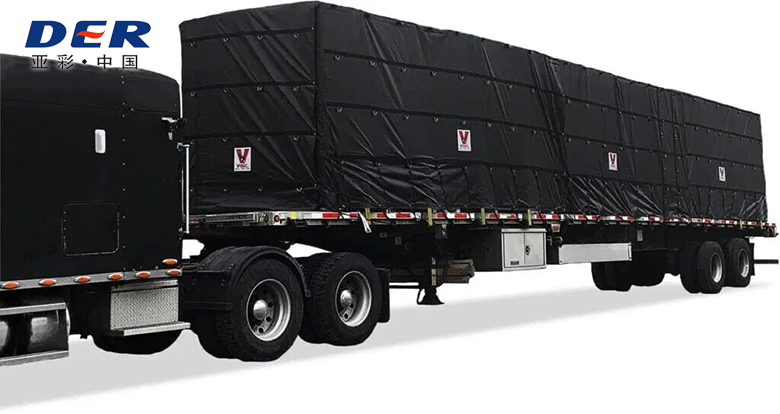
A flatbed tarp kit combines one or more cargo covers with a defined list of supporting components. A tarp-only set supplies coordinated covers; a broader flatbed starter kit may also contain tarp ties, edge protectors and cargo-securement equipment. Contents vary by supplier and order.
Start by deciding whether you need replacement covers, a multi-piece covering set or a wider equipment bundle. DERFLEX’s flatbed tarp range provides the cover foundation; the quotation should identify the exact scope of your kit.
01 / CHOOSE THE COVERING PLAN
Configuration directions for quotation—not fixed DERFLEX stock bundles. Confirm dimensions, quantities and accessory availability before ordering.
| Kit direction | Cover configuration | What to resolve before buying |
|---|---|---|
| Lumber tarp kitTALL / RECTANGULAR LOADS | Deeper-drop covers with end closure appropriate to stacked building materials. | Match stack height, rear flap and longitudinal overlap. Review lumber tarp construction before selecting the set. |
| Steel tarp kitLOW / DENSE FREIGHT | Shorter-drop rectangular covers, with padding planned at exposed contact edges. | Define usable drop and tie locations around plate, pipe or bundled profiles. See the steel tarp guide for cover geometry. |
| Mixed-freight tarp setVARIABLE ROUTES & LOADS | Separate cover families or modular front, center and rear panels. | Test each intended combination. More pieces add seams, overlaps and attachment work; they do not automatically improve weather protection. |
| Hotshot / compact kitSMALLER LOAD ENVELOPES | Load-specific panels with a manageable finished weight and storage footprint. | Check lifting method, cargo protrusions, attachment reach and packed volume. Trailer type alone does not determine cover size. |
02 / DEFINE THE BILL OF MATERIALS
Use a line-item bill of materials (BOM). Record a description, specification, quantity per kit and supply responsibility for each item. “Complete kit” is not a substitute for an agreed contents list.
Identify each front, center or rear cover by finished size, flap arrangement, fabric and piece count. Mark panels so the intended layout is clear.
Custom cover scopeDocument hems, webbing, D-ring rows, grommets and wear patches on each panel drawing. These are part of the cover specification.
Specify on the drawingList tie length, hook style, quantity and spare allowance if required. Determine quantities from the actual fastening plan and attachment reach.
Confirm supply & inclusionIdentify where the tarp contacts corners, exposed steel or rough timber. Specify compatible protection and separate it from strap edge protection.
Confirm supply & inclusionList these separately if a wider starter bundle is needed. Confirm applicable ratings, fittings and documentation with the equipment supplier.
Separate confirmation requiredAgree kit ID, panel labels, carton or pallet grouping and a contents sheet. State whether covers and accessories ship together or separately.
Agree in the purchase orderDERFLEX supply scope: Custom tarp manufacturing is verified in the current product range. A standard stocked accessory bundle has not been established here. Request written availability and pricing for each loose accessory; only items expressly included in the accepted quotation form part of the order.
03 / CHECK COVERAGE BEFORE QUANTITY
Measure the loaded cargo envelope. Deduct overlap from combined panel lengths, then allow for front and rear coverage. A nominal trailer length does not tell you how much usable cover remains.
For an 8 ft wide rectangular cargo top, the theoretical starting widths are:
These are geometry examples, not finished order sizes. Confirm slack, contour, hem construction and tolerances. End flaps and irregular cargo require their own dimensions.
Equal-length panels in one straight sequence. Enter finished panel lengths in feet; this checker does not size flaps or design a fastening system.
Usable length = panel count × panel length − (panel count − 1) × overlap. Compare with cargo length + end allowance. Overlap is a project input; 2 ft is an example, not a universal requirement.
MATERIAL & CONSTRUCTION REFERENCES
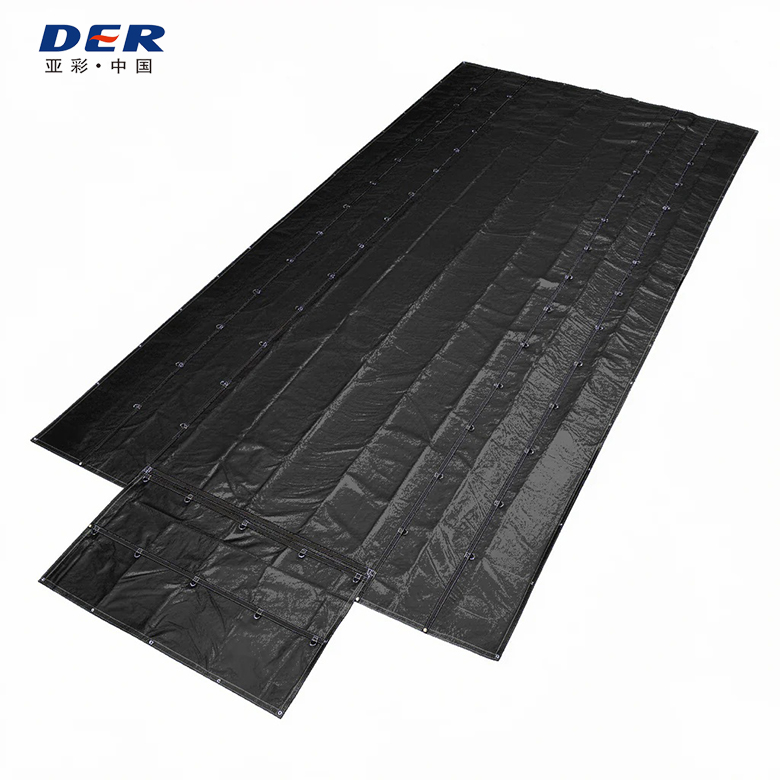
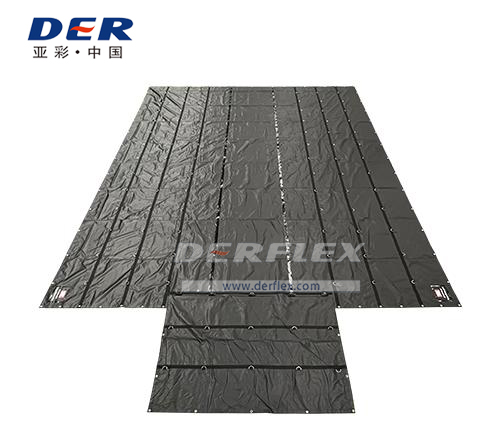
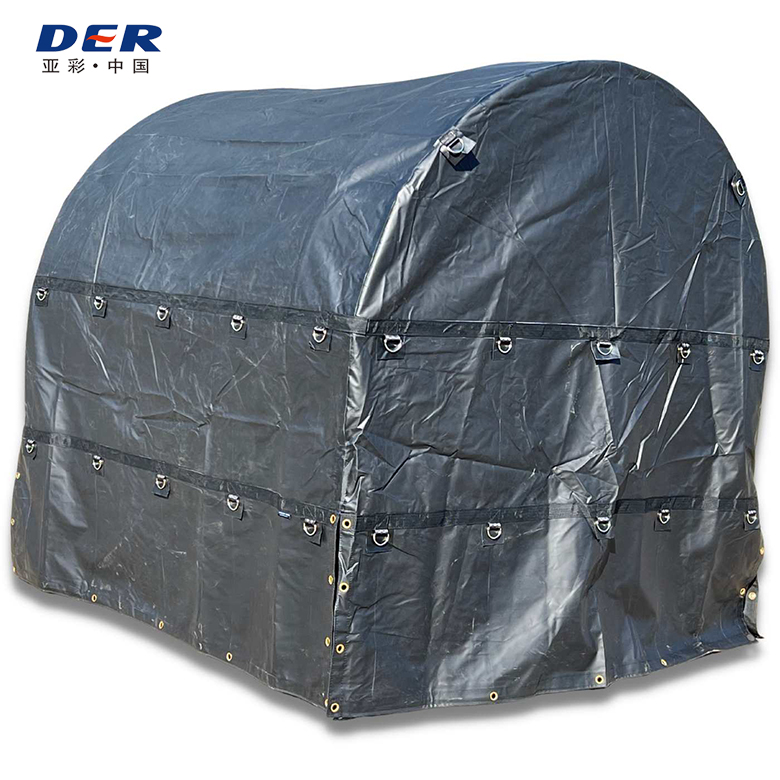
DERFLEX product photographs show cover geometry and built-in attachment details. Use your approved drawings to define which features belong on each ordered panel.
04 / TURN A KIT IDEA INTO A SPECIFICATION
For a heavy duty flatbed tarp kit, material weight is only one decision. DERFLEX’s PVC tarpaulin material options provide a starting point for matching the substrate, coating and fabrication to the intended route.
| Specification | What to document | Buyer acceptance focus |
|---|---|---|
| Material & mass | PVC coated polyester; requested GSM or oz/yd², base textile and coating structure. | Compare like-for-like construction. 18 oz/yd² is approximately 610 g/m²; it is mass per area, not thickness. |
| Finished dimensions | Width × length for each panel, side drop, front/rear flaps, overlap and tolerances. | Specify finished dimensions after fabrication; identify whether quoted length includes a flap. |
| Hems & fittings | Edge reinforcement, D-ring row positions, spacing, grommet pattern and patch details. | Use a dimensioned drawing. Match tie reach to real trailer attachment locations. |
| Seams & weather barrier | Seam positions, welding or sewing method, flap closures and any agreed leakage check. | Assess the completed assembly. A waterproof coated sheet does not seal an open overlap or exposed opening. |
| Route performance | Cold handling, UV exposure, abrasion and any required test method with acceptance value. | Confirm evidence for the selected grade. No universal service-life, temperature or certification claim is assumed. |
| Handling & packing | Finished weight per piece, folded size, panel ID, quantity per kit and carton/pallet grouping. | Check lifting and storage practicality; reconcile physical pieces with the packing list. |
| Commercial scope | Cover price, each accessory line, order quantity, sample scope, destination and delivery basis. | MOQ, lead time, accessory supply and freight costs require a project-specific quotation. |
Compare weight consistently. An 18 oz fabric label normally means ounces per square yard. Finished piece weight also includes end flaps, extra fabric at seams, reinforcement and fittings. Ask for the finished cover weight when planning handling.
05 / DETAILS THAT PREVENT MISMATCHES
Arrange the joint so water can shed over it, rather than collect in an upstream-facing pocket. Record the required overlap and attachment method for each operating layout. A loose overlap can open as the cover moves.
Check the distance between tarp fittings and permitted trailer anchors across the expected load heights. Confirm hook compatibility and follow the tie manufacturer’s stretch and use instructions; a longer elastic tie is not a remedy for an undersized cover.
Show sharp corners, rough ends and moving contact points on the load sketch. Padding and local reinforcement solve different parts of the wear problem. Use the truck tarp abrasion guidance to develop a contact-zone plan.
For a multi-piece set, compare the heaviest cover—not just total kit weight—with your handling procedure. An extra center panel can redistribute weight, but it also creates another joint to close and inspect.
06 / WHOLESALE & OEM PROCUREMENT
For wholesale flatbed tarp kits, fleet replacement programs and distributor stock, define the approved kit as a revision-controlled cover drawing plus a contents list. DERFLEX’s custom truck tarp manufacturing program supports discussions on finished size, reinforcement, fittings, branding and supply format.
Resolve the cover configuration and every included component.
Agree the reference specification before releasing production.
Agree checks for dimensions, seams, fittings and any specified performance.
Match panel IDs, accessories and labels to the order contents sheet.
PRACTICAL BUYER QUESTIONS
Clear answers on kit contents, dimensions, materials and purchasing.
There is no universal contents list. A tarp set may contain only coordinated covers; a flatbed starter kit may add rubber tarp ties, edge protectors, straps or other equipment. Confirm each item, specification and quantity in the accepted quotation.
Lumber tarp kits generally use deeper-drop covers and end coverage for tall rectangular stacks. Steel tarp kits generally use shorter-drop covers for lower-profile freight. Cargo dimensions and sharp contact edges determine the actual cover and protection requirements.
Not automatically. Two 27 ft panels provide 54 ft before overlap. With a 2 ft overlap, usable longitudinal coverage is 52 ft, which is already short of a 53 ft load before allowing for front or rear coverage. Check finished panel dimensions and any separate flap geometry.
No. 18 oz/yd² PVC coated polyester is a familiar market construction, but fabric mass alone does not define the finished cover. Select material, reinforcement, seams and panel size around wear exposure and handling, then confirm the chosen grade with DERFLEX.
Determine the quantity from the intended fastening layout and the attachment points actually used, with any agreed spare allowance. Do not assume every D-ring is used simultaneously. Confirm tie reach, hook compatibility and use limits with the tie supplier.
No. The kits discussed here are removable covers with a defined component list. A rolling or retractable flatbed system uses a compatible frame, rails and moving hardware. A replacement cover for that system needs its own system-specific dimensions and attachment details.
DERFLEX’s verified range includes custom tarps and coated-fabric supply. Chains, binders, loose tarp ties and other accessories must be requested and confirmed individually in writing. Do not assume they are included or available without an itemized quotation.
DERFLEX can discuss finished dimensions, fabric, reinforcement, D-ring and grommet layouts, color, logo, labels and packing. Send the cover drawing, quantities per kit, total order quantity and destination. MOQ, sample scope and lead time require confirmation for the selected specification.
BUILD YOUR COVERING PROGRAM
Share cargo dimensions, cover count, drops, overlaps, accessory requirements, order quantity and destination. Start with a specification that purchasing, fabrication and receiving can all use.