Confirm both working edges
Identify how the fabric attaches to the front roller and how the rear crossbar enters or fastens to the cover. Record the deployed landing point and the space available when stowed.



Replace worn fabric with a cover specified around your truck’s working flip-arm system. DERFLEX supports custom mesh and solid PVC/vinyl covers with drawing-defined dimensions, roller attachments, rear crossbar pockets and targeted reinforcement. Start with the system model, installed photos and finished cover measurements so the new panel can be reviewed for deployment, clearance and retraction.
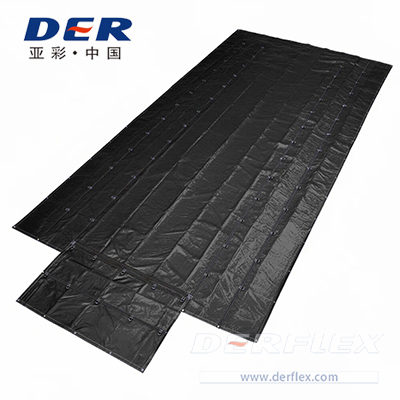
A flip tarp replacement is the fabric cover fitted to an existing arm-operated truck tarping system. On a typical front-to-back system, pivoting arms carry a rear crossbar while the cover winds onto a front roller. Correct replacement depends on the finished panel size, both attachment edges and the full operating path, as well as material suitability.
“Flip tarp” can describe different arm-operated arrangements. This page focuses on replacement fabric for front-to-back truck systems; other flip layouts need their own geometry review.
Identify how the fabric attaches to the front roller and how the rear crossbar enters or fastens to the cover. Record the deployed landing point and the space available when stowed.
Side-opening, hinged and two-panel systems can have different shapes, edge retention and overlaps. Supply drawings and panel orientation rather than treating them as the same rectangular replacement.
A motorized system is not automatically compatible with a heavier cover. Fabric mass, pocket build and reinforcement affect the load on the mechanism and the space needed for winding.
Need to identify a different operating arrangement? Compare DERFLEX’s truck tarp system configurations.
Truck-body length alone cannot define a flip tarp replacement cover. Use the system manufacturer’s measuring convention, check the old fabric in a relaxed condition, and resolve differences against the equipment before approving production.
Mesh and solid covers solve different problems. Changing the material can also change winding bulk, airflow and operating forces. Review that change before retaining the old dimensions.
| Working requirement | Material direction | What to verify |
|---|---|---|
| Aggregate, brush or landscape loads | PVC-coated polyester mesh where airflow and suitable load coverage are priorities. | Mesh opening relative to the load, yarn construction, edge abrasion and pocket reinforcement. Mesh is not rainproof. |
| Rain-sensitive or finer cargo | Solid PVC/vinyl where a closed fabric surface is required. | Coverage gaps, seam construction, water drainage, fabric mass and the system’s approval for solid material. The assembly is not a sealed enclosure. |
| Sharp or irregular debris | Load-specific fabric review with local wear protection. | Contact with protrusions, repeated snag points and handling practice. More GSM does not remove puncture risk. |
| Cold-weather daily operation | Verified low-temperature flexibility for the actual exposure. | Minimum operating temperature, flexing conditions and selected-material test evidence. Confirm the required limit with DERFLEX. |
| Asphalt or another hot load | Separate heat-duty assessment before material selection. | Actual contact temperature, exposure duration and documented material suitability. Ordinary PVC/vinyl is not an assumed hot-load solution. |
Compare the broader dump truck tarp material options, or explore mesh replacement tarp construction when airflow is the main requirement.
DERFLEX’s custom cover manufacturing can be discussed at the fabric, panel or finished-cover level. The following specification framework separates the information to request from the values that still need approval.
| Specification item | Custom sourcing direction | Approval record |
|---|---|---|
| Fabric construction | Coated polyester mesh or solid PVC-coated polyester; weight, finish and color selected for the duty. | Material reference, weight/thickness where relevant, and agreed performance requirements. |
| Finished geometry | Drawing-defined width, length and any taper, cutout, flap or asymmetry. | Dimension endpoints, units, measurement condition and agreed tolerances. |
| Roller and crossbar edges | System-specific pockets, sleeves, reinforced fastening edges or other agreed retention construction. | Section detail, usable opening, insertion direction and attachment layout. |
| Reinforcement | Hem build, webbing, pocket-mouth protection and local patches where appropriate. | Position, layer count, seam path and clearance at the tightest operating point. |
| Seams and fittings | Sewn and/or welded construction according to fabric and joint design; fittings only where required. | Joint location, water-control requirement, hole spacing and hardware responsibility. |
| Identification and packing | OEM label, size/revision identification and agreed export packing. | Part reference, quantity per pack, orientation label and carton marks. |
No universal GSM, pocket size, temperature rating or finished-size tolerance is specified here. Request the values and supporting information for your selected construction.
Photograph recurring damage before discarding the old tarp. The location often points to an interface problem that a heavier fabric alone will leave unresolved.
Check the bar end, insertion opening and nearby arm connection. Review local reinforcement and its seam transition while preserving the clearance needed for movement.
Compare left and right clearance, roller alignment and contact with rails or pivots. Correct the rubbing source before approving added wear strips.
Examine repeated bend locations, stiff repairs and accumulated dirt. Ask for a fabric-flexibility review against the actual winding and temperature conditions.
Recheck the measurement endpoints, cover orientation and permitted fabric build. Do not compensate for uncertain fit with extra length, layers or spring adjustment.
For other frames and cover types, see the custom replacement tarp sourcing guide.
These photographs are from the DERFLEX website. They show related tarp construction and coated-fabric processing, rather than a confirmed fit to a particular flip system.
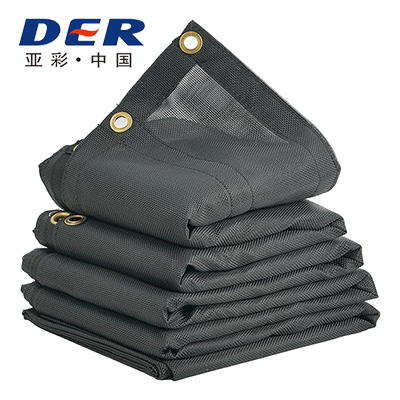
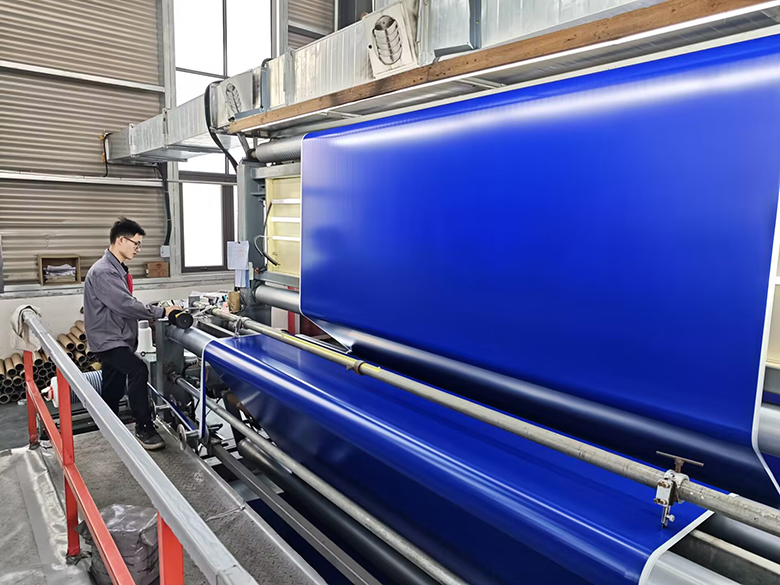
For custom flip tarp covers, a clear reference pack helps establish fit and manufacturing scope before price comparisons. Include the following information with your request.
Price, MOQ, samples and production lead time are confirmed for the actual specification. Request a quotation for your quantity and destination; no standard stock or dispatch promise is implied.
Practical answers for fleet buyers, repair shops, distributors and equipment OEMs.
Often, yes, if a qualified inspection confirms that the roller, arms, pivots, crossbar and drive remain serviceable. The new fabric must match the attachment geometry and operating envelope. A replacement cover does not correct bent arms, faulty springs or an overloaded drive.
No single cover specification fits every system. Two trucks with similar body dimensions can use different roller attachments, crossbar sleeves and arm clearances. Supply the system make and model where available, then verify the drawing against the equipment; a brand name alone is insufficient.
There is no reliable allowance for every flip system. Required length depends on roller location, retained engagement, rear landing position and the manufacturer’s measurement convention. Use the system instructions and confirm finished cover length on a drawing instead of applying a general add-on rule.
Possibly, when attachment dimensions, travel, stowed volume and permitted fabric load are the same. The operating method alone does not establish compatibility. Review the selected fabric and reinforcement with the system supplier, particularly when changing from mesh to a heavier solid cover.
Choose mesh when airflow and suitable loose-load coverage are the priority; it does not keep out rain or reliably contain every fine particle. Consider solid PVC/vinyl for rain-sensitive loads, subject to system approval. Waterproof fabric does not make the complete truck body watertight, and standard PVC should not be assumed suitable for hot asphalt.
Price depends on finished dimensions, fabric construction, pockets, local reinforcement, quantity, labeling and packing. Ask DERFLEX to confirm MOQ, sample arrangements and production lead time for the approved specification and destination. For a new fit, agree the sample or pilot-installation approval step before placing a bulk order.
Share the system reference, finished dimensions, interface photos, cargo and order quantity. DERFLEX can review the custom cover requirements an, d confirm the quotation scope for your project.