01
Rain & Moisture Entry
Water can dissolve salt, wet the stock surface and contribute to fertilizer caking. A coated tarp works best when welded seams, overlaps and drainage are planned together.



Large stockpiles of road salt, fertilizer and other moisture-sensitive bulk materials need more than a thick sheet. The cover system must control rain entry, runoff, caking risk, wind uplift, repeated loader access and material-contact exposure.
DERFLEX supplies PVC coated polyester tarp material and fabricated stockpile covers with custom panel layout, welded seams, reinforced perimeters, attachment hardware and project-specific surface or compatibility review.
Answer the storage problem first, then select the tarp construction.
For road salt and many dry fertilizer applications, PVC coated polyester is a practical reusable direction because it combines a continuous coated surface with textile reinforcement and heat-weldable fabrication. It should not be described as universally “chemical-proof.” Exact compatibility must be checked when the cover has direct, repeated or wet contact with the stored product.
Salt and fertilizer storage combines weather exposure with bulk-material handling and, in some cases, chemically aggressive residue.
Water can dissolve salt, wet the stock surface and contribute to fertilizer caking. A coated tarp works best when welded seams, overlaps and drainage are planned together.
Salt-bearing runoff can create site-management and environmental problems. Coverage should be coordinated with the storage pad, drainage and loading procedures.
Many mineral fertilizers absorb moisture from humid air. Surface wetting and condensation can worsen clumping and reduce flowability during handling.
The textile itself does not rust, but chloride-rich or fertilizer residue can attack metal hardware and nearby structures. Hardware should be selected for the actual exposure.
A wide pile produces large wind-exposed surfaces. The reinforced perimeter and anchor system must spread load instead of concentrating force into isolated grommets.
Frequent uncovering, dragging, contact with concrete bays or equipment can damage a cover faster than weather. Panelization and wear zones should reflect daily operations.
A waterproof cover cannot compensate for a poor pile profile, a leaking overlap, an under-reinforced edge or uncontrolled runoff. The most reliable specification connects the cover to the full storage layout: pile geometry, pad, drainage, anchors and operating access.
Covered storage is commonly used to reduce direct precipitation, lumping and salt-bearing runoff. Where permanent enclosed storage is required by local rules, a temporary tarp should not be treated as a substitute for compliance.
Moisture control is central because many fertilizers are hygroscopic. Load dry material where possible and avoid creating a situation where a non-breathable cover traps existing moisture.
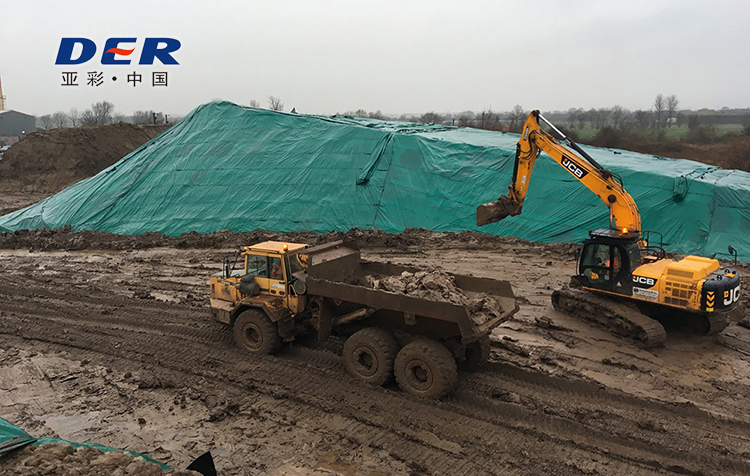
The same 700 gsm tarp can perform very differently on a compact salt pile, an irregular fertilizer heap or a frequently opened port stockpile.
| Storage Scenario | Main Risks | Material / Fabrication Direction | Details to Confirm Before Ordering |
|---|---|---|---|
| Road salt / de-icing salt pile | Rain dissolution, chloride runoff, wind, cold-weather handling, residue on hardware | Waterproof PVC coated polyester; welded large panels; reinforced perimeter; cold-flex direction where required | Pad and drainage, pile profile, winter temperature, anchor method, hardware exposure, loading opening |
| Bulk dry fertilizer heap | Moisture uptake, surface wetting, caking, contamination, repeated loader access | PVC coated polyester cover with welded seams and handling-friendly panel sizes; compatibility reviewed for direct contact | Fertilizer type or SDS, dry/wet contact, pile temperature, humidity, access frequency, overlap and ventilation strategy |
| Potash / urea / NPK staging | Humidity, dust, bag or pile contamination, seasonal outdoor exposure | Custom finished tarp or modular cover; smooth cleanable surface; reinforced wear zones where dragged | Storage period, bulk vs bagged product, contact duration, cleaning method, pallet or pile geometry |
| Port / terminal bulk storage | Wind, rapid access, changing pile size, equipment traffic, salt air | Numbered modular panels, welded seams, webbing, D-rings / anchor tabs, repairable sections | Crane or loader access, section weight, deployment crew, wind exposure, traffic routes, inspection openings |
| Short-term overflow storage | Fast deployment, cost, temporary weather exposure | Lighter cover direction may be possible where wind and abrasion are controlled; do not overspecify weight | Duration, expected storms, reuse plan, available labor, temporary anchors, disposal or storage after use |
| Direct or repeated corrosive contact | Coating attack, residue accumulation, accessory corrosion, cleaning chemicals | Application-specific coated fabric with compatibility review; seam and hardware materials reviewed as part of the system | Exact chemical identity, concentration, temperature, contact time, cleaning chemistry, required test method |
GSM is useful, but it does not describe the complete cover.
Double-sided PVC coating provides the primary waterproof surface and can be formulated or finished for outdoor exposure, cleaning and project-specific contact requirements.
Woven polyester carries tensile load and supports tear resistance when the cover is tensioned, folded, pulled or exposed to wind.
Large covers are assembled from panels. Seam location affects runoff, field handling, folding direction, repairability and water protection.
Webbing, hems, D-rings, eyelets, tabs, sleeves or ballast pockets transfer loads from the cover into the restraint system.
For DERFLEX large PVC stockpile covers, approximately 550–900 gsm is a practical engineering discussion range already used across industrial stockpile applications. The right point in that range depends on total cover area, wind, abrasion, folding frequency and the weight a crew can realistically deploy.
Adding more coating or mass can improve abrasion margin, but it does not automatically make a tarp compatible with a specific fertilizer, chloride solution or cleaning chemical. For direct-contact projects, compatibility should be reviewed independently of mechanical duty.
Buyers can compare broader material properties on the DERFLEX PVC tarpaulin material page, including coated polyester structure, welding and custom surface directions.
Use the table as a quotation framework. Final values should follow the approved material, pile geometry and installation method.
| Specification Item | DERFLEX Direction | Why It Matters |
|---|---|---|
| Material structure | High-tenacity polyester base fabric with double-sided PVC coating; alternative structures subject to application review | Controls waterproofing, mechanical strength, weldability and handling behavior. |
| Material weight | Approx. 550–900 gsm is a common stockpile-cover discussion range; lighter or heavier structures can be reviewed | Must be balanced against wind, abrasion, cover area and deployment weight. |
| Temperature direction | Selected DERFLEX PVC compounds can target approximately -30°C to +70°C; confirm actual project conditions | Cold folding and hot outdoor surfaces can change flexibility and handling. |
| Seams | Hot-air or high-frequency welded panels where compatible with selected fabric; sewn reinforcement only where design requires | Large covers need seam continuity, practical panel width and repeatable water protection. |
| Edge reinforcement | Webbing hem, double layer, rope edge, corner patches or custom reinforcement zones | Perimeter design controls how wind and tie-down forces enter the fabric. |
| Attachment options | Eyelets, D-rings, webbing loops, anchor tabs, sleeves, cable pockets or ballast pockets | Choose around anchor availability, chloride exposure, handling method and required access. |
| Surface / finish | Matte, semi-matte, glossy, embossed or protective lacquer direction subject to project needs | Surface choice affects cleanability, appearance, friction and residue removal. |
| Finished cover format | One-piece cover, cut panels, numbered modular sections or roll fabric for local fabrication | Modular construction can simplify shipping, deployment, access and repair on very large piles. |
| Color / identification | Standard and custom color discussion; section numbers, arrows, labels or OEM marks can be added | Field identification reduces installation errors and supports repeat multi-site programs. |
| Compliance / testing | Confirm required test method, report scope and applicable market before order approval | Do not assume one material grade or certificate applies to every formulation or finished cover. |
A wide or steep stockpile consumes far more fabric than a flat plan view suggests.
Planning formula for a simple draped pile:
Approx. cover length = pile length + front drop + rear drop + working allowance
Approx. cover width = fabric travel over the pile cross-section + side anchoring allowance
For irregular piles, retaining walls, conveyors, bunkers or loader openings, send a top view plus one or more cross-sections. Large covers may be easier to fabricate and operate as numbered sections rather than one oversized sheet.
Use the DERFLEX tarp size and measurement guide to separate finished-size requirements from raw cut allowance.
Define a positive drainage path. Avoid flat low points, seam pockets or loose fabric that can hold rainwater. Ponding adds weight and can overload welds, hems and anchors even when the tarp material itself is waterproof.
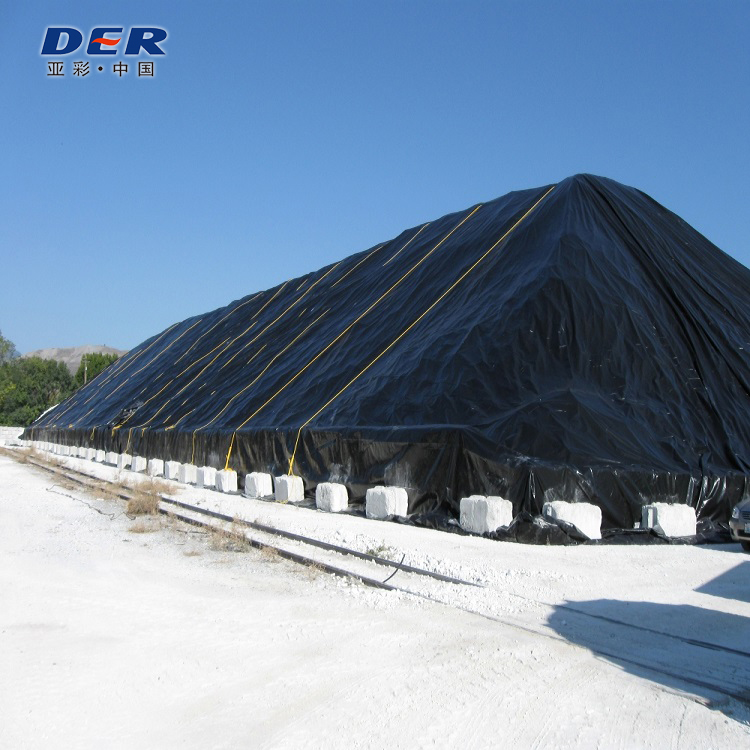
The word “corrosive” describes the storage environment, but material approval still depends on the actual media and contact mode.
Typical of a cover over a dry pile where the underside sees dust, crystals or dry fertilizer residue.
Rainwater, brine, dissolved fertilizer or washdown residue may contact the surface repeatedly.
Continuous wet contact, containment or immersion creates a different material-selection problem than a weather cover.
Some fertilizers require special fire, segregation, ventilation, building or hazardous-material controls.
For broader compatibility questions, see DERFLEX chemical resistant tarp selection guidance. Final suitability depends on the exact substance, concentration, temperature, duration and fabrication details.
Real stockpile images help procurement teams discuss slope, perimeter anchoring, modular handling and loader access before a drawing is finalized.
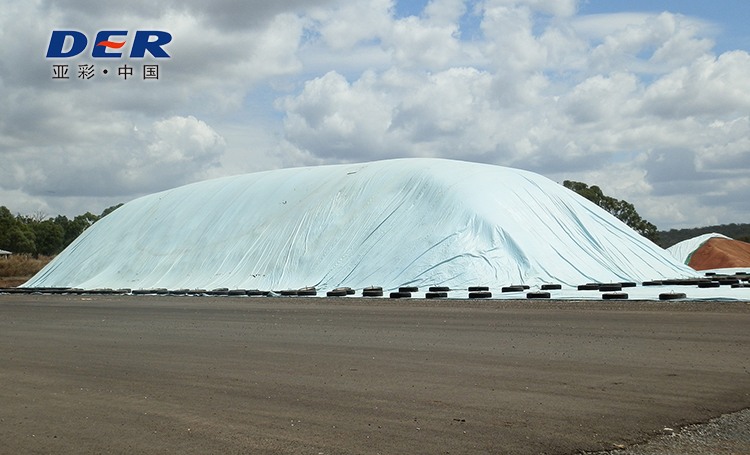
Good input prevents a generic tarp quote that ignores the actual storage risk.
Road salt, salt-sand blend, potash, urea, NPK, DAP, ammonium sulfate or other bulk product.
Provide composition or SDS when chemical-contact compatibility or regulated fertilizer handling must be reviewed.
Length, width, maximum height, slope or cross-section, retaining walls and expected profile changes.
Rain, snow, wind, UV, humidity and minimum / maximum service temperature.
Dry dust, occasional wet residue, repeated brine contact or another exposure mode.
Fixed anchors, ropes, cables, ballast, D-rings, sleeves, pockets or site-specific restraint points.
How often loaders, conveyors, sampling crews or trucks need to uncover sections of the pile.
Quantity, supply form, OEM marking, packaging, destination and any required test or documentation scope.
A more expensive fabric cannot rescue an incomplete cover specification.
Weight does not define chemical compatibility, seam performance, tie-down strength or pile fit.
A waterproof tarp can trap moisture already present in warm or damp fertilizer. Moisture strategy begins before the cover is installed.
A steep pile requires fabric over the slope and ridge. Flat length × width can leave a finished cover short.
Large wind loads should be distributed through reinforcement, not concentrated at a few eyelets.
Salt-rich residue can be aggressive to metal. Hardware material and exposure need separate review.
A cover that is too heavy to deploy safely can be operationally worse than a modular system with planned overlaps and section labels.
For B2B projects, repeatable drawings, section ma, rking and fabrication control matter as much as the first sample.
Review base fabric, coating weight, weather exposure, cold flexibility, surface finish and contact conditions together.
Panel welding, hems, reinforcement, D-rings, eyelets, sleeves, pockets and markings can be mapped to the storage site.
Repeat dimensions, custom color, labels, section numbering and export packaging can support distributors and multi-site programs.
If the project is primarily a large loose-material pile, compare the broader stockpile cover tarp system. If the stored product is fertilizer-specific, the fertilizer cover tarp page adds procurement details for urea, NPK, potash and other fertilizer programs.
Six verified topic-cluster links connect bulk storage, material selection, sizing and corrosion-exposure decisions.
Direct answers for procurement teams, distributors, storage operators and industrial fabricators.
For temporary or flexible outdoor salt stockpile protection, a waterproof reinforced tarp system such as PVC coated polyester is a practical direction when material, welded seams, perimeter reinforcement, anchoring and drainage are specified for the site. Permanent covered storage may be required by local environmental rules, so a tarp should be treated as part of the storage system rather than a substitute for compliance.
Sometimes, but not automatically. Salt and fertilizer create different contact, moisture, caking, corrosion and safety conditions. Review the exact stored material, composition or SDS, contact duration, temperature, residue and handling method before approving the coating and hardware.
PVC coated polyester can be suitable for many industrial covers, but chemical resistance is not universal. Compatibility depends on the exact salt or fertilizer, concentration, additives, wet or dry contact, temperature, contact duration and the selected PVC formulation.
Many DERFLEX industrial stockpile-cover directions fall around 550–900 gsm. Select GSM together with base-cloth strength, coating, pile size, wind exposure, abrasion, panel size and handling frequency. A heavier tarp is not automatically better for a very large cover if it becomes difficult to deploy.
Measure the actual fabric travel path over the pile, not only the ground footprint. Include maximum height, slopes, side drops, working allowance, overlap, anchoring reach and access points. For changing or very large piles, numbered modular panels may be easier to manage than one oversized sheet.
Maintain a drainage slope through pile geometry, support or tension; orient seams and overlaps so they do not create low points; and keep perimeter restraint balanced. Ponding adds load to the tarp, welds and tie-down points and should be designed out of the installation.
Send the stored material, composition or SDS when relevant, pile length, width and maximum height, site photos or cross-section, outdoor exposure, wind and temperature conditions, contact type, anchoring method, access requirements, quantity, destination and any required testing or documentation.
Send DERFLEX the material type, pile dimensions, site photos, expected exposure, contact condition, anchoring method and quantity. The team can review a practical PVC tarp, panel and reinforcement direction for quotation and sample discussion.
Application note: This page addresses flexible weather covers for bulk storage. It does not replace fertilizer-specific fire and segregation rules, hazardous-material requirements, environmental permits, engineered buildings, site drainage design or local operating procedures. Confirm the requirements applicable to the stored material and jurisdiction before use.