Polyester reinforcement
Denier, yarn type and fabric construction define the load-bearing skeleton. Ask for both warp and weft information when directional performance matters.



 Engineering Procurement Guide
Turn a tarp requirement into a purchase specification that suppliers can quote, factories can produce, and inspectors can verify. This guide explains how to define PVC tarpaulin construction, GSM, thickness, base fabric, tensile and tear performance, coating adhesion, surface treatment, fabrication details, tolerances and acceptance evidence before placing a bulk order.
A tarpaulin technical specification is the controlled description of the tarp material, physical dimensions, mechanical performance, environmental properties, fabrication details, tolerances, test methods and acceptance evidence required for a purchase. For PVC tarpaulin, a complete specification should connect the polyester base fabric and PVC coating to measurable finished-material performance instead of relying on GSM or thickness alone.
Two tarpaulins can be quoted at the same nominal weight yet use different yarn, fabric density, coating quantity, topcoat, plasticizer system or reinforcement design. They may not behave the same after welding, folding, tie-down loading or long outdoor exposure. For that reason, a buyer should compare a linked specification chain: construction → dimensions → strength → environment → fabrication → inspection.
This is especially important for importers, tarp fabricators, fleet suppliers, industrial distributors, construction contractors, agricultural cover programs and private-label buyers. If the specification is vague, a lower quotation can reflect a different material rather than a better price for the same product.
Use this table as a sourcing framework, not as a universal contractual data sheet. Final construction, tolerances, test methods and minimum values should be confirmed for the selected product code and approved sample.
| Specification field | Typical DERFLEX direction | What the buyer should define | Why it matters |
|---|---|---|---|
| Material system | PVC coated polyester, PVC laminated polyester, or project-specific technical fabric | Coated vs laminated; one-side / two-side treatment if relevant | Changes coating bond, flexibility, price, appearance and fabrication behavior. |
| Base fabric | 500D, 840D, 1000D × 1000D, 1300D or custom high-tenacity polyester structures | Yarn denier, warp / weft construction and required strength direction | The reinforcement layer has a major influence on tensile, tear and dimensional behavior. |
| Total weight | Approx. 350–1200 gsm across common tarp programs; custom heavier constructions can be discussed | Nominal GSM plus permitted tolerance | Useful for material comparison, handling and freight calculation, but not a stand-alone quality measure. |
| Thickness | Common PVC tarp directions around 0.35–0.85 mm, depending on fabric and coating structure | Nominal mm or mil plus tolerance when thickness is critical | Affects stiffness, surface protection and fit, but cannot replace strength data. |
| Roll / finished dimensions | Roll goods, cut panels or custom finished covers | Width, roll length, finished size, dimensional tolerance and whether dimensions are cut or finished | Prevents conversion waste, fit problems and disputes over finished cover size. |
| Tensile strength | Application-specific, reported by machine / warp and cross / weft direction | Minimum acceptable result, unit, specimen direction and test method | Represents resistance to distributed pulling loads and tension. |
| Tear resistance | Application-specific; higher-duty transport and industrial programs normally need greater tear margin | Required method, direction and minimum force | Helps control propagation after a cut, puncture or local damage starts. |
| Coating adhesion | Specified when coating bond is important to repeated flexing, welding or long-term use | Minimum result and test method | Weak adhesion can contribute to peeling or delamination even if GSM looks acceptable. |
| Surface finish | Glossy, matte, lacquered, embossed, printable, easy-clean or anti-scratch directions | Appearance target and functional topcoat requirement | Changes cleanability, printability, friction, weathering and perceived product grade. |
| Environmental options | UV-resistant, anti-mildew, cold-resistant, abrasion-resistant, low-wick or anti-static options by project | Real exposure condition, expected service cycle and evidence required | Prevents paying for irrelevant features while missing the property that controls field life. |
| Flame retardancy | FR formulation can be discussed for applicable projects | Named standard / classification, product construction, lab evidence and market requirement | “Flame retardant” without a defined test or classification is too vague for controlled procurement. |
| Color / appearance | Standard colors plus custom color matching subject to formulation and quantity | Color reference, acceptable ΔE or visual standard if needed, gloss / matte and print requirements | Important for branded programs, fleet replacement consistency and repeat orders. |
| Fabrication | Cutting, sewing, hot-air / hot-wedge / RF welding, hems, rope, webbing, eyelets, D-rings, straps and printing | Drawing, seam type, reinforcement zones, hardware type and spacing | The finished tarp can fail at edges and attachment points even when raw fabric is strong. |
| Packaging & ID | Roll or finished-cover packing; OEM / private-label options by agreement | Core, roll length, labels, barcodes, cartons / pallets, bundle quantity and shipping marks | Controls warehouse handling, traceability and downstream retail or fabrication workflow. |
The most useful tarp specification connects six layers. A weakness in any one layer can create a different product even when the headline GSM is unchanged.
Denier, yarn type and fabric construction define the load-bearing skeleton. Ask for both warp and weft information when directional performance matters.
The PVC layer provides weather protection, surface properties and weldability. Coating route and resin formulation influence adhesion, flexibility and finish.
GSM, oz/yd², mm and mil help normalize quotations. Weight and thickness describe different physical properties and should not be converted into each other by a universal rule.
Tensile, tear and adhesion data convert construction details into measurable performance. Direction, unit, specimen and method should be clear.
UV, cold, mildew, abrasion, chemical environment and flame requirements must come from the actual use case, not from a generic “heavy duty” label.
Seams, hems, webbing, hardware spacing and corner reinforcement determine how loads enter the fabric. Finished-cover engineering belongs in the same procurement brief.
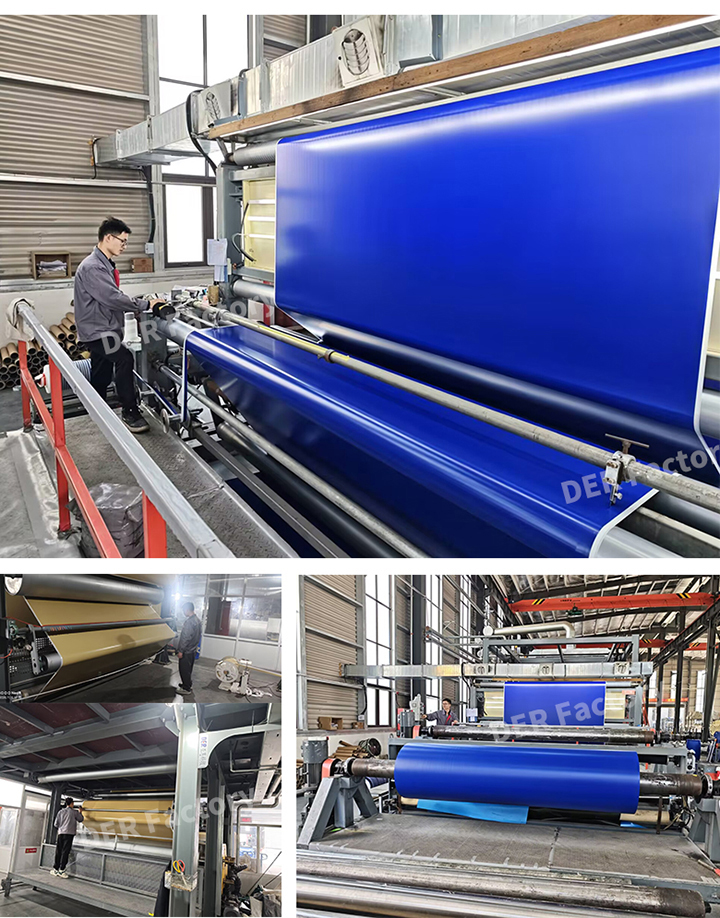
A buyer who compares only “650 gsm vs 650 gsm” may be comparing different materials. The same nominal area weight can be distributed differently between reinforcement and PVC, while the base fabric may use a different denier, thread density or yarn quality.
More structural reinforcement can affect tensile and tear behavior differently from simply adding coating mass.
Adhesion between PVC and the textile matters during flexing, welding and repeated handling.
Acrylic / PVDF-type or other surface treatments can change cleanability, printability and outdoor behavior.
Webbing, doubled hems, corner patches and hardware layout determine how the cover handles local loads.
Mechanical results are meaningful only when the unit, direction and test method are understood. Do not assume results from different methods are directly interchangeable.
| Property | What it tells you | Common reference for coated fabrics | Procurement instruction |
|---|---|---|---|
| Tensile strength / elongation | Resistance to pulling load and extension before break. | ISO 1421:2016 is a current international reference for tensile strength and elongation of rubber- or plastics-coated fabrics. | State MD / CD or warp / weft, unit, method and minimum acceptance value. |
| Tear resistance | Force required to initiate / propagate tearing after local damage. | ISO 4674-1:2016 covers constant-rate tear methods for coated fabrics. | Name the tear method because tongue, trouser and other methods do not produce directly comparable figures. |
| Coating adhesion | Bond strength between coating and textile substrate. | ISO 2411:2024 specifies a method for coating adhesion strength of coated fabrics. | Use the edition and procedure required by the buyer / market and define minimum result. |
| Mass per unit area | Total finished material mass per square meter. | Supplier / buyer-agreed coated-fabric procedure. | Specify nominal GSM and the allowed production tolerance. |
| Waterproof performance | Resistance to water penetration under the selected test condition. | Project-specific method depending on tarp construction and end use. | Avoid writing only “100% waterproof”; define the evidence or seam requirement where leakage consequence is important. |
| Flame performance | Response to an ignition / flame test under a defined classification system. | Market- or project-specific standard such as the standard named in the customer specification. | Confirm the exact construction tested and whether the required evidence applies to raw fabric or finished product. |
There is no single “best” tarpaulin technical specification. The right priorities change with loading, weather, handling frequency, fabrication and the consequence of failure.
Repeated tension, road movement, abrasion, folding and weather exposure.
Equipment edges, outdoor storage, frequent installation and removal.
Large welded panels, appearance, weathering and sometimes fire requirements.
Seasonal outdoor exposure, large coverage area and handling economics.
A procurement specification should contain both material requirements and finished-tarp requirements. These two groups are often separated too late in the buying process.
The most reliable sourcing process turns the specification into checkpoints before production starts, not a complaint document after shipment.
Application, climate, handling frequency, service expectation and failure consequence.
Material, base fabric, GSM, finish, mechanical targets and fabrication drawing.
Confirm appearance, hand feel, color, weldability, dimensions and agreed test evidence.
State tolerance, sampling / inspection items, packing rules and required production records.
Keep product code, revision, approved reference and traceable batch information consistent.
If you already have a TDS, drawing, old sample or competitor specification, DERFLEX can review the required fields and discuss a practical PVC tarpaulin construction. If you are starting from an application, provide the operating conditions first and build the measurable specification from there.
These six internal resources cover data-sheet interpretation, weight / thickness selection, material construction, roll sourcing, transport application and flame-retardant options.
Answers for buyers comparing specifications, samples and quotations.
At minimum, define material construction, base fabric, GSM, thickness when relevant, roll or finished dimensions, tensile and tear requirements, surface finish, required environmental functions, fabrication details, tolerances, test methods, inspection criteria and packaging. For repeat orders, include a product code and revision-controlled approved reference.
No. GSM measures mass per unit area, but two tarpaulins with the same GSM can use different base yarn, thread density, coating share, adhesion, formulation and top finish. Compare construction and mechanical data together with weight.
Thickness measures physical depth, usually in mm or mil. GSM measures mass per square meter. Both can help identify a product, but there is no universal conversion between them because material density, reinforcement and coating structure differ.
Tensile strength, tear resistance and coating adhesion are commonly important. Their priority depends on the application. Truck tarps may place more emphasis on tear, abrasion, edge reinforcement and tie-down load transfer, while tent and shelter programs may also emphasize welding, dimensional behavior, surface finish and required flame performance.
For procurement acceptance, the document should clearly distinguish typical / reference data from minimum contractual requirements. Critical pass/fail characteristics should have an agreed acceptance limit, tolerance, unit and method.
DERFLEX can discuss custom GSM, base-fabric construction, color, surface finish, UV / cold / mildew / FR directions, roll supply and finished-tarp fabrication. Final values, evidence, MOQ and manufacturing feasibility should be confirmed during quotation and sample approval.
Send DERFLEX your TDS, drawing, target GSM, strength requirement, application and quantity. The goal is to compare the right construction before comparing the final price.